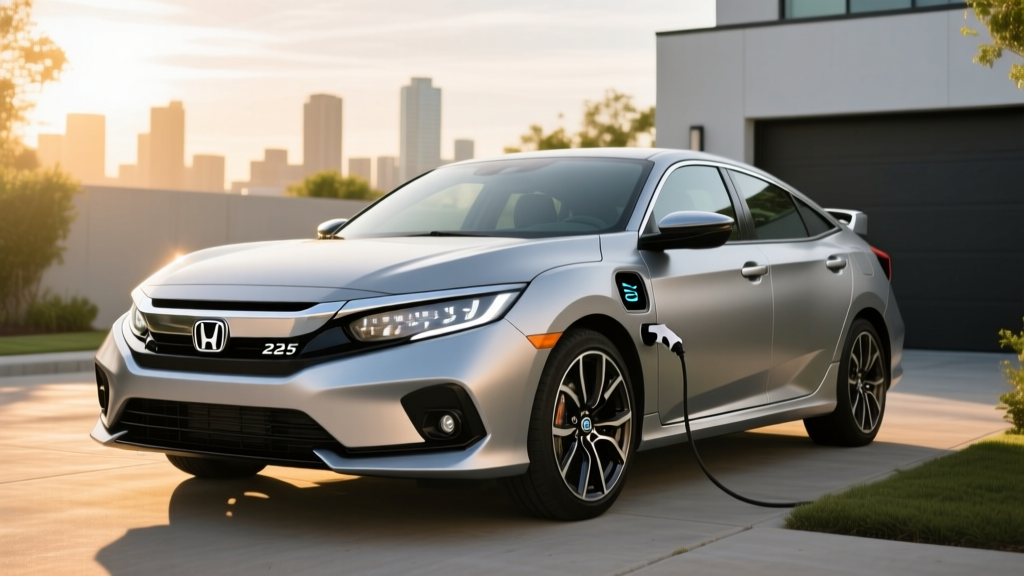
The 2025 Honda Civic Hybrid returns after a long absence from the US lineup, slotting into the Sport and Sport Touring trims with a two-motor hybrid system that prioritizes electric propulsion. If you've been searching for 2025 Honda Civic Hybrid Sport Touring specs, you're likely weighing this against the Mazda3, Toyota Corolla Hybrid, and Hyundai Elantra Hybrid — or wondering whether a conventional hybrid (HEV) makes more sense than a plug-in hybrid (PHEV) or a full battery-electric vehicle (BEV). This guide breaks down every critical number.
HEV vs PHEV: What the Civic Hybrid Actually Is
Before diving into specs, it's essential to understand the architecture. The 2025 Civic Hybrid is a conventional hybrid (HEV), not a plug-in hybrid. This distinction matters for ownership expectations:
| Feature | HEV (Civic Hybrid) | PHEV (e.g., Toyota Prius Prime) | BEV (e.g., Tesla Model 3) |
|---|---|---|---|
| Plug-in charging required? | No — refuels with gas only | Yes — plugs in for EV range | Yes — electric only |
| Electric-only range | ~1 mi at low speed | 30–45 mi typical | 250–360 mi typical |
| Battery size | ~1.0 kWh (small buffer) | 10–18 kWh | 50–82 kWh |
| Home charging install needed? | No | Recommended (Level 2) | Essential (Level 2) |
| Federal tax credit (§30D)? | No | Up to $7,500 (if eligible) | Up to $7,500 (if eligible) |
| Fuel/energy source | Gasoline + regen braking | Gasoline + grid electricity | Grid electricity only |
The Civic Hybrid recovers energy through regenerative braking and its gasoline engine to charge a small lithium-ion battery. You never plug it in. It drives like a normal gas car but delivers dramatically better fuel economy — particularly in city traffic where the electric motor handles most low-speed propulsion.
Powertrain: 200 HP Two-Motor Hybrid System
Honda's fourth-generation two-motor hybrid system pairs a 2.0-liter Atkinson-cycle inline-4 engine with two electric motors. The setup differs fundamentally from a traditional parallel hybrid (like older Toyota systems) — the gasoline engine primarily acts as a generator, while the electric traction motor drives the wheels in most conditions. At highway speeds, a lock-up clutch allows the engine to drive the wheels directly for efficiency.
| Specification | 2025 Civic Hybrid Sport Touring |
|---|---|
| Engine | 2.0L Atkinson-cycle DOHC inline-4 |
| Engine output | 143 hp / 134 lb-ft torque |
| Traction motor output | 184 hp / 232 lb-ft torque |
| Combined system output | 200 hp / 232 lb-ft torque |
| Transmission | e-CVT (no traditional gears) |
| Drivetrain | Front-wheel drive (FWD) |
| 0–60 mph (est.) | ~6.5 seconds |
| Hybrid battery type | Lithium-ion |
| Hybrid battery capacity | ~1.0 kWh (usable buffer) |
That 200-horsepower combined output makes the Civic Hybrid Sport Touring genuinely quick for a compact hybrid sedan. The 232 lb-ft of torque from the electric motor is available instantly, giving it punchy acceleration from stops — noticeably more responsive than the non-hybrid 1.5T Civic at low speeds. The 0–60 time of roughly 6.5 seconds puts it in the same ballpark as a Volkswagen GTI, which is remarkable for a car optimized for fuel economy.
Fuel Economy: EPA Ratings and Real-World MPG
This is the Civic Hybrid's headline act. Honda's fourth-generation system delivers class-leading efficiency numbers, and in real-world driving, hybrids often exceed their EPA city estimates because stop-and-go traffic maximizes regenerative braking.
| Driving Condition | EPA Rating | Real-World Expectation |
|---|---|---|
| City | 50 MPG | 48–54 MPG (often exceeds EPA) |
| Highway | 47 MPG | 43–47 MPG (hybrids lose advantage at sustained speed) |
| Combined | 49 MPG | 46–51 MPG |
For context, the non-hybrid 2025 Civic with the 1.5T turbo achieves 33 MPG combined. That's a 48% improvement with the hybrid system. On a 12.4-gallon fuel tank, the Civic Hybrid Sport Touring delivers a theoretical range of roughly 607 miles per tank — meaning most drivers will visit the gas station once every two to three weeks.
According to fueleconomy.gov, the Civic Hybrid's combined rating places it among the most efficient non-plug-in vehicles sold in the US, trailing only the Toyota Prius (57 MPG combined) and Hyundai Elantra Hybrid Blue (54 MPG combined) in the compact segment.
Pricing: 2025 Civic Hybrid Sport Touring MSRP and Tax Credit Eligibility
The 2025 Honda Civic Hybrid is offered in two trims. Here's the pricing breakdown:
| Trim | MSRP (incl. destination) | Key Features |
|---|---|---|
| Sport Hybrid | ~$29,845 | Hybrid powertrain, 7" touchscreen, wireless CarPlay/Android Auto, Honda Sensing suite |
| Sport Touring Hybrid | ~$32,845 | 9" touchscreen, Bose 12-speaker audio, wireless charging, leather-trimmed seats, heated rear seats, low-speed braking control |
Federal Tax Credit: Does the Civic Hybrid Qualify?
No. The 2025 Honda Civic Hybrid does not qualify for the federal §30D clean vehicle tax credit. Under current IRS rules, the §30D credit applies only to plug-in electric vehicles (BEVs and PHEVs) that meet specific battery capacity, critical mineral sourcing, and MSRP/income thresholds. Conventional hybrids (HEVs) like the Civic Hybrid have not qualified for any federal purchase incentive since the original Hybrid Tax Credit expired in the early 2010s.
Some states may offer minor incentives for efficient vehicles, but these vary by jurisdiction. Check your state's energy office or DMV for current programs. The Civic Hybrid's value proposition rests entirely on fuel savings and a modest price premium over the gas model — not on tax credits.
Battery Warranty, Reliability, and Replacement Cost
Hybrid battery longevity is consistently the top concern for first-time hybrid buyers. Honda backs the Civic Hybrid's battery and hybrid system components with a robust warranty:
• 8 years / 100,000 miles (most states)
• 10 years / 150,000 miles (CARB states: CA, CT, ME, MA, MD, NJ, NY, OR, RI, VT, WA, and others adopting California emissions standards)
• Covers battery capacity loss below functional thresholds and all hybrid system components (inverter, electric motors, control units)
Honda's hybrid systems have proven highly reliable in long-term use. The two-motor architecture is mechanically simpler than traditional transmissions — there are no gear sets, torque converters, or clutch packs to wear out. The e-CVT is essentially a pair of electric motors and a planetary gearset with far fewer moving parts than a conventional automatic.
What Does Hybrid Battery Replacement Cost?
If the hybrid battery fails outside warranty coverage (uncommon before 150,000+ miles based on Honda's track record with the Accord Hybrid and CR-V Hybrid), replacement costs typically range from $2,000 to $4,000 including labor at a dealership. Independent hybrid specialists often offer refurbished battery packs for $1,500–$2,500. Given the 8–10 year warranty coverage and Honda's reliability history, most owners will never face this expense.
For additional reliability data, Consumer Reports and owner forums consistently rate Honda's hybrid systems among the most dependable in the segment, with the Accord Hybrid battery showing minimal degradation even at 200,000+ miles in taxi and fleet use.
Sport Touring Trim: What You Get for the Premium
The Sport Touring Hybrid is the top-tier Civic Hybrid trim, and it bundles features that would cost thousands as options on competitors:
- 9-inch touchscreen with wireless Apple CarPlay and Android Auto
- Bose premium audio — 12 speakers, significantly better than the base 8-speaker system
- Wireless phone charging pad (Qi-compatible)
- Leather-trimmed seats with heated front and rear outboard seats
- Honda Sensing suite: adaptive cruise control with low-speed follow, lane-keeping assist, collision mitigation braking, traffic sign recognition, blind-spot monitoring with rear cross-traffic alert
- LED headlights with auto high-beam
- Dual-zone automatic climate control
- Smart entry with walk-away auto lock
Importantly, Honda Sensing on the Civic is an SAE Level 2 driver-assistance system — it provides steering and speed support but requires the driver to remain fully engaged at all times. It is not autonomous or self-driving. The system is competent for highway cruising and traffic jams but cannot navigate independently.
Who Should Choose the Civic Hybrid vs. a PHEV or Full EV?
Choose the Civic Hybrid (HEV) if:
- You lack access to home or workplace charging (apartment, street parking)
- You want maximum simplicity — no charging cables, no range planning
- Your budget is under $35,000 and you want top-tier fuel economy
- You take frequent road trips and don't want to rely on public charging
- You want proven reliability with minimal new-technology risk
Choose a PHEV (e.g., Toyota Prius Prime) if:
- You have home charging and want 30–45 miles of electric-only commuting
- You want to qualify for the §30D federal tax credit (up to $7,500, subject to IRS eligibility rules)
- Most of your driving is under 40 miles round-trip but you need gas flexibility for longer trips
Choose a full EV (e.g., Tesla Model 3, Hyundai Ioniq 6) if:
- You have reliable home Level 2 charging
- You want zero tailpipe emissions and the lowest per-mile fuel cost
- Your daily driving is under 250 miles and you're comfortable with road-trip charging planning
- You want to maximize federal and state incentives
Pros and Cons: 2025 Civic Hybrid Sport Touring
✓ Pros
- 49 MPG combined — among the best in the segment
- 200 hp makes it genuinely quick (0–60 ~6.5s)
- No plug-in required — zero lifestyle change from gas
- Sport Touring loaded with premium features at ~$33K
- Honda Sensing safety suite standard
- 8–10 year hybrid battery warranty
- 600+ mile range per tank
✗ Cons
- No federal tax credit eligibility
- FWD only — no AWD option (unlike Toyota Prius)
- Highway MPG drops below city rating (normal for hybrids)
- Hybrid only available in Sport and Sport Touring trims
- No plug-in hybrid variant offered
- Cargo space slightly reduced vs. gas Civic (battery placement)
Frequently Asked Questions
How many MPG does the 2025 Honda Civic Hybrid Sport Touring get?
The EPA rates the 2025 Civic Hybrid Sport Touring at 50 MPG city / 47 MPG highway / 49 MPG combined. In real-world driving, city MPG often exceeds the EPA estimate (50–54 MPG), while sustained highway driving above 70 mph may yield 43–47 MPG. Cold weather reduces efficiency by 5–10%.
Does the Civic Hybrid need to be plugged in?
No. The 2025 Civic Hybrid is a conventional hybrid (HEV). It charges its small lithium-ion battery through regenerative braking and the gasoline engine. You refuel it at a gas station exactly like a standard car. There is no charging port, no plug, and no electric-only range to manage.
How far can the Civic Hybrid drive on electric power alone?
Only about 1 mile at very low speeds (under 25 mph) in EV mode. This is not a plug-in hybrid — the electric motor assists the gasoline engine continuously rather than providing meaningful standalone range. If you want 30+ miles of electric-only driving, you need a PHEV like the Toyota Prius Prime or a full BEV.
Is the 2025 Civic Hybrid reliable, and what does battery replacement cost?
Honda's hybrid systems have an excellent reliability track record, particularly the two-motor architecture used in the Accord Hybrid and CR-V Hybrid. The hybrid battery is warranted for 8 years/100,000 miles (10 years/150,000 miles in CARB states). Out-of-warranty replacement runs $2,000–$4,000 at a dealership, but failures before 150,000+ miles are rare based on historical data.
Does the 2025 Civic Hybrid qualify for any federal tax credit?
No. The federal §30D clean vehicle credit applies only to plug-in electric vehicles (BEVs and PHEVs) that meet battery sourcing and MSRP/income requirements. Conventional hybrids like the Civic Hybrid do not qualify. Check IRS.gov for current rules on plug-in vehicle credits, and consult a tax professional for personal eligibility.
How does the Civic Hybrid compare to the Toyota Prius?
The 2025 Toyota Prius achieves 57 MPG combined (LE trim) vs. the Civic Hybrid's 49 MPG combined, and the Prius offers an available AWD powertrain. However, the Civic Hybrid delivers 200 hp vs. the Prius's 194 hp, has a more conventional (and to many, more attractive) sedan design, and the Sport Touring trim offers a more premium interior with Bose audio and leather. If maximum MPG is your priority, the Prius wins. If you want a sportier driving experience with strong efficiency, the Civic Hybrid is the better pick.
What is the difference between the Sport Hybrid and Sport Touring Hybrid trims?
The Sport Touring Hybrid adds approximately $3,000 over the Sport Hybrid and includes: 9-inch touchscreen (vs. 7-inch), Bose 12-speaker audio, wireless phone charging, leather-trimmed seats, heated rear seats, and additional driver-assist features. Both trims share the identical 200 hp hybrid powertrain and 49 MPG combined rating.