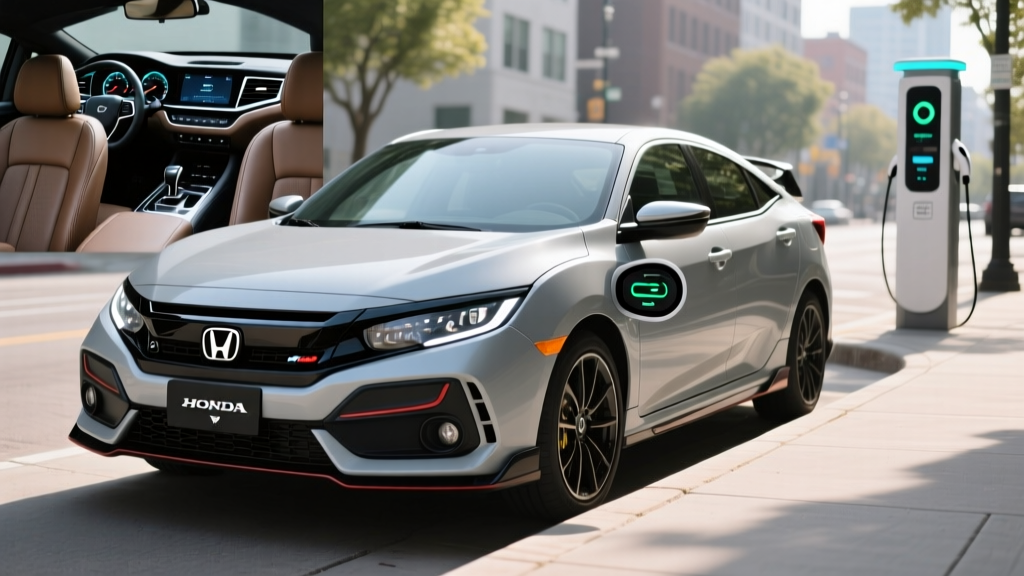
Search for a "2025 Honda Civic Hybrid Sport Touring Hatchback pic" and you'll find a sleek five-door that hides one of the most efficient powertrains in the compact segment. But the photos don't tell you what matters most to hybrid buyers: real-world fuel economy, battery longevity, and whether this HEV makes more sense than a PHEV or full EV for your daily driving. This guide breaks down every spec, MPG figure, and ownership cost you need before signing the paperwork.
HEV vs PHEV: What the Civic Hybrid Actually Is
The 2025 Honda Civic Hybrid — available in both sedan and hatchback body styles — is a conventional hybrid electric vehicle (HEV). It is not a plug-in hybrid (PHEV). That distinction matters for your expectations:
| Feature | Civic Hybrid (HEV) | Typical PHEV (e.g., Toyota Prius Prime) | Full EV (e.g., Chevy Equinox EV) |
|---|---|---|---|
| Plug-in charging required? | No — self-charging via regenerative braking and engine | Yes — plug in for electric-only miles | Yes — plug in exclusively |
| Electric-only range | ~1 mile at low speed (EV mode) | 25–44 miles typical | 250–350+ miles |
| Total range | ~500+ miles | 400–600+ miles (electric + gas) | 250–350 miles (no gas) |
| Fuel needed | Yes — regular unleaded | Yes — regular unleaded | No |
| Federal tax credit (§30D) | Not eligible | Up to $7,500 (if sourcing/income rules met) | Up to $7,500 (if sourcing/income rules met) |
The Civic Hybrid's two-motor system recaptures energy during braking and deceleration, storing it in a small lithium-ion battery. The gasoline engine and electric motors work together seamlessly — you never plug it in, and you never think about it. This is the right setup for drivers who want maximum MPG without changing their fueling habits.
EPA Fuel Economy and Real-World MPG
The 2025 Honda Civic Hybrid Sport Touring Hatchback carries the following EPA-estimated fuel economy figures:
| Driving Cycle | EPA Estimate | Real-World Expectation |
|---|---|---|
| City | 50 MPG | 50–55 MPG (hybrids often exceed EPA in stop-and-go) |
| Highway | 45 MPG | 41–45 MPG (high-speed driving favors the engine more) |
| Combined | 49 MPG | 46–52 MPG depending on commute mix |
Why real-world MPG often beats the EPA city estimate: Honda's two-motor hybrid system operates primarily in EV drive mode at low speeds, with the 2.0-liter Atkinson-cycle engine acting as a generator rather than directly turning the wheels. In city traffic with frequent stops, regenerative braking recaptures energy that a gas car would waste as heat. Owners with predominantly urban commutes consistently report 50–55 MPG. Highway driving at 75+ MPH shifts more load to the engine directly, pulling efficiency down to the low-to-mid 40s.
With a 12.4-gallon fuel tank, expect a real-world range of approximately 500–570 miles per fill-up in mixed driving. Cold weather (below freezing) may reduce MPG by 5–10% due to increased engine runtime for cabin heat and reduced battery efficiency — a normal hybrid characteristic, not a defect.
Powertrain Specs: 200 HP Two-Motor Hybrid System
The Sport Touring Hatchback uses Honda's fourth-generation two-motor hybrid system, shared with the Accord Hybrid and CR-V Hybrid. Here are the exact numbers:
| Specification | Value |
|---|---|
| Engine | 2.0L DOHC Atkinson-cycle 4-cylinder |
| Engine power | 146 HP @ 6,000 RPM |
| Drive motor power | 184 HP / 232 lb-ft torque |
| Combined system output | 200 HP / 232 lb-ft torque |
| Transmission | Direct-drive (no traditional CVT or gears) |
| 0–60 MPH | ~7.3 seconds (est.) |
| Drivetrain | Front-wheel drive |
| Battery type | Lithium-ion (traction) |
| Drive modes | EV Drive, Hybrid Drive, Engine Drive |
The system's brilliance is in its simplicity. At low speeds, the drive motor powers the wheels while the engine generates electricity. At highway cruising speeds, a lock-up clutch connects the engine directly to the wheels for maximum efficiency. There's no belt-driven CVT, no gear hunting — just smooth, linear electric-motor torque from a stop with the engine seamlessly blending in when needed.
The Sport Touring Hatchback trim also includes steering wheel-mounted paddle shifters that adjust the level of regenerative braking across four levels. In the strongest regen setting, you get meaningful deceleration when lifting off the accelerator — not true one-pedal driving like a full EV, but a noticeable drag that recaptures energy and reduces brake wear.
Sport Touring Hatchback: What You Get for the Price
The 2025 Civic Hybrid is offered in two hatchback trims. Here's the pricing breakdown (MSRP before destination):
| Trim | MSRP | Key Features |
|---|---|---|
| Sport Hybrid | $30,950 | 200 HP hybrid system, 18" alloy wheels, 7" touchscreen, wireless Apple CarPlay/Android Auto, Honda Sensing suite |
| Sport Touring Hybrid | $33,950 | All Sport features + Bose 12-speaker audio, 9" touchscreen with navigation, wireless phone charging, leather-trimmed seats, heated front seats, power moonroof, rain-sensing wipers, low-speed braking control |
Destination charge adds approximately $1,095, bringing the Sport Touring Hybrid to roughly $35,045 out the door before taxes, fees, or dealer adjustments.
Honda covers the hybrid battery and hybrid system components for 8 years / 100,000 miles (whichever comes first) under the standard hybrid battery limited warranty. In states that follow California Air Resources Board (CARB) emissions warranty requirements — including California, New York, Massachusetts, and several others — hybrid battery coverage extends to 10 years / 150,000 miles.
The conventional powertrain warranty covers 5 years / 60,000 miles, and the basic vehicle warranty is 3 years / 36,000 miles.
Battery Longevity and Replacement Cost
Honda's hybrid battery pack in the Civic is a relatively small lithium-ion unit — approximately 1.1 kWh of total capacity. This is not the large 10–20 kWh pack you'd find in a PHEV; it's a buffer battery that stores recaptured energy for short bursts of electric assist. Because it's small and the system manages charge/discharge cycles conservatively (never fully depleting or fully charging it), degradation is minimal over the vehicle's life.
Real-world longevity data: Honda's hybrid systems in the Insight, Accord Hybrid, and CR-V Hybrid have demonstrated strong durability, with many examples surpassing 200,000 miles on the original battery. The fourth-generation system in the 2025 Civic uses improved thermal management and more robust cell chemistry compared to earlier generations.
If replacement is ever needed: A hybrid battery replacement at a Honda dealer typically runs $2,000–$4,000 for the battery module assembly, depending on labor rates in your area. Third-party hybrid battery rebuilders and refurbished units can bring that cost down to $1,200–$2,500. Given the 8–10 year warranty and the conservative way Honda manages the pack, most original owners will never face this expense.
Reliability, Safety, and Ownership Costs
Honda's hybrid powertrain is among the most proven in the industry. The two-motor system has fewer moving parts than a traditional automatic transmission — no torque converter, no multi-speed gear set, no drive belts connected to the hybrid motors. The engine itself is an Atkinson-cycle design that runs at lower stress levels than a conventional engine, which contributes to longevity.
Safety ratings: The 2025 Civic Hatchback has earned strong scores from the IIHS and carries a 5-star overall rating from NHTSA. The standard Honda Sensing suite includes:
- Collision Mitigation Braking System (CMBS)
- Adaptive Cruise Control (ACC) with Low-Speed Follow
- Lane Keeping Assist System (LKAS)
- Road Departure Mitigation (RDM)
- Traffic Sign Recognition
- Blind Spot Information (BSI) with Cross Traffic Monitor (Sport Touring)
Important clarification: Honda Sensing is an SAE Level 2 driver-assistance system. It provides steering and speed assistance, but the driver must remain fully engaged and keep hands on the wheel at all times. This is not autonomous or self-driving technology.
Estimated annual fuel cost: At 49 MPG combined and 12,000 miles/year with gas at $3.40/gallon, you'd spend approximately $830/year on fuel. Compare that to a non-hybrid Civic (33 MPG combined) at roughly $1,236/year — a savings of about $400 annually, or $2,000 over five years.
Who Should Choose the Civic Hybrid vs a PHEV or Full EV?
- You don't have access to home or workplace charging
- You want 500+ mile range with zero behavior changes
- You live in an apartment or park on the street
- Your budget is under $36,000
- You want proven reliability with a simple ownership experience
- You drive a mix of city and highway with no single dominant pattern
- You have reliable home Level 2 charging and a short commute (PHEV covers daily miles on electricity)
- You want to minimize or eliminate gasoline use entirely
- You qualify for the federal §30D tax credit (up to $7,500 for eligible PHEVs/EVs — the Civic Hybrid does not qualify)
- You drive mostly under 40 miles round-trip and want zero tailpipe emissions on daily commutes
- You want access to HOV/carpool lanes (available for PHEVs/EVs in some states, not typically for HEVs)
Bottom line: The Civic Hybrid Sport Touring Hatchback occupies the sweet spot for buyers who want dramatically better fuel economy than a gas car, near-EV-like low-speed driving feel, and absolutely no charging infrastructure requirement. It's the pragmatic choice when a full EV isn't practical and a PHEV's premium isn't justified.
Federal Tax Credit: Does the Civic Hybrid Qualify?
No. Under current IRS §30D rules, the federal clean vehicle tax credit applies only to plug-in electric vehicles — battery electric vehicles (BEVs) and plug-in hybrids (PHEVs) with a minimum battery capacity of 7 kWh. The Civic Hybrid is a conventional HEV with a ~1.1 kWh battery and no plug-in capability, so it does not qualify for the $7,500 federal credit.
Some states and municipalities offer separate incentives for hybrid vehicles, though these are increasingly rare as incentive programs shift toward plug-in vehicles. Check your state's energy office or department of environmental quality for any current hybrid rebate programs. As of early 2026, no major state-level hybrid purchase incentives are widely available.
Frequently Asked Questions
How many MPG does the 2025 Honda Civic Hybrid Hatchback get?
The EPA rates the Civic Hybrid Sport Touring Hatchback at 50 MPG city, 45 MPG highway, and 49 MPG combined. In real-world city-heavy driving, owners frequently see 50–55 MPG. Highway-dominant commutes at 75+ MPH may return 41–45 MPG.
Does the Civic Hybrid need to be plugged in?
No. The Civic Hybrid is a conventional HEV. It charges its own battery through regenerative braking and the gasoline engine. There is no plug, no charging cable, and no electric-only range to manage. You fuel it like any gas car.
How far can the Civic Hybrid drive on electric only?
In EV Drive mode at low speeds (typically under 25 MPH), the Civic Hybrid can travel roughly 1 mile on battery alone before the engine starts generating electricity. This is not comparable to a PHEV's 25–44 miles of electric range. The EV mode is designed for quiet, zero-emission movement in parking lots and residential streets — not for commuting.
Is the Honda Civic Hybrid reliable? What about battery replacement?
Honda's hybrid systems have an excellent reliability track record. The hybrid battery is warrantied for 8 years/100,000 miles (10 years/150,000 miles in CARB states). Replacement cost, if needed outside warranty, is typically $2,000–$4,000. Most owners will never need a battery replacement during their ownership.
Does the 2025 Civic Hybrid qualify for any tax credit?
The Civic Hybrid does not qualify for the federal §30D clean vehicle tax credit because it is not a plug-in vehicle. Some states may offer small hybrid incentives, but these are uncommon as of 2026. Check your state's official energy website for current programs.
How does the Sport Touring Hybrid differ from the Sport Hybrid?
The Sport Touring adds approximately $3,000 in upgrades: Bose 12-speaker premium audio, 9" touchscreen with embedded navigation, wireless phone charging, leather-trimmed heated front seats, power moonroof, rain-sensing wipers, and low-speed braking control. Both trims share the identical 200 HP hybrid powertrain and 49 MPG combined rating.
How much cargo space does the Civic Hybrid Hatchback have?
The hatchback provides 24.5 cubic feet of cargo space behind the rear seats and approximately 46.2 cubic feet with the rear seats folded — a meaningful advantage over the sedan's 14.8-cubic-foot trunk. The hybrid battery is packaged under the rear seats, so cargo volume is unaffected compared to the gas-only hatchback.