The 2025 Honda Civic Hybrid Powertrain at a Glance
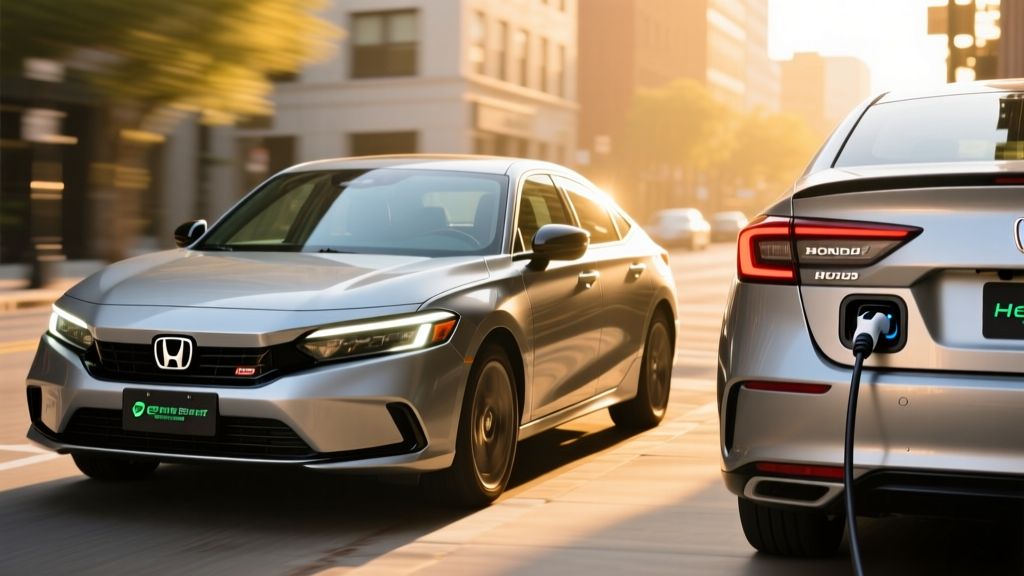
Honda's two-motor hybrid system returned to the Civic lineup for 2025 after a long absence from the U.S. market, and it arrived with a clear mission: deliver 50 MPG combined without sacrificing the driving dynamics the Civic is known for. The 2025 Honda Civic Hybrid powertrain pairs a 2.0-liter Atkinson-cycle four-cylinder engine with two electric motors and a compact lithium-ion battery pack — no plug required. This is a conventional hybrid (HEV), not a plug-in hybrid (PHEV), meaning it generates and recovers all its own electricity through regenerative braking and the engine.
After spending time with the Civic Hybrid in mixed driving, the powertrain delivers on its efficiency promise while offering 200 combined horsepower — a meaningful bump over the 158-hp turbocharged gas Civic. Here's everything buyers need to know about specs, real-world fuel economy, battery longevity, and whether this hybrid makes more sense than a PHEV or full EV for your situation.
| Specification | 2025 Honda Civic Hybrid |
|---|---|
| Powertrain Type | Conventional Hybrid (HEV), two-motor system |
| Engine | 2.0L Atkinson-cycle 4-cylinder |
| Combined System Output | 200 hp / 232 lb-ft torque |
| EPA Fuel Economy (Sport Touring) | 49 city / 47 highway / 49 combined MPG |
| EPA Fuel Economy (Sport) | 50 city / 47 highway / 50 combined MPG |
| Fuel Tank Capacity | 10.6 gallons |
| Total Driving Range | ~510–530 miles (EPA est.) |
| 0–60 mph (est.) | ~7.2 seconds |
| Drivetrain | Front-wheel drive (FWD) |
| Hybrid Battery | Lithium-ion, ~1.0 kWh (small buffer, not plug-charged) |
| Transmission | e-CVT (direct-drive, no belt) |
| Base MSRP (Sport) | $29,845 |
| Base MSRP (Sport Touring) | $32,845 |
| Hybrid Battery Warranty | 8 years / 100,000 miles (10 yr / 150,000 mi in CARB states) |
How the Two-Motor Hybrid System Actually Works
The 2025 Honda Civic Hybrid powertrain uses Honda's fourth-generation two-motor hybrid architecture, the same basic philosophy found in the Accord Hybrid and CR-V Hybrid but scaled and tuned for the Civic's lighter platform. Here's how it operates across different conditions:
- EV Drive: At low speeds and light loads, the propulsion motor drives the wheels using battery energy alone. The engine stays off. This is where the Civic Hybrid excels — stop-and-go city traffic.
- Hybrid Drive: Under moderate acceleration, the engine spins to generate electricity via the generator motor, which feeds the propulsion motor. There is no traditional mechanical connection between the engine and wheels in this mode.
- Engine Drive: At steady highway cruising speeds, a lock-up clutch engages to connect the engine directly to the wheels — this is more efficient than converting mechanical energy to electrical and back again at constant speeds.
- Regenerative Braking: During deceleration, the propulsion motor acts as a generator, recovering kinetic energy back into the battery. Steering-wheel paddles let you select from four levels of regen intensity.
The result is seamless transitions that most drivers won't notice. Unlike Toyota's planetary-gear e-CVT, Honda's system uses a direct-drive approach with a lock-up clutch, which gives a more linear, natural acceleration feel without the "rubber band" drone common in older hybrids.
EPA MPG vs. Real-World Fuel Economy
| Trim | City MPG | Highway MPG | Combined MPG |
|---|---|---|---|
| Sport | 50 | 47 | 50 |
| Sport Touring | 49 | 47 | 49 |
The EPA rates the Civic Hybrid Sport at 50 MPG combined, with the Sport Touring (heavier, larger wheels, more equipment) at 49 combined. These numbers are impressive for a compact sedan with 200 horsepower.
Real-world expectations: Honda's hybrid system, like most HEVs, tends to meet or slightly exceed its EPA city rating in actual stop-and-go driving because regenerative braking recovers energy that gas cars waste as heat. In city-heavy commutes, owners frequently report 51–54 MPG. Highway driving tells a slightly different story — at sustained 75–80 mph speeds, expect 43–46 MPG because the engine is doing more of the work directly and aerodynamic drag rises significantly. On a mixed route, 47–50 MPG is a realistic expectation.
Cold weather reduces efficiency by roughly 5–10% due to increased engine operation for cabin heat and reduced battery efficiency. In sub-30°F conditions, expect combined figures closer to 43–46 MPG until the powertrain reaches full operating temperature.
HEV vs. PHEV vs. Full EV: Which Fits Your Life?
A common question is whether the Civic Hybrid's conventional HEV setup is the right choice compared to a plug-in hybrid or a battery-electric vehicle. The answer depends on your charging access and driving patterns:
| Factor | HEV (Civic Hybrid) | PHEV (e.g., Toyota Prius Prime) | Full EV (e.g., Chevy Bolt, Tesla Model 3) |
|---|---|---|---|
| Plug-in Charging Required | No | Yes (for electric-only miles) | Yes (always) |
| Electric-Only Range | ~1 mi at low speed | 35–44 mi typical | 250–350+ mi |
| Total Range | ~520 mi | ~400–440 mi | 250–350 mi |
| Home Charging Setup | Not needed | Level 2 recommended | Level 2 strongly recommended |
| Federal Tax Credit (§30D) | Not eligible | Up to $7,500 (if eligible) | Up to $7,500 (if eligible) |
| Best For | No home charging, high-mileage commuters, simplicity | Home charging + short daily commute + road trips | Home charging + daily driving under 250 mi |
| Maintenance | Low (no plug, small battery) | Moderate (two systems) | Lowest (no engine) |
Choose the Civic Hybrid (HEV) if: You don't have access to home or workplace charging, you drive 15,000+ miles per year with mixed city/highway routes, and you want maximum simplicity — no cables, no charging apps, no range planning. Just fill up at any gas station and go.
Choose a PHEV if: You can install a Level 2 charger at home, your daily commute is under 40 miles round-trip (so you drive mostly on electricity), but you still want gas-engine range for road trips without charging stops.
Choose a full EV if: You have reliable home charging, your daily driving is well within the vehicle's range, and you want the lowest per-mile fuel cost and near-zero powertrain maintenance.
Pricing, Trims, and Tax Credit Eligibility
The 2025 Civic Hybrid is offered in two trims:
- Civic Hybrid Sport: $29,845 MSRP — includes 18-inch alloy wheels, sport styling, Honda Sensing safety suite, 7-inch touchscreen with wireless Apple CarPlay/Android Auto
- Civic Hybrid Sport Touring: $32,845 MSRP — adds 18-inch Berlina Black wheels, Bose 12-speaker audio, 9-inch touchscreen with wireless CarPlay, heated front seats, leather-trimmed interior, wireless phone charger, low-speed braking control
Federal tax credit status: The 2025 Honda Civic Hybrid does not qualify for the IRS §30D Clean Vehicle Credit. That credit applies only to plug-in electric vehicles (PHEVs and BEVs) with sufficient battery capacity and qualifying battery-sourcing/critical-minerals content. Conventional hybrids like the Civic Hybrid are not eligible for the federal purchase credit.
Some states offer their own incentives for hybrid vehicles, though these are increasingly rare as state programs shift toward plug-in vehicles. Check your state's energy or DMV website for any current hybrid rebates — but do not count on one.
Bottom line on incentives: The Civic Hybrid's value proposition is fuel savings, not tax credits. At 50 MPG combined versus the gas Civic's ~35 MPG combined, a driver covering 15,000 miles/year at $3.40/gallon saves approximately $640 annually in fuel — roughly $3,200 over five years.
Battery Longevity, Warranty, and Replacement Costs
Hybrid Battery Warranty: Honda covers the Civic Hybrid's lithium-ion battery pack for 8 years / 100,000 miles nationwide, extended to 10 years / 150,000 miles in CARB-emissions states (California, New York, Massachusetts, and others that follow CARB standards). The warranty covers capacity loss below a defined threshold and defects.
The Civic Hybrid's battery pack is small — approximately 1.0 kWh of total capacity — because it only needs to buffer energy between regenerative braking events and motor assist bursts. It's never deeply cycled the way a PHEV or EV battery is, which significantly extends its operational lifespan.
How long do Honda hybrid batteries actually last? Based on data from the Accord Hybrid, CR-V Hybrid, and earlier Civic Hybrids, Honda's lithium-ion hybrid battery packs routinely exceed 150,000 miles with minimal degradation. The shallow charge/discharge cycles (the battery typically operates between roughly 40% and 80% state of charge) are gentle on cell chemistry. Failures before 100,000 miles are uncommon.
Replacement cost: If the hybrid battery does need replacement outside of warranty, expect a dealer-installed replacement to cost between $2,000 and $4,000 depending on labor rates and whether a new or remanufactured pack is used. Independent hybrid-specialty shops can sometimes perform the replacement for $1,500–$2,500. This is far less than an EV traction battery replacement because the pack is small and relatively accessible.
The 12-volt auxiliary battery (a separate, conventional battery that powers electronics when the hybrid system is off) may need replacement every 4–6 years at a cost of $150–$300 — standard for any modern vehicle.
Driving Impressions and Performance
The 200 combined horsepower and 232 lb-ft of torque give the Civic Hybrid a noticeable performance edge over the 158-hp turbocharged 1.5T gas Civic. The electric motor's instant torque delivery makes the car feel responsive from a stoplight, and the transition between EV, hybrid, and engine-direct modes is remarkably smooth.
The e-CVT in the Civic Hybrid is not a traditional belt-and-pulley CVT — it's a direct-drive system with a fixed gear ratio for engine-direct mode and motor-driven operation otherwise. This eliminates the "engine drone at fixed RPM" sensation that plagues many hybrids under hard acceleration. Honda has also programmed simulated shift points during aggressive acceleration to give a more natural, geared feel.
Handling is essentially unchanged from the gas Civic — the hybrid components add roughly 150–200 lbs, mostly low in the chassis, so the car's balance and cornering composure remain intact. The Sport Touring's standard adaptive dampers (a segment rarity at this price) further sharpen the ride.
Pros
- 50 MPG combined EPA — among the best in the compact sedan segment
- 200 hp / 232 lb-ft — more torque than the gas Civic, strong low-end pull
- No plug-in charging needed — ideal for apartment dwellers and street parkers
- 520+ mile total range between fill-ups
- Generous hybrid battery warranty (8 yr / 100k mi, 10 yr / 150k mi CARB)
- Honda Sensing safety suite standard on all trims
- Refined, quiet hybrid operation — minimal engine drone
Cons
- Not eligible for the $7,500 federal §30D tax credit (HEV, not PHEV)
- FWD only — no AWD option (the CR-V Hybrid offers AWD)
- Only available in Sport and Sport Touring trims — no base LX Hybrid
- 10.6-gallon fuel tank is smaller than the gas Civic's 12.4-gallon tank
- Highway MPG drops to mid-40s at sustained 75+ mph
- Sport Touring at $32,845 pushes into Accord Hybrid territory
Ownership Costs: Civic Hybrid vs. Gas Civic vs. EV
To put the Civic Hybrid's economics in perspective, here's a simplified 5-year / 75,000-mile cost comparison assuming $3.40/gallon gas and $0.14/kWh electricity:
| Vehicle | MSRP (base) | 5-Yr Fuel Cost | Federal Credit | Approx. 5-Yr Total |
|---|---|---|---|---|
| 2025 Civic Hybrid Sport | $29,845 | ~$5,100 | $0 | ~$34,945 |
| 2025 Civic Sport (1.5T gas) | $27,845 | ~$7,290 | $0 | ~$35,135 |
| 2025 Chevy Bolt EV (2LT) | $29,895 | ~$1,575 | Up to $7,500* | ~$23,970 |
*Federal credit eligibility depends on buyer income, MSRP caps, and battery-sourcing requirements per IRS §30D rules. Consult a tax professional.
The Civic Hybrid essentially pays for its own price premium over the gas Civic through fuel savings within 4–5 years. The Bolt EV is substantially cheaper to operate if you qualify for the full credit and have home charging — but it requires lifestyle adjustments around charging infrastructure that the Civic Hybrid does not.
Frequently Asked Questions
How many MPG does the 2025 Honda Civic Hybrid get?
The EPA rates the Civic Hybrid Sport at 50 city / 47 highway / 50 combined MPG. The Sport Touring trim is rated at 49 city / 47 highway / 49 combined. In real-world city-heavy driving, many owners report 51–54 MPG thanks to strong regenerative braking. Highway-only driving at 75+ mph typically yields 43–46 MPG.
Does the 2025 Civic Hybrid need to be plugged in?
No. The Civic Hybrid is a conventional hybrid (HEV), not a plug-in hybrid. It charges its small lithium-ion battery through regenerative braking and the gasoline engine. You never plug it in — just refuel at any gas station.
Is the Civic Hybrid a PHEV or an HEV?
It is a conventional hybrid (HEV). Honda does not currently offer a plug-in hybrid (PHEV) version of the Civic in the U.S. market. If you want a Honda PHEV, the closest option is the Clarity Plug-In Hybrid (discontinued after 2022) or the upcoming next-generation models Honda has announced for later this decade.
Is the 2025 Civic Hybrid reliable, and what does battery replacement cost?
Honda's hybrid powertrains have a strong reliability track record, particularly the two-motor system used in the Accord and CR-V hybrids. The Civic Hybrid battery is covered by an 8-year/100,000-mile warranty (10 years/150,000 miles in CARB states). Based on historical data, these small hybrid batteries regularly last 150,000+ miles. Out-of-warranty replacement costs approximately $2,000–$4,000 at a dealer, or $1,500–$2,500 at an independent hybrid shop.
Does the 2025 Honda Civic Hybrid qualify for any tax credit?
No. The federal §30D Clean Vehicle Credit applies only to plug-in electric vehicles (PHEVs and BEVs) that meet battery capacity, sourcing, MSRP, and buyer income requirements. Conventional hybrids like the Civic Hybrid are not eligible. Some states may offer minor hybrid incentives, but these are increasingly uncommon. Check your state energy office for current programs.
How does the Civic Hybrid compare to the Toyota Prius?
The Toyota Prius (57 MPG combined for the LE FWD) edges out the Civic Hybrid on pure fuel economy, but the Civic offers 200 hp versus the Prius's 194 hp, a more conventional sedan design, and Honda's driving dynamics. The Prius also offers an AWD option. Both are excellent — the choice comes down to styling preference, brand loyalty, and whether you prioritize maximum MPG (Prius) or a sportier driving experience (Civic Hybrid).
Can I get the Civic Hybrid with all-wheel drive?
No. The 2025 Civic Hybrid is front-wheel drive only. If AWD is a priority in a Honda hybrid, the CR-V Hybrid offers a real-time AWD system with the same two-motor architecture.