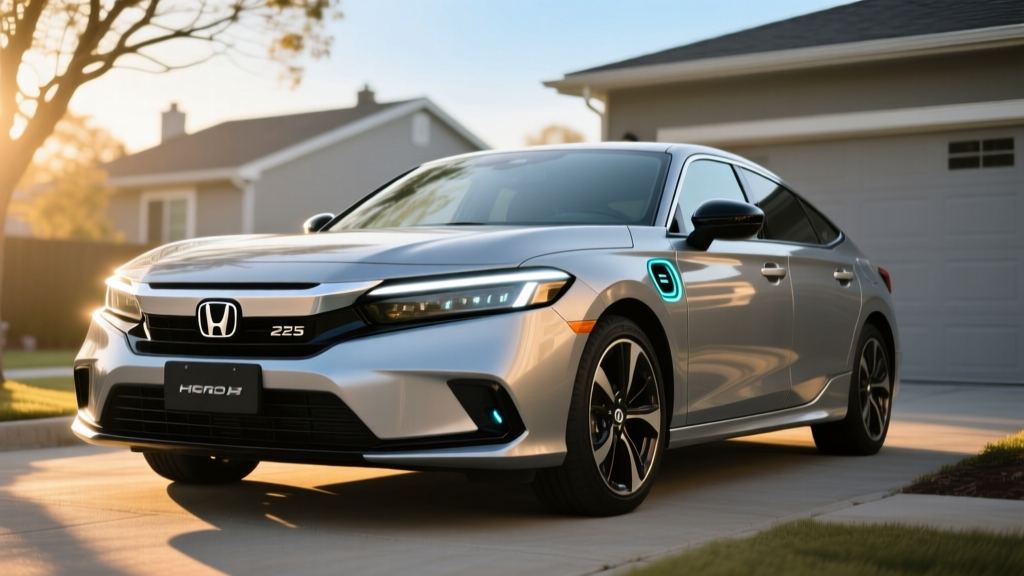
The 2025 Honda Civic Hybrid returns to the lineup after a multi-year absence, slotting into a compact sedan market where buyers increasingly want fuel savings without plugging in. Honda's two-motor hybrid system pairs a 2.0-liter Atkinson-cycle engine with dual electric motors to deliver class-leading efficiency and surprisingly brisk acceleration. For shoppers researching the 2025 Honda Civic Hybrid MSRP, pricing starts at $28,950 for the Sport Hybrid trim and climbs to $31,950 for the Sport Touring Hybrid — positioning it as a premium compact hybrid that undercuts the Toyota Prius Prime PHEV while offering more power than the standard Civic.
This guide covers every number that matters: EPA fuel economy by driving condition, real-world MPG expectations, the hybrid powertrain's output, battery longevity, and whether any tax credits apply. We'll also clarify the difference between this conventional hybrid (HEV) and plug-in hybrid (PHEV) alternatives, so you can decide which electrified approach fits your routine.
2025 Honda Civic Hybrid MSRP by Trim
Honda offers the Civic Hybrid in two trims for 2025, both built on the 11th-generation Civic platform. Here is the exact pricing structure before destination charges:
| Trim | MSRP | Destination | Total | Key Additions Over Base |
|---|---|---|---|---|
| Sport Hybrid | $28,950 | $1,150 | $30,100 | Hybrid powertrain, 18" alloy wheels, sport-tuned suspension, wireless Apple CarPlay/Android Auto |
| Sport Touring Hybrid | $31,950 | $1,150 | $33,100 | Leather seats, Bose 12-speaker audio, wireless charging, Honda Sensing suite with low-speed braking, navigation |
Neither trim qualifies for the federal §30D clean vehicle tax credit. That credit applies exclusively to plug-in electric vehicles (BEVs and PHEVs) with sufficient battery capacity — conventional hybrids like the Civic Hybrid are ineligible. Some states offer separate rebates or reduced registration fees for hybrids, but these vary by jurisdiction. Check your state's energy office or department of revenue for current programs.
EPA Fuel Economy and Real-World MPG
The 2025 Civic Hybrid carries EPA ratings of 50 MPG city / 47 MPG highway / 49 MPG combined for the Sport Hybrid trim, according to fueleconomy.gov. The Sport Touring Hybrid drops slightly to 48/44/46 MPG due to added weight from premium interior materials and equipment.
| Trim | City | Highway | Combined |
|---|---|---|---|
| Sport Hybrid | 50 MPG | 47 MPG | 49 MPG |
| Sport Touring Hybrid | 48 MPG | 44 MPG | 46 MPG |
Real-World MPG: What to Actually Expect
Honda's two-motor hybrid system excels in stop-and-go traffic, where regenerative braking recaptures energy and the electric motors handle low-speed propulsion. In real-world city driving, many owners report exceeding the EPA city estimate — hitting 52–55 MPG on routes with frequent stops and moderate speeds. This is a common pattern with series-parallel hybrids: the EPA city test cycle doesn't fully capture the benefit of aggressive regenerative braking in heavy congestion.
Highway driving tells a different story. At sustained 70–80 MPH speeds, the gasoline engine operates more often and aerodynamic drag increases fuel consumption. Expect 42–45 MPG on the highway in real-world conditions, slightly below the EPA sticker. Cold weather (below 32°F) will reduce fuel economy by roughly 5–10% across all conditions, as the engine runs more frequently to heat the cabin and maintain battery temperature.
Powertrain Specs: Two-Motor Hybrid System
The Civic Hybrid uses Honda's fourth-generation two-motor hybrid system, which operates in three modes depending on driving conditions:
- EV Drive: Electric motors only, at low speeds and light loads
- Hybrid Drive: Engine generates electricity to power the motors (series hybrid mode)
- Engine Drive: Engine directly drives the wheels via a lock-up clutch at highway cruising speeds
| Component | Specification |
|---|---|
| Engine | 2.0L Atkinson-cycle 4-cylinder |
| Engine Output | 143 HP / 134 lb-ft torque |
| Electric Motors | Dual-motor system |
| Combined System Output | 200 HP / 232 lb-ft torque |
| Transmission | Single-speed (no traditional CVT or gears) |
| 0–60 MPH | ~7.3 seconds (est.) |
| Drivetrain | Front-wheel drive |
The 200 combined horsepower figure is significant — it makes the Civic Hybrid the most powerful non-Type R Civic in the lineup, substantially outperforming the 158 HP turbocharged 2.0L in the standard Civic Sport. The electric motors deliver instant torque at low RPM, giving the hybrid a noticeably more responsive feel in city acceleration compared to its gasoline-only siblings.
Hybrid vs. PHEV vs. EV: Which Fits Your Needs?
The Civic Hybrid is a conventional hybrid (HEV) — it does not plug in. The small lithium-ion battery (approximately 1.1 kWh) recharges through regenerative braking and the gasoline engine. This is fundamentally different from a plug-in hybrid (PHEV) or battery electric vehicle (BEV).
HEV vs. PHEV vs. BEV — Key Differences
| Feature | HEV (Civic Hybrid) | PHEV (e.g., Prius Prime) | BEV (e.g., Chevy Bolt) |
|---|---|---|---|
| Plugs In? | No | Yes | Yes |
| Electric-Only Range | ~1 mile at low speed | 25–44 miles | 200–350+ miles |
| Battery Size | ~1.1 kWh | 10–18 kWh | 50–85 kWh |
| Home Charging Needed? | No | Recommended | Required |
| Federal Tax Credit | Not eligible | Up to $7,500* | Up to $7,500* |
| Gasoline Required? | Yes (always) | Yes (after EV range) | No |
| Starting MSRP Range | $28,950 | $33,000–$40,000 | $28,000–$45,000 |
*§30D credit eligibility depends on MSRP caps, buyer income limits, battery sourcing requirements, and point-of-sale transfer rules. See IRS guidelines for current-year details.
Choose the Civic Hybrid (HEV) If:
- You cannot install a home charger (apartment, street parking, no garage)
- You want maximum fuel savings with zero change to your fueling routine
- Your budget tops out around $33,000 and you don't qualify for PHEV/EV tax credits
- You drive a mix of city and highway and want consistent efficiency everywhere
Consider a PHEV Instead If:
- You can charge at home and your daily commute is under 40 miles round-trip
- You want electric-only driving for most daily trips but gas flexibility for road trips
- You qualify for the §30D tax credit and it brings the effective price below the Civic Hybrid
Consider a Full EV Instead If:
- You have reliable home Level 2 charging and your daily driving is under 250 miles
- You want zero tailpipe emissions and minimal maintenance (no oil changes, no engine)
- Your total cost of ownership analysis favors electricity over gasoline in your area
Battery Warranty, Longevity, and Replacement Cost
Honda's hybrid battery warranty covers defects and capacity loss below a specified threshold (typically 60–70% of original capacity, though Honda does not publish an exact degradation guarantee for HEVs the way BEV manufacturers do). The warranty is fully transferable to subsequent owners.
How Long Will the Battery Last?
Real-world data from Honda's earlier hybrid systems (Insight, Accord Hybrid, CR-V Hybrid) suggests that the lithium-ion battery packs typically last 150,000–200,000 miles before significant degradation requires attention. Honda's fourth-generation two-motor system uses a smaller, less stressed battery than a PHEV or BEV — it never fully depletes and never charges to 100%, operating in a narrow state-of-charge window that extends cycle life.
Battery Replacement Cost
If the hybrid battery does fail outside warranty, replacement costs for Honda's hybrid battery packs currently range from $2,000 to $4,000 for parts and labor at a dealership. Independent hybrid specialists often offer refurbished or reconditioned packs for $1,500–$2,500. Individual cell replacement (if only a few cells degrade) can cost $500–$1,200. These costs are significantly lower than BEV battery replacements, which can exceed $10,000, because the Civic Hybrid's battery is small (~1.1 kWh) compared to a full EV's 60–80 kWh pack.
Driving Impressions and Practical Ownership
The Civic Hybrid's 200 HP output and 232 lb-ft of torque give it a character that separates it from efficiency-focused rivals. The electric motors provide immediate response off the line, and the transition between EV, hybrid, and engine-drive modes is nearly imperceptible from the driver's seat. Honda has tuned the regenerative braking to feel natural — there's no aggressive grabbiness, and the paddle-shift-mounted regen selectors let you adjust deceleration intensity without committing to full one-pedal driving.
Cargo space remains competitive at approximately 14.8 cubic feet of trunk volume, essentially identical to the gasoline Civic sedan. The hybrid battery sits beneath the rear seats, preserving trunk depth and eliminating the cargo compromises that plagued earlier hybrid conversions. The rear seats do not gain a pass-through hump from battery placement.
Insurance costs for the Civic Hybrid typically run 5–12% higher than the equivalent gasoline Civic trim, reflecting the higher replacement cost of hybrid-specific components. However, this premium is modest compared to BEV insurance surcharges, which can reach 20–30% in some markets.
Pros
- 49 MPG combined EPA — among the best in the compact class
- 200 HP system output — quickest non-Type R Civic
- No plug-in required — zero infrastructure changes
- 8–10 year hybrid battery warranty
- Full trunk space preserved vs. gas Civic
- Excellent city MPG that can exceed EPA estimate
Cons
- No federal tax credit eligibility
- Only two trims available (no base LX Hybrid)
- Highway MPG drops below EPA in real-world 75+ MPH driving
- FWD only — no AWD option unlike Toyota Prius
- Sport Touring Hybrid exceeds $33,000 with destination
- No EV-only mode for meaningful electric-only distance
Total Cost of Ownership: Civic Hybrid vs. Gas Civic
To put the Civic Hybrid's value in context, consider a 5-year / 75,000-mile ownership comparison against the gasoline Civic Sport (2.0L turbo, 158 HP, EPA 31/38/34 MPG combined):
| Category | Civic Hybrid Sport | Civic Gas Sport (2.0T) |
|---|---|---|
| MSRP + Destination | $30,100 | $26,600 |
| Fuel Cost (75K mi, $3.40/gal avg) | $5,204 | $7,500 |
| Estimated Maintenance | $2,800 | $3,200 |
| Insurance (est. 5-yr) | $8,400 | $7,800 |
| 5-Year Total (before depreciation) | $46,504 | $45,100 |
| Fuel Savings vs. Gas | Hybrid saves ~$2,296 in fuel over 5 years | |
The Hybrid's $3,500 MSRP premium over the gas model is partially offset by fuel savings of roughly $2,300 over five years at current gas prices. Break-even on the powertrain premium alone takes approximately 7.5 years or 112,000 miles at 15,000 miles/year. However, the Hybrid's stronger acceleration, standard equipment upgrades, and potential resale value premium for fuel-efficient vehicles can shift this calculation. Higher gas prices in your area or a longer ownership horizon tilt the math further in the Hybrid's favor.
Frequently Asked Questions
How many MPG does the 2025 Honda Civic Hybrid get?
The Sport Hybrid trim achieves an EPA-estimated 50 MPG city, 47 MPG highway, and 49 MPG combined. The Sport Touring Hybrid rates at 48/44/46 MPG. In real-world city driving with frequent stops, owners often exceed the EPA city estimate, reaching 52–55 MPG. Highway driving at 70–80 MPH typically yields 42–45 MPG.
Does the 2025 Civic Hybrid need to be plugged in?
No. The Civic Hybrid is a conventional hybrid (HEV), not a plug-in hybrid (PHEV). Its small lithium-ion battery recharges entirely through regenerative braking and the gasoline engine. You fuel it exactly like a standard gasoline car — at the pump, with regular unleaded.
Does the Civic Hybrid qualify for any federal tax credit?
No. The federal §30D clean vehicle credit applies only to plug-in electric vehicles (BEVs and PHEVs) that meet battery capacity, sourcing, MSRP, and buyer income requirements. Conventional hybrids like the Civic Hybrid are not eligible. Some states may offer separate incentives for hybrids — check your state's energy or revenue department.
How reliable is the Honda Civic Hybrid, and what does battery replacement cost?
Honda's hybrid systems have demonstrated strong reliability over multiple generations, with battery packs typically lasting 150,000–200,000 miles. The battery is warrantied for 8 years/100,000 miles (10 years/150,000 miles in CARB states). Out-of-warranty battery replacement costs approximately $2,000–$4,000 at a dealer, or $1,500–$2,500 from an independent hybrid specialist using refurbished packs. Check NHTSA for the latest safety and reliability data.
How does the Civic Hybrid compare to the Toyota Prius?
The 2025 Toyota Prius (LE trim) rates at 57 MPG combined and starts around $28,550, offering slightly better fuel economy and a lower base price. However, the Civic Hybrid delivers 200 HP versus the Prius's 194 HP, a more conventional driving feel, and a more premium interior at the Sport Touring level. The Prius also offers an AWD option (54 MPG combined) that the Civic Hybrid lacks. If maximum MPG is your priority, the Prius edges ahead. If driving dynamics and interior quality matter more, the Civic Hybrid is the stronger pick.
Is the Civic Hybrid good for highway driving?
Yes, though this is where its efficiency advantage narrows. At sustained highway speeds, the gasoline engine operates more frequently, and real-world highway MPG drops to 42–45 MPG — below the 47 MPG EPA highway estimate. The 200 HP system output provides confident highway merging and passing power, and the cabin remains quiet at speed. For drivers who log primarily highway miles, the fuel savings over a gas Civic are smaller than for city-dominant commuters.
Sources: fueleconomy.gov, IRS §30D Credit Guidelines, NHTSA, Honda Newsroom official specifications.