The 2025 Honda Civic Hybrid returns after a hiatus with a two-motor powertrain rated at 50 MPG combined and an interior that punches well above its compact-car price bracket. For shoppers searching for the 2025 Honda Civic Hybrid interior, the cabin blends soft-touch materials, a driver-focused layout, and Honda's latest infotainment — all wrapped around a hybrid system that prioritizes city efficiency without sacrificing highway composure.
This guide covers everything a buyer needs: exact EPA fuel economy, the two-motor e:HEV powertrain, real-world MPG expectations, battery warranty details, pricing by trim, and how the Civic Hybrid stacks up against plug-in hybrids and full EVs.
HEV vs PHEV: What the Civic Hybrid Actually Is
Before diving into specs, it is critical to understand what the 2025 Civic Hybrid is — and what it is not.
Conventional Hybrid (HEV): The Civic Hybrid uses a small lithium-ion battery (approximately 1.1 kWh usable) charged entirely by regenerative braking and the gasoline engine. You never plug it in. The electric motor assists the engine and enables brief electric-only driving at low speeds, but the primary energy source remains gasoline.
Plug-in Hybrid (PHEV): A PHEV like the Toyota Prius Prime or Hyundai Tucson PHEV carries a much larger battery (typically 13–20 kWh) that charges via a plug, delivering 25–45 miles of electric-only range before the gas engine engages. PHEVs can qualify for the federal §30D tax credit; conventional HEVs like the Civic Hybrid cannot.
The Civic Hybrid is an HEV. It requires no plug, no home charger, and no change in fueling habits. You simply fill up at a gas station and let the hybrid system optimize efficiency automatically.
Fuel Economy: EPA Ratings and Real-World MPG
The headline number is 50 MPG combined, but the city/highway split reveals where this powertrain excels.
| Metric | Sport Touring Hybrid | Sport Hybrid (sedan) |
|---|---|---|
| EPA City | 50 MPG | 51 MPG |
| EPA Highway | 47 MPG | 47 MPG |
| EPA Combined | 49 MPG | 50 MPG |
| Fuel Tank Capacity | 12.4 gal | 12.4 gal |
| Total Range (est.) | ~607 mi | ~620 mi |
Source: fueleconomy.gov (EPA estimates for 2025 Honda Civic Hybrid sedan trims).
Real-World MPG: What to Actually Expect
Honda's two-motor hybrid system is city-biased by design. The electric motor handles most low-speed propulsion, with the 2.0L engine acting primarily as a generator. In real-world driving:
- City/suburban driving: Expect 48–53 MPG. Many owners report exceeding the EPA city rating in stop-and-go traffic, where regenerative braking recaptures energy most effectively.
- Highway cruising (70–80 mph): Expect 42–46 MPG. At sustained highway speeds, the engine drives the wheels directly through a lock-up clutch, but aerodynamic drag and the engine's Atkinson-cycle tuning favor lower RPMs over peak power.
- Cold weather (below 32°F): Expect a 5–10% reduction (roughly 44–47 MPG combined). The engine runs more frequently to provide cabin heat and maintain battery temperature.
- Hilly terrain: Regenerative braking on descents partially offsets the energy cost of climbing, but net efficiency drops to roughly 40–44 MPG in mountainous routes.
The Civic Hybrid's real-world advantage over conventional gas cars is most pronounced in urban environments. If your commute is predominantly city and suburban, this is one of the most efficient non-plug-in vehicles available.
Powertrain Specs: Two-Motor e:HEV System
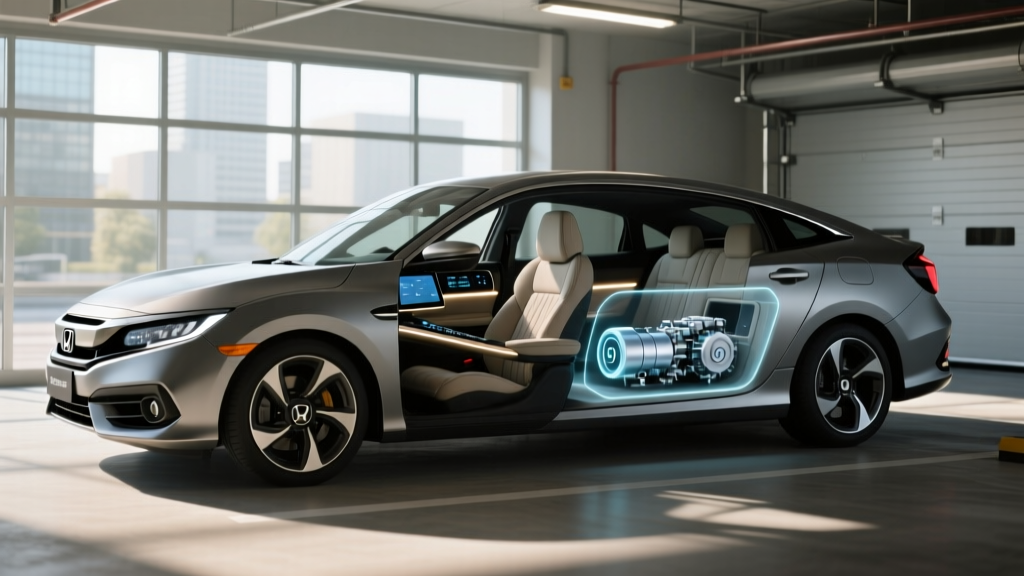
Honda's fourth-generation two-motor hybrid system pairs a 2.0-liter direct-injected Atkinson-cycle four-cylinder engine with two electric motors and a lithium-ion battery pack.
| Specification | Value |
|---|---|
| Engine | 2.0L DOHC 16-valve Atkinson-cycle I-4 |
| Engine Horsepower | 143 hp @ 6,000 rpm |
| Engine Torque | 134 lb-ft @ 4,500 rpm |
| Drive Motor Output | 184 hp / 232 lb-ft |
| Combined System Output | 200 hp / 232 lb-ft |
| Transmission | Direct-drive (no traditional CVT or gears) |
| Drive Type | FWD (AWD not available) |
| 0–60 mph (est.) | ~7.3 seconds |
| Battery Chemistry | Lithium-ion |
| Battery Capacity | ~1.1 kWh (usable) |
| Plug-in Charging | No — self-charging HEV |
The system operates in three modes seamlessly managed by the powertrain control unit:
- EV Drive: The battery powers the drive motor alone. Used at low speeds, gentle acceleration, and deceleration. Battery capacity limits this to roughly 1 mile at low speed.
- Hybrid Drive: The gasoline engine spins the generator motor, which sends electricity directly to the drive motor. This is the predominant mode in city and suburban driving. Excess energy charges the battery.
- Engine Drive: At steady highway speeds, a lock-up clutch mechanically connects the engine to the front wheels for maximum efficiency. The drive motor can add torque assist during passing maneuvers.
The result is a powertrain that feels like an EV around town (smooth, instant torque from the 184-hp drive motor) and cruises efficiently on the highway without the drone typical of CVT-equipped hybrids.
2025 Honda Civic Hybrid Interior: Cabin Quality and Technology
The Civic Hybrid is offered in Sport and Sport Touring trims, both featuring the same hybrid powertrain but with meaningful interior differences.
Sport Hybrid Interior
The Sport trim includes a 7-inch digital instrument cluster, a 7-inch touchscreen with wireless Apple CarPlay and Android Auto, cloth seating surfaces with leatherette bolsters, heated front seats, a leather-wrapped steering wheel, and dual-zone automatic climate control. The honeycomb mesh dashboard accent and metal-look trim give the cabin a premium feel uncommon at this price point.
Sport Touring Hybrid Interior
Step up to the Sport Touring and you get a 10.2-inch fully digital instrument cluster, a 9-inch touchscreen with wireless Apple CarPlay and Android Auto, built-in navigation, a 12-speaker Bose premium audio system, leather-trimmed seats, a power-adjustable driver's seat with memory, heated rear seats, wireless phone charging, and low-speed braking control with pedestrian detection. The Sport Touring also adds a low-speed handling assist and traffic jam assist to the Honda Sensing suite.
Cargo and Passenger Space
Because the lithium-ion battery is compact and positioned under the rear seats, cargo volume is unaffected compared to the gas Civic sedan: 14.8 cubic feet of trunk space. Rear legroom measures 37.4 inches, and headroom is 37.1 inches front and 36.0 inches rear. The Civic Hybrid hatchback variant offers 24.5 cubic feet behind the rear seats with a wider cargo opening.
Pricing, Trims, and Tax Credit Eligibility
The 2025 Civic Hybrid starts at a competitive price point and is available in two sedan trims and two hatchback trims.
| Trim | Body Style | MSRP |
|---|---|---|
| Sport Hybrid | Sedan | $29,845 |
| Sport Touring Hybrid | Sedan | $32,845 |
| Sport Hybrid | Hatchback | $31,445 |
| Sport Touring Hybrid | Hatchback | $34,445 |
MSRP includes destination charge. Source: Honda.com 2025 Civic pricing.
Federal Tax Credit: Does the Civic Hybrid Qualify?
No. The 2025 Honda Civic Hybrid is a conventional HEV, not a plug-in vehicle. Under IRS §30D rules, only plug-in electric vehicles (BEVs and PHEVs with at least 7 kWh of battery capacity) are eligible for the federal clean vehicle credit of up to $7,500. The Civic Hybrid's ~1.1 kWh battery does not meet this threshold.
Some states offer rebates or tax incentives for conventional hybrids, but these vary by jurisdiction and change frequently. Check your state's energy office or department of revenue for current programs.
Battery Warranty, Reliability, and Replacement Cost
Honda Hybrid Battery Warranty: 8 years / 100,000 miles (10 years / 150,000 miles in CARB states including California, New York, Massachusetts, and others that follow California emissions standards).
Powertrain Warranty: 5 years / 60,000 miles (covers the hybrid drive motor, generator motor, and powertrain control unit).
Limited Vehicle Warranty: 3 years / 36,000 miles bumper-to-bumper.
How Long Will the Hybrid Battery Last?
Honda's lithium-ion hybrid batteries in the Civic are designed to last the life of the vehicle under normal use. The battery is small (~1.1 kWh) and operates in a narrow state-of-charge window — typically between 20% and 80% — which dramatically reduces stress and degradation compared to a full EV battery that cycles through a wider range.
Based on long-term data from Honda's earlier hybrid systems (Insight, Accord Hybrid), significant battery degradation before 150,000 miles is uncommon. The hybrid battery management system actively controls temperature and charge cycles to maximize longevity.
Hybrid Battery Replacement Cost
If the battery does fail outside warranty, replacement cost for the Civic Hybrid's lithium-ion pack is estimated at $2,000–$4,000 for the battery module plus labor. This is substantially less than a full EV battery replacement because the pack is small. Third-party refurbishers and aftermarket options may reduce this cost further as the hybrid fleet ages.
Overall Reliability
Honda's hybrid powertrains have demonstrated strong reliability in the Accord Hybrid and CR-V Hybrid. The two-motor system has fewer moving parts than a conventional transmission — there is no CVT belt, no torque converter, and no multi-gear shifting mechanism. The IIHS has rated the 2025 Civic as a Top Safety Pick+ when equipped with specific headlights, and the Honda Sensing suite comes standard on all Hybrid trims.
Civic Hybrid vs Plug-in Hybrid vs Full EV: Which Fits You?
The right choice depends on your driving pattern, charging access, and budget.
Choose the Civic Hybrid (HEV) if:
- You cannot charge at home (apartment, street parking, no garage).
- Your budget is under $35,000 and you want maximum MPG without behavioral changes.
- You take frequent long road trips and don't want to plan around charging stops.
- You want a simple ownership experience identical to a gas car, just with fewer fuel stops.
Choose a PHEV (e.g., Toyota Prius Prime, Hyundai Tucson PHEV) if:
- You can charge at home (Level 1 or Level 2) and want 25–45 miles of electric-only commuting.
- Your daily commute is under 40 miles round-trip, so most driving is electric.
- You want to qualify for the federal §30D tax credit (up to $7,500, subject to income and sourcing rules).
- You still want gas-engine flexibility for weekend road trips.
Choose a full EV (e.g., Chevrolet Equinox EV, Hyundai Ioniq 5) if:
- You have reliable home charging (Level 2 preferred).
- Your daily driving is under 250 miles and you can plan for longer trips.
- You want to eliminate gasoline costs entirely and minimize maintenance (no oil changes, no spark plugs).
- You qualify for the federal tax credit and/or state EV rebates.
Pros and Cons of the 2025 Honda Civic Hybrid
Pros
- 50 MPG combined EPA — among the highest of any non-plug-in compact sedan
- 200 hp combined output delivers confident acceleration for the class
- Premium interior materials and tech, especially in Sport Touring trim
- No plug-in charging required — zero lifestyle change from a gas car
- 8-year/100,000-mile hybrid battery warranty (10/150k in CARB states)
- Full 14.8 cu-ft trunk (sedan) with no battery intrusion
- Honda Sensing ADAS suite standard on all trims
Cons
- No AWD option — FWD only limits appeal in snow-belt states
- No federal tax credit (HEV, not PHEV)
- Highway MPG drops to low-to-mid 40s at 75+ mph
- Only available in Sport and Sport Touring trims (no base LX Hybrid)
- Engine noise is noticeable under hard acceleration despite improved sound insulation
- No DC fast charging capability (not applicable — HEV)
Frequently Asked Questions
How many MPG does the 2025 Honda Civic Hybrid get?
The EPA rates the Civic Hybrid Sport sedan at 51 city / 47 highway / 50 combined MPG. The Sport Touring sedan is rated at 50/47/49. In real-world city driving, many drivers report matching or slightly exceeding these figures. Highway fuel economy at sustained speeds above 70 mph typically falls to 42–46 MPG.
Does the Civic Hybrid need to be plugged in?
No. The Civic Hybrid is a conventional hybrid (HEV). The battery charges through regenerative braking and the gasoline engine. You fuel it like any other gas car — no plug, no charger, no electric-only commuting range.
How far can the Civic Hybrid drive on electric only?
Only about 1 mile at very low speeds. The small ~1.1 kWh battery is designed to assist the engine and capture regenerative energy, not to provide meaningful electric-only range. If electric-only commuting is your goal, look at a PHEV like the Toyota Prius Prime (44 miles electric) or a full EV.
Is the 2025 Civic Hybrid reliable, and what does battery replacement cost?
Honda's two-motor hybrid system has proven reliable across the Accord and CR-V Hybrid lineups. The Civic Hybrid battery is covered for 8 years/100,000 miles (10 years/150,000 miles in CARB states). Out-of-warranty battery replacement is estimated at $2,000–$4,000 — far less than an EV battery because the pack is small.
Does the Civic Hybrid qualify for any federal tax credit?
No. The federal §30D clean vehicle credit applies only to plug-in vehicles (BEVs and PHEVs) with at least 7 kWh of battery capacity. The Civic Hybrid's ~1.1 kWh battery does not qualify. Check your state for any local hybrid incentives.
What is the 2025 Honda Civic Hybrid interior like in Sport Touring trim?
The Sport Touring interior features a 10.2-inch digital gauge cluster, a 9-inch touchscreen with wireless Apple CarPlay/Android Auto, a 12-speaker Bose audio system, leather-trimmed heated seats (front and rear), wireless phone charging, and built-in navigation. It is one of the most well-appointed cabins in the compact hybrid segment.
Is the Civic Hybrid available with all-wheel drive?
No. The 2025 Civic Hybrid is front-wheel drive only across all trims and body styles. If AWD is essential, consider the Toyota Prius AWD (54 MPG combined with AWD) or the Subaru Crosstrek Hybrid.