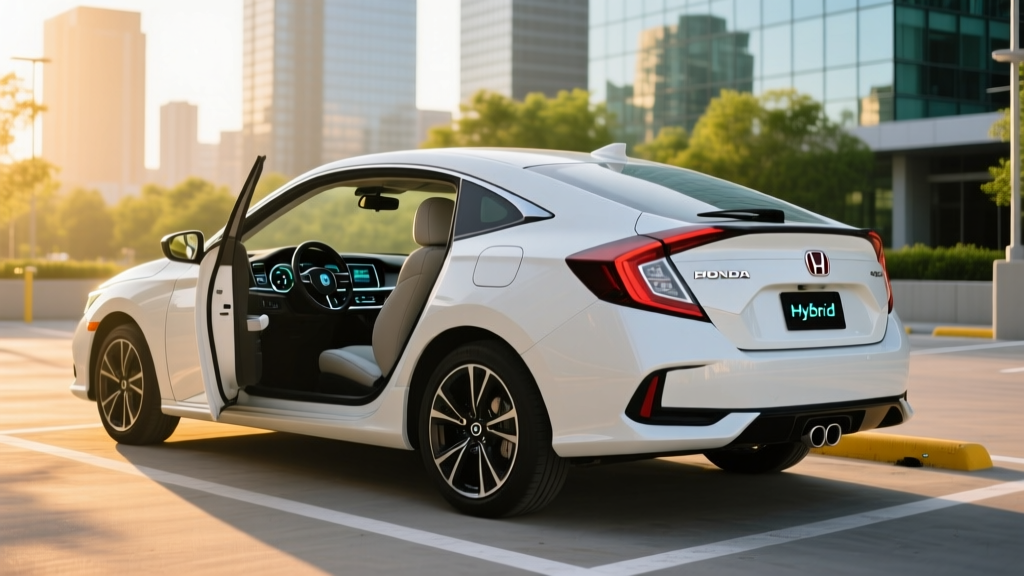
The 2025 Honda Civic Hybrid Hatchback occupies a precise niche: maximum fuel efficiency without plugging in, paired with the cargo versatility of a hatchback body style. For buyers weighing a full electric vehicle against the simplicity of a conventional hybrid, this powertrain eliminates charging logistics while still cutting fuel consumption roughly in half compared to the standard turbo Civic. After reviewing the specs, EPA data, and Honda's hybrid history, here's what real buyers need to know.
Quick Verdict: Who Should Consider the Civic Hybrid Hatchback?
The 2025 Civic Hybrid Hatchback is engineered for drivers who want to reduce fuel costs without changing their refueling habits. You never plug it in — the gasoline engine and regenerative braking handle all battery charging automatically. If you lack access to home or workplace charging but still want 50 MPG in daily driving, this is one of the strongest options in the compact segment.
The hatchback body adds 2.3 cubic feet of cargo volume behind the rear seats compared to the sedan, making it practical for gear-heavy commuters, small families, and weekend trips. Honda pairs its two-motor hybrid system with a 2.0-liter Atkinson-cycle engine for a combined 200 horsepower — noticeably more responsive than many competing hybrids that prioritize efficiency over acceleration.
HEV vs PHEV: Where the Civic Hybrid Fits
Conventional Hybrid (HEV) — This car: The Civic Hybrid is a self-charging hybrid. A small lithium-ion battery (approximately 1.1 kWh) assists the gas engine and enables brief low-speed electric-only driving, but you never plug it in. The battery recharges through regenerative braking and the engine. There is no meaningful electric-only range at highway speeds.
Plug-In Hybrid (PHEV) — Not this car: A PHEV like the Toyota Prius Prime or Hyundai Tucson PHEV carries a larger battery (12–18 kWh) that you plug in to charge, delivering 25–45 miles of electric-only driving before the gas engine engages. PHEVs require access to charging infrastructure to realize their full efficiency benefit.
Full EV (BEV): Zero gasoline, zero tailpipe emissions, but requires reliable charging access and involves higher upfront cost. Vehicles like the Chevrolet Equinox EV or Hyundai Ioniq 5 deliver 250–300+ miles of range but demand a shift in refueling behavior.
The Civic Hybrid Hatchback is strictly an HEV. Honda does not offer a plug-in variant of the Civic in the US market. If you need electric-only commuting range and have charging access, look to PHEVs. If you want zero gas and can charge at home, consider a BEV. For everyone else who just wants excellent MPG at a gas station, the Civic Hybrid delivers.
Fuel Economy: EPA Ratings and Real-World MPG
| Driving Condition | EPA Estimate | Real-World Expectation |
|---|---|---|
| City | 50 MPG | 50–55 MPG (hybrids often exceed EPA in stop-and-go) |
| Highway | 47 MPG | 43–47 MPG (sustained high speeds reduce hybrid advantage) |
| Combined | 49 MPG | 46–52 MPG depending on driving mix |
The EPA rates the 2025 Civic Hybrid Hatchback at 50 city / 47 highway / 49 combined MPG per fueleconomy.gov. These figures apply to the Sport and Sport Touring trims with the hybrid powertrain and 18-inch wheels.
Real-world results typically align closely with EPA estimates in mixed driving, and many owners report exceeding the city figure. Conventional hybrids shine in urban environments where regenerative braking recaptures energy at every stop light and the engine shuts off frequently. On sustained highway runs above 70 mph, the aerodynamic drag and continuous engine load reduce the hybrid system's efficiency advantage — expect highway MPG to land in the low-to-mid 40s.
Cold weather reduces fuel economy in all vehicles. Expect a 5–10% drop in winter months due to colder engine warm-up cycles, increased battery internal resistance, and heater usage. This is less severe than the 20–30% range loss seen in full EVs in freezing conditions, but it's measurable.
Powertrain Specs: Horsepower, Engine, and Hybrid System
| Specification | 2025 Civic Hybrid Hatchback |
|---|---|
| Engine | 2.0L 4-cylinder Atkinson-cycle |
| Electric Motors | Two-motor hybrid system |
| Combined System Output | 200 hp / 232 lb-ft torque |
| Transmission | e-CVT (no traditional gears) |
| Drivetrain | Front-wheel drive |
| 0–60 mph | ~7.3 seconds (estimated) |
| Battery Type | Lithium-ion (~1.1 kWh) |
| Fuel Tank | 10.6 gallons |
| Total Driving Range | ~519 miles (combined) |
| Cargo Volume | 24.5 cu ft (rear seats up) |
Honda's two-motor hybrid system is one of the most refined in the compact segment. Unlike some competitors that use a single motor for assist-only duty, the Civic Hybrid can drive the wheels electrically at low speeds, with the gasoline engine acting primarily as a generator. At highway speeds, a lock-up clutch connects the engine directly to the wheels for maximum efficiency. The result is seamless power delivery with none of the rubber-band feeling associated with older CVTs.
The 200 combined horsepower and 232 lb-ft of torque give the Civic Hybrid Hatchback genuine passing power. It's noticeably quicker than the Toyota Prius (196 hp combined) and substantially more powerful than the Hyundai Elantra Hybrid (139 hp). For a fuel-sipping commuter car, the acceleration is a genuine differentiator.
Pricing, Trims, and Tax Credit Eligibility
The 2025 Honda Civic Hybrid Hatchback is offered in two trims:
- Sport Hybrid: Starting at approximately $29,845 MSRP (including destination)
- Sport Touring Hybrid: Starting at approximately $32,845 MSRP (including destination)
The Sport Touring adds leather-trimmed seats, a Bose premium audio system, wireless phone charging, a heated steering wheel, and Honda's full Honda Sensing suite with low-speed braking control and traffic jam assist.
Federal Tax Credit Status: Not Eligible for §30D New EV Credit
The Civic Hybrid is a conventional hybrid (HEV), not a plug-in vehicle. Under current IRS §30D rules, only battery electric vehicles (BEVs) and plug-in hybrids (PHEVs) with sufficient battery capacity qualify for the federal clean vehicle credit. Conventional hybrids like the Civic Hybrid do not qualify for the $7,500 new vehicle credit or the point-of-sale transfer option.
Some states offer rebates or reduced registration fees for conventional hybrids. Check your state's energy office or DMV for current programs, as these vary significantly by jurisdiction and change frequently.
Without a federal tax credit, the Civic Hybrid's value proposition rests on fuel savings. At 49 MPG combined versus the gas Civic Hatchback's approximately 35 MPG combined, and with gas at $3.50/gallon, a driver covering 15,000 miles annually saves roughly $430 per year in fuel — paying back the hybrid premium in approximately 3–4 years depending on trim and local fuel prices.
Battery Warranty, Reliability, and Replacement Cost
Honda Hybrid Battery Warranty:
- Hybrid battery: 8 years / 100,000 miles (10 years / 150,000 miles in CARB states including California, New York, Massachusetts, and others)
- Hybrid system components: 8 years / 100,000 miles
- Standard powertrain warranty: 5 years / 60,000 miles
Honda's hybrid system has an excellent reliability track record. The two-motor architecture used in the Civic, Accord, and CR-V hybrids has been in production since 2014 with minimal widespread failure reports. Unlike early-generation hybrids from the 2000s, modern lithium-ion hybrid batteries are engineered with conservative charge windows (the system never fully charges or fully depletes the battery) that significantly extend cycle life.
Most Honda hybrid owners will never need a battery replacement during the vehicle's typical ownership period. However, if replacement is needed out of warranty, expect costs in the range of $2,000–$4,000 for the hybrid battery pack — substantially less than a full EV battery replacement, because the pack is small (~1.1 kWh versus 60–100 kWh in a BEV).
According to IIHS, the Civic Hatchback earns strong safety ratings across crash test categories, and the Honda Sensing ADAS suite (forward collision warning, automatic emergency braking, lane keeping assist, adaptive cruise control) comes standard on all trims. Note that Honda Sensing is a Level 2 driver-assist system — the driver must remain fully engaged and attentive at all times.
Driving Impressions and Practical Ownership Notes
The Civic Hybrid Hatchback drives like a well-sorted compact car that happens to be efficient — rather than an efficiency project that compromises on driving dynamics. The steering is precise, the ride is firm but controlled, and the low-end torque from the electric motor gives it responsive off-the-line acceleration that the turbocharged gas Civic can't match without a downshift.
Practical considerations for daily ownership:
- No charging required: You fuel up at any gas station. There is no charging port, no Level 2 cable, no app to manage. This is the simplest possible ownership experience for an electrified vehicle.
- Regenerative braking: Paddle shifters behind the steering wheel let you adjust regen intensity, from minimal (coasting feel) to strong (significant deceleration when you lift off the accelerator). It's not true one-pedal driving like a BEV, but it reduces brake wear in city traffic.
- EV mode button: A dashboard button forces electric-only driving for short distances at low speeds — useful for quiet departure from a residential driveway or creeping through a parking garage. The system reverts to hybrid mode once speed or battery state demands engine engagement.
- Maintenance: Oil changes still apply (typically every 7,500–10,000 miles), but brake pad replacement intervals are extended significantly thanks to regenerative braking handling most deceleration.
Civic Hybrid Hatchback vs. Alternatives
Here's how the Civic Hybrid Hatchback compares to its closest competitors:
| Vehicle | Combined MPG | Horsepower | Starting MSRP | Body Style |
|---|---|---|---|---|
| 2025 Honda Civic Hybrid Hatchback | 49 MPG | 200 hp | ~$29,845 | Hatchback |
| 2025 Toyota Prius (AWD) | 54 MPG | 196 hp | ~$29,445 | Liftback |
| 2025 Hyundai Elantra Hybrid | 54 MPG | 139 hp | ~$26,250 | Sedan |
| 2025 Toyota Corolla Hybrid | 50 MPG | 138 hp | ~$24,345 | Sedan |
The Civic Hybrid Hatchback stands out for its combination of power and practicality. The Prius edges it on pure MPG but offers less cargo space and a less engaging driving experience. The Elantra Hybrid and Corolla Hybrid are more affordable but deliver significantly less horsepower and lack a hatchback option.
Pros
- 50 MPG city without plugging in — no charging infrastructure needed
- 200 hp combined — quickest and most powerful in its segment
- Hatchback cargo versatility (24.5 cu ft, expandable with folded seats)
- Strong reliability record; 8–10 year hybrid battery warranty
- Refined e-CVT with direct engine clutch at highway speed
- Honda Sensing ADAS standard on all trims
Cons
- No federal tax credit (HEV, not PHEV or BEV)
- Only two trims available; no base hybrid option under $29K
- Front-wheel drive only — no AWD option (Prius offers AWD)
- Highway MPG drops to low 40s at sustained 75+ mph speeds
- Hybrid battery replacement cost ($2K–$4K) if needed out of warranty
Decision Framework: Hybrid, PHEV, or Full EV?
Choose the Civic Hybrid Hatchback (HEV) if:
- You cannot install a home charger and public charging access is limited
- You want maximum MPG with zero change to your refueling routine
- Your budget is under $35,000 and you want a practical hatchback
- You drive 12,000–20,000 miles per year and want lower fuel costs
Consider a PHEV (e.g., Toyota Prius Prime) if:
- You can charge at home (Level 1 or Level 2) most nights
- Your daily commute is under 40 miles round-trip (coverable on electric-only)
- You want some electric-only driving but still need gas-engine range for road trips
- You want to qualify for potential federal or state PHEV incentives
Consider a full EV (e.g., Chevrolet Equinox EV, Hyundai Ioniq 5) if:
- You have reliable home Level 2 charging access
- You want zero tailpipe emissions and minimal maintenance
- You qualify for the $7,500 federal EV tax credit under current §30D rules
- You're willing to plan around charging on long road trips
Frequently Asked Questions
How many MPG does the 2025 Honda Civic Hybrid Hatchback get?
The EPA rates it at 50 city / 47 highway / 49 combined MPG. In real-world mixed driving, most owners report 46–52 MPG depending on their city-versus-highway ratio. City driving often yields results at or above the 50 MPG sticker thanks to frequent regenerative braking.
Does the Civic Hybrid need to be plugged in?
No. The Civic Hybrid is a conventional hybrid (HEV). The battery charges automatically through regenerative braking and the gasoline engine. There is no charging port and no plug. You refuel at any gas station as normal.
How far can it drive on electric power alone?
Not far, and not at meaningful speeds. The EV mode allows roughly 1 mile of electric-only driving at very low speeds (under 25 mph) in parking lots or residential areas. This is not a plug-in hybrid — there is no usable electric-only commuting range. The electric motor's primary role is assisting the gas engine and improving overall efficiency, not replacing it.
Does the 2025 Civic Hybrid qualify for any tax credit?
No federal tax credit applies. The IRS §30D clean vehicle credit is limited to plug-in vehicles (BEVs and PHEVs) meeting battery sourcing, MSRP, and buyer income requirements. Conventional hybrids do not qualify. Some states may offer small rebates for hybrids — check your state energy office for current programs.
Is the hybrid battery reliable and what does replacement cost?
Honda's hybrid battery is covered for 8 years / 100,000 miles (10 years / 150,000 miles in CARB states). Honda's two-motor hybrid system has a strong reliability record since its introduction in 2014. The lithium-ion battery is managed conservatively — the system never fully charges or depletes it, which extends lifespan. If replacement is needed out of warranty, expect $2,000–$4,000. Most owners will never face this cost.
Is the Civic Hybrid Hatchback better than the gas-only Civic Hatchback?
For most buyers, yes. The hybrid delivers 49 MPG combined versus approximately 35 MPG for the turbocharged gas model, saving roughly $430 per year in fuel at 15,000 miles annually. It also produces more torque (232 lb-ft vs 184 lb-ft), making it quicker in daily driving. The trade-off is a higher starting price (~$29,845 vs ~$25,045 for the gas Sport Hatchback) and no federal tax credit to offset it. The hybrid premium pays for itself in approximately 3–4 years for average drivers.
Can I get all-wheel drive with the Civic Hybrid Hatchback?
No. Honda offers the Civic Hybrid Hatchback exclusively with front-wheel drive. If AWD is a priority in a hybrid, the Toyota Prius (available with electronic AWD) or the Subaru Crosstrek Hybrid (PHEV) are alternatives to cross-shop.