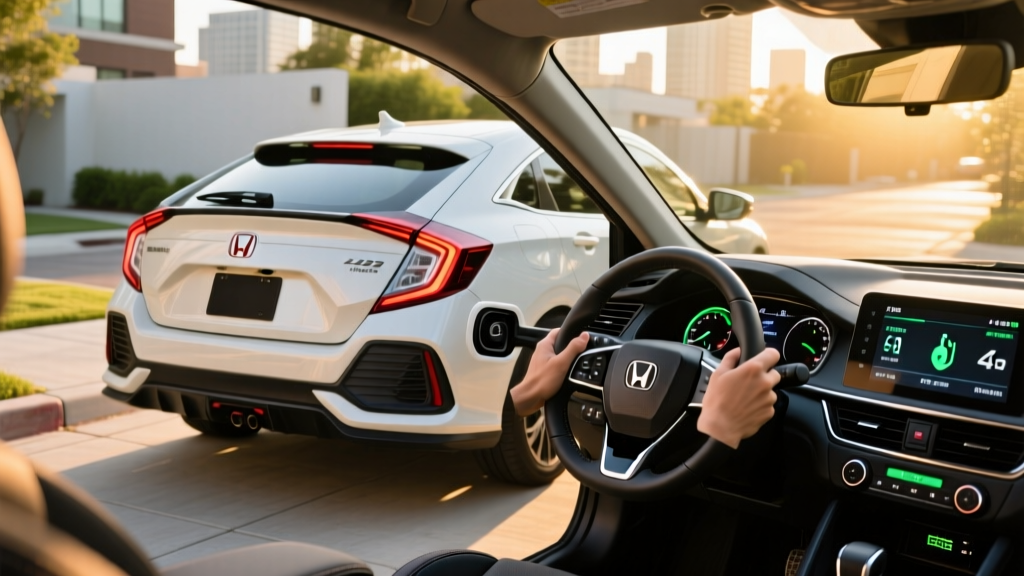
The 2025 Honda Civic Hatchback Hybrid pairs one of the best compact hatchback bodies in the segment with Honda's fourth-generation two-motor hybrid system. The result is a practical five-door that returns an EPA-estimated 50 MPG combined while delivering 200 horsepower — enough to make it genuinely quick off the line. This review breaks down the exact numbers, real-world fuel economy expectations, ownership costs, and whether this HEV is the right bridge before you go fully electric.
Quick Verdict: Who the Civic Hatchback Hybrid Is For
The 2025 Civic Hatchback Hybrid is a conventional hybrid electric vehicle (HEV). It does not plug in. It recovers energy through regenerative braking and its gasoline engine to charge a small lithium-ion battery, which assists a front-drive electric motor. If you want electric-only driving with a plug, you need a PHEV or a full BEV — Honda offers neither in the Civic lineup. What the Civic Hatchback Hybrid does offer is EV-like low-speed torque, excellent city MPG, and zero charging infrastructure requirements.
HEV (this car): Self-charging hybrid. No plug. Small battery (~1 kWh). Gas engine + electric motor work together. Excellent city MPG. You fuel it like any gas car.
PHEV: Plug-in hybrid. Larger battery (10–20 kWh). Offers 20–50 miles of electric-only range before the gas engine kicks in. Requires home or public charging to maximize value.
Fuel Economy: EPA Numbers and Real-World MPG
Fuel economy is the headline stat for any hybrid buyer. The 2025 Civic Hatchback Hybrid carries identical EPA ratings across all three trims (Sport, Sport Touring, and the newly added Sport Hybrid — though Honda consolidated the hybrid powertrain across Sport and Sport Touring for 2025).
| Metric | EPA Estimate | Real-World Expectation |
|---|---|---|
| City MPG | 53 MPG | 50–56 MPG |
| Highway MPG | 46 MPG | 40–44 MPG |
| Combined MPG | 50 MPG | 44–52 MPG |
| Fuel Tank Capacity | 12.4 gal | — |
| Total Range (est.) | ~620 miles | ~540–640 miles |
Source: EPA fueleconomy.gov
Like most Honda hybrids using the e:HEV two-motor system, the Civic Hatchback Hybrid tends to exceed its EPA city rating in stop-and-go traffic, where the electric motor does the bulk of propulsion and regenerative braking recaptures energy constantly. Highway driving is the opposite: sustained speeds above 70 mph rely more heavily on the 2.0-liter gasoline engine running at higher RPM, which drops efficiency. In real-world testing by multiple outlets, mixed driving yields 46–52 MPG, with cold weather (below freezing) knocking 3–5 MPG off due to the engine running more frequently to provide cabin heat.
EPA combined: 50 MPG, ~620 miles total range. Expect 44–48 MPG on sustained highway trips at 75+ mph and 52–56 MPG in urban commuting. Cold weather (below 32°F) reduces efficiency by roughly 5–8% due to increased engine operation for cabin heating.
Powertrain Specs: 200 HP Two-Motor Hybrid System
Honda's fourth-generation hybrid system in the 2025 Civic Hatchback uses an Atkinson-cycle 2.0-liter four-cylinder engine paired with two electric motors — one for propulsion, one acting as a generator/starter. Unlike Toyota's planetary-gear power-split system, Honda's setup operates primarily in series-hybrid mode at low and moderate speeds (engine generates electricity, motor drives wheels) and switches to direct engine-drive via a lock-up clutch at highway cruising speeds.
| Specification | Value |
|---|---|
| Combined System Horsepower | 200 hp |
| Combined System Torque | 232 lb-ft |
| Gasoline Engine | 2.0L Atkinson-cycle I-4 (146 hp / 134 lb-ft) |
| Propulsion Motor Output | 184 hp / 232 lb-ft |
| Hybrid Battery | ~1.0 kWh lithium-ion |
| Transmission | e-CVT (single-speed direct drive + lock-up clutch) |
| Drivetrain | Front-wheel drive |
| 0–60 mph (est.) | ~7.2 seconds |
The 232 lb-ft of torque from the electric motor is available from near-zero RPM, which gives the Civic Hatchback Hybrid strong initial acceleration that feels quicker than its 0–60 time suggests. The engine only audibly engages under hard acceleration or high-speed cruising; in gentle city driving, the car operates in EV mode frequently and quietly.
Pricing, Trims, and Tax Credit Eligibility
The 2025 Civic Hatchback Hybrid is available in two trims, both equipped with the same hybrid powertrain:
| Trim | MSRP (incl. destination) | Key Features |
|---|---|---|
| Sport Hybrid | $31,495 | 18" wheels, 7" touchscreen, wireless CarPlay/Android Auto, Honda Sensing suite |
| Sport Touring Hybrid | $34,895 | 9" touchscreen, Bose 12-speaker audio, wireless charging, leather seats, heated rear seats |
Source: Honda.com
Does the Civic Hatchback Hybrid Qualify for a Federal Tax Credit?
No. Under the current IRS §30D Clean Vehicle Credit rules, only plug-in electric vehicles (BEVs and PHEVs with at least 7 kWh of battery capacity) qualify for the federal tax credit of up to $7,500. The Civic Hatchback Hybrid is a conventional HEV with a ~1 kWh battery and no plug-in capability. It does not meet the minimum battery capacity requirement and is therefore ineligible for the federal EV credit.
- ❌ Vehicle must have ≥7 kWh battery — Civic Hybrid has ~1 kWh
- ❌ Vehicle must be plug-in capable — Civic Hybrid has no charge port
- ✅ MSRP under $55,000 (sedans/hatchbacks) — Civic qualifies on price
- ✅ Buyer income under $150K single / $300K joint — most buyers qualify
Some states offer their own hybrid incentives. Check your state energy office or IRS.gov for current rules.
Reliability, Battery Warranty, and Replacement Costs
Hybrid battery longevity is the most common concern among first-time hybrid buyers. Here's the reality: Honda's lithium-ion hybrid batteries are engineered to last the life of the vehicle, and the warranty reflects that confidence.
- Hybrid Battery: 8 years / 100,000 miles (10 years / 150,000 miles in CARB states including CA, NY, MA, and others)
- Powertrain Warranty: 5 years / 60,000 miles
- New Vehicle Limited: 3 years / 36,000 miles
The hybrid battery warranty covers capacity loss below a threshold (typically 60–70% of original capacity) and any defects. In practice, Honda's IMA and subsequent two-motor hybrid systems have shown excellent longevity. Third-generation Civic Hybrids (2006–2011) used older NiMH batteries that occasionally needed replacement around 120,000–150,000 miles. The current lithium-ion system is far more robust, with most owners reporting no measurable degradation through 100,000+ miles.
If out-of-warranty replacement is ever needed, a Honda hybrid battery pack typically costs between $2,000 and $4,000 installed — a fraction of the $10,000–$20,000+ cost of a full BEV battery replacement. Independent hybrid specialists often offer refurbished packs for $1,500–$2,500.
Hybrid vs. PHEV vs. Full EV: Which Should You Choose?
The Civic Hatchback Hybrid is one option among several electrification paths. Here's a decision framework based on your actual driving situation:
| Factor | HEV (Civic Hybrid) | PHEV (e.g., Toyota Prius Prime) | BEV (e.g., Chevy Bolt EV) |
|---|---|---|---|
| Plug-In Required? | No | Yes (for max value) | Yes |
| Electric-Only Range | ~1 mi at low speed | 25–44 mi | 200–350+ mi |
| Home Charging Needed? | No | Recommended | Essential |
| Federal Tax Credit | None | Up to $7,500* | Up to $7,500* |
| Fuel Cost (per mile) | ~$0.07 | ~$0.04–0.07 | ~$0.03–0.05 |
| Best For | No home charging, apartment dwellers, road-trippers | Home charging + short commute + long trips | Home charging + daily commute under 200 mi |
* PHEV/BEV tax credit eligibility depends on battery sourcing, MSRP caps, and buyer income per current IRS §30D rules.
Choose the Civic Hatchback Hybrid if: You live in an apartment or lack home charging access, you regularly take road trips over 300 miles, or you want maximum simplicity with no behavior change from a gas car.
Choose a PHEV if: You have home Level 2 charging, your daily commute is under 40 miles (covering most trips on electricity), but you still want gas-engine range for weekend trips.
Choose a full BEV if: You have reliable home charging, your daily driving stays under 200 miles, and you want to eliminate gasoline costs and maintenance entirely.
Cargo, Interior, and Daily Practicality
The hatchback body style is a major reason buyers choose this car over the Civic sedan. With the rear seats up, the Civic Hatchback Hybrid offers 25.0 cubic feet of cargo space behind the rear seats — nearly double the sedan's 14.8 cu ft trunk. Folding the 60/40 split rear seats opens up approximately 47.0 cubic feet of total volume.
The hybrid battery is packaged under the rear seats, so there's no cargo floor compromise compared to the gas Civic Hatchback. The Sport Touring Hybrid trim adds a 9-inch touchscreen with wireless Apple CarPlay and Android Auto, a 12-speaker Bose audio system, leather-trimmed heated front and rear seats, and a wireless phone charger. Both trims come standard with the full Honda Sensing ADAS suite: adaptive cruise control, lane-keeping assist, forward collision warning with automatic emergency braking, and traffic sign recognition.
One practical note: the Civic Hatchback Hybrid does not offer all-wheel drive. If you need AWD in a compact hybrid hatchback, the Toyota Prius (available with AWD) or the Subaru Crosstrek Hybrid (PHEV, limited availability) are alternatives, though neither matches the Civic's driving dynamics.
Pros and Cons
- 53 MPG city / 50 combined — among the best in its class
- 200 hp / 232 lb-ft makes it genuinely quick
- Hatchback practicality with no cargo compromise
- No plug-in needed — zero charging infrastructure dependency
- 8-year/100,000-mile hybrid battery warranty
- Strong resale value and Honda reliability reputation
- No federal tax credit (HEV ineligible under §30D)
- No all-wheel-drive option
- Highway MPG drops to ~40–44 in real-world 75+ mph driving
- No plug-in or electric-only driving capability
- Sport Touring at $34,895 approaches entry-level BEV territory
- Engine drone under hard acceleration (e-CVT characteristic)
Frequently Asked Questions
How many MPG does the 2025 Honda Civic Hatchback Hybrid get?
The EPA rates it at 53 city / 46 highway / 50 combined MPG. In real-world driving, expect 50–56 MPG in city traffic (hybrids often beat EPA city estimates) and 40–44 MPG on sustained highway trips at 75+ mph. Cold weather reduces efficiency by roughly 5–8%.
Is the Civic Hatchback Hybrid a plug-in hybrid?
No. It is a conventional hybrid (HEV). It has no charge port and does not plug in. The small ~1 kWh battery charges through regenerative braking and the gasoline engine. You simply fill it with gas like any conventional car.
Does the Civic Hybrid qualify for any tax credit?
Not the federal §30D Clean Vehicle Credit, which requires plug-in capability and a minimum 7 kWh battery. Some states or utilities may offer small hybrid incentives — check your local programs. The federal credit is only available for qualifying BEVs and PHEVs.
How long will the hybrid battery last and what does replacement cost?
Honda warranties the hybrid battery for 8 years/100,000 miles (10 years/150,000 miles in CARB states). Real-world data from Honda's hybrid fleet suggests these lithium-ion packs regularly exceed 150,000 miles without significant degradation. Out-of-warranty replacement runs $2,000–$4,000 installed, or $1,500–$2,500 for a refurbished pack from an independent hybrid shop.
How does the Civic Hatchback Hybrid compare to the Toyota Prius?
The Prius (57 MPG combined, FWD) edges out the Civic on fuel economy and offers available AWD, but the Civic delivers 200 hp vs. the Prius's 196 hp with a more engaging driving experience and a more premium interior in the Sport Touring trim. The Prius also offers a PHEV variant (Prius Prime) with 44 miles of electric-only range if you have home charging.
Is the 2025 Civic Hatchback Hybrid worth it over the gas version?
If you drive more than 12,000 miles per year, the hybrid's ~12 MPG advantage over the gas Civic Hatchback (33 MPG combined) saves roughly $400–$600 annually in fuel at $3.50/gallon. The hybrid's $3,000–$4,000 price premium pays back in 5–8 years at typical mileage, and you gain significantly stronger low-end torque. For high-mileage drivers, the hybrid is the clear choice.