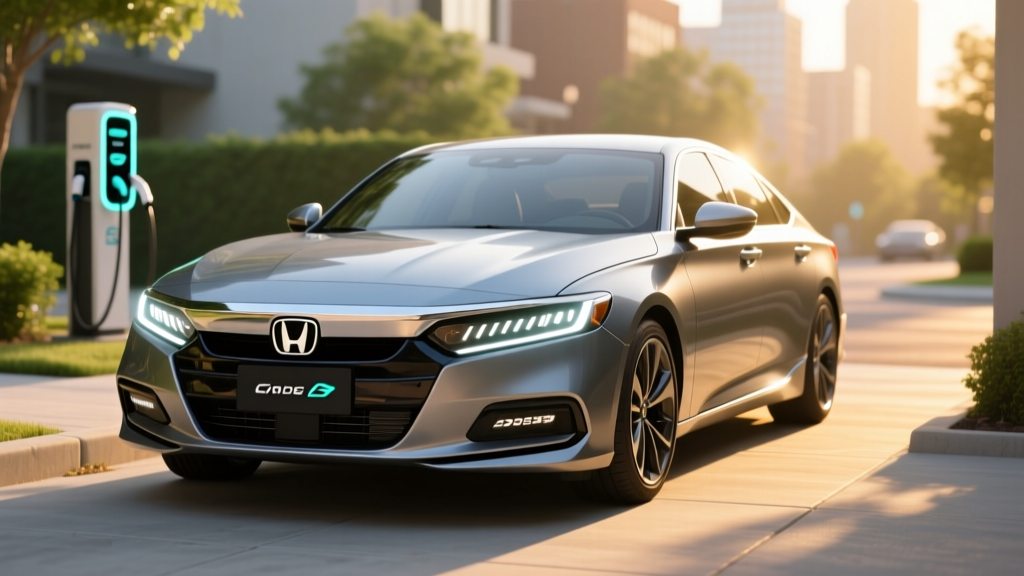
The midsize sedan segment has thinned out, but the Honda Accord remains a volume leader — and the hybrid variant now accounts for a significant share of Accord sales. For 2025, the Accord Hybrid is the default choice for buyers who want the car's spacious cabin and refined ride without the fuel cost penalty of a purely gasoline powertrain. This guide breaks down exactly how the 2025 Honda Accord Hybrid powertrain works, what kind of fuel economy you can expect in real driving, and where it fits against plug-in hybrids and full EVs.
2025 Honda Accord Hybrid Powertrain: How It Works
The 2025 Accord Hybrid uses Honda's fourth-generation two-motor hybrid system. Unlike a traditional parallel hybrid that mechanically couples the engine to the wheels at all times, this system operates primarily as a series hybrid at low and moderate speeds. The 2.0-liter Atkinson-cycle four-cylinder engine acts mostly as a generator, producing electricity that feeds a 181-horsepower drive motor connected to the front axle. A second, smaller motor functions as a generator/starter.
At highway speeds (roughly above 45 mph under steady load), a lock-up clutch engages to connect the engine directly to the wheels for improved efficiency — this is where Honda's system diverges from a pure series hybrid like the old BMW i3 REx. Combined system output is 204 horsepower and 247 lb-ft of torque, with the electric motor providing instant low-end thrust that makes the Accord Hybrid feel noticeably quicker off the line than its turbocharged gas-only sibling.
| Specification | 2025 Honda Accord Hybrid |
|---|---|
| Powertrain Type | Conventional Hybrid (HEV) — no plug |
| Engine | 2.0L Atkinson-cycle 4-cylinder |
| Drive Motor Output | 181 hp / 247 lb-ft |
| Combined System Output | 204 hp |
| Transmission | e-CVT (no traditional gears) |
| Drivetrain | Front-wheel drive |
| Hybrid Battery | Lithium-ion, ~1.0 kWh (not plug-in) |
| 0-60 mph | ~7.3 seconds (est.) |
| EPA Fuel Economy (Sport/L) | 46 city / 41 hwy / 44 combined |
| EPA Fuel Economy (EX-L/Sport-L) | 51 city / 44 hwy / 48 combined |
| Fuel Tank | 12.8 gallons |
| Total Range (est.) | ~560-615 miles |
An important clarification: the 2025 Accord Hybrid is a conventional hybrid (HEV), not a plug-in hybrid (PHEV). There is no Accord PHEV sold in the United States for the 2025 model year. You never plug this car in. The small lithium-ion battery pack recharges through regenerative braking and the gasoline engine. If you're looking for electric-only driving range, you'll need to look at a PHEV or a full BEV — more on that comparison below.
Fuel Economy: EPA Ratings and Real-World MPG
Honda offers the Accord Hybrid across four trims for 2025: Sport, EX-L, Sport-L, and Touring. The EPA ratings split into two tiers based on wheel size and equipment weight:
| Trim | City MPG | Highway MPG | Combined MPG |
|---|---|---|---|
| Sport | 46 | 41 | 44 |
| Sport-L | 46 | 41 | 44 |
| EX-L | 51 | 44 | 48 |
| Touring | 46 | 41 | 44 |
Source: EPA Fuel Economy
The EX-L's higher rating comes from lighter 17-inch wheels and the absence of sport-tuned suspension hardware. If maximum efficiency is your priority, the EX-L at 48 MPG combined is the trim to choose.
Real-World MPG vs. EPA Sticker
One of the defining traits of conventional hybrids is that they frequently beat their EPA city rating in actual driving. The Accord Hybrid's two-motor system excels in stop-and-go traffic where regenerative braking recovers energy and the engine rarely runs. Owners on FuelEconomy.gov's My MPG tracker report averages in the 42-50 MPG range for mixed driving, with city-heavy commuters sometimes seeing figures above 50 MPG.
Highway driving tells a different story. At sustained 75-80 mph speeds, the engine must work harder and the electric motor's advantage diminishes. Expect highway-only trips to yield 38-42 MPG — slightly below the EPA highway rating. Cold weather (below 30°F) can knock 3-5 MPG off combined figures due to increased engine runtime for cabin heat and reduced battery efficiency.
HEV vs PHEV vs EV: Which Powertrain Fits You?
Buyers cross-shopping the Accord Hybrid often wonder whether they should consider a plug-in hybrid or a full battery-electric vehicle instead. Here's a practical decision framework:
| Factor | HEV (Accord Hybrid) | PHEV (e.g., Toyota Prius Prime) | BEV (e.g., Tesla Model 3) |
|---|---|---|---|
| Plug-in Required? | No | Yes (for EV range) | Yes (always) |
| Electric-Only Range | 0 miles | 25-44 miles typical | 250-350+ miles |
| Fuel Cost (per mile) | ~$0.08-0.10 | ~$0.04 electric / $0.08 gas | ~$0.03-0.05 |
| Home Charging Needed | No | Recommended (Level 2) | Essential (Level 2) |
| Federal Tax Credit | None (§30D is BEV/PHEV only) | Up to $7,500 (if eligible) | Up to $7,500 (if eligible) |
| Upfront Cost Premium | Low (~$1,000-1,500 over gas) | Medium ($3,000-6,000) | High ($5,000-15,000+) |
| Best For | No home charging, long highway commutes | Short daily commute + home charging | Home charging + mostly under 250 mi/day |
The Accord Hybrid is the right call if you lack access to home or workplace charging, frequently drive long distances where EV charging infrastructure is sparse, or simply want to minimize complexity. It requires zero behavioral change from a gas car — you fill up at a gas station, just less often.
If you have a garage with a 240V outlet and your daily commute is under 35 miles, a PHEV like the Toyota Prius Prime or Hyundai Tucson PHEV lets you do most driving on electricity while keeping a gas engine for longer trips. However, Honda does not currently offer an Accord PHEV in the U.S. market.
Pricing, Trims, and Tax Credit Eligibility
The 2025 Honda Accord Hybrid lineup starts at $33,655 MSRP for the Sport trim (including destination) and tops out around $39,655 for the Touring. Here's the trim breakdown:
- Sport: $33,655 — 19-inch wheels, heated front seats, Honda Sensing suite
- EX-L: $35,290 — 17-inch wheels (best MPG), leather seats, power passenger seat
- Sport-L: $35,700 — Sport appearance with leather interior
- Touring: $39,655 — Adaptive dampers, Bose audio, wireless CarPlay/Android Auto, heated rear seats
Does the Accord Hybrid Qualify for a Federal Tax Credit?
No. The IRS §30D Clean Vehicle Credit applies exclusively to plug-in electric vehicles — battery-electric vehicles (BEVs) and plug-in hybrids (PHEVs) with a minimum battery capacity of 7 kWh. The Accord Hybrid's battery pack is approximately 1.0 kWh and cannot be charged from an external source, making it ineligible for any federal EV tax credit.
Some states offer their own incentives for conventional hybrids, but these are increasingly rare as incentive programs shift toward plug-in vehicles. Check your state's energy office or department of environmental quality for current programs. A few states (Oregon, Colorado) have had hybrid-specific rebates in the past, but availability varies year to year.
Battery Warranty, Lifespan, and Replacement Cost
Hybrid battery longevity remains one of the most common concerns for buyers transitioning from a conventional gas car. Honda addresses this with a substantial warranty:
| Coverage | Terms |
|---|---|
| Hybrid Battery Warranty | 8 years / 100,000 miles (10 years / 150,000 miles in CARB states) |
| Powertrain Warranty | 5 years / 60,000 miles |
| Bumper-to-Bumper | 3 years / 36,000 miles |
| Hybrid System Components | 8 years / 100,000 miles (inverter, control unit, etc.) |
CARB states include California, Colorado, Connecticut, Maine, Maryland, Massachusetts, New Jersey, New York, Oregon, Rhode Island, Vermont, Virginia, and Washington — covering a large portion of U.S. car buyers.
Real-World Hybrid Battery Lifespan
Honda's lithium-ion hybrid batteries in the Accord are designed to last the life of the vehicle under normal use. Real-world data from earlier-generation Accord Hybrids (2014-2022) shows that battery degradation is typically minimal — most owners report no meaningful loss in fuel economy even past 150,000 miles. The small battery pack (~1.0 kWh) experiences shallow charge/discharge cycles, which is far less stressful than the deep cycles a full EV battery undergoes.
If a replacement is ever needed out of warranty, expect a cost in the range of $2,000 to $4,000 for the hybrid battery pack, plus labor. This is substantially less than an EV traction battery replacement, which can exceed $10,000-$15,000. Third-party refurbished hybrid batteries are also available for $1,000-$2,000 as a budget option for high-mileage vehicles.
Driving Impressions and Performance
The Accord Hybrid's 204 combined horsepower and 247 lb-ft of electric motor torque give it a character distinct from what the spec sheet suggests. The electric drive motor delivers its peak torque from 0 RPM, making the car feel responsive in city driving and confident during highway merging. The 0-60 mph time of approximately 7.3 seconds is respectable for the class — quicker than the base 1.5L turbo gas Accord.
The e-CVT operates without the rubber-band feeling that plagued earlier CVT designs. Because the system primarily uses the engine as a generator, there's no traditional transmission hunting for gears. Under hard acceleration, the engine RPM rises to match power demand, but the transition is smoother than most competitors. Honda has also refined the regenerative braking feel — the paddle shifters behind the steering wheel let you select from four levels of regen deceleration, approaching one-pedal driving at the highest setting without fully stopping the car.
Ride quality varies by trim. The Touring's adaptive dampers provide a noticeable improvement over the Sport's firmer tuning, absorbing sharp pavement imperfections while maintaining composure through corners. All trims share the same low center of gravity afforded by the hybrid battery placement under the rear seats, preserving the Accord's traditionally balanced handling.
Reliability and Long-Term Ownership
Honda's hybrid powertrain has a strong reliability track record. The two-motor system has fewer moving parts than a traditional automatic transmission — no torque converter, no planetary gear sets, no clutch packs to wear out. The e-CVT is mechanically simpler than a conventional automatic or dual-clutch transmission.
The IIHS has historically rated the Accord as a Top Safety Pick, and the hybrid variant shares the same structure and safety systems. The Honda Sensing suite (adaptive cruise, lane-keeping, collision mitigation) is standard across all trims.
Maintenance costs for the Accord Hybrid are comparable to the gas model. The Atkinson-cycle engine still requires regular oil changes, and the hybrid system adds no scheduled maintenance items beyond the standard service intervals. Brake pad life is often extended significantly — regenerative braking handles most deceleration, so the friction brakes see far less use than in a gas car. Many hybrid owners report 60,000-80,000 miles on original brake pads.
Who Should Buy the 2025 Accord Hybrid?
Pros
- 48 MPG combined (EX-L) — among the best in the midsize sedan class
- No plug-in required; zero lifestyle change from a gas car
- 204 hp with strong low-end electric torque
- Spacious cabin, 16.7 cu-ft trunk (same as gas model)
- Strong hybrid battery warranty (8-10 years)
- Lower starting price than comparable PHEVs or EVs
Cons
- No electric-only driving capability
- No federal tax credit eligibility
- Highway MPG drops below EPA estimate at sustained 75+ mph
- Not available with all-wheel drive (competitors like Camry AWD Hybrid exist)
- Cabin noise under hard acceleration (engine drone)
The 2025 Accord Hybrid is the strongest pick for a buyer who wants a reliable, efficient midsize sedan with no charging hassle. It's ideal for apartment dwellers without garage access, high-mileage commuters covering 40+ miles daily, and buyers in regions with limited public charging infrastructure. If you need electric-only operation for HOV lane access or to minimize tailpipe emissions on short trips, you'll need to look at a PHEV or BEV instead.
Frequently Asked Questions
How many MPG does the 2025 Honda Accord Hybrid get?
The EPA rates the Accord Hybrid EX-L at 51 city / 44 highway / 48 combined MPG. Sport, Sport-L, and Touring trims are rated at 46 city / 41 highway / 44 combined due to larger wheels and additional equipment. Real-world mixed driving typically yields 42-50 MPG depending on driving style and climate.
Can the 2025 Accord Hybrid drive on electric power alone?
Only for very brief, low-speed moments (under 1 mile at parking-lot speeds). This is a conventional hybrid (HEV), not a plug-in hybrid. The battery is too small (~1.0 kWh) to provide meaningful electric-only range. If you need 25-40 miles of EV driving, consider a PHEV like the Toyota Prius Prime.
Does the 2025 Accord Hybrid qualify for any tax credit?
No. The federal §30D Clean Vehicle Credit requires a plug-in vehicle with at least 7 kWh of battery capacity. The Accord Hybrid has approximately 1.0 kWh and no plug. It is not eligible for the federal credit or most state EV incentives. Some states may offer small hybrid rebates — check your state energy office.
Is the Accord Hybrid battery expensive to replace?
Out-of-warranty replacement typically costs $2,000-$4,000 including labor. However, Honda's hybrid batteries are designed to last the vehicle's lifetime, and real-world data shows minimal degradation even past 150,000 miles. The battery is covered for 8 years/100,000 miles (10 years/150,000 miles in CARB states).
Is the Accord Hybrid available with all-wheel drive?
No. The 2025 Accord Hybrid is front-wheel drive only. If AWD is a priority in a hybrid sedan, the Toyota Camry Hybrid offers an available electronic AWD system (though with lower combined horsepower).
How does the Accord Hybrid compare to the Toyota Camry Hybrid?
The Camry Hybrid (225 hp combined, up to 52 MPG combined on the LE trim) offers slightly better highway fuel economy and available AWD. The Accord Hybrid counters with a more spacious rear seat, a larger trunk, and a more premium interior on upper trims. Both are strong choices — the Camry wins on pure efficiency and AWD availability, while the Accord leads in refinement and interior space.