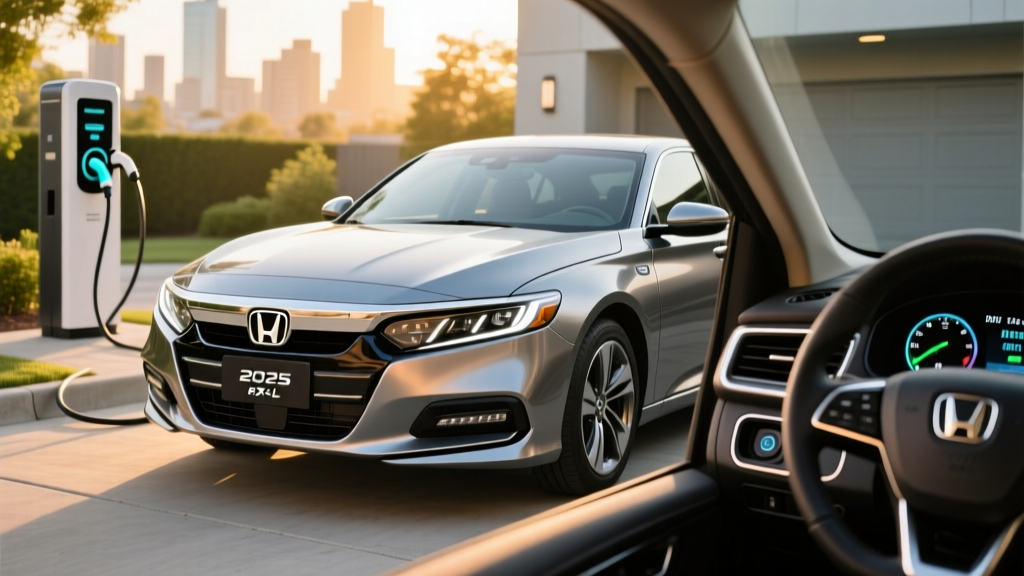
The 2025 Honda Accord Hybrid EX-L occupies a specific niche: a midsize sedan that slashes fuel consumption without demanding any change to your daily routine. No plugs, no charging apps, no range math. You fill it with gasoline and drive. For the 320 or so shoppers each month specifically searching for the 2025 Honda Accord Hybrid EX-L, the question isn't whether it's efficient — it's whether this particular trim, at this price, is the smartest version of an already smart car.
After examining EPA data, Honda's powertrain specifications, and real-world driving patterns, the EX-L emerges as the value sweet spot in the Accord Hybrid lineup. It adds leather, a power passenger seat, heated rear seats, and wireless CarPlay/Android Auto over the Sport Hybrid, while staying thousands below the Touring. Here's the complete ownership picture.
HEV vs PHEV: What the Accord Hybrid Actually Is
Before getting into the numbers, it's essential to clarify what the Accord Hybrid is — and what it isn't. The Accord Hybrid is a conventional hybrid electric vehicle (HEV), not a plug-in hybrid (PHEV). It cannot be plugged in, has no electric-only driving mode of meaningful distance, and carries a small battery recharged entirely through regenerative braking and the gasoline engine.
HEV vs PHEV — Quick Distinction
| Feature | HEV (Accord Hybrid) | PHEV (e.g., Toyota Prius Prime) |
|---|---|---|
| Plugs in? | No | Yes |
| Electric-only range | ~1 mile at low speed | 25–44 miles typical |
| Battery size | ~1.1 kWh (gross) | 13–18 kWh typical |
| Federal tax credit | Not eligible (§30D) | Up to $7,500 if eligible |
| Home charging needed | No | Recommended (Level 2) |
If you're comparing the Accord Hybrid to a plug-in alternative, the trade-off is straightforward: a PHEV gives you 25–40 miles of electric-only commuting if you can charge at home, but costs more upfront and adds complexity. The HEV approach sacrifices that electric-only commute but eliminates charging logistics entirely and keeps the purchase price lower.
EPA Fuel Economy and Real-World MPG
The 2025 Accord Hybrid EX-L carries an EPA-estimated 51 mpg city / 44 mpg highway / 48 mpg combined. These figures apply to the EX-L and Sport-L trims, which use 17-inch wheels. The Sport Hybrid trim, on 19-inch wheels, drops slightly to 46/41/44 mpg (city/highway/combined) per fueleconomy.gov.
| Trim | City | Highway | Combined | Wheel Size |
|---|---|---|---|---|
| Sport Hybrid | 46 mpg | 41 mpg | 44 mpg | 19" |
| EX-L Hybrid | 51 mpg | 44 mpg | 48 mpg | 17" |
| Sport-L Hybrid | 51 mpg | 44 mpg | 48 mpg | 17" |
Real-World MPG: What to Actually Expect
Honda's two-motor hybrid system excels in stop-and-go driving, where the electric motors handle low-speed propulsion and the 2.0L Atkinson-cycle engine only engages for higher loads or battery replenishment. In real-world mixed driving, owners commonly report matching or slightly exceeding the 48 mpg combined EPA figure in suburban and urban conditions.
Highway driving tells a different story. At sustained 75–80 mph speeds, expect the Accord Hybrid to return roughly 40–43 mpg — below its EPA highway number. This is typical for all hybrids, which rely more heavily on the gasoline engine at steady high speeds where regenerative braking opportunities disappear. In cold weather (below 35°F), plan for a 5–10% reduction across the board due to increased engine runtime for cabin heat and reduced battery efficiency.
For context, a conventional 2025 Accord with the 1.5L turbo and CVT rates at 29/37/32 mpg combined. The hybrid's 48 mpg combined represents a 50% improvement in fuel consumption — roughly 240 fewer gallons per year at 12,000 miles, or about $840 in annual fuel savings at $3.50/gallon.
Powertrain Specs: Two-Motor Hybrid System
| 2025 Honda Accord Hybrid EX-L — Key Specifications | |
|---|---|
| Powertrain | 2.0L DOHC Atkinson-cycle 4-cyl + two-motor hybrid system |
| Combined System Horsepower | 204 hp |
| Combined System Torque | 247 lb-ft (electric motor) |
| Engine Horsepower | 146 hp @ 6,100 rpm |
| Drive Motor Output | 181 hp / 247 lb-ft |
| Transmission | e-CVT (no traditional gears) |
| Drivetrain | Front-wheel drive |
| 0–60 mph (est.) | ~7.5 seconds |
| Hybrid Battery | Lithium-ion, ~1.1 kWh gross |
| Fuel Tank | 12.8 gallons |
| Total Driving Range (est.) | ~614 miles (at 48 mpg combined) |
| Curb Weight | ~3,488 lbs |
| MSRP (EX-L Hybrid) | $34,990 (incl. $1,095 destination) |
Honda's fourth-generation two-motor hybrid system is one of the most refined in the segment. The primary drive motor powers the front wheels most of the time, while the 2.0L engine acts primarily as a generator. Only at higher highway speeds does a lockup clutch mechanically connect the engine to the wheels for efficiency. The result is seamless acceleration with 247 lb-ft of torque available from near-zero rpm — it pulls harder off the line than the turbocharged gas Accord.
EX-L Trim: What You Get for $34,990
The EX-L Hybrid sits as the second-highest trim in the Accord Hybrid lineup. At $34,990 (including destination), it positions itself $2,350 above the Sport Hybrid ($32,640) and $2,350 below the Sport-L Hybrid ($37,340). Here's what distinguishes the EX-L:
- Leather-trimmed seats (vs. cloth/leatherette on Sport)
- Heated front seats and heated rear outboard seats
- Power-adjustable front passenger seat (4-way)
- Wireless Apple CarPlay and Android Auto
- Wireless phone charger
- 10.2-inch digital instrument cluster
- 12.3-inch touchscreen with 8 speakers
- 17-inch alloy wheels (key to its higher MPG rating)
- Honda Sensing suite: adaptive cruise, lane-keeping, collision mitigation, traffic sign recognition
- Low Speed Braking Control and traffic jam assist
The EX-L trades the Sport's blacked-out exterior accents and 19-inch wheels for a more conservative look and a meaningful 4-mpg combined improvement. If fuel economy is your priority over appearance, the EX-L is the objectively better choice.
Battery Warranty, Reliability, and Replacement Cost
Honda Hybrid Battery Warranty
Coverage: 8 years / 100,000 miles (10 years / 150,000 miles in CARB states including CA, NY, MA, NJ, CT, RI, VT, ME, MD, OR, WA, CO, and others adopting California emissions standards).
What's covered: Hybrid battery pack, hybrid control module, and related hybrid system components against defects and abnormal capacity loss.
Threshold: Honda does not publish a specific capacity-retention percentage trigger, but warranty claims are honored for significant degradation affecting vehicle operation.
Honda's hybrid system has proven among the most durable in the industry. The Accord Hybrid's lithium-ion battery pack is small (~1.1 kWh) and operates within a conservative state-of-charge window — it never fully charges or fully depletes — which dramatically reduces degradation stress. Real-world reports of hybrid battery failures before 150,000 miles are uncommon.
If replacement becomes necessary out of warranty, a new OEM hybrid battery for the Accord Hybrid typically runs $2,000–$3,500 including labor at a dealership. Third-party refurbished units are available for $1,000–$2,000. This is far less than a full EV traction battery replacement, which can exceed $10,000–$15,000.
For reliability data, the 2025 Accord carries predicted reliability ratings from IIHS, where it earns Top Safety Pick+ status when equipped with specific headlights. Honda's hybrid powertrain has been in continuous production since the early 2000s, and the current two-motor architecture has been in service since 2014 across multiple models.
Tax Credit Eligibility: What Hybrid Buyers Need to Know
The 2025 Honda Accord Hybrid does not qualify for the federal §30D Clean Vehicle Credit. That credit — up to $7,500 for new vehicles — is restricted to battery electric vehicles (BEVs) and plug-in hybrid electric vehicles (PHEVs) meeting specific battery-sourcing, critical-mineral, MSRP, and buyer-income requirements as outlined by the IRS.
Conventional hybrids like the Accord Hybrid have not qualified for any federal purchase incentive since the original Hybrid Tax Credit expired for Honda in 2008. No current federal incentive applies.
Some states and local utilities offer rebates for hybrid vehicles, though these are increasingly rare and typically focused on PHEVs and BEVs. Check your state energy office or utility provider for any current programs. The Accord Hybrid's value proposition rests on fuel savings, not purchase incentives.
Accord Hybrid vs. Full EV vs. Gas: Which Fits You?
Choose the Accord Hybrid EX-L If:
- You lack reliable home or workplace charging access
- You want 48 mpg without any behavior change
- You regularly take long road trips and don't want to plan around chargers
- Your budget is under $36,000 and you want a midsize sedan
- You live in an area with extreme cold where EV range loss is significant
Consider a Full EV Instead If:
- You can install a Level 2 home charger (240V)
- Your daily commute is under 60 miles round-trip
- You want to eliminate gasoline expenses entirely (~$1,400/yr savings vs. hybrid)
- You qualify for the $7,500 federal tax credit on a BEV
- Local electricity rates are low (under $0.15/kWh)
The math is straightforward. At 12,000 miles per year, the Accord Hybrid EX-L at 48 mpg and $3.50/gallon costs roughly $875/year in fuel. A comparable gas-only midsize sedan at 30 mpg combined costs about $1,400/year. A BEV charged at the national average of $0.16/kWh and consuming 30 kWh/100 miles costs approximately $576/year. The hybrid splits the difference — meaningful savings over gas, without the charging infrastructure requirement of a BEV.
For apartment dwellers, street parkers, and frequent road-trippers, the Accord Hybrid's zero-compromise efficiency is difficult to beat. For homeowners with a garage and a predictable commute, a BEV like the Hyundai Ioniq 6 or Tesla Model 3 delivers lower operating costs and a smoother driving experience — provided the purchase price and tax-credit eligibility work out.
Ownership Costs: 5-Year Projection
| Category | Accord Hybrid EX-L | Gas Accord EX-L (1.5T) |
|---|---|---|
| Purchase Price (MSRP) | $34,990 | $33,690 |
| Fuel (60k mi) | $4,375 | $7,000 |
| Maintenance (est.) | $2,200 | $2,800 |
| Insurance (est. avg) | $8,400 | $8,100 |
| Total (approx.) | $49,965 | $51,590 |
The hybrid's $1,300 higher MSRP is recovered through roughly $2,625 in fuel savings over five years. Maintenance costs trend lower because regenerative braking extends brake pad life significantly — many hybrid owners go 60,000+ miles on original brake pads. Insurance premiums may run slightly higher due to the hybrid's replacement-cost profile, but the gap is typically small.
Frequently Asked Questions
How many MPG does the 2025 Honda Accord Hybrid EX-L get?
The EPA rates the 2025 Accord Hybrid EX-L at 51 mpg city, 44 mpg highway, and 48 mpg combined. In real-world mixed driving, expect to match or slightly exceed the combined figure in urban conditions, while sustained highway driving at 75+ mph typically returns 40–43 mpg.
Does the Accord Hybrid need to be plugged in?
No. The Accord Hybrid is a conventional hybrid (HEV). Its small lithium-ion battery recharges through regenerative braking and the gasoline engine. You never plug it in — you simply fill it with gasoline as you would any conventional car.
Is the Accord Hybrid available as a plug-in hybrid (PHEV)?
No. Honda discontinued the Accord Plug-In Hybrid after the 2015 model year. The current 11th-generation Accord is offered only as a conventional hybrid or a turbocharged gasoline model. If you need a PHEV midsize sedan, the closest alternatives are the Toyota Camry (hybrid only for 2025, no PHEV) or a PHEV SUV like the Hyundai Tucson PHEV.
How long will the hybrid battery last?
Honda's hybrid battery is warranted for 8 years/100,000 miles (10 years/150,000 miles in CARB states). In practice, Honda's lithium-ion hybrid batteries commonly last 150,000–200,000+ miles without significant issues, thanks to conservative charge-discharge cycling. Out-of-warranty replacement costs $2,000–$3,500 at a dealer.
Does the 2025 Accord Hybrid qualify for any tax credit?
No federal tax credit applies. The §30D Clean Vehicle Credit is limited to BEVs and PHEVs. The Accord Hybrid, as a conventional HEV, does not qualify. Check your state and local utility for any hybrid-specific rebates, though these are uncommon.
Is the EX-L the best Accord Hybrid trim to buy?
For most buyers, yes. The EX-L delivers the highest EPA rating (48 mpg combined) thanks to its 17-inch wheels, adds premium features like leather and heated rear seats, and undercuts the Sport-L by $2,350. The only reason to choose the Sport Hybrid is if you prefer its styling and accept a 4-mpg penalty.
How does the Accord Hybrid compare to the Toyota Camry Hybrid?
The 2025 Toyota Camry (now hybrid-only) rates at 51/49/50 mpg combined for LE FWD trims — slightly ahead of the Accord on highway. The Accord counters with a more spacious rear seat, larger trunk (16.7 vs 15.1 cu ft), and a more engaging driving experience. Pricing is competitive, with both starting in the low-to-mid $30,000s.
Sources: EPA Fuel Economy, IRS §30D Clean Vehicle Credit, Honda Newsroom. Pricing and specifications reflect 2025 model year as published by American Honda Motor Co. Tax credit rules are subject to change; consult a tax professional for eligibility.