Quick Verdict: The Family Hauler That Sips Fuel
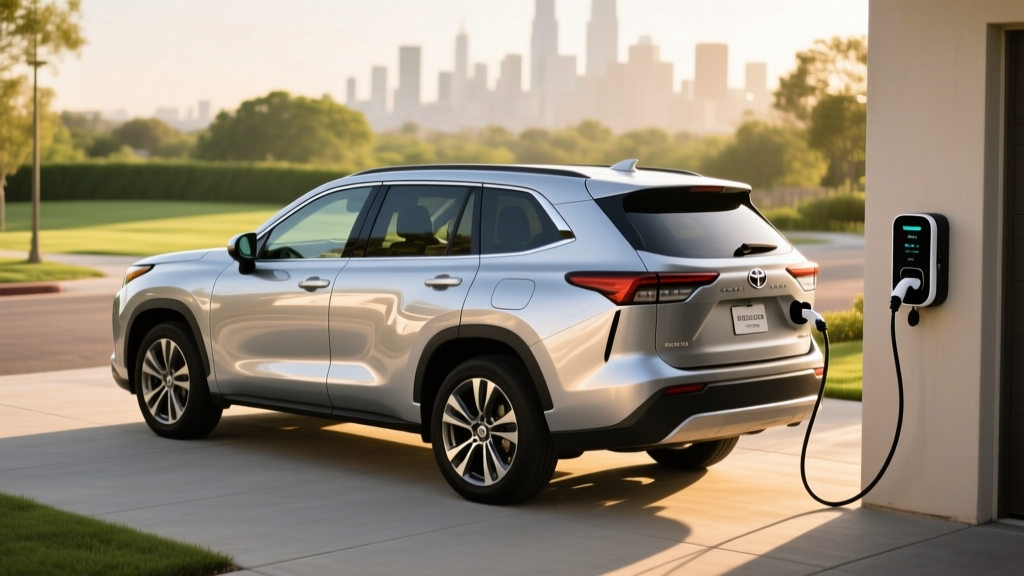
The 2025 Toyota Highlander Hybrid occupies a narrow but valuable lane: a three-row SUV that returns 35 MPG combined without requiring a plug, a charger, or any change in driving habits. With 243 combined horsepower, standard electronic all-wheel drive, and Toyota's proven hybrid synergy drive system, it remains one of the most practical electrified family vehicles on the market. It isn't a plug-in hybrid, it won't drive on electric power alone at highway speeds, and it won't qualify for the federal EV tax credit. But for buyers who want meaningful fuel savings without range anxiety or infrastructure dependence, the Highlander Hybrid makes a compelling, data-backed case.
This review covers the conventional hybrid (HEV) model only. Toyota does not currently offer a plug-in hybrid (PHEV) version of the Highlander in the US market — if you need electric-only commuting range, you'll want to look at the RAV4 Prime or consider a full BEV. We'll address that decision framework below.
HEV vs PHEV: What the Highlander Hybrid Is (and Isn't)
Conventional Hybrid (HEV) — This is the Highlander Hybrid. It pairs a 2.5-liter four-cylinder gasoline engine with two electric motor-generators and a small nickel-metal hydride (NiMH) traction battery. The battery recharges through regenerative braking and engine power. You never plug it in. You simply fuel up at any gas station and drive. The electric motors assist during acceleration and enable brief low-speed electric-only operation (typically under 1 mile at parking-lot speeds).
Plug-in Hybrid (PHEV) — The Highlander is NOT this. A PHEV has a larger battery (typically 14–20+ kWh) that you charge from a wall outlet or charger, giving 25–45 miles of pure electric range before the gas engine engages. Toyota offers this architecture in the RAV4 Prime (42 miles electric-only) but has not applied it to the Highlander. If plug-in capability matters to you, the Highlander Hybrid is not the right vehicle.
Fuel Economy: EPA Ratings and Real-World MPG
The EPA rates the 2025 Highlander Hybrid at 35 MPG combined across all trims with the standard electronic AWD system. Here is the full breakdown:
| Driving Cycle | EPA Rating | Real-World Expectation |
|---|---|---|
| City | 35 MPG | 36–40 MPG (hybrids excel in stop-and-go) |
| Highway | 35 MPG | 30–33 MPG (aerodynamic drag reduces hybrid advantage) |
| Combined | 35 MPG | 33–37 MPG depending on driving mix |
Why city MPG matches highway MPG: Unlike conventional gas vehicles that are far less efficient in the city, hybrids recapture braking energy through regenerative braking and shut off the engine at stops. This effectively equalizes city and highway efficiency — a hallmark of Toyota's hybrid system.
Real-world note: According to fueleconomy.gov, owner-reported fuel economy for recent Highlander Hybrids clusters tightly around the EPA estimate. Drivers with predominantly city routes frequently report 37–40 MPG, while those running sustained 75+ MPH highway trips see figures dip to 29–32 MPG. Cold weather (below 30°F) typically reduces fuel economy by 3–5 MPG due to increased engine runtime for cabin heat and reduced battery efficiency.
For context, the non-hybrid 2025 Highlander (with the turbocharged 2.4-liter four-cylinder) returns 24 MPG combined — making the hybrid roughly 46% more fuel-efficient.
Powertrain Specs: Engine, Motors, and Performance
| Specification | 2025 Highlander Hybrid |
|---|---|
| Engine | 2.5L DOHC 4-cylinder |
| Front Electric Motor | 134 hp / 199 lb-ft |
| Rear Electric Motor (AWD) | 54 hp / 89 lb-ft |
| Net Combined Horsepower | 243 hp |
| Transmission | eCVT (planetary gearset) |
| Drivetrain | Electronic AWD (standard) |
| Traction Battery | NiMH, ~1.6 kWh (sealed, self-charging) |
| 0–60 MPH | ~7.8 seconds |
| Towing Capacity | 3,500 lbs |
| Fuel Tank | 17.9 gallons |
| Total Driving Range | ~626 miles |
The Highlander Hybrid uses Toyota's fourth-generation hybrid system. The eCVT is not a belt-driven continuously variable transmission — it's a planetary gearset that seamlessly blends engine and motor power with no rubber-band effect. Acceleration is adequate for merging and passing, though the 243 hp output is modest for a 4,500-lb vehicle. The electric motors deliver instant torque from a stop, which makes the Highlander Hybrid feel punchier than its 0–60 time suggests in around-town driving.
The electronic AWD system uses the rear electric motor independently — there is no mechanical driveshaft connecting front and rear axles. This means AWD engagement is seamless and imposes no fuel-economy penalty compared to a FWD configuration (which Toyota does not offer on the Highlander Hybrid in the US).
Pricing, Trims, and Tax Credit Eligibility
The 2025 Highlander Hybrid is available in five trims. Pricing below reflects MSRP including destination charge:
- LE: $42,115
- XLE: $45,065
- XLE Nightshade: $46,075
- Limited: $49,515
- Platinum: $52,475
Federal tax credit: The Highlander Hybrid does not qualify for the IRS §30D Clean Vehicle Credit. That credit ($3,750–$7,500) applies only to plug-in electric vehicles (BEVs and PHEVs) with sufficient battery capacity. As a conventional hybrid with a ~1.6 kWh battery, the Highlander Hybrid falls well below the 7 kWh minimum threshold. No federal purchase incentive applies.
State incentives: A handful of states offer modest rebates or HOV-lane access for conventional hybrids, but these programs are increasingly rare as incentives shift toward plug-in vehicles. Check your state energy office or DMV for current programs.
Value proposition: The hybrid powertrain adds approximately $1,600–$2,000 over the equivalent gas-only Highlander trim. At 35 MPG vs 24 MPG combined, and assuming $3.40/gallon fuel and 15,000 miles/year, the hybrid saves roughly $950 per year in fuel costs — paying back the premium in about 2 years.
Battery Warranty, Reliability, and Replacement Cost
Hybrid Battery Warranty: Toyota covers the Highlander Hybrid's traction battery for 10 years or 150,000 miles (whichever comes first) in all 50 states. This has been Toyota's standard hybrid battery warranty since the 2020 model year and applies regardless of state emissions regulations.
Hybrid System Components: The hybrid control module, inverter, and related components carry the same 10-year/150,000-mile coverage.
Reliability data: Toyota's hybrid system is among the most proven in the industry, with over 25 years of continuous production since the 1997 Prius. The NiMH battery chemistry used in the Highlander Hybrid is less energy-dense than lithium-ion but offers exceptional cycle stability and thermal tolerance. Real-world data from Toyota taxi fleets and high-mileage owners shows these batteries routinely lasting 180,000–250,000 miles before significant capacity loss.
Battery replacement cost: If the hybrid battery does fail outside of warranty, a new OEM replacement from Toyota costs approximately $3,000–$4,500 installed. Refurbished or reconditioned battery packs are available from third-party suppliers for $1,500–$2,500. Individual cell replacement (addressing a single failed module) can cost as little as $500–$800 at a hybrid-specialist shop.
For comparison, a conventional transmission replacement on a gas-only SUV can cost $3,500–$5,000. The hybrid system's eCVT has no belts, clutches, or torque converter — components that commonly fail in traditional automatics — making it one of the most reliable drivetrain configurations Toyota produces.
Who Should Choose the Highlander Hybrid?
Choose the Highlander Hybrid if:
- You need three rows and AWD but want fuel costs closer to a midsize sedan
- You lack access to home charging (apartment, street parking) and cannot use a plug-in vehicle
- You tow occasionally (3,500-lb capacity covers small boats and utility trailers)
- You plan to own the vehicle 8+ years and value Toyota's long-term reliability record
- You drive a mix of city and highway miles and want consistent efficiency in both
Look elsewhere if:
- You want electric-only commuting (consider the RAV4 Prime PHEV with 42 miles EV range, or a BEV like the Kia EV9)
- You need maximum cargo space — the Highlander's third row is tight for adults, and the hybrid battery slightly reduces under-floor storage vs. the gas model
- You want the lowest possible purchase price — the gas-only Highlander LE starts ~$3,000 lower (but costs ~$950/year more in fuel)
- You want to qualify for the $7,500 federal tax credit, which requires a plug-in vehicle
Highlander Hybrid vs the Competition
The three-row hybrid SUV segment is competitive. Here is how the Highlander stacks up against key rivals on EPA combined fuel economy and starting price:
| Vehicle | EPA Combined MPG | Combined HP | Starting MSRP |
|---|---|---|---|
| Toyota Highlander Hybrid | 35 | 243 | $42,115 |
| Kia Sorento Hybrid | 34 | 227 | $39,090 |
| Hyundai Santa Fe Hybrid | 34 | 232 | $40,850 |
| Ford Explorer Hybrid | 24 | 318 | $54,625 |
The Highlander Hybrid leads the segment in combined MPG and has the strongest long-term reliability reputation. The Sorento Hybrid undercuts it on price and offers slightly more third-row room, while the Santa Fe Hybrid's boxy redesign provides superior cargo versatility. The Explorer Hybrid prioritizes power over efficiency and costs significantly more.
Frequently Asked Questions
How many MPG does the 2025 Highlander Hybrid get?
The EPA rates the 2025 Highlander Hybrid at 35 MPG city, 35 MPG highway, and 35 MPG combined. In real-world driving, expect 36–40 MPG in predominantly city use and 30–33 MPG on sustained highway trips at 70+ MPH. Cold weather can reduce these figures by 3–5 MPG.
Does the Highlander Hybrid need to be plugged in?
No. The Highlander Hybrid is a conventional (self-charging) hybrid. Its small traction battery recharges through regenerative braking and the gasoline engine. You fuel it at any gas station like a conventional vehicle.
Is there a plug-in hybrid (PHEV) Highlander?
Not in the US market. Toyota has not produced a Highlander PHEV. The closest Toyota alternative is the RAV4 Prime, which offers 42 miles of electric-only range but has only two rows of seating and less cargo capacity.
How long will the Highlander Hybrid battery last?
Toyota's NiMH hybrid batteries in the Highlander have demonstrated lifespans of 180,000–250,000 miles in real-world use. Toyota warranties the battery for 10 years or 150,000 miles. Out-of-warranty replacement costs $3,000–$4,500 for a new OEM pack.
Does the Highlander Hybrid qualify for any tax credit?
No. The federal §30D Clean Vehicle Credit requires a plug-in vehicle with at least 7 kWh of battery capacity. The Highlander Hybrid's ~1.6 kWh battery does not qualify. Some states may offer minor incentives for hybrids — check your local program.
Is the Highlander Hybrid good for towing?
The Highlander Hybrid is rated to tow 3,500 lbs, matching the gas-only model. This is sufficient for small boat trailers, utility trailers, and lightweight campers. For heavier loads (5,000+ lbs), you would need to look at a body-on-frame SUV like the Toyota Sequoia or a truck.
How does the Highlander Hybrid compare to a full electric SUV?
A BEV like the Kia EV9 (304 miles EPA range, $54,900 starting) eliminates fuel costs entirely and qualifies for the $7,500 federal credit — but requires reliable home or workplace charging and costs more upfront. The Highlander Hybrid makes sense if you lack charging access, regularly drive 400+ miles between stops, or want the lowest-complexity path to better fuel economy. If you can charge at home and your daily driving is under 250 miles, a BEV will save more money over time.
Pros
- 35 MPG combined is best-in-class for a three-row SUV
- Standard AWD with no fuel-economy penalty
- Proven hybrid reliability with 10-year/150k-mile battery warranty
- No plug-in required — zero infrastructure dependency
- Smooth, quiet operation in electric-assist mode
- Strong resale value (Toyota hybrids hold premium)
Cons
- No electric-only commuting capability (not a PHEV)
- Third row is tight for adults on longer trips
- No federal tax credit eligibility
- Modest 243 hp feels adequate but not quick for the vehicle's weight
- Infotainment system lags behind rivals in responsiveness
- Hybrid premium adds ~$1,600–$2,000 over gas-only trims
Sources: EPA fuel economy data from fueleconomy.gov; pricing and specifications from Toyota USA; federal tax credit rules from IRS.gov.