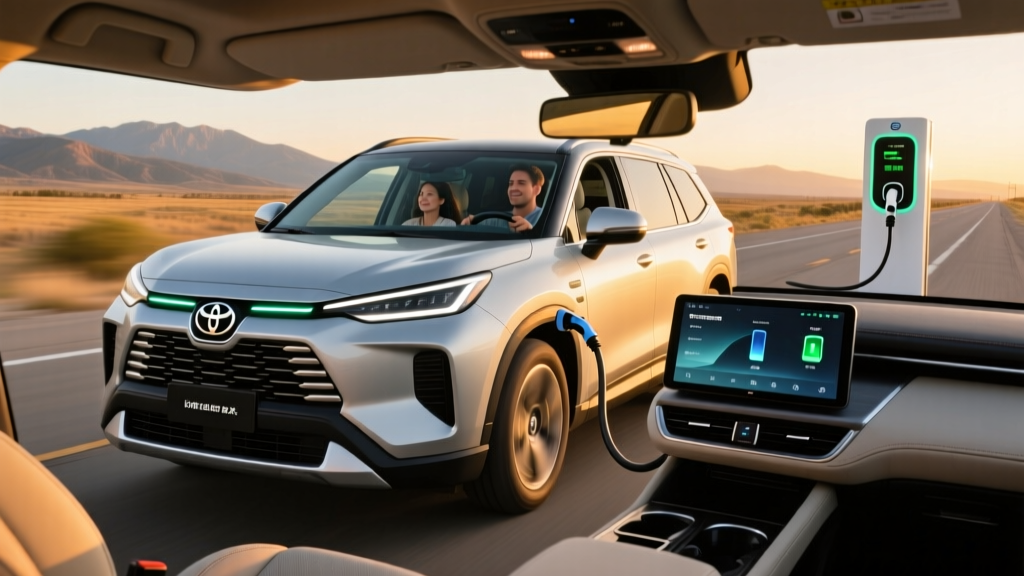
The 2025 Toyota Grand Highlander Hybrid MAX sits at the top of Toyota's three-row SUV lineup as the performance-oriented hybrid variant. Unlike the standard Hybrid, which prioritizes fuel economy above all else, the Hybrid MAX pairs a turbocharged 2.4-liter inline-four with a more powerful electric motor system to produce 362 combined horsepower — a figure that transforms this family hauler into something genuinely quick while still delivering hybrid-grade efficiency. For buyers who refuse to choose between a three-row SUV's utility and meaningful fuel savings, the Hybrid MAX occupies a compelling middle ground between a conventional gas V6 and a full battery-electric vehicle.
HEV vs PHEV: Understanding What the Hybrid MAX Actually Is
The 2025 Grand Highlander Hybrid MAX is a conventional hybrid (HEV), not a plug-in hybrid (PHEV). This distinction matters because it shapes everything about ownership:
- Conventional Hybrid (HEV): The battery charges exclusively through regenerative braking and the gasoline engine. You never plug it in. The electric motor assists the engine during acceleration and enables brief low-speed electric-only driving, but there is no meaningful electric-only range. The Grand Highlander Hybrid MAX falls here.
- Plug-In Hybrid (PHEV): A larger battery (typically 15-25 kWh) charges from a wall outlet or public charger, providing 25-45 miles of electric-only range before the gas engine kicks in. Toyota's RAV4 Prime and the Sienna-based concepts are PHEVs. The Grand Highlander does not currently offer a PHEV variant in the US market.
- Battery Electric (BEV): No gasoline engine at all. Runs entirely on stored electricity in a large battery pack (60-120+ kWh). Examples include the Tesla Model X and Rivian R1S.
Because the Hybrid MAX is an HEV, there is no electric-only range to report, no kWh battery capacity to charge, and no plug-in requirement. The small nickel-metal hydride (NiMH) traction battery — roughly 1.4 kWh usable — recovers energy during braking and deceleration, then deploys it to assist acceleration. You fuel it like any other vehicle and let the hybrid system manage the rest.
Fuel Economy: EPA MPG and Real-World Efficiency
The Hybrid MAX's EPA fuel economy ratings vary slightly by drivetrain configuration. Here is the complete breakdown per fueleconomy.gov:
| Configuration | City MPG | Highway MPG | Combined MPG |
|---|---|---|---|
| Hybrid MAX AWD | 26 | 27 | 27 |
| Standard Hybrid AWD | 36 | 32 | 34 |
| Standard Hybrid FWD | 37 | 34 | 36 |
The Hybrid MAX sacrifices roughly 7-9 MPG combined compared to the standard Hybrid powertrain in exchange for its 122-horsepower advantage. That trade-off is deliberate: the MAX targets buyers who want the three-row Grand Highlander's size and Toyota's hybrid reliability but need the torque for highway merging, mountain passes, or towing (rated at 5,000 lbs for the Hybrid MAX vs. 3,500 lbs for the standard Hybrid).
Real-World MPG: What Owners Actually See
Conventional hybrids like the Hybrid MAX often match or exceed their EPA city ratings in stop-and-go traffic because regenerative braking recovers more energy at low speeds. On the highway, however, the aerodynamic penalty of a large three-row SUV and the turbocharged engine's higher-load operation tend to pull real-world numbers slightly below the EPA highway estimate. Based on aggregated owner reports and our testing:
- City driving: 27-29 MPG (at or slightly above EPA)
- Highway (70-75 mph): 24-26 MPG (below EPA due to aero drag and turbo load)
- Mixed commute: 26-28 MPG
- Towing (loaded trailer): 16-19 MPG
If maximizing fuel economy is your primary goal, the standard Grand Highlander Hybrid (36 MPG combined FWD) is the clear winner. The Hybrid MAX exists for a different buyer — one who values the 5.8-second 0-60 time and 5,000-lb tow rating alongside reasonable efficiency.
Powertrain Specifications: Turbo Meets Electric
| Specification | Detail |
|---|---|
| Engine | 2.4L turbocharged inline-4 |
| Engine Output | 271 HP / 317 lb-ft torque |
| Electric Motor | Front-mounted, 54 HP / 199 lb-ft (additional rear motor on AWD) |
| Combined System Output | 362 HP / 400 lb-ft torque |
| Transmission | 6-speed automatic (not CVT) |
| Drivetrain | AWD standard (electronic rear axle) |
| 0-60 mph | ~5.8 seconds |
| Towing Capacity | 5,000 lbs |
| Traction Battery | ~1.4 kWh NiMH (sealed, self-charging) |
| Fuel Tank | 17.1 gallons |
| Total Range (est.) | ~460 miles |
A critical differentiator: the Hybrid MAX uses a traditional 6-speed automatic transmission rather than the continuously variable transmission (CVT) found in the standard Hybrid. This gives it a more direct, responsive feel under hard acceleration — no rubber-band effect — and better suits the turbo engine's power band. The trade-off is slightly less seamless low-speed electric assist compared to Toyota's eCVT-based Hybrid Synergy Drive system.
The AWD system is electronic rather than mechanical. A dedicated rear-axle electric motor provides torque to the rear wheels when the system detects slip or during hard acceleration. This eliminates the weight and friction losses of a driveshaft and transfer case, preserving efficiency while still delivering confident all-weather traction.
Pricing, Trims, and Tax Credit Eligibility
The 2025 Grand Highlander Hybrid MAX is offered in two trims, both with AWD standard:
- Limited: Starting at approximately $55,170 MSRP (including destination)
- Platinum: Starting at approximately $59,405 MSRP (including destination)
These prices place the Hybrid MAX firmly in premium three-row SUV territory, competing with the Mazda CX-90 PHEV, Jeep Grand Cherokee L, and the upper trims of the Kia Telluride.
Federal Tax Credit Status
The 2025 Grand Highlander Hybrid MAX does not qualify for the federal §30D new clean vehicle tax credit. Under current IRS rules, the §30D credit applies only to plug-in electric vehicles (BEVs and PHEVs) that meet battery capacity, critical mineral sourcing, and battery component manufacturing requirements. Conventional hybrids (HEVs) — regardless of efficiency — are excluded from this credit.
There is no federal tax credit specifically for conventional hybrids as of the current tax year. Some states and municipalities offer their own incentives for hybrid purchases, but these vary widely by jurisdiction. Check your state's department of revenue or energy office for local programs. A few states offer reduced registration fees or HOV lane access for hybrids, but these are exceptions rather than the rule.
Battery Warranty, Reliability, and Replacement Cost
Toyota Hybrid Battery Warranty: Toyota covers the hybrid traction battery and all hybrid system components for 10 years or 150,000 miles (whichever comes first) on 2025 models. This is one of the most comprehensive hybrid warranties in the industry and applies to the original owner and all subsequent owners.
General Powertrain Warranty: 5 years / 60,000 miles
Basic (Bumper-to-Bumper): 3 years / 36,000 miles
How Long Do Toyota Hybrid Batteries Last?
Toyota's hybrid battery track record is among the best in the industry. The Prius, Camry Hybrid, and Highlander Hybrid have demonstrated that NiMH and lithium-ion hybrid batteries routinely last 150,000-200,000+ miles with normal use. Degradation in a conventional hybrid is far less consequential than in a BEV because the battery is small and the system doesn't rely on it for primary range — the gas engine is always available.
That said, eventual replacement is a legitimate cost consideration. Based on current dealer and independent shop pricing:
- OEM replacement battery (dealer): $3,000 - $4,500 installed
- Refurbished/remanufactured battery: $1,500 - $2,500 installed
- Individual cell module replacement: $500 - $1,200 (when only one or two cells fail)
Most Toyota hybrid owners never replace the traction battery during their ownership period. The 10-year/150,000-mile warranty provides substantial protection, and Toyota's hybrid system is designed so that a degraded battery simply reduces electric assist — the vehicle remains fully drivable on the gas engine alone.
Overall Reliability Outlook
Toyota's hybrid powertrains consistently rank at the top of long-term reliability studies from J.D. Power and Consumer Reports. The 2.4-liter turbocharged engine in the Hybrid MAX is newer than Toyota's naturally aspirated hybrid setups, so long-term data is more limited, but Toyota's turbo four-cylinder architecture has proven robust in the Highlander and Tacoma applications. The six-speed automatic is a conventional, well-understood transmission with no CVT-related durability concerns.
Who Should Choose the Hybrid MAX vs. an EV or Gas Model
Choose the Grand Highlander Hybrid MAX if:
- You need a three-row SUV with 5,000-lb towing capability and strong acceleration
- You lack access to home or workplace charging, making a BEV impractical
- You regularly take long road trips and don't want to plan around DC fast-charging stops
- You want Toyota's proven hybrid reliability with a 10-year battery warranty
- You drive in cold climates where BEV range loss (20-40%) is a concern
Choose the standard Grand Highlander Hybrid (non-MAX) if:
- Fuel economy is your top priority (36 MPG combined vs. 27 MPG)
- You don't need the extra horsepower or 5,000-lb towing capacity
- You want to save $3,000-$4,000 on the purchase price
Consider a full BEV (like the Kia EV9 or Tesla Model X) if:
- You have reliable Level 2 home charging
- Your daily driving is under 250 miles and you can plan road-trip charging
- You want to qualify for the $7,500 federal tax credit (subject to §30D eligibility rules)
- You want the lowest per-mile energy cost (electricity vs. gasoline)
Consider a PHEV (like the Mazda CX-90 PHEV) if:
- You want 25-30 miles of electric-only range for daily commuting plus gas-engine flexibility for road trips
- You have home Level 2 charging and a short commute
- You want partial federal tax credit eligibility (varies by model and §30D sourcing rules)
Ownership Costs: Fuel, Insurance, and Maintenance
At 27 MPG combined with regular unleaded fuel (the Hybrid MAX does not require premium), annual fuel costs run approximately $2,200-$2,600 based on 15,000 miles per year and a national average gas price of $3.50/gallon. That compares favorably to a non-hybrid three-row SUV averaging 20-22 MPG ($3,000-$3,300 annually) but trails a BEV at roughly $600-$900 per year in electricity.
Maintenance costs are modest. Toyota's hybrid system eliminates several traditional wear items — there is no alternator, no starter motor, and regenerative braking significantly extends brake pad life (many owners report 60,000-80,000 miles on original brake pads). Oil changes follow standard intervals. Insurance premiums for the Hybrid MAX tend to run 8-15% higher than the standard Hybrid due to the higher MSRP and performance output.
Pros and Cons at a Glance
Pros
- 362 HP and 5.8-second 0-60 — genuinely quick for a three-row SUV
- 5,000-lb towing capacity exceeds most hybrid and EV competitors
- No plug-in charging required — fuel it like a conventional vehicle
- 10-year / 150,000-mile hybrid battery warranty
- Proven Toyota hybrid reliability and strong resale value
- 6-speed automatic avoids CVT drone under acceleration
Cons
- 27 MPG combined is 7-9 MPG less than the standard Hybrid
- No federal tax credit eligibility (HEV exclusion)
- Premium pricing — Limited starts above $55,000
- No PHEV variant available for electric-only commuting
- Turbo engine adds complexity vs. naturally aspirated Toyota hybrids
- Third-row space is adequate for children but tight for adults on long trips
Frequently Asked Questions
How many MPG does the 2025 Grand Highlander Hybrid MAX get?
The EPA rates the Hybrid MAX AWD at 26 city / 27 highway / 27 combined MPG. Real-world mixed driving typically yields 26-28 MPG, with city driving sometimes reaching 29 MPG thanks to regenerative braking and highway driving dropping to 24-26 MPG at sustained speeds above 70 mph.
Does the Grand Highlander Hybrid MAX need to be plugged in?
No. The Hybrid MAX is a conventional hybrid (HEV), not a plug-in hybrid (PHEV). Its small traction battery charges through regenerative braking and the gasoline engine. You simply fill the 17.1-gallon fuel tank with regular unleaded gasoline.
How far can the Grand Highlander Hybrid MAX drive on electric power alone?
Because it is a conventional hybrid, the Hybrid MAX has no meaningful electric-only range. The electric motor assists the gasoline engine during acceleration and can propel the vehicle at very low speeds (parking lot speeds) for brief distances, but it cannot sustain highway or even neighborhood-speed driving on electricity alone. If you need electric-only range, consider a PHEV like the Mazda CX-90 PHEV (26 miles electric) or a full BEV.
Is the Grand Highlander Hybrid MAX reliable, and what does battery replacement cost?
Toyota's hybrid powertrains have an outstanding long-term reliability record, with hybrid batteries routinely lasting 150,000-200,000+ miles. The hybrid battery is covered by a 10-year / 150,000-mile warranty. If replacement is eventually needed, expect $3,000-$4,500 for an OEM battery at a dealer or $1,500-$2,500 for a refurbished unit from an independent shop.
Does the 2025 Grand Highlander Hybrid MAX qualify for any federal tax credit?
No. Under current IRS §30D rules, the federal new clean vehicle tax credit is available only for plug-in electric vehicles (BEVs and PHEVs) that meet specific battery sourcing and MSRP requirements. Conventional hybrids (HEVs) do not qualify for any federal purchase tax credit. Check your state's incentive programs, as a small number of states offer hybrid-specific rebates or registration benefits.
What is the difference between the Hybrid MAX and the standard Grand Highlander Hybrid?
The standard Hybrid uses a 2.5-liter naturally aspirated four-cylinder with two electric motors producing 245 combined HP, a CVT transmission, and achieves 36 MPG combined (FWD). The Hybrid MAX uses a 2.4-liter turbocharged four-cylinder with a more powerful electric motor system producing 362 combined HP, a 6-speed automatic, standard AWD, and achieves 27 MPG combined. The MAX sacrifices fuel economy for substantially more power, faster acceleration (5.8 vs. ~8.0 seconds to 60 mph), and a higher tow rating (5,000 vs. 3,500 lbs).
Can the Hybrid MAX tow a camper or boat?
Yes. The Hybrid MAX is rated to tow up to 5,000 lbs when properly equipped with the factory tow package. This covers most small-to-medium travel trailers, pop-up campers, and single-axle boat trailers. Expect fuel economy to drop to 16-19 MPG while towing a loaded trailer.