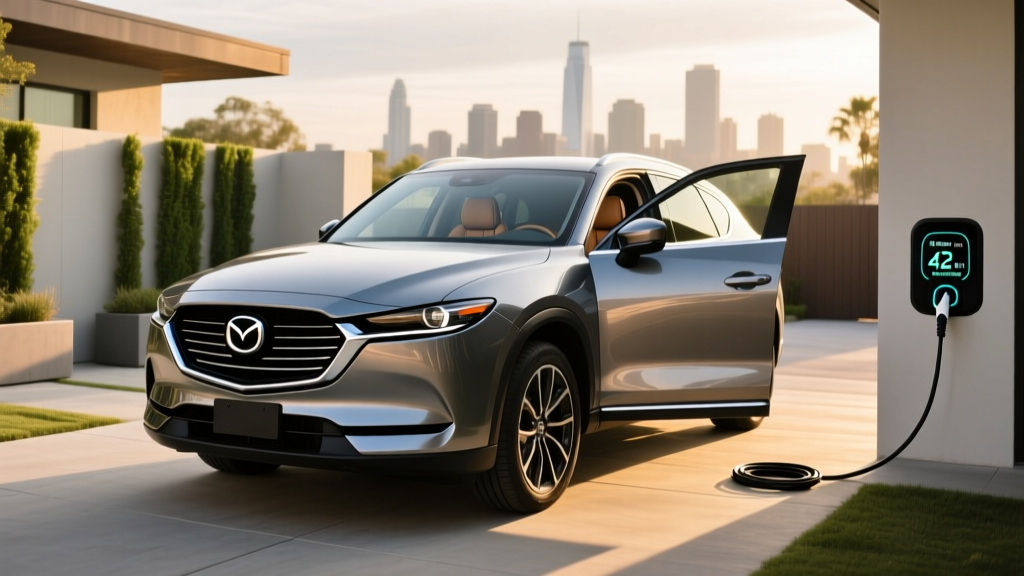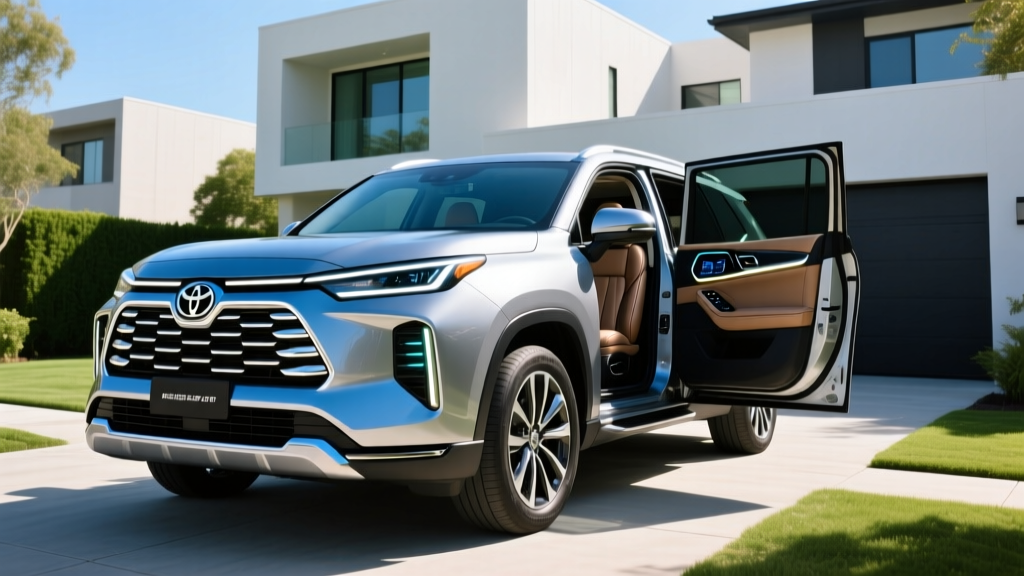
The 2025 Toyota Grand Highlander Hybrid MAX Platinum occupies a narrow but compelling lane in the three-row SUV market: it pairs a turbocharged hybrid powertrain with premium trim appointments and genuine adult-sized third-row space. For buyers who need the cargo capacity and passenger room of a full-size family hauler but want better fuel economy than a body-on-frame SUV — without committing to a full battery-electric vehicle — this powertrain and trim combination warrants a close look.
This guide breaks down the Hybrid MAX powertrain (a conventional hybrid, not a plug-in), its EPA-rated and real-world fuel economy, what the Platinum trim adds, total cost of ownership considerations, and how it stacks up against both plug-in hybrid and full EV alternatives in the three-row segment.
Hybrid MAX Powertrain: How Toyota's Turbo Hybrid Works
The Hybrid MAX system in the Grand Highlander is fundamentally different from Toyota's standard hybrid setup found in the base Grand Highlander Hybrid. It pairs a 2.4-liter turbocharged inline-four engine with a front-mounted electric motor and a rear-mounted electric motor (e-AWD), routed through a 6-speed automatic transmission rather than the e-CVT used in the non-MAX hybrid.
The result is a combined output of 362 horsepower and 400 lb-ft of torque — making it the most powerful Grand Highlander variant and one of the quickest three-row hybrids on the market, with a Toyota-estimated 0–60 mph time of approximately 5.8 seconds.
| Specification | Value |
|---|---|
| Powertrain | 2.4L Turbo I4 + Front & Rear Electric Motors (Hybrid MAX) |
| Combined Horsepower | 362 hp |
| Combined Torque | 400 lb-ft |
| Transmission | 6-Speed Automatic (Direct Shift) |
| Drivetrain | Electronic On-Demand AWD (e-AWD) |
| Battery Type | Lithium-ion (sealed, self-charging — no plug-in) |
| EPA Fuel Economy (City / Hwy / Combined) | 26 / 27 / 27 MPG |
| Fuel Tank Capacity | 17.1 gallons |
| Estimated Total Range | ~460 miles |
| 0–60 mph (est.) | ~5.8 seconds |
| Towing Capacity | 5,000 lbs |
| Seating Capacity | 7 passengers (captain's chairs, 2nd row) |
| Cargo Volume (behind 3rd / 2nd / 1st row) | 20.6 / 57.9 / 97.5 cu ft |
| Base MSRP (Platinum trim) | $58,175 (incl. destination) |
It's important to understand what this system is not: the Hybrid MAX is a conventional hybrid (HEV), meaning it cannot be plugged in. The small lithium-ion battery charges exclusively through regenerative braking and the gasoline engine. There is no electric-only driving range to speak of — the electric motors assist the engine and enable brief low-speed electric-only operation, but the engine is the primary energy source at all times.
Fuel Economy: EPA Ratings vs. Real-World MPG
The EPA rates the 2025 Grand Highlander Hybrid MAX at 26 city / 27 highway / 27 combined MPG per fueleconomy.gov. These numbers deserve context because the Hybrid MAX sacrifices some efficiency for its performance advantage.
| Powertrain | City MPG | Highway MPG | Combined MPG |
|---|---|---|---|
| Hybrid MAX (2.4L Turbo, 362 hp) | 26 | 27 | 27 |
| Standard Hybrid (2.5L, 245 hp) | 36 | 32 | 34 |
| Gas-only (2.4L Turbo, 265 hp) | 21 | 27 | 23 |
The standard (non-MAX) Grand Highlander Hybrid returns a notably higher 36 city / 32 highway / 34 combined MPG, which is a substantial 7-MPG combined advantage. The Hybrid MAX's turbo engine, heavier powertrain components, and performance tuning trade some efficiency for 117 additional horsepower and a more engaging driving experience — particularly useful when merging onto highways or towing up to its 5,000-pound rating.
Real-world expectations: In mixed driving, owners of Toyota's Hybrid MAX systems (also used in the Crown and Highlander) typically report fuel economy that lands close to or slightly above the EPA combined figure in suburban and city driving, thanks to frequent regenerative braking opportunities. Highway-only trips at 75+ mph tend to drop to the mid-20s. In cold weather (below 30°F), expect a 5–10% reduction as the engine runs more frequently for cabin heat and battery warming.
Platinum Trim: What You Get for $58,175
The Platinum is the top-tier trim for the Hybrid MAX lineup, sitting above the Limited. At $58,175 including destination (per Toyota's official pricing), the Platinum adds several features over the Limited that are relevant to daily usability:
- Panoramic glass roof with power sunshade
- Head-Up Display (HUD) — projects speed and navigation onto the windshield
- Digital rearview mirror with HomeLink
- 360-degree camera system with curb-view monitoring
- Heated and ventilated second-row captain's chairs (in addition to heated/ventilated front seats)
- 11-speaker JBL premium audio with subwoofer
- 20-inch alloy wheels (specific to Platinum)
- Toyota Audio Multimedia with 12.3-inch touchscreen, wireless Apple CarPlay/Android Auto
- Toyota Safety Sense 3.0 — full ADAS suite including Pre-Collision System, Lane Tracing Assist, Full-Speed Range Dynamic Radar Cruise Control, and Proactive Driving Assist
Options that can push the price above $60,000 include premium paint colors ($425–$1,195), a trailer hitch package, and all-weather floor/cargo liners. A fully loaded Platinum can approach $61,000–$62,000 out the door before taxes and registration.
Hybrid (HEV) vs. Plug-In Hybrid (PHEV) vs. Full EV: Which Three-Row SUV Fits?
| Factor | Conventional Hybrid (HEV) | Plug-In Hybrid (PHEV) | Battery Electric (BEV) |
|---|---|---|---|
| Example | Grand Highlander Hybrid MAX | Kia Sorento PHEV / Mazda CX-90 PHEV | Kia EV9 / Rivian R1S |
| Plug-in Required? | No — self-charging | Yes — plug in for EV range | Yes — plug in always |
| Electric-Only Range | N/A (brief low-speed only) | ~30–35 miles typical | 250–300+ miles |
| Fuel Economy (combined) | 27 MPG (MAX) / 34 MPG (std hybrid) | ~30–34 MPG (gas) + 79–85 MPGe (electric) | N/A — MPGe only (83–99 MPGe) |
| Home Charging Needed? | No | Recommended (Level 2 for best experience) | Essential (Level 2 strongly recommended) |
| Federal Tax Credit (§30D) | Not eligible | Up to $7,500 (if eligible — see below) | Up to $7,500 (if eligible) |
| Best For | No home charging access; frequent long trips; towing | Short daily commutes + occasional long road trips; home charging available | Home charging available; mostly daily driving under 300 miles; lowest running costs |
| Upfront Cost | Lowest | Mid-range | Highest |
The Grand Highlander Hybrid MAX makes the most sense for buyers who:
- Cannot install a Level 2 home charger (apartment/condo living, no garage, or HOA restrictions)
- Regularly tow trailers, boats, or campers (5,000-lb rating vs. most PHEVs at 3,500 lbs)
- Take frequent road trips exceeding 300 miles where charging stops would add unwanted time
- Want the acceleration and passing power of a turbo hybrid without the complexity of plug-in management
Conversely, if you have home charging access and your daily driving is under 30 miles round-trip, a three-row PHEV like the Mazda CX-90 PHEV (26 miles electric-only, 25 combined MPG on gas) or a full EV like the Kia EV9 (304 miles EPA range, $54,900 base) could deliver substantially lower daily energy costs — particularly if you qualify for the federal tax credit.
Federal Tax Credit and Incentive Eligibility
Because the Grand Highlander Hybrid MAX is a conventional hybrid (HEV) — not a plug-in — it does not qualify for the federal §30D Clean Vehicle Credit. That credit, which offers up to $7,500 for qualifying new plug-in electric vehicles, requires a minimum battery capacity of 7 kWh and plug-in capability, neither of which applies here.
This is a meaningful financial consideration. A similarly priced PHEV or BEV that qualifies for the full $7,500 credit effectively reduces its purchase price gap versus the Grand Highlander Hybrid MAX by that amount. However, the Grand Highlander's larger interior volume, third-row comfort, and 5,000-lb towing capacity may justify the trade-off for families who need those capabilities.
Battery Warranty, Reliability, and Long-Term Ownership Costs
Toyota's hybrid systems have an exceptionally well-documented reliability record spanning more than two decades since the original Prius. The Hybrid MAX system, while newer (introduced for the 2023 Crown), uses proven components: the A25A-FXS-derived turbo engine architecture, Toyota's well-established hybrid synergy drive electronics, and a lithium-ion battery pack that operates within a conservative state-of-charge window to minimize degradation.
Battery replacement cost: If the hybrid battery fails outside warranty (rare based on historical data), a replacement battery pack for Toyota's turbo-hybrid systems typically ranges from $3,000 to $5,000 including labor at a dealership. Independent hybrid specialists can sometimes source refurbished packs for $2,000–$3,500. Given the 10-year/150,000-mile warranty and Toyota's track record, most owners will never face this expense.
General maintenance advantages: Compared to a conventional gas-only vehicle, the hybrid system reduces wear on the brake pads (regenerative braking handles much of the deceleration), eliminates the need for a traditional starter motor and alternator, and can extend engine life by allowing the engine to shut off during low-load conditions. Toyota recommends synthetic oil changes every 10,000 miles, and there is no transmission fluid change interval under normal driving conditions for the 6-speed automatic.
Real-World Ownership: Daily Driving, Road Trips, and Towing
Daily commuting: The Hybrid MAX's electric motors provide immediate torque from a stop, making it feel responsive in city and suburban driving. The engine start-stop transitions are well-damped — noticeably smoother than the non-hybrid turbo Grand Highlander. In stop-and-go traffic, the hybrid system's ability to shut off the engine and creep on electric power contributes to its 26-MPG city rating, which is 5 MPG better than the gas-only model's 21-MPG city figure.
Road trips: With a 17.1-gallon fuel tank and 27-MPG combined rating, expect approximately 460 miles of total range before needing to refuel. Highway cruising at 70–75 mph yields real-world figures in the 25–27 MPG range depending on terrain, wind, and load. The 6-speed automatic keeps engine RPM low at highway speeds, reducing noise compared to e-CVT-equipped competitors that can drone under hard acceleration.
Towing: The Hybrid MAX's 5,000-pound tow rating is a significant differentiator. Most three-row PHEVs and EVs in this price range (Mazda CX-90 PHEV at 3,500 lbs, Kia EV9 at 5,000 lbs but with substantial range reduction while towing) cannot match the combination of towing capacity and fuel economy. When towing near maximum capacity, expect fuel economy to drop to the 15–18 MPG range, which is typical for any vehicle in this weight class under load.
Cold-weather performance: Unlike full EVs, which can lose 20–30% of their range in sub-freezing temperatures, the Grand Highlander Hybrid MAX's fuel economy impact in cold weather is modest — typically a 5–10% reduction (roughly 1.5–2.5 MPG). The engine generates waste heat that warms the cabin without drawing additional energy from the battery, an inherent advantage of hybrid powertrains in cold climates.
Pros, Cons, and the Bottom Line
✓ Pros
- 362 hp / 400 lb-ft — genuinely quick for a three-row SUV (sub-6-second 0–60)
- 27 MPG combined despite performance tuning — 4 MPG better than gas-only equivalent
- 5,000-lb towing capacity — class-leading for hybrid three-rows
- True adult-sized third row with 34.4 inches of legroom
- No plug-in required — no charging infrastructure dependency
- 10-year / 150,000-mile hybrid battery warranty
- Toyota Safety Sense 3.0 standard across all trims
- Platinum trim features (HUD, 360° camera, ventilated 2nd row) justify premium price
✗ Cons
- 27 MPG combined trails the standard Grand Highlander Hybrid's 34 MPG by 7 MPG
- No federal tax credit eligibility (not a plug-in vehicle)
- Platinum MSRP of $58,175 is steep; options push past $62K
- Hybrid MAX's turbo engine requires premium fuel (91 octane recommended) for best performance
- No spare tire — run-flat tires with inflator kit only
- Third-row access requires folding captain's chair (no pass-through)
- Infotainment system can lag with multiple apps active
The 2025 Toyota Grand Highlander Hybrid MAX Platinum is best understood as a performance-oriented family hauler that happens to be a hybrid. It trades 7 MPG versus the standard hybrid for 117 more horsepower, a more engaging transmission, and 5,000-lb towing capability. If acceleration, towing, and a premium interior are your priorities and you lack home charging access, it's a compelling choice. If maximum fuel economy is the goal, the standard Grand Highlander Hybrid (34 combined MPG, starting at $42,470) is the more efficient path — and at a substantially lower price.
Frequently Asked Questions
How many MPG does the 2025 Grand Highlander Hybrid MAX get?
The EPA rates it at 26 city / 27 highway / 27 combined MPG. Real-world driving typically lands in the 25–28 MPG range depending on driving style and conditions. This is 7 MPG less than the standard (non-MAX) Grand Highlander Hybrid, which achieves 36/32/34 MPG, due to the MAX's turbocharged engine and performance tuning.
Does the Grand Highlander Hybrid MAX need to be plugged in?
No. This is a conventional hybrid (HEV), not a plug-in hybrid (PHEV). The battery charges through regenerative braking and the gasoline engine. You fuel it exclusively at gas stations — there is no charging port and no electric-only driving range.
Is the Grand Highlander Hybrid MAX reliable? What about battery replacement cost?
Toyota's hybrid systems have an industry-leading reliability record over 25+ years of production. The hybrid battery is covered by a 10-year / 150,000-mile warranty. Out-of-warranty battery replacement typically costs $3,000–$5,000 at a dealership, but failure rates based on historical Toyota hybrid data are very low within the first 15 years of ownership.
Does the Grand Highlander Hybrid MAX qualify for any tax credit?
No. The federal §30D Clean Vehicle Credit applies only to plug-in electric vehicles (BEVs and PHEVs) with a minimum 7 kWh battery. Since the Grand Highlander Hybrid MAX is a self-charging conventional hybrid, it does not qualify for the $7,500 federal credit or most state EV incentives. Check with your state energy office for any hybrid-specific rebates.
Should I get the Hybrid MAX or the standard Grand Highlander Hybrid?
Choose the Hybrid MAX if you prioritize acceleration (362 hp vs. 245 hp), need the 5,000-lb tow rating, prefer the feel of a conventional automatic transmission over an e-CVT, and don't mind paying ~$6,000 more and burning ~3 more gallons per 100 miles. Choose the standard Hybrid if maximum fuel economy (34 vs. 27 combined MPG), lower purchase price, and lower annual fuel costs are your priorities. For most families, the standard Hybrid is the more pragmatic choice — the MAX is for buyers who want the performance and towing edge.
How does the Hybrid MAX compare to three-row plug-in hybrids?
PHEVs like the Mazda CX-90 PHEV (26 miles electric-only, $55,950 base) and Kia Sorento PHEV (32 miles electric-only, $50,290 base) offer short electric-only commutes and may qualify for the $7,500 federal tax credit, effectively lowering their price. However, they typically offer less third-row space, lower tow ratings (3,500 lbs), and less total power. The Grand Highlander Hybrid MAX trades electric-only capability for greater interior volume, more power, and higher towing capacity without any charging dependency.
Does the Hybrid MAX require premium fuel?
Toyota recommends 91-octane premium fuel for the Hybrid MAX's 2.4-liter turbocharged engine to achieve its full 362-hp output. The engine will run on 87-octane regular with reduced performance and potentially slightly lower fuel economy. Factor the premium fuel cost into your ownership budget — at a $0.40–$0.60 per gallon premium over regular, this adds roughly $200–$400 per year in fuel costs for an average driver.