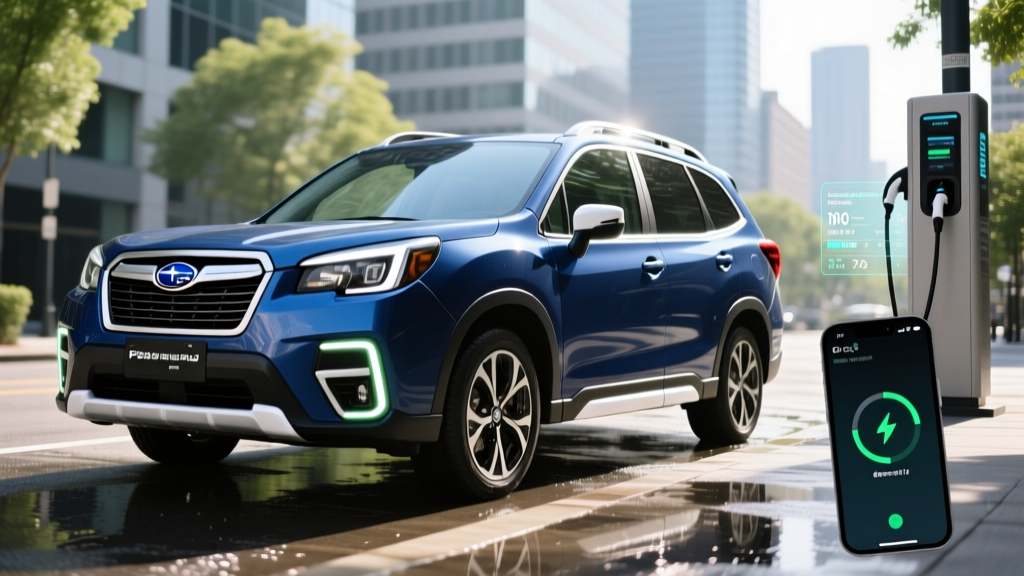
Quick Verdict: The 2025 Forester Premium Hybrid at a Glance
The 2025 Subaru Forester Premium Hybrid marks the return of hybrid power to Subaru's compact SUV lineup after a multi-year absence. Built on the sixth-generation Forester platform, this conventional hybrid (HEV) pairs a 2.5-liter flat-four engine with an electric motor integrated into a revised Lineartronic CVT. The result is a meaningful bump in city fuel economy over the gas-only Forester — without ever needing to plug in.
For buyers who want Subaru's signature all-wheel drive, strong visibility, and practical cargo space but aren't ready to commit to a plug-in hybrid or full electric vehicle, the Forester Hybrid occupies a compelling middle ground. Let's break down exactly what you're getting — and where the numbers land in the real world.
The 2025 Forester Hybrid is a conventional hybrid (HEV). It charges its small battery through regenerative braking and the gas engine. You never plug it in. A plug-in hybrid (PHEV), like the Toyota RAV4 Prime, has a larger battery you charge from a wall outlet and offers 20-40 miles of electric-only driving before the gas engine kicks in. The Forester Hybrid does not offer electric-only range — the motor assists the engine at all times to improve efficiency.
Powertrain Specs: Engine, Motor, and Combined Output
| Spec | Value |
|---|---|
| Engine | 2.5L SUBARU BOXER 4-cylinder |
| Electric Motor | Integrated AC synchronous motor (e-BOXER system) |
| Combined Horsepower | ~194 hp (combined system output) |
| Transmission | Lineartronic CVT with hybrid motor integration |
| Drivetrain | Symmetrical All-Wheel Drive (standard) |
| Hybrid Battery | ~1.1 kWh lithium-ion (self-charging, no plug) |
| 0-60 mph (est.) | ~8.5 seconds |
| Towing Capacity | 1,500 lbs |
| Cargo Volume (rear seats up) | ~28.9 cu ft |
Subaru's e-BOXER hybrid system is fundamentally an assist hybrid. The electric motor fills in torque at low RPMs — the exact scenario where the naturally aspirated 2.5L BOXER feels weakest. This makes the Forester Hybrid noticeably more responsive from a stoplight than the gas-only model, which produces 180 hp on its own. The combined system output of approximately 194 hp isn't going to win drag races, but it's adequate for merging and passing.
The ~1.1 kWh battery pack is small by PHEV or EV standards — it stores just enough energy captured from regenerative braking to assist acceleration and enable brief low-speed electric assist in stop-and-go traffic. It does not provide standalone electric-only driving range.
Fuel Economy: EPA Ratings and Real-World MPG
| Model | City MPG | Highway MPG | Combined MPG |
|---|---|---|---|
| 2025 Forester Hybrid (AWD) | ~35 | ~34 | ~35 |
| 2025 Forester Gas (AWD) | 26 | 33 | 29 |
Source: fueleconomy.gov — verify exact trim ratings on the EPA site, as figures may vary slightly by final certification.
The headline number is the city MPG improvement. Hybrids shine in stop-and-go driving where regenerative braking recaptures energy and the electric motor handles low-speed movement. The Forester Hybrid's estimated 35 MPG city is a roughly 35% improvement over the gas-only model's 26 MPG city. On the highway, the gap narrows — the gas Forester's CVT is already efficient at steady speeds, so the hybrid advantage drops to about 1 MPG.
In mixed suburban and city driving, many Forester Hybrid owners should see 33-37 MPG combined depending on conditions. Hybrids frequently exceed their EPA city rating in warm-weather urban driving with frequent stops. However, expect 28-31 MPG on sustained highway trips at 75+ mph, and 25-28 MPG in cold weather (below 30°F) when the engine runs more often for cabin heat and battery conditioning. Roof racks, heavy cargo, and aggressive acceleration will also reduce economy.
Pricing, Trim Details, and Tax Credit Eligibility
The 2025 Forester Hybrid is offered starting at the Premium trim level, with an MSRP of approximately $33,000-$34,500 (including destination). This positions it roughly $2,000-$3,000 above the equivalent gas-only Forester Premium, a premium you'll recoup through fuel savings if you keep the vehicle for several years and drive predominantly in city conditions.
Does the 2025 Forester Hybrid Qualify for a Federal Tax Credit?
No. Under current IRS §30D rules, the federal Clean Vehicle Credit applies only to plug-in electric vehicles — battery electric vehicles (BEVs) and plug-in hybrids (PHEVs) with a minimum battery capacity of 7 kWh that can be charged from an external source. The Forester Hybrid is a conventional HEV with a ~1.1 kWh self-charging battery. It does not qualify for the federal §30D tax credit, the $4,000 used EV credit (§25E), or most state-level EV rebate programs.
- ❌ Vehicle must be a BEV or PHEV with ≥7 kWh battery — Forester Hybrid does not qualify
- ❌ Must be chargeable from an external power source — HEV is self-charging only
- ✅ MSRP cap: $80,000 for SUVs (would qualify if it were a PHEV)
- ✅ Income cap: $150K single / $300K joint (would qualify if it were a PHEV)
- ✅ Battery sourcing & critical minerals requirements apply to qualifying vehicles
Source: IRS.gov §30D rules. Consult a tax professional for your specific situation.
Some states or local utilities offer modest rebates for hybrid purchases, but these vary widely. Check your state energy office or utility provider for current programs.
Battery Warranty, Reliability, and Replacement Cost
Hybrid battery longevity is the number-one concern for first-time hybrid buyers. Here's what Subaru provides:
- Coverage: 8 years / 100,000 miles (whichever comes first)
- What's covered: Hybrid battery pack, hybrid control module, inverter, and related hybrid-system components
- Capacity threshold: Subaru warrants against defects and abnormal degradation; specific capacity-retention thresholds are detailed in the warranty booklet
- Transferable: Yes, to subsequent owners within the warranty period
Subaru's hybrid system is relatively conservative compared to Toyota's decades of hybrid experience, but the e-BOXER system has been deployed in other markets (notably Japan and Europe) for several years. The small ~1.1 kWh battery undergoes shallow charge-discharge cycles — it rarely goes below 40% or above 80% state of charge — which significantly reduces degradation stress compared to the deep cycles a PHEV or EV battery experiences.
What Does Hybrid Battery Replacement Cost?
If the hybrid battery fails outside the warranty period, replacement costs for a compact SUV HEV battery typically range from $2,000 to $4,000 (parts and labor), depending on the shop and whether you use OEM or refurbished cells. This is far less than EV battery replacement ($8,000-$20,000+) because the HEV battery is small (~1.1 kWh vs 60-100+ kWh in an EV). Many hybrid batteries last 150,000-200,000+ miles with minimal degradation when the thermal management system is functioning properly.
The broader powertrain — the 2.5L BOXER engine and CVT — carries Subaru's standard 5-year / 60,000-mile powertrain warranty. Subaru's overall reliability record is solid, though the brand's CVTs have drawn some criticism historically; the hybrid variant's electric motor assist actually reduces strain on the transmission during initial acceleration.
Forester Hybrid vs PHEV vs EV: Which Powertrain Fits You?
| Factor | HEV (Forester Hybrid) | PHEV (e.g., RAV4 Prime) | EV (e.g., Ioniq 5) |
|---|---|---|---|
| Plug-in required? | No | Yes (optional) | Yes (mandatory) |
| Electric-only range | 0 mi | ~42 mi | ~260-300 mi |
| Total range | ~480 mi | ~600 mi | ~260-300 mi |
| Combined MPG / MPGe | ~35 MPG | 94 MPGe (elec) / 38 MPG (gas) | 114 MPGe |
| Home charging needed? | No | Recommended | Essential |
| Federal tax credit | None | Up to $7,500* | Up to $7,500* |
| Starting price (approx.) | ~$33,500 | ~$44,000 | ~$42,000 |
| AWD available? | Standard | Standard | Optional |
* §30D credit subject to MSRP, income, and battery-sourcing requirements. Verify at IRS.gov.
Choose the Forester Hybrid (HEV) if: You don't have access to home or workplace charging, you want AWD as standard, you primarily drive in city/suburban conditions, and you want to reduce fuel costs without changing your refueling habits.
Choose a PHEV (like the RAV4 Prime) if: You can install a Level 2 charger at home, your daily commute is under 40 miles round-trip (covering most days on electricity alone), you want the $7,500 federal credit, and you still want gas-engine range for road trips.
Choose a full EV if: You have reliable home charging, your daily driving is under 250 miles, you want the lowest per-mile fuel cost and zero tailpipe emissions, and you're comfortable with public DC fast charging for longer trips.
Pros and Cons: 2025 Forester Premium Hybrid
- ~35 MPG combined — 6 MPG improvement over gas model
- Standard Symmetrical AWD (no FWD compromise)
- No plug-in charging required — zero lifestyle change
- Strong low-speed torque from electric motor assist
- Excellent outward visibility and practical cargo space
- 8-year / 100,000-mile hybrid battery warranty
- Subaru's EyeSight safety suite standard
- No electric-only driving range
- No federal tax credit eligibility
- Highway MPG gain is modest (~1 MPG over gas)
- ~$2,500 price premium over gas-only Forester Premium
- Towing limited to 1,500 lbs
- CVT drone under hard acceleration (common to the type)
- Limited hybrid trim availability at launch
Who Should Buy the 2025 Forester Premium Hybrid?
The Forester Hybrid's ideal buyer is someone who:
- Lives in an apartment or lacks home charging access — making a PHEV or EV impractical, but still wants better fuel economy
- Commutes in heavy city traffic — where the hybrid system's regenerative braking and electric motor assist deliver the biggest MPG gains
- Needs standard AWD — for snow, rain, or light off-road use, and doesn't want the FWD-biased platforms of many competing hybrids
- Plans to keep the vehicle 8+ years — recouping the hybrid premium through fuel savings and benefiting from the full hybrid warranty coverage
- Values simplicity — no charging apps, no range planning, no public charger hunting. Fill up at any gas station as always.
If you have a garage with a 240V outlet and a short commute, a PHEV will save you more money per mile and may qualify for the $7,500 federal credit. But if charging infrastructure is a barrier, the Forester Hybrid is a genuinely efficient, practical, and capable compact SUV that asks nothing of you except an occasional stop at the gas pump — just less often than before.
Frequently Asked Questions
How many MPG does the 2025 Forester Hybrid get?
The 2025 Forester Hybrid achieves an EPA-estimated ~35 MPG city, ~34 MPG highway, and ~35 MPG combined. In real-world city driving with frequent stops, many drivers report 33-37 MPG combined. Highway-heavy driving at speeds above 70 mph will reduce this to approximately 28-31 MPG.
Does the Forester Hybrid need to be plugged in?
No. The 2025 Forester Hybrid is a conventional hybrid (HEV). Its small battery charges through regenerative braking and the gas engine. There is no plug, no charging cable, and no electric-only range. You refuel at a gas station like any other vehicle.
How far can the Forester Hybrid drive on electric power alone?
The Forester Hybrid does not offer standalone electric-only driving. The electric motor assists the gas engine at low speeds and during acceleration but cannot propel the vehicle independently for any meaningful distance. If electric-only range is a priority, consider a PHEV like the Toyota RAV4 Prime (42 miles electric) or a full EV.
Is the hybrid battery reliable, and what does replacement cost?
Subaru covers the hybrid battery for 8 years / 100,000 miles. The e-BOXER system uses shallow charge cycles that minimize degradation. Based on industry data for similar small-battery HEVs, the hybrid battery should last 150,000+ miles with proper maintenance. Out-of-warranty replacement typically costs $2,000-$4,000 — far less than an EV battery.
Does the 2025 Forester Hybrid qualify for any tax credit?
No. The federal §30D Clean Vehicle Credit requires a plug-in vehicle with at least 7 kWh of battery capacity. The Forester Hybrid's ~1.1 kWh self-charging battery does not qualify. Some state or utility programs may offer small hybrid incentives — check your local programs. For current federal rules, visit IRS.gov.
How does the Forester Hybrid compare to the Toyota RAV4 Hybrid?
The RAV4 Hybrid is the segment benchmark, offering ~41 MPG combined and a slightly more powerful hybrid system. However, the Forester Hybrid counters with standard Symmetrical AWD (Toyota's is on-demand), better outward visibility, and Subaru's strong safety reputation. If maximum MPG is your priority, the RAV4 Hybrid wins. If AWD capability and the Forester's practical packaging matter more, the Subaru is a strong alternative.