Quick Verdict: What the Maverick Hybrid Can (and Can't) Tow
The 2025 Ford Maverick Hybrid is rated to tow 2,000 pounds when properly equipped — half of what the available 2.0L EcoBoost AWD model manages with the 4K Tow Package (4,000 lbs). That's a hard ceiling set by Ford, and no aftermarket hitch or tuning workaround changes it. But here's the trade-off buyers need to weigh: that 2,000-lb limit comes paired with an EPA-rated 42 MPG city, making the Maverick Hybrid the most fuel-efficient truck in its class by a wide margin.
If you need to pull a small utility trailer, a pair of jet skis, or a lightweight pop-up camper, the hybrid powertrain handles it. If you're eyeing a 5,000-lb boat or a loaded car hauler, you need the EcoBoost — or a different truck entirely. Let's break down the numbers, the real-world towing experience, and the total ownership math.
2025 Maverick Hybrid: Full Powertrain & Towing Spec Sheet
| Specification | 2025 Maverick Hybrid (FWD) | 2025 Maverick 2.0L EcoBoost (AWD w/ 4K Tow) |
|---|---|---|
| Engine | 2.5L Atkinson-cycle I-4 | 2.0L Turbocharged I-4 |
| Combined System Horsepower | 191 hp | 250 hp |
| Combined System Torque | 155 lb-ft (engine) + electric motor assist | 277 lb-ft |
| Transmission | eCVT (planetary gearset) | 8-speed automatic |
| Drivetrain | FWD only | AWD |
| Max Towing Capacity | 2,000 lbs | 4,000 lbs (with 4K Tow Pkg) |
| Standard Towing (no pkg) | 2,000 lbs | 2,000 lbs |
| Max Payload | 1,500 lbs | 1,500 lbs |
| 0–60 mph | ~8.5 sec (est.) | ~6.5 sec |
| Bed Length | 4.5 ft (54.4 cu ft volume) | 4.5 ft (54.4 cu ft volume) |
| Starting MSRP (XL trim) | $27,495 | $28,495 |
Source: Ford 2025 Maverick Specifications
Fuel Economy: EPA Ratings vs. Real-World MPG
The Maverick Hybrid's headline number is its fuel economy, and the EPA figures are strong even by compact-car standards — let alone for a pickup truck.
| Driving Cycle | EPA Rating (Maverick Hybrid FWD) | Real-World Expectation |
|---|---|---|
| City | 42 MPG | 40–45 MPG (hybrids often beat EPA in stop-and-go) |
| Highway | 33 MPG | 30–34 MPG (aerodynamic drag dominates at 70+ mph) |
| Combined | 37 MPG | 34–38 MPG depending on driving mix |
Source: fueleconomy.gov — 2025 Ford Maverick Hybrid
What Happens to MPG When You're Towing?
This is the question every truck-buying hybrid shopper asks, and the honest answer is: expect a 30–50% fuel economy reduction when towing near the 2,000-lb limit. That means roughly 18–25 MPG combined with a loaded trailer, depending on terrain, speed, and wind conditions. The eCVT and electric motor assist smooth out low-speed pulling and reduce the engine strain you'd feel in a conventional powertrain, but physics is physics — moving 4,000+ pounds of combined vehicle-and-trailer weight requires substantially more energy.
For lighter loads (500–1,000 lbs, like a small motorcycle trailer or cargo carrier), the hit is more modest — typically 5–10 MPG off the combined figure. Owners who tow occasionally but commute daily will still come out far ahead on annual fuel costs compared to a body-on-frame midsize truck.
HEV vs. PHEV vs. EV: Which Truck Powertrain Fits You?
The Maverick Hybrid is a conventional hybrid electric vehicle (HEV). It does not plug in. The 1.1 kWh battery recharges through regenerative braking and the gasoline engine. There is no electric-only range to manage, no charging cable to deal with, and no home charger to install. You fuel it like any other gas car and the hybrid system works invisibly in the background.
| Factor | HEV (Maverick Hybrid) | PHEV (e.g., Chrysler Pacifica Hybrid) | BEV (e.g., Ford F-150 Lightning) |
|---|---|---|---|
| Plugs In? | No | Yes (Level 1/2) | Yes (Level 1/2/DC) |
| Electric-Only Range | None (motor assist only) | 20–40 mi typical | 200–350+ mi |
| Gasoline Required? | Yes, always | Yes, for longer trips | No |
| Home Charging Needed? | No | Recommended (Level 2) | Essential (Level 2) |
| Federal Tax Credit (§30D) | Not eligible | Up to $7,500 (varies) | Up to $7,500 (varies) |
| Best For | Daily drivers who want MPG gains with zero behavior change | Commuters with short trips + home charging | Drivers with home charging who want zero tailpipe emissions |
The Maverick Hybrid sits in the lowest-friction category: you get a meaningful fuel economy improvement (37 combined vs. roughly 26 combined for the EcoBoost AWD) without changing a single habit. No charging logistics, no range planning, no cold-weather battery anxiety. The trade-off is that you'll always burn gasoline, and you forfeit the §30D federal tax credit that PHEVs and BEVs can access.
Pricing, Trim Breakdown & Tax Credit Reality
Here's where the 2025 Maverick Hybrid lands across the trim lineup:
- XL Hybrid (base): $27,495 MSRP
- XLT Hybrid: ~$29,015 MSRP
- Lariat Hybrid: ~$33,560 MSRP
- Tremor Hybrid (off-road-oriented): ~$37,495 MSRP
Prices reflect 2025 model-year MSRP before destination charges. Ford typically adds ~$1,595 destination.
Does the Maverick Hybrid Qualify for Any Tax Credit?
No. Under current IRS §30D rules, the federal clean vehicle credit applies only to plug-in electric vehicles — battery electric vehicles (BEVs) and plug-in hybrids (PHEVs) with a minimum battery capacity of 7 kWh. The Maverick Hybrid's 1.1 kWh battery is far below that threshold, and as a conventional HEV, it is categorically ineligible. This also means it does not qualify for most state-level EV rebate programs, which typically mirror the federal plug-in requirement.
For buyers in states with hybrid-specific incentives (rare but occasionally available through utility companies or local air-quality districts), check your local programs. But plan your purchase budget assuming no credit or rebate.
Real-World Ownership: Reliability, Battery Lifespan & Costs
Ford's 2.5L Atkinson-cycle hybrid powertrain is derived from the architecture used in the Escape Hybrid and Fusion Hybrid before it — a system with well over a decade of field data behind it. The eCVT (which is not a traditional belt-and-pulley CVT but a planetary gearset with no friction bands or clutches to wear) is among the most durable transmissions in the industry.
Battery Replacement Cost
If the 1.1 kWh hybrid battery fails outside warranty, replacement costs typically range from $2,000 to $4,000 including labor at a Ford dealership. However, real-world data from Ford's hybrid fleet suggests these small-capacity packs rarely require full replacement. Unlike a BEV's large traction battery, the Maverick's hybrid battery undergoes shallow charge-discharge cycles (it never fully depletes or fully charges), which dramatically reduces degradation stress. Most hybrid batteries outlast the vehicle itself.
Maintenance Cost Advantage
The Maverick Hybrid has no additional maintenance items compared to the EcoBoost model — in fact, regenerative braking reduces brake pad wear, often extending pad life to 80,000+ miles. Oil changes, coolant service, and tire rotations follow Ford's standard schedule. There is no electric motor service interval.
Towing in Practice: What 2,000 Pounds Actually Gets You
To put the 2,000-lb limit in practical terms, here's what fits within the Maverick Hybrid's rating:
- Small enclosed utility trailer (5×8 ft, empty ~800 lbs) + ~1,200 lbs cargo
- Two personal watercraft on a dual jet-ski trailer (~1,600–1,900 lbs total)
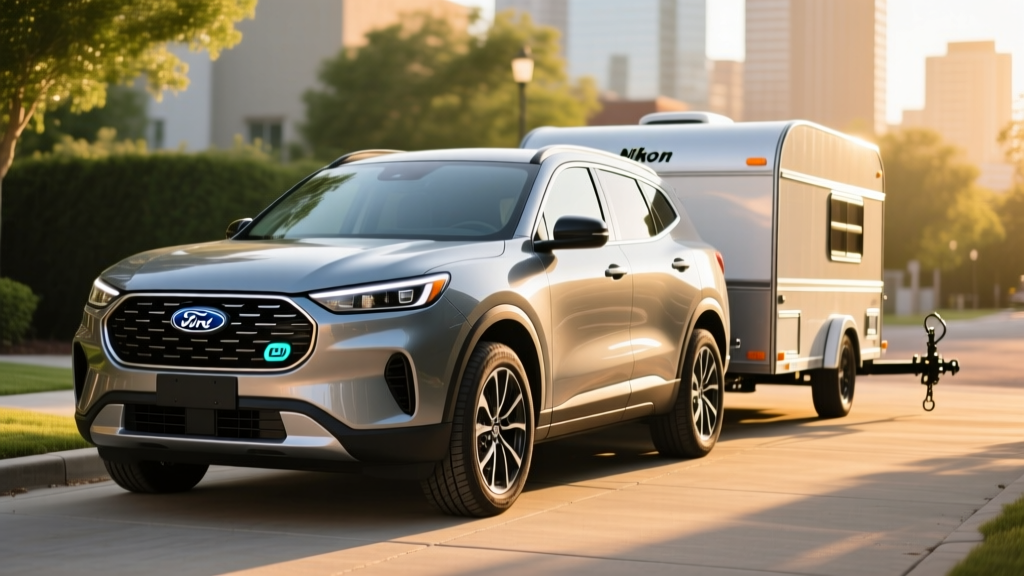
- Lightweight pop-up camper (e.g., Aliner or similar, ~1,200–1,700 lbs dry)
- Small motorcycle trailer with one or two bikes (~1,000–1,500 lbs)
- Landscaping trailer with a riding mower (~1,500–1,800 lbs)
What it does NOT cover: most travel trailers, enclosed car haulers, large boat trailers, or any load exceeding 2,000 lbs gross trailer weight. If your typical tow exceeds this, the EcoBoost AWD with the 4K Tow Package (4,000 lbs) is the correct Maverick configuration — or consider stepping up to an F-150.
When towing, Ford requires the Class II trailer hitch receiver (included with the tow package) and a 4-pin wiring harness. The Maverick Hybrid does not offer an integrated trailer brake controller, so trailers with electric brakes require an aftermarket controller installed in the cab.
Pros, Cons & Who Should Buy the Maverick Hybrid
Pros
- 42 MPG city / 37 MPG combined — best-in-class truck efficiency
- $27,495 starting price undercuts most compact SUVs
- 1,500-lb payload still very useful for a truck this size
- eCVT durability — no traditional transmission wear components
- 8-year/100,000-mile hybrid battery warranty (10/150k in CARB states)
- No plug-in, no charging infrastructure needed
Cons
- 2,000-lb tow limit — half of the EcoBoost's 4,000-lb max
- FWD only — no AWD option on the hybrid
- No federal or state tax credit eligibility
- 33 MPG highway is merely average (city is where hybrids shine)
- No integrated trailer brake controller option
- 191 hp combined feels modest when loaded or merging uphill
Decision Framework
Choose the Maverick Hybrid if: You want a truck for occasional light hauling and daily commuting, prioritize fuel cost savings over towing capacity, live in an urban or suburban area where FWD is sufficient, and don't want to manage any charging logistics.
Choose the Maverick EcoBoost AWD if: You need 4,000-lb towing, want all-wheel drive for snow or dirt roads, or regularly drive in hilly terrain where the turbo's 277 lb-ft of torque outperforms the hybrid's 191 hp system.
Choose a full EV truck (F-150 Lightning, Rivian R1T) if: You have home Level 2 charging, your daily driving is under 250 miles, you want zero tailpipe emissions, and you can absorb a significantly higher purchase price ($55,000+).
Frequently Asked Questions
How many MPG does the 2025 Ford Maverick Hybrid get?
The EPA rates the 2025 Maverick Hybrid at 42 MPG city, 33 MPG highway, and 37 MPG combined. In real-world driving, city mileage often exceeds the EPA estimate thanks to regenerative braking, while sustained highway driving above 70 mph may return 30–32 MPG. Towing reduces combined MPG to roughly 18–25 depending on trailer weight and conditions.
Can the Maverick Hybrid tow a camper or boat?
Yes, but only lightweight ones. The 2,000-lb maximum covers small pop-up campers (under ~1,700 lbs dry), personal watercraft on a dual trailer, and small utility trailers. Most hard-sided travel trailers and larger boats exceed this limit. For heavier towing, the EcoBoost AWD with the 4K Tow Package handles up to 4,000 lbs.
Does the Ford Maverick Hybrid need to be plugged in?
No. The Maverick Hybrid is a conventional HEV — its 1.1 kWh battery recharges automatically through regenerative braking and the gasoline engine. There is no charging port, no plug, and no electric-only driving mode. You operate it exactly like a standard gasoline vehicle.
Is the Maverick Hybrid reliable, and what does battery replacement cost?
Ford's hybrid powertrain has a strong reliability track record spanning the Escape Hybrid, Fusion Hybrid, and now the Maverick. The eCVT has no wearable friction components. The hybrid battery is warrantied for 8 years/100,000 miles (10 years/150,000 miles in CARB states). Out-of-warranty replacement typically costs $2,000–$4,000, but shallow-cycle usage means most hybrid batteries last the life of the vehicle.
Does the 2025 Maverick Hybrid qualify for a federal tax credit?
No. The IRS §30D clean vehicle credit applies only to plug-in vehicles (BEVs and PHEVs) with battery packs of at least 7 kWh. The Maverick Hybrid's 1.1 kWh pack and conventional HEV architecture make it ineligible for the federal credit and most state EV incentive programs. Budget accordingly — the purchase price you see is the price you pay, minus any conventional vehicle trade-in or financing incentives.
Is the Maverick Hybrid available with all-wheel drive?
No. For the 2025 model year, the Maverick Hybrid is offered exclusively with front-wheel drive. If AWD is a priority — for snow, gravel roads, or trailering in low-traction conditions — you'll need the 2.0L EcoBoost engine, which pairs with an available AWD system across all trims.