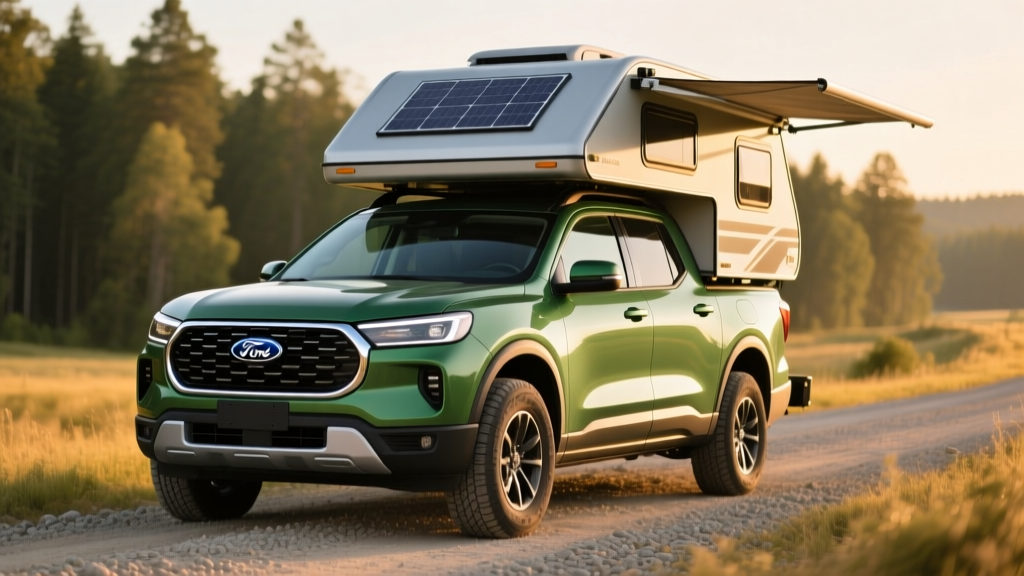
If you have been searching for a 2025 Ford Maverick Hybrid w topper configuration — a compact hybrid pickup wearing a camper shell or hard tonneau — you are not alone. The Maverick Hybrid has become the default compact truck for buyers who want real cargo utility without the fuel bill of a full-size pickup, and adding a topper turns the 4.5-foot bed into a weather-sealed cargo pod that is close to SUV-like in practicality. This guide covers what the 2025 Maverick Hybrid actually delivers in EPA and real-world MPG with a topper installed, how the hybrid powertrain behaves under load, what you give up in payload, and whether the math still beats a gas-only Maverick, a small SUV, or a full EV for your use case.
HEV vs PHEV vs EV: Where the Maverick Hybrid Fits
Before getting into the numbers, it is worth being precise about what the Maverick Hybrid is — and what it is not. Ford sells the Maverick Hybrid as a conventional hybrid (HEV). There is no plug, no EV-only driving mode of any meaningful distance, and no larger traction battery you can charge from a wall outlet. It recovers energy under braking and coasting, stores it in a small lithium-ion pack, and uses that energy to assist the gasoline engine or drive the front wheels at low speed. You never plug it in; you just fill it with regular unleaded.
| Attribute | HEV (Maverick Hybrid) | PHEV (e.g., RAV4 Prime, Tucson PHEV) | BEV (e.g., Rivian R1T, F-150 Lightning) |
|---|---|---|---|
| Plug-in charging | No | Yes (Level 1/2) | Yes (Level 1/2/DC) |
| Electric-only range | ~1 mi low-speed creep | 30–42 mi typical | 230–400 mi |
| Battery size | ~1.1 kWh usable | 15–20 kWh usable | 75–135 kWh usable |
| Refuel / recharge | Gas only | Gas + plug | Plug / DC only |
| Federal §30D credit | No | Up to $7,500 if eligible | Up to $7,500 if eligible |
The Maverick Hybrid does not compete with the F-150 Lightning or Rivian R1T on capability. It competes with small crossovers and midsize sedans on running cost, while offering a bed. If you need 30+ miles of electric commuting, look at a PHEV SUV. If you want zero tailpipe emissions and have home charging, look at a BEV. If you want a truck bed, low fuel cost, and zero lifestyle change around charging, the Maverick HEV is the narrow lane it occupies — and occupies well.
Powertrain: 2.5L Atkinson-Cycle Hybrid, FWD Only
The 2025 Maverick Hybrid pairs a 2.5-liter Atkinson-cycle four-cylinder with a permanent-magnet electric motor through Ford's e-CVT power-split transaxle. Combined output is 191 horsepower, routed exclusively to the front wheels — AWD is not offered on the Hybrid trim. The traction battery is a small lithium-ion pack (approximately 1.1 kWh usable), mounted under the rear seat, which is why the Hybrid gives up a small amount of under-seat storage compared to the EcoBoost models.
| Spec | Value |
|---|---|
| Engine | 2.5L Atkinson-cycle I-4 |
| Electric motor | Permanent-magnet, integrated in transaxle |
| Combined output | 191 hp |
| Transmission | e-CVT (power-split) |
| Drivetrain | FWD only (no AWD on Hybrid) |
| Traction battery | ~1.1 kWh usable, lithium-ion |
| Towing (max, properly equipped) | 2,000 lb (no 4K Tow pkg on Hybrid) |
| Bed length | 4.5 ft (54.4 in) |
| Fuel tank | 16.5 gal |
Two things to internalize before you buy. First, the Hybrid is FWD-only, which matters for traction on boat ramps, snow, and loose gravel — a topper adds weight over the rear axle, which can actually help rear grip modestly, but this is still a front-driven truck. Second, the Hybrid does not offer the 4,000-lb tow package that is available on the 2.0L EcoBoost AWD models; you are capped at 2,000 lb.
EPA MPG and Real-World MPG With a Topper
According to fueleconomy.gov, the 2025 Ford Maverick Hybrid FWD is rated at 42 mpg city / 33 mpg highway / 37 mpg combined. The city number is unusually high for a truck because the power-split hybrid leans heavily on the electric motor at low speeds, where regenerative braking recovers energy that a conventional truck would waste as heat.
| Scenario | City | Highway | Combined |
|---|---|---|---|
| EPA sticker (no topper) | 42 | 33 | 37 |
| Real-world, no topper (owner-reported avg) | 40–45 | 30–34 | 35–39 |
| Real-world w/ hard fiberglass topper, mixed driving | 38–43 | 28–31 | 33–36 |
| Real-world w/ topper + 300 lb bed load, highway | — | 26–29 | 31–34 |
How much does a topper actually cost you in fuel economy? A hard fiberglass camper shell typically weighs 150–225 lb and adds a few inches of frontal area plus a small aero penalty at the bed-cab transition. On the Maverick Hybrid, the real-world hit is usually 1–3 mpg combined, skewing toward the highway side where aerodynamics matter more. In stop-and-go city driving, the regen-heavy hybrid system largely masks the added mass, and many owners report nearly unchanged city MPG with a topper installed. On a 70-mph highway run with a loaded bed, expect the low 30s rather than the mid-30s.
For context, a similarly sized gas-only compact SUV with AWD typically returns 24–28 mpg combined. Even with a topper and some cargo, the Maverick Hybrid still sips roughly 30–40% less fuel per mile in mixed driving.
Topper Options: What Fits the 4.5-Foot Bed
The Maverick's 4.5-foot bed is compact, which limits your topper choices compared to midsize trucks, but the aftermarket has caught up. The main categories:
- Hard fiberglass camper shells (ARE, LEER, SnugTop): 160–225 lb, $2,200–$4,200 installed. Best weather seal, best security, best for overlanding builds with a platform and mattress. Adds the most weight.
- Aluminum commercial shells (ARE Commercial, LEER work caps): 120–170 lb, $1,800–$3,000. Lighter, more utilitarian, good for tools and gear.
- Soft-to-hard folding tonneaus (BakFlip MX4, ROLL-N-LOCK): 50–80 lb, $600–$1,400. Minimal weight penalty, easy to remove, but no standing headroom or sleeping platform.
- Pop-up truck campers (Four Wheel Campers, Scout, Project M): 400–900 lb, $8,000–$20,000+. These push the Maverick Hybrid to its payload limit and are better matched to the EcoBoost AWD model.
For the Maverick Hybrid specifically, a hard fiberglass shell in the 175–200 lb range is the sweet spot: you get a sealed cargo area and a sleeping platform without eating too deeply into the truck's payload allowance or MPG.
Payload, GVWR, and What a Topper Does to Your Numbers
This is the section most Maverick Hybrid topper buyers skip, and it is the one that matters most. The 2025 Maverick Hybrid has a GVWR around 5,080 lb and a curb weight that varies by trim but sits in the ~3,670–3,750 lb range for the Hybrid. That leaves a payload window of roughly 1,300–1,410 lb on the door jamb sticker — the only number that legally matters for your specific truck.
| Item | Approx. Weight |
|---|---|
| Available payload (sticker, typical) | 1,350 lb |
| Hard fiberglass topper | –190 lb |
| Bed platform / drawer system | –80 lb |
| Two occupants (avg) | –360 lb |
| Remaining for gear, cooler, tools | ~720 lb |
You still have comfortable margin for weekend gear, a cooler, and a dog, but you are not loading 800 lb of lumber on top of a topper and two passengers. Always weigh your truck on a CAT scale with the topper installed and subtract from your door-jamb GVWR to know your exact number.
Pricing, Trims, and the Tax-Credit Question
For the 2025 model year, the Maverick Hybrid is available across the XL, XLT, Lobo, and Lariat trims. Base MSRPs (before destination) land roughly in the $27,000–$36,000 window depending on trim and options; a well-optioned Lariat Hybrid with a topper installed typically comes in around $37,000–$40,000 out the door once the shell is added.
If the tax credit is a hard requirement for your purchase math, you will need to look at a PHEV SUV (RAV4 Prime, Tucson PHEV, Wrangler 4xe) or a BEV — but none of those give you a truck bed in the Maverick's price and footprint class.
Reliability, Battery Warranty, and Replacement Cost
Ford covers the Maverick Hybrid's high-voltage battery and hybrid-specific components with a 8-year / 100,000-mile warranty (extended to 10 years / 150,000 miles in California-emissions states, which covers the hybrid battery on CARB-adopting states as well). This is in line with Toyota, Hyundai, and Honda hybrid coverage.
On reliability: Ford's 2.5L hybrid system is a mature design shared with the Escape Hybrid and has accumulated high mileage in taxi and fleet service. The power-split e-CVT has no traditional clutch packs or bands to wear out, which is a durability advantage over conventional automatics. The most common real-world complaints on early Mavericks (2022–2023) were 12-volt electrical gremlins and build-quality issues rather than hybrid powertrain failures.
| Item | Detail |
|---|---|
| Hybrid battery warranty | 8 yr / 100,000 mi (10/150k in CARB states) |
| Hybrid component warranty | 8 yr / 100,000 mi |
| Expected battery lifespan | 150,000–200,000+ mi typical for Li-ion HEV packs |
| Out-of-warranty replacement cost | $2,500–$4,500 (dealer), $1,500–$2,800 (independent hybrid shops) |
| Module-level repair | Often possible for $400–$900 per failed module |
Because the Maverick Hybrid's battery is small (~1.1 kWh) and operates in a shallow state-of-charge window (never fully full, never fully empty), degradation is slow. Most owners will trade the truck long before the hybrid battery becomes an issue. If it does fail out of warranty, independent hybrid specialists can often replace individual modules rather than the whole pack, keeping cost well below the dealer quote.
Who Should Buy the Maverick Hybrid With a Topper?
Pros
- 33–39 mpg combined real-world, even with a topper
- Lowest fuel cost per mile in the compact truck segment
- Sealed, secure cargo area with a hard shell — SUV-like utility
- Compact footprint, easy to park, tight turning radius
- No charging infrastructure needed — just gas it up
- Mature, proven power-split hybrid system
Cons
- FWD only — no AWD option on the Hybrid
- 2,000-lb max tow rating (no 4K package available)
- Payload margin tightens with heavy camper builds
- No federal tax credit (HEV, not PHEV/BEV)
- Small 4.5-ft bed limits pop-up camper compatibility
- Highway MPG drops more than city MPG with a topper
Choose the Maverick Hybrid w/ topper if: you commute 20–60 miles a day in mixed or city-heavy traffic, want a secure bed for gear or a dog, don't tow more than 2,000 lb, and have no desire to install home charging or plan road trips around DC fast chargers. It is the lowest-friction path to truck-bed utility with hybrid fuel economy.
Look at a PHEV SUV instead if: your commute is under 35 miles round-trip and you can charge at home — a RAV4 Prime or Tucson PHEV will run most daily miles on electricity with a backstop gas engine, and both qualify for partial or full federal credits depending on sourcing and income.
Look at a BEV truck instead if: you have reliable Level 2 home charging, your daily drive is under 200 miles, and you want the lowest per-mile energy cost plus instant torque. The F-150 Lightning and Rivian R1T are in a different price and size class, but the per-mile cost gap is real.
Frequently Asked Questions
How many MPG does the 2025 Ford Maverick Hybrid actually get with a topper?
EPA rates it at 42 city / 33 highway / 37 combined without a topper. With a hard fiberglass camper shell, expect roughly 38–43 city, 28–31 highway, and 33–36 combined in real-world mixed driving. City MPG holds up well thanks to regenerative braking; highway MPG takes the bigger hit from added weight and aero drag.
Does the Maverick Hybrid plug in or have electric-only range?
No. The Maverick Hybrid is a conventional HEV — it has no plug and no meaningful electric-only range (the truck can creep at very low speed on battery for short distances, but the engine starts almost immediately under any real load). You refuel it with regular 87-octane gasoline only.
Can I put a pop-up truck camper on the Maverick Hybrid?
You can, but you will be close to or over the truck's payload limit. Most pop-up campers weigh 400–900 lb dry, and the Maverick Hybrid's usable payload after occupants is typically 700–1,000 lb. A lightweight Scout or Project M on a lightly optioned Hybrid can work for two people with minimal gear, but the EcoBoost AWD model is a better match for camper duty.
Is the Maverick Hybrid reliable, and what does a battery replacement cost?
The 2.5L hybrid powertrain is a mature Ford design shared with the Escape Hybrid and has a strong fleet-service track record. The hybrid battery is warrantied for 8 years / 100,000 miles (10/150k in CARB states). Out-of-warranty full-pack replacement runs roughly $2,500–$4,500 at a dealer, but independent hybrid shops can often repair individual modules for $400–$900 each. Most packs last 150,000–200,000+ miles.
Does the 2025 Maverick Hybrid qualify for any federal tax credit?
No. The federal §30D Clean Vehicle Credit applies only to plug-in vehicles (PHEVs and BEVs). The Maverick Hybrid is a conventional HEV and does not qualify. Some states offer small hybrid rebates — check your state's energy office for current programs, as these change frequently.
How much does a topper reduce my Maverick Hybrid's payload?
A hard fiberglass camper shell typically weighs 160–225 lb. On a Maverick Hybrid with roughly 1,300–1,410 lb of rated payload, that leaves about 1,100–1,250 lb for occupants and gear before you add a bed platform, drawer system, or heavy cargo. Always check your specific door-jamb sticker for your truck's exact payload rating.