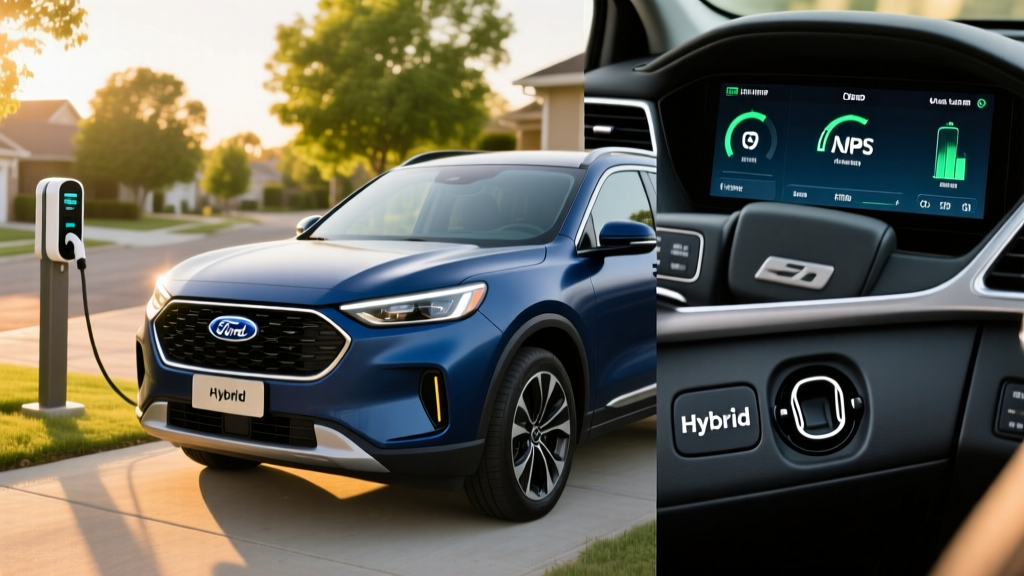
The Ford Maverick Hybrid has carved out a rare niche: a compact pickup that sips fuel like a midsize sedan while still offering a usable 4.5-foot bed and 1,500-pound payload capacity. For 2025, Ford has updated the Maverick with a refreshed interior, expanded standard safety tech, and a new Tremor off-road trim — but the hybrid powertrain remains the efficiency headline. If you've been searching for 2025 Ford Maverick hybrid gas mileage figures, this guide breaks down the EPA numbers, real-world expectations, powertrain details, and whether the hybrid or the new EcoBoost AWD setup is the smarter buy.
2025 Ford Maverick Hybrid MPG: EPA Estimates vs. Real-World Results
The 2025 Maverick Hybrid pairs a 2.5-liter Atkinson-cycle four-cylinder engine with an electric motor and a continuously variable transmission (CVT). Front-wheel drive is standard and, for 2025, Ford has finally added all-wheel drive availability to the hybrid — though AWD trims carry a slight fuel economy penalty.
| Drivetrain | City MPG | Highway MPG | Combined MPG | Total Range (est.) |
|---|---|---|---|---|
| FWD Hybrid | 42 | 35 | 38 | ~500 miles |
| AWD Hybrid (new for 2025) | 38 | 33 | 35 | ~460 miles |
Source: EPA Fuel Economy
Hybrid (HEV) vs. Plug-In Hybrid (PHEV) vs. Full EV: Which Fits Your Drive?
The Maverick Hybrid is a conventional hybrid (HEV), not a plug-in hybrid. That distinction matters because it defines how you interact with the vehicle daily.
HEV (Maverick Hybrid)
- No plug required — refuels at any gas station
- Small 1.1 kWh battery charges via regenerative braking and engine
- Best for: buyers without home charging access who want better MPG
PHEV (e.g., RAV4 Prime)
- Plugs in for 30–42 miles of electric-only driving
- Larger ~18 kWh battery; Level 2 charging in ~2.5 hours
- Best for: short commuters who can charge at home
BEV (e.g., Rivian R1T)
- 100% electric — no gasoline engine
- 250–400 mile range; DC fast charging capable
- Best for: buyers with reliable home/work charging and low range-anxiety tolerance
The Maverick Hybrid does not offer any electric-only driving mode beyond low-speed creeping (roughly 1–2 miles at under 25 mph on battery alone). If you want 30+ miles of gas-free commuting, you'd need to look at PHEV SUVs like the Toyota RAV4 Prime or Ford Escape PHEV — neither of which offers a truck bed.
Powertrain, Performance, and What the Numbers Mean
| Specification | Detail |
|---|---|
| Engine | 2.5L Atkinson-cycle inline-4 |
| Electric Motor | Permanent-magnet synchronous, integrated into transaxle |
| Combined System Horsepower | 191 hp |
| Combined System Torque | 155 lb-ft (engine) + electric motor assist |
| Transmission | Electronic CVT (eCVT) |
| Battery Capacity | 1.1 kWh (lithium-ion, not plug-in) |
| 0–60 mph | ~8.5 seconds (FWD) |
| Towing Capacity | 2,000 lbs (hybrid); 4,000 lbs with EcoBoost + tow package |
| Payload Capacity | 1,500 lbs |
| Drivetrain | FWD standard; AWD available (new 2025) |
The 191-hp combined output is adequate for daily driving and highway merging, but it won't win drag races against the turbocharged 2.0L EcoBoost (250 hp). The eCVT keeps the engine in its most efficient RPM band, which is great for fuel economy but produces the characteristic drone under hard acceleration that some drivers find objectionable. Around town, the electric motor fills in low-end torque smoothly, making the hybrid feel peppier in city traffic than the raw horsepower number suggests.
2025 Maverick Pricing and Tax Credit Eligibility
The 2025 Maverick Hybrid received a modest price increase over the outgoing model year. Here's the current MSRP breakdown by trim:
| Trim | MSRP | AWD Add-On |
|---|---|---|
| XL Hybrid | $27,995 | +$1,875 |
| XLT Hybrid | $29,995 | +$1,875 |
| Lobo (new sport trim) | $32,995 | N/A (FWD only) |
| Lariat Hybrid | $34,495 | +$1,875 |
Federal Tax Credit: The Maverick Hybrid is a conventional HEV — it does not qualify for the federal §30D clean vehicle tax credit. That credit (up to $7,500) is reserved for battery electric vehicles (BEVs) and plug-in hybrids (PHEVs) that meet battery sourcing, critical mineral, MSRP, and buyer income requirements per IRS guidelines. Conventional hybrids are excluded regardless of price.
Some states and municipalities offer smaller rebates for HEVs — check your local utility and state energy office for current programs, but don't count on it. The hybrid's value proposition is fuel savings, not incentive stacking.
Who Should Choose the Maverick Hybrid — and Who Shouldn't
Choose the Maverick Hybrid If:
- You drive primarily in city/suburban traffic (hybrids shine at low speeds)
- You want a truck bed but average 35+ MPG combined
- You lack access to home or workplace EV charging
- Your typical towing needs stay under 2,000 lbs
- You want lower fuel costs without changing your refueling habits
Look at the EcoBoost or a Full EV If:
- You regularly tow 3,000+ lbs (EcoBoost with tow package: 4,000 lbs)
- Most of your driving is highway at 75+ mph (hybrid advantage narrows)
- You want AWD with serious off-road capability (EcoBoost Tremor)
- You have home charging and want zero tailpipe emissions (consider the F-150 Lightning or Rivian R1T)
- You need brisk acceleration for mountain passes or loaded highway merges
5-Year Ownership Cost Snapshot: Hybrid vs. EcoBoost
Let's compare the real cost of owning the hybrid versus the turbocharged EcoBoost over five years and 75,000 miles, assuming $3.50/gallon regular unleaded and EPA combined MPG figures.
| Metric | Hybrid FWD (38 MPG) | EcoBoost AWD (25 MPG) |
|---|---|---|
| Gallons consumed (75,000 mi) | 1,974 gal | 3,000 gal |
| Fuel cost @ $3.50/gal | $6,909 | $10,500 |
| 5-year fuel savings (hybrid) | ~$3,591 | |
| Estimated maintenance (5 yr) | ~$2,800 | ~$3,200 |
| Insurance (avg. annual) | ~$1,650/yr | ~$1,700/yr |
The hybrid's fuel savings alone nearly cover its modest price premium over the EcoBoost in the first three years. Factor in slightly lower maintenance (no turbo, less brake wear from regen braking), and the hybrid becomes the clear financial winner for drivers who don't need the EcoBoost's extra towing and power.
Real-World Ownership Insights: What Spec Sheets Don't Tell You
The AWD hybrid trade-off is real but modest. Adding AWD costs you roughly 3 MPG combined and $1,875 at purchase. If you live in a snowy climate and need all-weather traction, the AWD hybrid is still far more efficient than the EcoBoost AWD (25 MPG combined). If you're in a mild climate, FWD saves fuel and money.
Highway efficiency is the hybrid's weak point. On a 400-mile road trip at 75 mph, expect 30–32 MPG with the FWD hybrid — good for a truck, but not dramatically better than some turbocharged competitors at highway speed. The hybrid's advantage is almost entirely in city and suburban driving.
The bed is functional but compact. At 4.5 feet, the Maverick's bed handles home improvement runs and weekend gear but won't fit full sheets of plywood flat between the wheel wells. If bed length is critical, the Hyundai Santa Cruz (4.3 ft) is shorter, but the Honda Ridgeline (5.3 ft) or midsize trucks are substantially longer — at the cost of fuel economy.
Charging is a non-issue. Because the Maverick Hybrid is an HEV, there's no plug, no charging cable, and no need for a Level 2 home charger. The 1.1 kWh battery charges itself through regenerative braking and the gasoline engine. You'll never think about it.
Frequently Asked Questions
How many MPG does the 2025 Ford Maverick Hybrid get?
The FWD Maverick Hybrid achieves 42 city / 35 highway / 38 combined MPG per the EPA. The new AWD hybrid drops to 38 city / 33 highway / 35 combined. Real-world city driving often exceeds the EPA estimate by 2–4 MPG thanks to regenerative braking, while sustained highway driving at 70+ mph typically yields 30–33 MPG (FWD).
Is the Maverick Hybrid a plug-in hybrid?
No. The Maverick Hybrid is a conventional hybrid (HEV). It cannot be plugged in, has no electric-only driving range beyond low-speed creeping, and refuels exclusively at gas stations. If you want a Ford plug-in hybrid, the closest option is the Escape PHEV (37 miles electric-only range) — but it's an SUV, not a truck.
Does the 2025 Maverick Hybrid qualify for a federal tax credit?
No. The federal §30D clean vehicle credit applies only to plug-in hybrids and battery electric vehicles. Conventional hybrids like the Maverick Hybrid are not eligible. Some state or utility programs may offer small HEV incentives, but these vary widely by location.
How long will the hybrid battery last?
Ford covers the hybrid battery for 8 years or 100,000 miles. Based on long-term data from the Escape Hybrid (which uses similar nickel-metal-hydride and lithium-ion architectures), most hybrid batteries last 150,000–200,000 miles before significant degradation. Full replacement outside warranty runs approximately $2,500–$4,000.
Can the Maverick Hybrid tow as much as the EcoBoost?
No. The hybrid is rated for 2,000 pounds of towing. The 2.0L EcoBoost with the 4K Tow Package handles up to 4,000 pounds. If you regularly tow a small camper, boat, or utility trailer, the EcoBoost is the better choice despite its lower fuel economy.
How does the Maverick Hybrid compare to the Hyundai Santa Cruz?
The Santa Cruz does not offer a hybrid powertrain. Its turbocharged 2.5L achieves roughly 22 city / 26 highway / 23 combined MPG — significantly less efficient than the Maverick Hybrid's 38 combined. The Santa Cruz does offer standard AWD and a slightly more refined ride, but for fuel-economy-focused truck buyers, the Maverick Hybrid has no direct competitor.