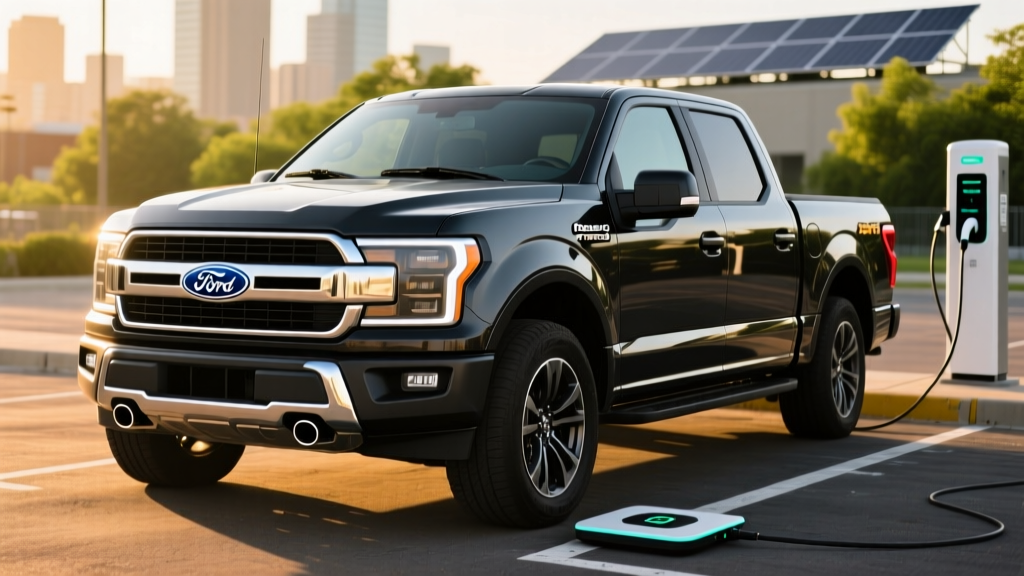
The full-size pickup segment hasn't gone electric overnight, and the 2025 Ford F-150 Hybrid — officially badged as the PowerBoost — is proof that electrification doesn't have to mean a charging cable. Ford's full hybrid system integrates a 35-kW (47-hp) electric motor between the engine and 10-speed transmission, powered by a compact 1.5 kWh lithium-ion battery pack tucked under the rear seat. The result: meaningful fuel economy gains, a built-in 7.2-kW onboard generator (Pro Power Onboard), and zero change to the F-150's bed, cabin, or towing credentials.
This guide covers everything a truck buyer needs to know about the 2025 F-150 PowerBoost — from EPA fuel economy and real-world MPG results to towing limits, pricing, reliability data, and how it stacks up against going full EV with the F-150 Lightning.
HEV vs PHEV: Where the F-150 PowerBoost Fits
Before diving into specs, it's essential to distinguish what this truck is — and what it isn't. The 2025 Ford F-150 PowerBoost is a conventional hybrid electric vehicle (HEV). It does not plug in. It has no electric-only driving range. The 1.5 kWh battery recharges exclusively through regenerative braking and the gasoline engine.
Conventional Hybrid (HEV)
- No plug — charges via regen and engine
- Battery: ~1-2 kWh (small buffer)
- Electric-only range: None (motor assists engine)
- Fuel economy benefit: 15-25% over gas-only
- Example: F-150 PowerBoost
Plug-In Hybrid (PHEV)
- Plugs into Level 1/2 charger
- Battery: 12-25+ kWh
- Electric-only range: 20-50 miles typical
- Fuel economy benefit: Massive if charged daily
- Example: Jeep Wrangler 4xe, Toyota RAV4 Prime
There is currently no plug-in hybrid (PHEV) version of the F-150. Ford's electrified truck lineup splits between the PowerBoost HEV and the fully electric F-150 Lightning BEV. If you need electric-only commuting in a Ford truck, the Lightning is the answer. If you need a gas engine with better fuel economy and no charging infrastructure required, the PowerBoost fills that gap.
Fuel Economy: EPA Ratings and Real-World MPG
The headline number for any hybrid buyer is fuel economy. Here's what the EPA rates the 2025 F-150 PowerBoost at, per fueleconomy.gov:
| Configuration | City | Highway | Combined |
|---|---|---|---|
| 4x2 (RWD) | 25 MPG | 26 MPG | 25 MPG |
| 4x4 (AWD) | 22 MPG | 24 MPG | 22 MPG |
Compared to the non-hybrid 3.5L EcoBoost V6 (EPA 20 MPG combined for 4x4), the PowerBoost saves roughly 2-3 gallons per 100 miles in mixed driving. At $3.50/gallon and 15,000 miles per year, that translates to approximately $350-$500 in annual fuel savings — not transformative, but meaningful over a 5-year ownership period.
Powertrain Specs: Engine, Motor, and Combined Output
| Spec | Value |
|---|---|
| Engine | 3.5L twin-turbo V6 (EcoBoost) |
| Electric Motor | 35 kW (47 hp), integrated in 10-speed transmission |
| Combined Horsepower | 430 hp |
| Combined Torque | 570 lb-ft |
| Battery | 1.5 kWh lithium-ion (under rear seat) |
| Transmission | 10-speed automatic |
| 0-60 MPH (est.) | ~5.5 seconds (4x4) |
| Max Towing Capacity | Up to 7,000 lbs (properly equipped, varies by config) |
| Max Payload | Up to ~1,740 lbs (varies by config) |
| Pro Power Onboard | 7.2 kW (standard on PowerBoost) |
The 430-hp combined output makes the PowerBoost the most powerful engine option in the F-150 lineup short of the high-output 3.5L in the Raptor. The 570 lb-ft of torque arrives low in the rev range thanks to the electric motor's instant contribution, which you'll notice immediately when pulling away from a stop with a loaded bed or merging onto a highway.
The 7.2-kW Pro Power Onboard generator is a standout feature included with every PowerBoost. It provides up to 7,200 watts through bed-mounted 120V and 240V outlets — enough to run a welder, circular saw, or the A/C and appliances in a camper simultaneously. This feature alone justifies the hybrid powertrain for contractors, job-site workers, and overlanders who need mobile power.
Pricing, Trims, and Tax Credit Eligibility
The PowerBoost hybrid is not available on the base XL trim. For the 2025 model year, it's offered on XLT (with specific packages), Lariat, King Ranch, Platinum, and Limited trims. Pricing is approximate and varies with options:
| Trim | Approx. Starting MSRP |
|---|---|
| XLT (w/ PowerBoost package) | ~$60,000 |
| Lariat | ~$65,000 |
| King Ranch | ~$72,000 |
| Platinum | ~$74,000 |
| Limited | ~$84,000+ |
The PowerBoost hybrid adds roughly $2,500-$4,400 over the equivalent non-hybrid 3.5L EcoBoost on the same trim, depending on configuration and package bundling.
Reliability, Battery Warranty, and Replacement Costs
Hybrid battery longevity is the number-one concern for buyers new to electrified powertrains. Here's what Ford backs the PowerBoost with:
Battery & Hybrid Component Warranty
- Hybrid battery: 8 years / 100,000 miles (whichever comes first)
- Hybrid-specific components (motor, inverter, control electronics): 8 years / 100,000 miles
- Powertrain warranty (engine, transmission): 5 years / 60,000 miles
- Bumper-to-bumper: 3 years / 36,000 miles
In California-emissions states (CA, CT, MA, ME, NY, and others adopting CARB standards), hybrid battery coverage extends to 10 years / 150,000 miles.
The 1.5 kWh battery in the PowerBoost is far smaller and less stressed than the packs in full EVs or PHEVs. It operates in a narrow state-of-charge window (roughly 30-70%), managed by the vehicle's thermal and charge controls to minimize degradation. Ford has used this hybrid architecture since the 2021 model year, and there have been no widespread battery failure reports as of 2025.
If the hybrid battery does require out-of-warranty replacement, expect a cost in the range of $2,500-$4,000 (parts and labor) at a Ford dealer — significantly less than a full EV battery replacement, which can exceed $10,000. The smaller battery size and simpler chemistry keep costs manageable. Third-party hybrid battery rebuilders may offer lower-cost options as the truck ages.
For general reliability, the 3.5L EcoBoost V6 is one of Ford's most proven engines, now in its third generation. The hybrid system adds complexity (an electric motor, inverter, and additional cooling circuits), but the motor itself has very few wear components. NHTSA and IIHS safety data should be checked for the specific model year as crash-test results are released.
Who Should Buy the F-150 PowerBoost — and Who Shouldn't
✅ Choose the PowerBoost If...
- You drive 15,000+ miles/year and want to cut fuel costs without plugging in
- You need mobile power (7.2 kW Pro Power Onboard is unmatched)
- You tow regularly but want slightly better fuel economy vs. gas-only
- You live in an area with limited or no charging infrastructure
- You want full F-150 bed, payload, and cabin utility with no compromises
❌ Look Elsewhere If...
- You want electric-only commuting — consider the F-150 Lightning or a PHEV SUV
- You want a federal tax credit — the PowerBoost doesn't qualify
- You drive mostly highway miles at high speed — the hybrid advantage shrinks
- You want maximum towing — the 3.5L EcoBoost with Max Tow package can tow up to ~13,000 lbs
- Budget is tight — the hybrid premium adds $2,500-$4,400 over gas-only
Hybrid vs PHEV vs Full EV — Decision Framework
F-150 PowerBoost (HEV): Best for truck buyers who need full capability, drive long or unpredictable routes, and have no home charging. Saves ~$350-$500/yr in fuel vs. gas-only. No plug, no behavior change required.
F-150 Lightning (BEV): Best for drivers with home Level 2 charging who commute daily, rarely tow heavy, and want the lowest operating cost (~$0.04-$0.06/mile on home electricity). 230-320 miles EPA range. Qualifies for the §30D tax credit (subject to income/MSRP/sourcing rules).
PHEV (no F-150 option currently): If Ford or another maker offered an F-150 PHEV with 30+ miles of electric range, it would suit daily commuters who can charge at home but need gas for weekend towing. For now, this category doesn't exist in the full-size truck segment.
Pros and Cons at a Glance
Pros
- 22-25 MPG combined — best-in-class for full-size trucks
- 430 hp / 570 lb-ft — strong acceleration and towing
- 7.2 kW Pro Power Onboard included standard
- No plug-in required — zero behavior change
- Full F-150 bed, cabin, and upfit compatibility
- 8-year/100k-mile hybrid warranty
Cons
- No federal tax credit eligibility
- $2,500-$4,400 price premium over gas-only EcoBoost
- Not available on base XL trim
- Towing capacity lower than max-tow EcoBoost configs
- Highway MPG advantage over gas-only is modest
- Small hybrid battery offers no electric-only driving
Frequently Asked Questions
How many MPG does the 2025 F-150 Hybrid get?
The EPA rates the 2025 F-150 PowerBoost at 22 MPG combined (22 city / 24 highway) for 4x4 models and 25 MPG combined (25 city / 26 highway) for 4x2 models. In real-world mixed suburban driving, owners commonly see 23-27 MPG with the 4x4. Highway-only driving at 75+ MPH drops to around 20-22 MPG. Towing significantly reduces fuel economy to 12-15 MPG depending on trailer weight.
Does the F-150 Hybrid need to be plugged in?
No. The F-150 PowerBoost is a conventional hybrid (HEV). Its 1.5 kWh battery recharges entirely through regenerative braking and the gasoline engine. There is no charging port and no electric-only driving mode. You fuel it like any other gasoline truck.
Is the F-150 Hybrid reliable, and what does a battery replacement cost?
Ford's 3.5L EcoBoost engine is well-proven, and the hybrid system has been in production since 2021 with no widespread failure patterns. The hybrid battery is warranted for 8 years/100,000 miles (10 years/150,000 miles in CARB states). Out-of-warranty replacement is estimated at $2,500-$4,000 — far less than a full EV battery swap.
Does the 2025 F-150 Hybrid qualify for any tax credit?
No. Under current IRS §30D rules, only plug-in hybrids (PHEVs) with 7+ kWh of battery capacity and full battery-electric vehicles (BEVs) qualify for the federal Clean Vehicle Credit. The PowerBoost's 1.5 kWh battery does not meet the minimum threshold. Check your state's incentive programs for any local hybrid rebates.
How does the PowerBoost compare to the F-150 Lightning?
They serve different buyers. The PowerBoost offers 22-25 MPG, 7,000-lb towing, unlimited range via gas stations, and no charging requirement — ideal for rural drivers, heavy towers, and those without home charging. The Lightning offers 230-320 miles of electric range, dramatically lower fuel and maintenance costs, a frunk, and qualifies for the federal tax credit — ideal for commuters with home Level 2 charging who don't regularly tow heavy loads.
What is Pro Power Onboard and how much power does it provide?
Every F-150 PowerBoost includes the 7.2-kW Pro Power Onboard system as standard equipment. It provides up to 7,200 watts of continuous power through 120V and 240V outlets in the bed. This is enough to simultaneously run power tools on a job site, power a camper's appliances, or serve as emergency backup power for essential home circuits during an outage (with proper transfer equipment). The system draws from the hybrid battery and gasoline engine, so it can run for extended periods as long as fuel is available.