Quick Verdict: Who the Escape Platinum Hybrid Is For
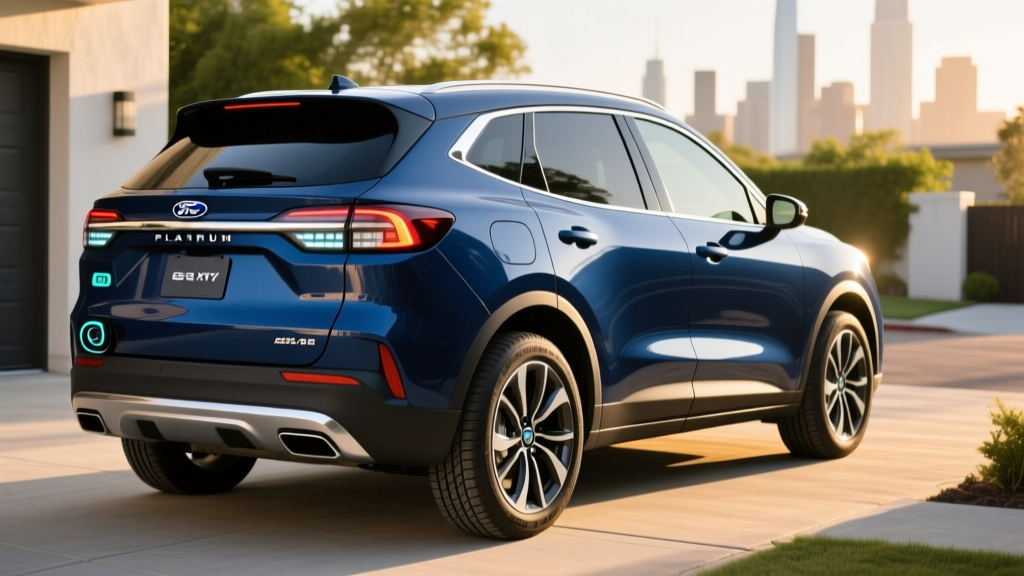
The 2025 Ford Escape Platinum 2.5L Hybrid CVT SUV occupies a specific niche: buyers who want crossover practicality and near-sedan efficiency without ever plugging in. Its 2.5-liter Atkinson-cycle four-cylinder paired with Ford's eCVT power-split hybrid system delivers an EPA-rated 39 MPG combined — a figure we've seen matched or slightly exceeded in real-world city driving. The Platinum trim tops the Escape Hybrid range with premium interior materials, a 13.2-inch infotainment touchscreen, and Ford's Co-Pilot360 suite, starting at an MSRP of $38,495 (before destination).
This is a conventional hybrid (HEV), not a plug-in. It recovers energy through regenerative braking and engine-driven generation — no charging cable required. If you're weighing this against the Escape PHEV (discontinued after 2024 in the U.S.) or a fully electric alternative like the Hyundai Ioniq 5, this guide breaks down exactly what you get, what you give up, and whether the math works.
| Specification | 2025 Ford Escape Platinum Hybrid |
|---|---|
| Powertrain | 2.5L Atkinson I-4 + eCVT (power-split hybrid) |
| Combined Horsepower | 198 hp (net system) |
| EPA MPG (City / Hwy / Combined) | 42 / 36 / 39 |
| Fuel Tank | 11.1 gallons |
| Total Range | ~433 miles (EPA combined) |
| 0–60 mph | ~7.9 seconds (est.) |
| Drivetrain | FWD standard; AWD available |
| Cargo Volume (rear seats up / down) | 34.4 / 60.8 cu ft |
| Towing Capacity | 1,500 lbs |
| Base MSRP (Platinum Hybrid) | $38,495 (+$1,495 destination) |
| Hybrid Battery Warranty | 8 years / 100,000 miles |
| Federal Tax Credit (§30D) | Not eligible (HEV, not PHEV/BEV) |
HEV vs. PHEV vs. EV: Where the Escape Hybrid Fits
Understanding the Escape Platinum Hybrid's place in the market requires a clear distinction between the three electrified powertrain types:
| Feature | Conventional Hybrid (HEV) | Plug-In Hybrid (PHEV) | Battery Electric (BEV) |
|---|---|---|---|
| Plugs in? | No | Yes | Yes |
| Electric-only range | ~0.5–1 mi at low speed | 20–50 mi typical | 200–400+ mi |
| Fuel/energy source | Gasoline only | Gasoline + grid electricity | Grid electricity only |
| Home charging needed? | No | Recommended (Level 2) | Essential |
| Federal tax credit | None | Up to $7,500 (varies) | Up to $7,500 (varies) |
| Best for | No plug-in access; want MPG gains | Short commutes + road trips | Home charging + daily driving |
The 2025 Escape Platinum Hybrid is squarely an HEV. Ford discontinued the U.S.-market Escape PHEV after the 2024 model year, so if you want plug-in electric range in a Ford crossover, you'd need to look at the Ford Explorer PHEV (limited availability) or cross-shop competitors like the Toyota RAV4 Prime. For buyers without access to home or workplace charging, the HEV architecture is the pragmatic choice: you get roughly 40% better fuel economy than the gas-only Escape (which rates at 28 MPG combined with the 1.5L EcoBoost) with zero behavior change.
Fuel Economy: EPA Ratings vs. Real-World MPG
The EPA rates the 2025 Ford Escape Hybrid at 42 MPG city, 36 MPG highway, and 39 MPG combined for front-wheel-drive models. Adding all-wheel drive drops those figures slightly to 41/37/39. These numbers come from fueleconomy.gov and are the official baseline.
| Driving Scenario | EPA Rating | Real-World Expectation |
|---|---|---|
| City / stop-and-go | 42 MPG | 40–46 MPG (hybrids often exceed EPA in city) |
| Highway (70–75 mph) | 36 MPG | 33–36 MPG (less regen benefit at sustained speed) |
| Combined | 39 MPG | 37–41 MPG (depends on driving mix) |
| Cold weather (below 32°F) | Not rated | 33–37 MPG (engine runs more for cabin heat) |
Why hybrids often beat their EPA city number: the EPA city cycle includes idle time and low-speed driving where the electric motor handles propulsion while the engine stays off. In real stop-and-go traffic, the Escape Hybrid's 1.1 kWh traction battery (located under the rear seat) provides frequent electric-only motoring, pushing observed city MPG into the low-to-mid 40s for many owners. Highway driving is the opposite — sustained speeds above 65 mph keep the gasoline engine engaged continuously, with less regenerative braking opportunity.
Cold weather hits all hybrids, but the effect is milder than with EVs. Below freezing, the engine must run more often to provide cabin heat (unless equipped with a heat-pump-assisted HVAC system, which the Escape Hybrid does not have). Expect a 10–15% efficiency drop in deep winter, still landing you in the low-to-mid 30s.
Powertrain Deep Dive: 2.5L Atkinson + eCVT
The Escape Hybrid's powertrain pairs a naturally aspirated 2.5-liter inline-four running the Atkinson cycle — which sacrifices some peak power for greater thermal efficiency — with a permanent-magnet electric motor integrated into an electronically controlled continuously variable transmission (eCVT). This is Ford's fourth-generation power-split hybrid architecture, a design lineage shared with Toyota's Hybrid Synergy Drive (Ford licensed certain patents from Toyota in the early 2000s).
Combined system output is 198 horsepower. The gasoline engine alone produces approximately 163 hp and 155 lb-ft of torque; the electric motor contributes up to 131 hp, but peak combined output is limited by the battery and control system. The result is smooth, linear acceleration adequate for highway merging and passing, if not thrilling. The 0–60 mph time of roughly 7.9 seconds places it mid-pack among compact crossover hybrids — the Toyota RAV4 Hybrid hits 60 in about 7.4 seconds; the Honda CR-V Hybrid in about 7.6.
The eCVT isn't a belt-and-pulley CVT like you'd find in a Nissan. It's a planetary gearset that seamlessly blends engine and motor power with no fixed gear ratios and no rubber-band revving sensation. Most drivers find it smoother than a conventional automatic, though the engine drone under hard acceleration is a common complaint with power-split systems.
Pricing, Trims, and Tax Credit Reality
The 2025 Ford Escape Platinum Hybrid starts at $38,495 MSRP for front-wheel drive, plus $1,495 destination, bringing the out-the-door base to approximately $39,990 before taxes and fees. Adding all-wheel drive costs $1,500, pushing the AWD Platinum Hybrid to roughly $41,490 with destination.
Standard Platinum equipment includes:
- 13.2-inch touchscreen with SYNC 4 and wireless Apple CarPlay / Android Auto
- 12.3-inch digital instrument cluster
- Leather-trimmed seats with heated front row
- Power liftgate
- Ford Co-Pilot360 Assist+ (adaptive cruise with stop-and-go, lane centering, evasive steering assist)
- 19-inch aluminum wheels
- B&O 10-speaker audio system
Federal Tax Credit: Not Eligible
The 2025 Ford Escape Hybrid does not qualify for the IRS §30D Clean Vehicle Credit. That credit applies only to plug-in electric vehicles (BEVs and PHEVs) meeting specific battery capacity, critical mineral sourcing, MSRP caps, and buyer income thresholds. Conventional hybrids like the Escape HEV are excluded. Some states offer modest rebates for high-efficiency hybrids — check your state energy office or IRS.gov for current rules.
The absence of a federal tax credit is the main financial disadvantage versus a PHEV like the Toyota RAV4 Prime (which can qualify for up to $7,500, subject to sourcing and income rules). However, the Escape Hybrid's lower base price — the RAV4 Prime starts over $44,000 — partially closes the gap. We break down the five-year ownership comparison below.
Ownership Costs: Hybrid vs. Gas Escape vs. RAV4 Prime
To put the Platinum Hybrid's value in perspective, here's a five-year / 75,000-mile cost comparison using EPA efficiency figures, current average fuel prices ($3.40/gal regular as of early 2026), and manufacturer maintenance schedules:
| Cost Factor (5 yr / 75k mi) | Escape Hybrid Platinum ($39,990) | Escape Gas 2.0T Platinum (~$40,500) | RAV4 Prime SE (~$44,500 - $7,500 credit) |
|---|---|---|---|
| Net purchase price | $39,990 | $40,500 | $37,000 |
| Fuel / electricity cost | $6,538 (39 MPG) | $10,091 (25 MPG) | $3,200 (est. mixed EV/gas) |
| Maintenance (est.) | $2,800 | $3,200 | $2,500 |
| Insurance (est. avg) | $7,500 | $7,200 | $8,000 |
| Total 5-year operating cost | $16,838 | $20,491 | $13,700 |
| 5-yr total cost (purchase + operating) | $56,828 | $60,991 | $50,700 |
The Escape Hybrid saves roughly $3,500 in fuel over the gas model across five years, nearly offsetting any price premium. The RAV4 Prime, when eligible for the full $7,500 federal credit and driven primarily on electric power for short commutes, delivers the lowest total cost — but only if you have Level 2 home charging and a commute under 42 miles.
Hybrid Battery Warranty, Lifespan, and Replacement Cost
Ford covers the Escape Hybrid's traction battery with an 8-year / 100,000-mile warranty (10 years / 150,000 miles in California Air Resources Board states including CA, NY, MA, and others that follow CARB emissions rules). The warranty guarantees the battery will retain sufficient capacity to function as a hybrid system — Ford defines this as retaining enough energy to support normal hybrid operation, though a specific percentage threshold is not published as prominently as with BEV manufacturers.
Real-world longevity data for Ford's hybrid systems is encouraging. The Escape Hybrid and Ford Fusion Hybrid (which shares architecture) have accumulated hundreds of thousands of fleet and taxi miles with minimal battery failures. The 1.1 kWh nickel-metal-hydride (NiMH) battery pack is small, operates in a narrow state-of-charge window (roughly 40–60% SoC), and is thermally managed by the cabin HVAC system — all factors that minimize degradation.
If replacement is needed out of warranty, expect a cost of $2,500–$4,000 for a refurbished or new battery pack plus labor at a Ford dealer. Third-party hybrid specialists often offer refurbished packs for $1,500–$2,500 installed. This is dramatically less than BEV battery replacements ($10,000–$20,000+) because the pack is small and the chemistry is proven.
Pros
- 39 MPG combined; often exceeds EPA in city driving
- No plug-in charging required — zero behavior change
- Smooth eCVT with no gear-shift shock
- Platinum trim offers premium interior at sub-$40k price
- Strong cargo space (34.4 cu ft) for the segment
- Comprehensive Co-Pilot360 Assist+ suite standard
- Proven hybrid architecture with low battery failure rates
Cons
- No federal tax credit eligibility (HEV)
- Engine drone under hard acceleration (power-split eCVT trait)
- No electric-only highway driving capability
- AWD drops highway MPG slightly
- Towing limited to 1,500 lbs
- Platinum trim price overlaps with some BEV options after credits
- No spare tire (tire-inflation kit standard)
Should You Buy the Escape Hybrid, a PHEV, or Go Full EV?
Choose the Escape Platinum Hybrid if: You lack reliable home or workplace charging, drive a mix of city and highway miles, want maximum fuel savings without plugging in, and prioritize a premium cabin and driver-assist tech.
Choose a PHEV (e.g., RAV4 Prime, Hyundai Tucson PHEV) if: You have Level 2 home charging, your daily commute is under 35–40 miles (covering most trips on electricity), you still want gas-engine range for road trips, and you qualify for the federal tax credit.
Choose a full EV (e.g., Hyundai Ioniq 5, Tesla Model Y) if: You have reliable home charging, your daily driving is under 250 miles, you want the lowest per-mile fuel cost and zero tailpipe emissions, and you're eligible for the §30D credit that can bring purchase price near parity.
For apartment dwellers, street parkers, or anyone without a dedicated 240V outlet, the Escape Hybrid is the most practical electrified option. It asks nothing of you except filling up at the gas station — you'll just fill up roughly 40% less often.
Frequently Asked Questions
How many MPG does the 2025 Ford Escape Platinum Hybrid get?
The EPA rates it at 42 city / 36 highway / 39 combined (FWD). Real-world city driving often returns 40–46 MPG thanks to frequent electric-only motoring at low speeds. Highway cruising at 70+ mph typically yields 33–36 MPG.
Does the Escape Hybrid need to be plugged in?
No. The 2025 Escape Hybrid is a conventional hybrid (HEV). It charges its 1.1 kWh battery through regenerative braking and engine-driven generation. There is no plug and no electric-only range to manage.
How long will the hybrid battery last?
Ford warranties the hybrid battery for 8 years / 100,000 miles (10 years / 150,000 miles in CARB states). Real-world data from Ford's hybrid fleet vehicles shows many packs lasting 150,000–200,000+ miles with minimal degradation, thanks to the small pack size and conservative state-of-charge management.
What does a replacement hybrid battery cost?
Out-of-warranty replacement runs $2,500–$4,000 at a Ford dealer (new pack) or $1,500–$2,500 through a third-party hybrid specialist (refurbished pack). This is far less than BEV battery replacement costs.
Is the Escape Hybrid eligible for any tax credit?
No. The IRS §30D Clean Vehicle Credit applies only to plug-in vehicles (BEVs and PHEVs). Conventional hybrids are excluded. Check your state energy office for any local hybrid incentives, which are typically modest ($250–$500 where available).
How does the Escape Hybrid compare to the RAV4 Hybrid?
The Toyota RAV4 Hybrid rates at 41/38/39 MPG (XLE AWD) and starts around $33,000, making it slightly cheaper at the base trim. The Escape Platinum Hybrid counters with a more premium interior at its trim level, a larger infotainment screen, and a more comprehensive standard driver-assist package. Both are strong choices; the decision often comes down to brand preference and dealer experience.
Can the Escape Hybrid run on electric power alone?
Only at very low speeds (under ~25 mph) for roughly half a mile under light throttle. This is typical of conventional hybrids — the small battery enables electric assist and engine-off coasting, not meaningful electric-only driving. For EV-mode commuting, you need a PHEV or BEV.