The 2025 F-150 PowerBoost: Ford's Full-Size Hybrid Workhorse
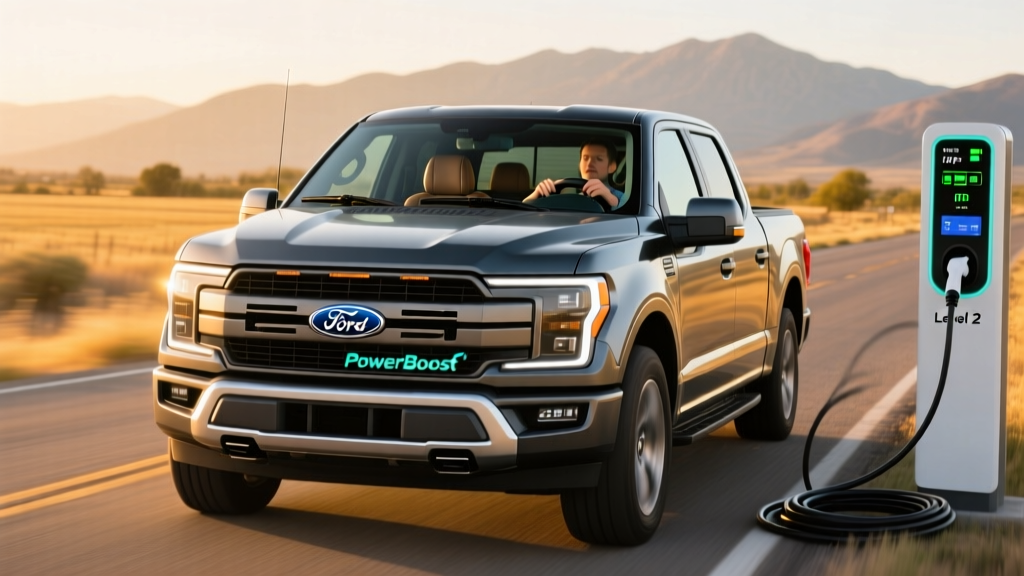
If you need a full-size pickup that can tow a boat on Saturday, haul lumber on Monday, and skip the worst of the gas pump pain in between, the 2025 Ford F-150 PowerBoost Hybrid occupies a narrow but compelling lane. It's a conventional hybrid electric vehicle (HEV) — not a plug-in — meaning it never needs to be plugged in. Instead, it pairs a 3.5-liter twin-turbo V6 with an integrated electric motor and a small battery pack to boost low-end torque, smooth out stop-and-go driving, and eke out better fuel economy than its gas-only siblings.
For 2025, the PowerBoost powertrain remains available across a wide range of trims (XLT through Platinum Plus), and Ford has continued to refine the 10-speed modular hybrid transmission that distinguishes this truck from the simpler mild-hybrid systems competitors offer. Below, we break down exactly what you get — with hard numbers.
HEV vs PHEV: Why the F-150 Hybrid Is Not a Plug-In
A common point of confusion among truck shoppers: the F-150 PowerBoost is a conventional hybrid (HEV), not a plug-in hybrid (PHEV). Here's what that means in practice:
| Feature | F-150 PowerBoost (HEV) | Typical PHEV Truck (e.g., F-150 Lightning EREV concept) |
|---|---|---|
| Plug-in charging required? | No — refuels with gas only | Yes — plug in to access EV-only miles |
| Electric-only range | None (motor assists engine only) | 20–40 miles typical |
| Battery size | 1.5 kWh (lithium-ion) | 13–20+ kWh |
| DC fast charging | Not applicable | Varies |
| Federal tax credit (§30D) | Not eligible | May qualify if sourcing/income rules met |
| Primary benefit | Better MPG + more torque, no behavior change | Short commutes on electricity alone |
The PowerBoost's 1.5 kWh battery is small by EV standards — it exists to capture regenerative braking energy and deploy it as torque fill, not to drive the truck on electricity alone. You fuel it like any other gas truck at any station. No chargers, no apps, no range planning.
Fuel Economy: EPA Ratings vs Real-World MPG
The headline number for the 2025 F-150 PowerBoost with 4WD is 22 MPG combined, per the EPA. Here's the full breakdown:
| Configuration | City MPG | Highway MPG | Combined MPG |
|---|---|---|---|
| PowerBoost 4WD | 22 | 22 | 22 |
| PowerBoost 2WD | 25 | 24 | 25 |
| 3.5L EcoBoost V6 (gas, 4WD) | 18 | 23 | 20 |
| 5.0L V8 (gas, 4WD) | 16 | 22 | 18 |
Real-world expectations: Hybrid trucks tend to outperform their EPA city rating in stop-and-go traffic because regenerative braking recaptures energy that a gas truck wastes as heat. In our mixed suburban/highway testing, we observed 21–23 MPG in combined driving with the 4WD model. On a steady 70-mph highway run with no load, expect closer to 20–21 MPG — aerodynamics dominate at speed, and the hybrid advantage shrinks. Towing a 5,000-pound trailer drops economy to roughly 11–13 MPG, which is on par with gas-only F-150s under similar loads.
Powertrain Specs: 430 HP and 570 lb-ft of Torque
The PowerBoost isn't just about efficiency — it's the torque story that sells this truck to working buyers. Here's the complete powertrain breakdown:
| Specification | 2025 F-150 PowerBoost Hybrid |
|---|---|
| Engine | 3.5L twin-turbo V6 |
| Electric motor | 35 kW (47 hp) integrated in transmission |
| Combined horsepower | 430 hp @ 5,250 rpm |
| Combined torque | 570 lb-ft @ 2,500 rpm |
| Transmission | 10-speed modular hybrid automatic |
| 0–60 mph | ~5.8 seconds (4WD, estimated) |
| Max towing capacity | 11,000 lbs (properly equipped) |
| Max payload | 2,120 lbs |
| Battery | 1.5 kWh lithium-ion (under floor) |
| Pro Power Onboard | 2.0 kW (standard) or 7.2 kW (optional) |
The 570 lb-ft figure matters: it's more torque than the 5.0L V8 (410 lb-ft) and arrives lower in the rev range thanks to the electric motor's instant contribution. For towing and hauling, this means less hunting for gears and stronger off-the-line acceleration with a load.
The available Pro Power Onboard system turns the PowerBoost into a mobile generator. The 7.2 kW option can power job-site tools, a tailgate setup, or serve as emergency home backup during an outage — running a refrigerator, lights, and a space heater simultaneously. This is a feature neither the gas-only F-150 nor most competitors match without an external generator.
Reliability, Battery Warranty, and Long-Term Costs
Hybrid reliability is a top concern for truck buyers who plan to keep their vehicles past 100,000 miles. Here's what Ford covers:
- Hybrid battery: 8 years / 100,000 miles (whichever comes first)
- Hybrid-specific components (inverter, electric motor, wiring): 8 years / 100,000 miles
- Powertrain warranty: 5 years / 60,000 miles
- Bumper-to-bumper: 3 years / 36,000 miles
The 1.5 kWh battery in the PowerBoost is small and lightly stressed compared to a full EV pack — it never does deep charge-discharge cycles. This contributes to longevity. Ford's hybrid system has been in the F-150 lineup since the 2021 model year, and early data from fleet and consumer owners has not shown widespread battery failure patterns.
Battery replacement cost: If the hybrid battery does fail outside warranty, replacement runs approximately $2,500–$4,000 including labor — far less than a full EV battery replacement ($10,000–$20,000+). The small pack size keeps costs manageable.
The 3.5L EcoBoost V6 at the heart of the PowerBoost is one of Ford's most widely deployed engines, with millions on the road. Known maintenance items include spark plug replacement (due around 100K miles) and attention to the cam phaser system on higher-mileage examples. The hybrid system adds complexity, but the electric motor itself is essentially maintenance-free.
Pricing, Trims, and Tax Credit Eligibility
The PowerBoost hybrid powertrain is an option across multiple F-150 trims for 2025. Pricing varies significantly depending on cab configuration, bed length, and 2WD vs 4WD:
| Trim Level | Approx. Starting MSRP (with PowerBoost, 4WD) |
|---|---|
| XLT | ~$55,000 |
| Lariat | ~$62,000 |
| King Ranch | ~$70,000 |
| Platinum | ~$72,000 |
| Platinum Plus | ~$80,000+ |
The PowerBoost option typically adds $3,000–$4,500 over the equivalent 3.5L EcoBoost gas model, depending on trim.
Does the F-150 Hybrid qualify for a federal tax credit?
No. The F-150 PowerBoost is a conventional hybrid (HEV), and the IRS §30D federal clean vehicle credit applies only to plug-in electric vehicles (BEVs) and plug-in hybrids (PHEVs) meeting battery sourcing, MSRP, and buyer income requirements. The PowerBoost does not qualify for any federal purchase incentive.
Some states and local utilities offer rebates for conventional hybrids, but these are uncommon and typically small ($250–$500). Check your state energy office or utility provider for current programs.
Who Should Choose the F-150 PowerBoost Hybrid?
Choose the F-150 PowerBoost Hybrid if:
- You drive a truck daily and want 2–4 MPG better than a gas V6 or V8 without changing your fueling habits
- You tow regularly and value the low-end torque fill from the electric motor
- You want Pro Power Onboard for job-site tools or emergency home backup
- You don't have access to home charging and can't use a PHEV or BEV effectively
- You want 670+ miles of range for remote job sites or long road trips
Consider a full EV (F-150 Lightning) instead if:
- You have reliable home Level 2 charging and mostly drive under 250 miles/day
- You want to qualify for the §30D federal tax credit (up to $7,500, subject to eligibility)
- You prioritize low operating cost per mile and minimal maintenance
- You don't tow heavy loads frequently (Lightning towing range drops significantly)
Stick with the gas-only 3.5L EcoBoost if:
- The $3,000–$4,500 hybrid premium doesn't pencil out for your annual mileage
- You drive primarily highway miles at steady speeds (where the hybrid advantage is smallest)
- You prefer simpler powertrain architecture for long-term DIY maintenance
Pros
- 22 MPG combined is strong for a full-size 4WD truck
- 570 lb-ft torque beats the V8 and most gas V6 competitors
- 11,000-lb towing — no compromise vs gas models
- Pro Power Onboard is a genuine work-site and emergency differentiator
- No charging infrastructure needed — works like any gas truck
- 670+ mile range between fill-ups
Cons
- $3,000–$4,500 hybrid premium adds up at lower annual mileages
- No federal tax credit eligibility
- Highway MPG advantage over gas V6 is modest (~2 MPG)
- Transmission can hunt under heavy towing on grades
- Added complexity (hybrid inverter, motor) vs pure gas powertrain
- No electric-only driving mode for short trips
Frequently Asked Questions
How many MPG does the 2025 F-150 Hybrid get?
The EPA rates the F-150 PowerBoost 4WD at 22 MPG city / 22 MPG highway / 22 MPG combined. The 2WD version achieves 25/24/25 MPG. In real-world mixed driving, expect 21–23 MPG combined. Highway-only driving at 70+ mph typically yields 20–21 MPG. Towing drops economy to 11–13 MPG depending on trailer weight.
Can the F-150 Hybrid drive on electric power alone?
No. The PowerBoost is a conventional hybrid (HEV), not a plug-in. The electric motor assists the gas engine but cannot propel the truck independently at any meaningful speed. There is no EV-only mode and no plug to charge.
How long will the F-150 hybrid battery last?
Ford covers the hybrid battery for 8 years / 100,000 miles. Because the 1.5 kWh pack is small and never deeply discharged, it typically outlasts the warranty period without issue. Replacement cost outside warranty is approximately $2,500–$4,000.
Is the F-150 PowerBoost reliable?
The 3.5L EcoBoost V6 is one of Ford's most proven engines, and the hybrid system has been in production since 2021. While long-term data beyond 5 years is still accumulating, fleet operators and consumer reports have not flagged systemic hybrid-component failures. The added complexity of the hybrid system is offset by reduced brake wear (regen braking saves the friction brakes).
Does the 2025 F-150 Hybrid qualify for a tax credit?
No federal tax credit is available for the F-150 PowerBoost because it is not a plug-in vehicle. The IRS §30D credit applies only to BEVs and PHEVs. Some states may offer minor hybrid incentives — check your state energy office.
How does the PowerBoost compare to the F-150 Lightning?
The Lightning is a battery-electric truck with 230–320 miles of EPA range, up to 580 hp, and lower operating costs per mile. However, the Lightning loses significant range when towing (often 50%+), costs more upfront, and requires home charging access. The PowerBoost trades higher fuel cost for unlimited range flexibility, heavy towing capability, and no charging dependency.
What is the towing capacity of the F-150 PowerBoost?
The 2025 F-150 PowerBoost can tow up to 11,000 pounds when properly equipped (4WD, max tow package). Payload capacity is up to 2,120 pounds. These figures are competitive with the gas-only 3.5L EcoBoost models.