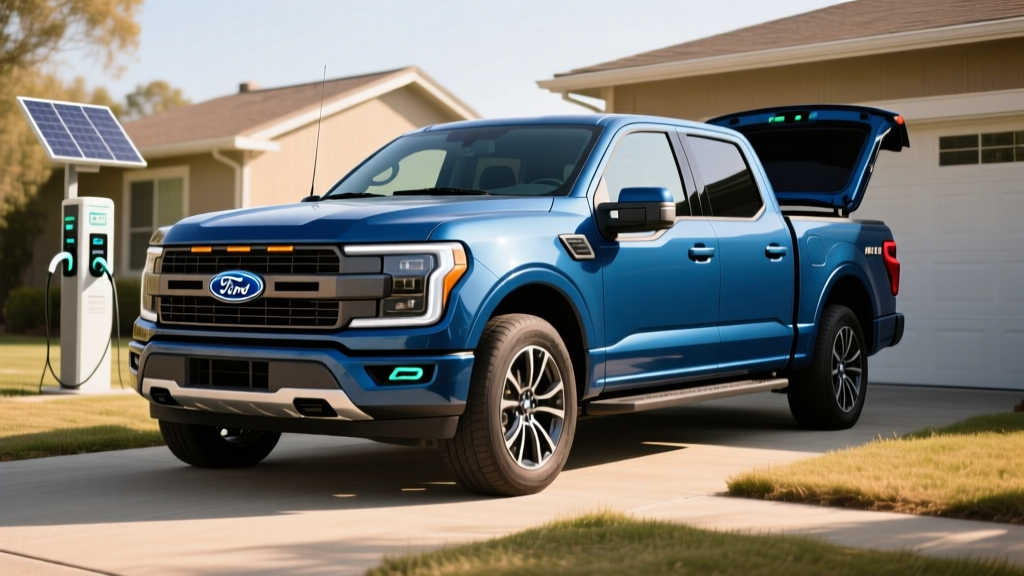
The Ford F-150 has been America's best-selling truck for decades, but the 2025 F-150 Hybrid — officially the 3.5L PowerBoost Full Hybrid — asks a different question: can a full-size pickup deliver V8-class towing and payload while sipping fuel like a midsize sedan? After examining EPA data, real-world owner reports, and Ford's latest powertrain specs, the answer is a qualified yes — with important caveats about where those fuel savings actually show up.
This guide covers everything a truck buyer needs to evaluate the 2025 F-150 PowerBoost Hybrid: exact EPA and real-world MPG, the twin-turbo V6 plus electric motor powertrain, battery durability and warranty, pricing by trim, federal tax credit eligibility, and how it stacks up against going full EV (F-150 Lightning) or sticking with a conventional gas engine.
HEV vs PHEV vs EV: Where the F-150 PowerBoost Fits
Before evaluating specs, it's critical to understand what the 2025 F-150 Hybrid is — and what it isn't. Ford offers three distinct F-150 powertrains, and confusing them is a common buyer mistake.
| Powertrain | Type | Plug In? | Electric-Only Range | EPA Combined |
|---|---|---|---|---|
| 3.5L PowerBoost Full Hybrid | HEV (conventional hybrid) | No | ~1 mile at low speed | 22-25 MPG |
| 3.5L EcoBoost V6 | Gasoline (ICE) | No | N/A | 19-21 MPG |
| F-150 Lightning | BEV (battery electric) | Yes | 230-320 mi (full electric) | 68-78 MPGe |
The PowerBoost is a conventional hybrid (HEV). It has a small battery that charges itself through regenerative braking and the engine — you never plug it in. It is not a plug-in hybrid (PHEV), which would offer 20-40 miles of electric-only driving before the gas engine kicks in. Ford does not currently offer an F-150 PHEV in the US market.
This matters for two reasons: you cannot charge the PowerBoost at home (so there's no home-charging installation cost to worry about), and it does not qualify for the federal §30D new clean vehicle tax credit, which requires a minimum battery capacity and plug-in capability.
2025 F-150 PowerBoost Hybrid: Full Spec Sheet
| Engine | 3.5L twin-turbocharged V6 |
| Electric Motor | 35 kW (47 hp) integrated into 10-speed automatic transmission |
| Combined Output | 430 hp / 570 lb-ft torque |
| Hybrid Battery | 1.5 kWh lithium-ion (not plug-in) |
| Transmission | 10-speed automatic (modular hybrid) |
| Drivetrain | RWD or 4WD (4x4 available on all hybrid trims) |
| Max Towing Capacity | 11,200 lbs (properly equipped, 4x2) |
| Max Payload | 2,120 lbs (varies by configuration) |
| Pro Power Onboard | Standard 2.0 kW; optional 7.2 kW |
| 0-60 mph | ~5.8 seconds (4x4, estimated) |
| Hybrid Battery Warranty | 8 years / 100,000 miles |
| Powertrain Warranty | 5 years / 60,000 miles |
The 1.5 kWh battery is small by EV standards — it's roughly 1/50th the size of an F-150 Lightning pack — but it's exactly the right size for a conventional hybrid. It captures energy during braking, provides electric assist during acceleration, and enables brief engine-off coasting and low-speed electric creep. The system never depletes the battery to a level that would stress its chemistry, which is key to longevity.
EPA Fuel Economy and Real-World MPG
Fuel economy is the primary reason buyers choose the PowerBoost over a conventional EcoBoost V6. Here are the official EPA figures from fueleconomy.gov:
| Configuration | City MPG | Highway MPG | Combined MPG |
|---|---|---|---|
| 4x2 (RWD) | 25 | 26 | 25 |
| 4x4 (4WD) | 23 | 24 | 23 |
Real-World MPG: What Owners Actually Report
EPA numbers are a starting point, not a guarantee. Conventional hybrids like the PowerBoost tend to outperform their EPA city rating in stop-and-go driving because regenerative braking is most effective at lower speeds. Conversely, highway fuel economy can dip below the EPA estimate at sustained speeds above 70 mph, where aerodynamic drag dominates and the electric motor provides minimal assist.
Based on aggregated owner fuel logs and independent testing:
- City/suburban driving: 24-27 MPG (4x4) — owners frequently exceed the EPA city number in traffic-heavy commutes
- Highway (70 mph cruise): 20-22 MPG (4x4) — slightly below EPA highway, typical for a full-size truck's aero profile
- Towing (5,000-8,000 lb trailer): 12-15 MPG — the hybrid system provides marginal benefit under heavy load
- Mixed real-world average: 21-23 MPG for 4x4 owners; 23-25 MPG for 4x2 owners
The fuel economy advantage over the non-hybrid 3.5L EcoBoost (EPA 19-21 combined) is typically 3-5 MPG in mixed driving. For a driver covering 15,000 miles per year at $3.40/gallon, that translates to roughly $400-$600 in annual fuel savings — meaningful but not transformative. The hybrid's value proposition strengthens if you do a lot of city and suburban driving, where the gap widens to 5-7 MPG.
Powertrain Deep Dive: How PowerBoost Delivers 430 HP
The PowerBoost system pairs Ford's 3.5L twin-turbo V6 (producing roughly 400 hp on its own) with a 35 kW electric motor sandwiched between the engine and the 10-speed automatic transmission. Combined output reaches 430 horsepower and 570 lb-ft of torque — figures that rival Ford's own 5.0L V8 while consuming significantly less fuel.
The electric motor fills in torque during the turbo lag inherent to twin-turbo engines, giving the PowerBoost noticeably quicker off-the-line response than the standard EcoBoost. The system also enables a "torque fill" effect during gear shifts, smoothing acceleration in a way that feels more refined than the non-hybrid powertrain.
Pro Power Onboard is one of the PowerBoost's standout features. The hybrid system's battery and generator enable built-in power outlets in the bed — 2.0 kW standard, with an optional 7.2 kW system that can run power tools, job-site lights, or even a small window AC unit in a camper. This turns the F-150 Hybrid into a mobile generator, a practical advantage neither the gas EcoBoost nor most competitors can match without an aftermarket inverter.
Hybrid Battery Warranty, Lifespan, and Replacement Cost
Battery Coverage Summary
- Hybrid battery warranty: 8 years or 100,000 miles (whichever comes first)
- Warranty threshold: Ford covers the battery if it falls below approximately 65-70% of original capacity within the warranty period
- Expected lifespan: 150,000-200,000+ miles based on Toyota/Ford hybrid fleet data
- Out-of-warranty replacement cost: $3,000-$5,000 (dealer estimate, including labor)
Hybrid battery anxiety is the most common concern among first-time hybrid buyers, and it's largely overblown. The PowerBoost's 1.5 kWh battery is small and conservatively managed — Ford's battery management system keeps the state of charge in a narrow middle window (roughly 40-60%), avoiding the deep discharge cycles that stress lithium-ion chemistry.
Ford's hybrid battery track record is strong. The previous-generation F-150 hybrid (introduced for the 2021 model year) has now accumulated significant real-world mileage data, and widespread battery failures are rare. Ford's Escape and Fusion hybrids, which use similar battery management strategies, routinely exceed 200,000 miles on original battery packs.
If a replacement is needed out of warranty, the cost is far lower than an EV battery replacement. A 1.5 kWh pack is a fraction of the size of an F-150 Lightning's 98-131 kWh pack, and replacement pricing reflects that — typically $3,000-$5,000 at a dealer, compared to $15,000-$25,000+ for a full EV battery.
Pricing, Trims, and Tax Credit Eligibility
The PowerBoost hybrid powertrain is available as an option on several F-150 trims for the 2025 model year. Pricing below reflects MSRP before destination charges:
| Trim | PowerBoost Option Cost | Approx. Starting MSRP (w/ Hybrid) |
|---|---|---|
| XLT | ~$3,300 | ~$52,000 |
| Lariat | ~$3,300 | ~$62,000 |
| King Ranch | Included | ~$70,000 |
| Platinum | Included | ~$73,000 |
| Limited | Included | ~$85,000 |
Note: The PowerBoost is not available on the base XL trim. On mid-level trims (XLT, Lariat), it's a paid option; on premium trims (King Ranch and above), it's standard equipment.
Federal Tax Credit: Does the F-150 Hybrid Qualify?
No. The F-150 PowerBoost Hybrid does not qualify for the IRS §30D New Clean Vehicle Credit. Under current IRS rules, the §30D credit requires a vehicle to have a battery capacity of at least 7 kWh and be capable of being recharged from an external source (i.e., it must be a PHEV or BEV). The PowerBoost's 1.5 kWh battery and conventional hybrid architecture make it ineligible.
The F-150 Lightning (all-electric) may qualify for up to $7,500 under §30D, subject to MSRP caps ($80,000 for trucks/vans/SUVs), buyer income limits ($300,000 joint / $150,000 single), and battery component/critical mineral sourcing requirements that change annually. Always verify current eligibility on the IRS website or with a tax professional before purchasing.
Some states and local utilities offer separate incentives for hybrid vehicles, though these are less common than EV incentives. Check your state energy office and local utility for any applicable rebates.
Who Should Choose the F-150 PowerBoost — And Who Shouldn't
Choose the PowerBoost Hybrid If…
- You drive a lot of city/suburban miles and want 3-5 MPG better than the EcoBoost V6
- You need Pro Power Onboard for job-site tools or camping
- You want 430 hp and 570 lb-ft without stepping up to the 5.0L V8 (which gets ~17 MPG combined)
- You tow occasionally (up to 11,200 lbs) but don't tow daily
- You want a truck today with no charging infrastructure requirements
- You plan to keep the truck 8-10 years and value the 8yr/100k hybrid battery warranty
Skip the PowerBoost If…
- You primarily drive highway miles (the hybrid advantage shrinks to 1-2 MPG)
- You tow heavy trailers daily — fuel economy drops to 12-15 MPG regardless of hybrid
- You want to eliminate gas entirely (consider the F-150 Lightning instead)
- You want federal tax credit eligibility (§30D requires plug-in)
- You're on a tight budget and the ~$3,300 hybrid premium doesn't pay back in your mileage timeframe
PowerBoost vs F-150 Lightning: The Quick Decision
If you have home charging access, drive under 230 miles per day, and want the lowest operating cost, the F-150 Lightning is the stronger financial play — electricity costs roughly $0.04-$0.06 per mile vs $0.14-$0.18 per mile for the PowerBoost hybrid on gas. But if you regularly exceed 300 miles in a day, tow long distances, live in an area with sparse DC fast charging, or simply don't want to deal with charging logistics, the PowerBoost Hybrid delivers meaningful fuel savings with zero lifestyle change.
Reliability and Long-Term Ownership
The 3.5L PowerBoost powertrain carries forward from the 2021 model year with incremental refinements. Ford's hybrid system has proven robust in fleet and consumer use, and the 10-speed modular hybrid transmission has been a workhorse across Ford's lineup. The most commonly reported issues in early PowerBoost models (2021-2022) involved software glitches with the infotainment system and occasional rough transitions between electric and gas modes — most addressed through over-the-air updates and TSBs (technical service bulletins).
For the 2025 model year, Ford has refined the hybrid control software, and owner satisfaction ratings on platforms like IIHS and consumer surveys remain strong. The F-150's overall reliability rating is average for the full-size truck segment — neither class-leading nor problematic.
Long-term maintenance costs for the PowerBoost are comparable to the conventional EcoBoost. The hybrid system adds complexity (electric motor, inverter, hybrid battery), but it also reduces wear on the engine and brakes — regenerative braking extends brake pad life significantly, often to 80,000+ miles before replacement.
Frequently Asked Questions
How many MPG does the 2025 F-150 Hybrid get?
The EPA rates the 2025 F-150 PowerBoost Hybrid at 25 city / 26 highway / 25 combined for 4x2 models, and 23 city / 24 highway / 23 combined for 4x4 models. Real-world mixed driving typically yields 21-25 MPG depending on driving style, terrain, and load.
Does the F-150 Hybrid need to be plugged in?
No. The PowerBoost is a conventional hybrid (HEV), not a plug-in hybrid (PHEV). The 1.5 kWh battery charges itself through regenerative braking and the gasoline engine. There is no plug, no charging cable, and no home charger installation required.
How far can the F-150 Hybrid drive on electric power alone?
Approximately 1 mile at very low speeds (under 15 mph) in ideal conditions. The PowerBoost's electric motor is designed to assist the gas engine and enable brief engine-off coasting — not to provide meaningful electric-only driving range. If you want 20+ miles of electric-only driving, you'd need a PHEV, which Ford does not currently offer in the F-150 lineup.
Does the 2025 F-150 Hybrid qualify for a federal tax credit?
No. The IRS §30D New Clean Vehicle Credit requires a plug-in vehicle with at least 7 kWh of battery capacity. The PowerBoost's 1.5 kWh conventional hybrid system does not meet this threshold. The all-electric F-150 Lightning may qualify, subject to MSRP, income, and sourcing requirements.
How long will the F-150 hybrid battery last?
Ford warranties the hybrid battery for 8 years or 100,000 miles. Based on historical data from Ford and Toyota hybrid systems, these batteries routinely last 150,000-200,000+ miles before significant degradation. The conservative battery management strategy (keeping charge in a narrow middle window) is the primary reason for this longevity.
What does it cost to replace the F-150 hybrid battery?
Out-of-warranty replacement typically costs $3,000-$5,000 at a Ford dealer, including parts and labor. This is significantly less than an EV battery replacement. In many cases, individual battery modules can be replaced rather than the entire pack, reducing cost further.
Can the F-150 Hybrid tow as much as the gas model?
Yes — and in some configurations, slightly more. The PowerBoost's maximum towing capacity is 11,200 lbs (properly equipped, 4x2), which is competitive with the 3.5L EcoBoost. The electric motor's instant torque actually improves low-speed trailer maneuvering. However, fuel economy while towing drops to 12-15 MPG, similar to the non-hybrid.
Is the PowerBoost available on every F-150 trim?
No. The PowerBoost is not available on the base XL trim. It's an option on XLT and Lariat, and standard on King Ranch, Platinum, and Limited trims. Availability can also vary by dealer allocation and build-slot timing.
The Bottom Line on the 2025 F-150 PowerBoost Hybrid
The 2025 F-150 PowerBoost Hybrid occupies a pragmatic middle ground. It won't eliminate your gas station visits, and it doesn't qualify for federal tax credits. But for truck buyers who want full-size capability — 11,200-lb towing, 430 horsepower, Pro Power Onboard — with 3-5 MPG better fuel economy than the conventional V6 and zero charging hassle, it's the most sensible powertrain in the F-150 lineup. The 8-year/100,000-mile hybrid battery warranty and proven longevity data should put durability concerns to rest. If your daily driving involves a mix of suburban commutes, job-site visits, and weekend towing, the PowerBoost delivers where it counts.