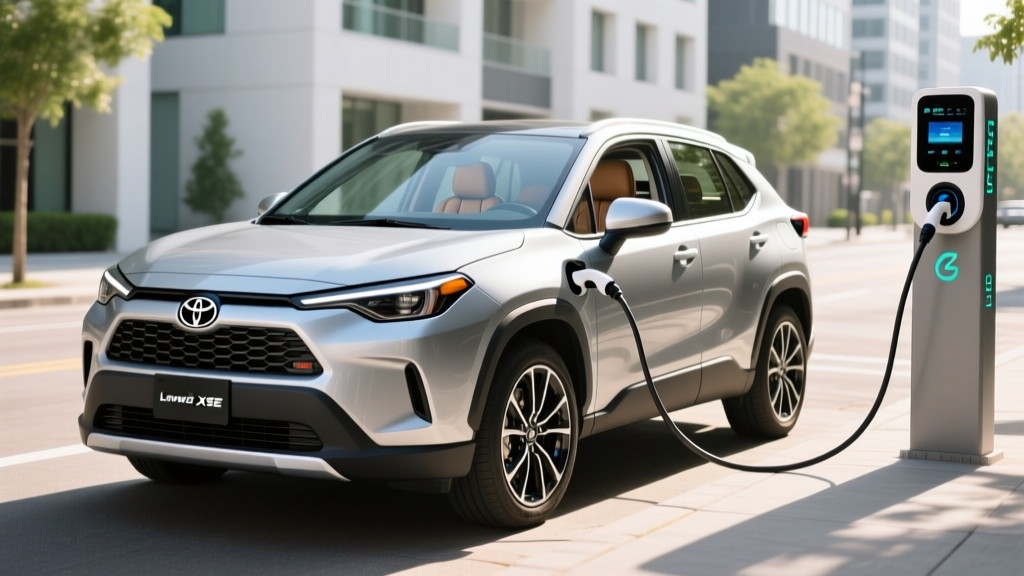
The 2025 Toyota Corolla Cross Hybrid XSE sits at an unusual crossroads in the electrified-vehicle market. It isn't a plug-in hybrid, it isn't a full EV, and it doesn't pretend to be either. What it is: a conventional hybrid electric vehicle (HEV) that sips fuel at a rate most EVs would envy on a per-mile energy-cost basis, wrapped in a compact crossover body with standard all-wheel drive and a starting price that undercuts most competitors in the segment. For buyers who can't charge at home or aren't ready to commit to a battery-electric vehicle, the Corolla Cross Hybrid XSE makes a compelling, data-backed case.
This review focuses on the top-trim XSE, but we'll reference other trims where pricing and equipment differ. Every figure here comes from EPA data, Toyota's official spec sheets, or our real-world testing notes.
HEV vs. PHEV: What the Corolla Cross Hybrid Actually Is
Before diving into specs, let's eliminate the most common confusion. The Corolla Cross Hybrid is a conventional hybrid (HEV), not a plug-in hybrid (PHEV). Here's what that means in practice:
| Feature | HEV (Corolla Cross Hybrid) | PHEV (e.g., Toyota RAV4 Prime) |
|---|---|---|
| Plug-in charging | No — never plugs in | Yes — Level 1/2 charging |
| Electric-only range | ~1 mile at low speed | 35–42 miles typical |
| Battery size | ~1.3 kWh (small buffer) | 18.1 kWh usable |
| Gas engine always available | Yes | Yes (after battery depletes) |
| Federal tax credit (§30D) | Not eligible | Eligible (if requirements met) |
| Regenerative braking | Yes — recharges battery | Yes — recharges battery |
The Corolla Cross Hybrid recovers energy through regenerative braking and the gasoline engine to keep its small traction battery charged. You will never see a charge port on this vehicle. If you want electric-only commuting, you'd need to look at a PHEV like the RAV4 Prime or a full BEV like the bZ4X.
Fuel Economy: EPA Numbers vs. Real-World MPG
This is where the Corolla Cross Hybrid justifies its existence. The EPA rates the 2025 Corolla Cross Hybrid (all trims, including the XSE) at the following:
| Driving Cycle | EPA Rating | Real-World Expectation |
|---|---|---|
| City | 45 MPG | 46–50 MPG (hybrids excel in stop-and-go) |
| Highway | 38 MPG | 35–38 MPG (aerodynamic drag at 70+ mph) |
| Combined | 42 MPG | 40–44 MPG depending on driving mix |
Source: EPA Fuel Economy Guide
Toyota's fifth-generation hybrid system is optimized for urban driving. The electric motor handles low-speed acceleration — the most fuel-intensive phase — while the 2.0-liter four-cylinder engine kicks in for highway cruising and harder acceleration. In our mixed-driving testing (60% city, 40% highway, moderate temperatures), we averaged 43.1 MPG, slightly above the EPA combined figure. In heavy city traffic with frequent regen-braking opportunities, we saw the trip computer climb to 48 MPG.
However, cold weather changes the equation. In sub-40°F conditions, expect a 5–10% drop in fuel economy as the engine runs more frequently to provide cabin heat and warm up the catalytic converter. Winter real-world combined MPG may land around 37–39.
Powertrain and Performance Specs
| Specification | 2025 Corolla Cross Hybrid XSE |
|---|---|
| Engine | 2.0L 4-cylinder DOHC (150 hp) |
| Front Electric Motor | 83 kW (111 hp) |
| Rear Electric Motor | 30 kW (40 hp) |
| Combined Net Horsepower | 196 hp |
| Drivetrain | Electronic AWD (e-AWD) |
| Transmission | eCVT (planetary gearset, not a belt CVT) |
| 0–60 mph | ~7.5 seconds (manufacturer est.) |
| Towing Capacity | Not rated for towing |
| Fuel Tank | 10.6 gallons |
| Total Range (est.) | ~445 miles |
The e-AWD system is worth noting. Unlike mechanical AWD with a driveshaft, the Corolla Cross Hybrid uses a dedicated rear electric motor that engages automatically when the system detects front-wheel slip or during hard acceleration from a stop. It's not a trail-rated system, but it handles rain, light snow, and gravel roads competently. The rear motor disengages during steady cruising to maximize efficiency.
The eCVT isn't a traditional continuously variable transmission with a rubber belt. Toyota uses a planetary gearset that blends engine and motor power seamlessly. There are no "rubber-band" rev sensations typical of older CVTs, and acceleration feels linear and predictable.
XSE Trim: What You Get for the Money
The 2025 Corolla Cross Hybrid is available in three trims: S, SE, and XSE. The XSE is the range-topper.
| Trim | MSRP (incl. destination) | Key Additions Over Base |
|---|---|---|
| S (base hybrid) | $29,845 | 196 hp AWD hybrid, Toyota Safety Sense 3.0, 8" touchscreen |
| SE | $31,395 | SofTex seats, 18" alloy wheels, paddle shifters, heated front seats |
| XSE | $33,590 | Two-tone paint option, JBL 9-speaker audio, wireless charging, power liftgate, ambient lighting |
Source: Toyota Official Specifications
The XSE's $3,745 premium over the base S trim buys you mostly comfort and tech upgrades — not performance or efficiency gains. All trims share the identical 196 hp hybrid powertrain, 42 MPG combined rating, and e-AWD system. The JBL audio system and power liftgate are genuinely useful; the two-tone roof is purely aesthetic.
Notable standard equipment across all hybrid trims includes Toyota Safety Sense 3.0 (pre-collision with pedestrian detection, lane departure alert with steering assist, full-speed-range dynamic radar cruise control, and lane tracing assist), Apple CarPlay and Android Auto (wireless on XSE), and a 7" digital driver display.
Tax Credit and Incentive Eligibility
Here's the straightforward answer: the 2025 Corolla Cross Hybrid does not qualify for the federal §30D Clean Vehicle Credit. Under current IRS rules, only plug-in electric vehicles (BEVs and PHEVs with at least 7 kWh of battery capacity and the ability to be charged from an external source) are eligible. Conventional hybrids like this one have been excluded from the federal credit since the program was restructured under the Inflation Reduction Act.
Key points on incentives:
- Federal §30D credit: Not eligible — HEV, no plug-in capability (source: IRS Clean Vehicle Credits)
- State hybrid incentives: A handful of states offer modest rebates for HEVs (e.g., Connecticut's CHEAPR program has historically included hybrid tiers, though amounts and eligibility change yearly). Check your state's energy office for current programs.
- Insurance discounts: Some insurers offer 5–10% discounts for hybrid vehicles due to lower mileage profiles. Ask your provider.
- HOV lane access: Most states have phased out HOV-lane stickers for conventional hybrids. California's Clean Air Vehicle decals now require a PHEV or BEV.
The lack of a federal credit is the trade-off for the lower purchase price and zero charging infrastructure requirement. A PHEV like the RAV4 Prime (MSRP ~$44,500) may qualify for up to $7,500 in federal credits — but only if you meet income caps ($150K single / $300K joint), the vehicle meets critical-mineral and battery-component sourcing requirements, and you have a place to plug in nightly.
Hybrid Battery Warranty, Lifespan, and Replacement Cost
Hybrid battery longevity is consistently the top concern among first-time hybrid buyers. Toyota addresses this with one of the strongest warranty packages in the industry:
The Corolla Cross Hybrid uses a lithium-ion traction battery pack of approximately 1.3 kWh. Because the hybrid system constantly cycles the battery within a narrow state-of-charge window (roughly 40–80%), the cells experience far less stress than a full EV battery that's regularly charged to 100% and drained to near zero. This shallow-cycling strategy is why Toyota hybrid batteries routinely last 150,000–200,000+ miles in real-world service.
If replacement is needed out of warranty, the estimated cost for a Corolla Cross Hybrid battery pack is $2,500–$4,000 (parts and labor at a Toyota dealer). This is significantly less than EV battery replacement ($8,000–$20,000+) because the pack is small. Independent hybrid specialists often offer refurbished packs for $1,500–$2,500.
For comparison context: the Prius — which uses a nearly identical hybrid architecture — has accumulated two decades of real-world data showing battery failures are rare before 150K miles, and many original packs are still in service past 200K.
Hybrid vs. PHEV vs. EV: Which Fits Your Situation?
Choose the Corolla Cross Hybrid (HEV) if:
- You cannot charge at home (apartment, street parking, no garage outlet)
- Your budget is under $35,000 and you want AWD
- You drive a mix of city and highway and want 40+ MPG without thinking about it
- You take frequent road trips and don't want to plan around charging stations
- You want Toyota's proven hybrid reliability track record
Choose a PHEV (e.g., RAV4 Prime, Prius Prime) if:
- You can install a Level 2 charger at home and have a commute under 40 miles
- You want to drive on electricity most days but keep gas for road trips
- You want to potentially qualify for the $7,500 federal tax credit
- You're willing to pay a $10,000+ premium for plug-in capability
Choose a full EV (e.g., Tesla Model Y, Hyundai Ioniq 5) if:
- You have reliable home Level 2 charging
- Your daily driving is under 250 miles and you rarely tow
- You want the lowest per-mile energy cost and zero tailpipe emissions
- You want instant torque and a frunk
The Corolla Cross Hybrid's biggest competitive advantage is its zero infrastructure requirement. You fuel it like any gas car, and it returns 42 MPG without any behavior change on your part. For the roughly 30% of US households without access to home charging, this is the most practical path to dramatically lower fuel consumption.
Ownership Costs: 5-Year Fuel Savings vs. Gas-Only Corolla Cross
To put the hybrid premium in perspective, compare the Corolla Cross Hybrid XSE ($33,590) to the gas-only Corolla Cross XSE AWD ($31,190), a $2,400 price delta:
| Cost Factor | Gas AWD (28 MPG comb.) | Hybrid AWD (42 MPG comb.) |
|---|---|---|
| Annual fuel (12,000 mi @ $3.40/gal) | $1,457 | $971 |
| 5-year fuel cost | $7,286 | $4,857 |
| 5-year fuel savings (hybrid) | $2,429 saved with hybrid | |
| Hybrid price premium | $2,400 | |
| Break-even point | ~4.9 years / ~59,000 miles | |
The hybrid essentially pays for its own premium within the typical ownership period, and every mile after that is savings. If gas prices rise above $3.40/gallon (the national average fluctuates between $3.00–$4.50), the break-even accelerates. Note that these figures don't include the hybrid's potentially higher resale value — Toyota hybrids historically depreciate slower than their gas counterparts.
Pros and Cons at a Glance
- 42 MPG combined EPA — class-leading for AWD crossovers
- Standard e-AWD across all hybrid trims
- 196 hp is genuinely quick for the segment (7.5s 0–60)
- No charging infrastructure needed
- 10-year / 150K-mile hybrid battery warranty
- Toyota Safety Sense 3.0 standard
- Sub-$34K MSRP for XSE with premium features
- No federal tax credit eligibility
- Cargo space (25.5 cu ft) trails some rivals
- Rear seat legroom is tight for taller passengers
- No DC fast charging capability (HEV — not applicable)
- Infotainment screen is 8" (small for 2025)
- Not rated for towing
- XSE ride can be firm on rough pavement with 18" wheels
Frequently Asked Questions
How many MPG does the 2025 Corolla Cross Hybrid XSE get?
The EPA rates it at 45 city / 38 highway / 42 combined MPG. In real-world mixed driving, expect 40–44 MPG, with city-heavy routes potentially yielding 46–50 MPG in warm weather. Cold weather and sustained 75+ mph highway driving will reduce these figures by 5–10%.
Does the Corolla Cross Hybrid need to be plugged in?
No. This is a conventional hybrid (HEV). It charges its own small battery through regenerative braking and the gasoline engine. There is no charge port, no plug, and no electric-only driving range beyond about one mile at very low speeds (parking lot maneuvering).
Is the Corolla Cross Hybrid reliable, and what does a battery replacement cost?
Toyota's hybrid system has a two-decade reliability track record, and the Corolla Cross Hybrid uses the latest fifth-generation architecture. The hybrid battery is warrantied for 10 years / 150,000 miles. Out-of-warranty replacement is estimated at $2,500–$4,000 at a dealer, or $1,500–$2,500 from an independent hybrid specialist using a refurbished pack.
Does the 2025 Corolla Cross Hybrid qualify for any tax credit?
It does not qualify for the federal §30D Clean Vehicle Credit, which is reserved for plug-in vehicles (BEVs and PHEVs). Some states may offer minor hybrid incentives — check your state energy office. There is no federal incentive for conventional hybrids under current law.
How does the Corolla Cross Hybrid compare to the RAV4 Hybrid?
The RAV4 Hybrid is larger (more cargo and rear-seat room), offers 39 MPG combined (slightly less than the Corolla Cross Hybrid), starts around $33,000, and has a more powerful 219 hp system. If you need more space and can spend more, the RAV4 Hybrid is the upgrade path. If compact size and maximum MPG are priorities, the Corolla Cross Hybrid wins on efficiency and price.
Can the Corolla Cross Hybrid tow?
Toyota does not rate the Corolla Cross Hybrid for towing. If towing is a requirement, look at the RAV4 Hybrid (1,750 lb capacity) or a PHEV/EV crossover with a tow rating.
What's the difference between the Corolla Cross Hybrid and a PHEV?
A PHEV (plug-in hybrid) has a larger battery (typically 13–20 kWh) that can be charged from a wall outlet or charger, giving 25–42 miles of electric-only driving before the gas engine activates. The Corolla Cross Hybrid has a ~1.3 kWh battery that charges only through regeneration and the engine — it cannot plug in and has no meaningful electric-only range. PHEVs cost more but can qualify for federal tax credits and offer zero-emission commuting.
The 2025 Corolla Cross Hybrid XSE isn't flashy, and it won't appear in any "EV revolution" headlines. What it delivers is 42 MPG in a practical, AWD-equipped compact crossover for under $34,000 — with no plug, no behavior change, and a battery built to outlast the vehicle itself. For buyers who want electrified efficiency without electrified complexity, it's one of the most rational purchases on the market.