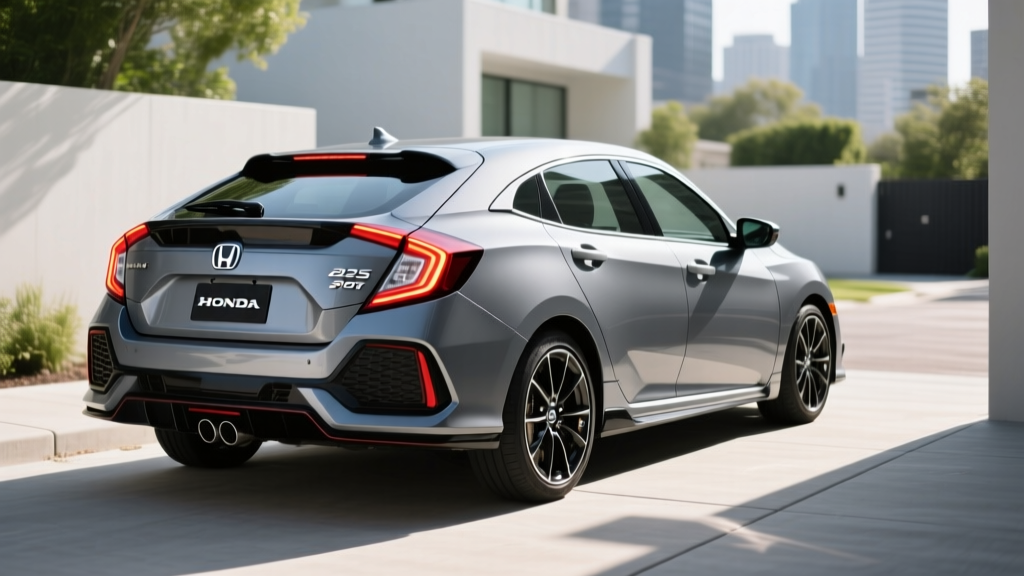
The 2025 Honda Civic Hybrid Sport Touring Hatchback occupies a narrow but compelling lane: it delivers the cargo versatility of a hatchback, the fuel sipping of a hybrid, and enough power to make merging onto the highway genuinely effortless. For buyers researching the 2025 Honda Civic Hybrid Sport Touring Hatchback price and wondering whether this top-trim hybrid justifies its premium over the gas-only Sport Touring, the answer hinges on how you drive, where you drive, and how long you plan to keep the car.
This guide breaks down every number that matters — EPA MPG, real-world fuel economy, the two-motor hybrid powertrain, battery warranty, tax-credit eligibility, and total ownership cost — so you can decide with data, not dealership pressure.
2025 Honda Civic Hybrid Sport Touring Hatchback Price by Trim
The 2025 Civic Hybrid is offered in two trims. The Sport Touring Hatchback sits at the top of the lineup and is the only hybrid hatchback trim available (the Sport Hybrid sedan is the other body style). Here is the MSRP breakdown including destination charges:
| Trim / Body Style | MSRP (incl. destination) | Powertrain | EPA Combined MPG |
|---|---|---|---|
| Civic Hybrid Sport Sedan | $29,845 | 2.0L + 2-motor hybrid | 50 MPG |
| Civic Hybrid Sport Touring Sedan | $32,045 | 2.0L + 2-motor hybrid | 49 MPG |
| Civic Hybrid Sport Hatchback | $30,845 | 2.0L + 2-motor hybrid | 48 MPG |
| Civic Hybrid Sport Touring Hatchback | $32,845 | 2.0L + 2-motor hybrid | 47 MPG |
The Sport Touring Hatchback commands a $2,000 premium over the Sport Hatchback. That extra spend adds a Bose 12-speaker audio system, a 9-inch touchscreen with wireless Apple CarPlay and Android Auto, wireless phone charging, heated rear seats, a power-adjustable driver's seat with memory, and Honda's full Honda Sensing suite with low-speed braking control. For a daily commuter who plans to keep the car past the five-year mark, the equipment delta is worthwhile.
How Many MPG Does the Civic Hybrid Hatchback Get?
The EPA rates the 2025 Civic Hybrid Sport Touring Hatchback at 50 city / 45 highway / 47 combined MPG. That is a substantial improvement over the gas-only Civic Sport Touring Hatchback, which returns 30 city / 38 highway / 33 combined MPG.
| Model | City MPG | Highway MPG | Combined MPG |
|---|---|---|---|
| Civic Hybrid Sport Touring Hatchback | 50 | 45 | 47 |
| Civic Gas Sport Touring Hatchback (1.5T CVT) | 30 | 38 | 33 |
| Toyota Prius LE (AWD, for comparison) | 53 | 54 | 54 |
Source: EPA Fuel Economy
Real-World MPG vs. EPA Sticker
Hybrids frequently outperform their EPA city ratings in stop-and-go traffic because regenerative braking recovers energy that a gas car wastes as heat. In mixed suburban driving with moderate climate-control use, owners regularly report 48–52 MPG combined. On sustained highway trips at 75+ mph, expect the figure to dip to 42–44 MPG, since the electric motor contributes less at high speeds and aerodynamic drag dominates.
In cold weather (below 30°F), the gasoline engine runs more frequently to generate cabin heat, reducing city MPG to roughly 42–45. This is normal for all hybrids without a dedicated heat pump — the Civic Hybrid uses engine waste heat for cabin warming, which is efficient once the engine is warm but forces more engine-on time in winter.
Hybrid (HEV) vs. Plug-In Hybrid (PHEV) vs. Full EV: Which Fits You?
The 2025 Civic Hybrid is a conventional hybrid (HEV). It has no plug, no electric-only driving mode of meaningful distance, and no large battery pack. It recovers energy through regenerative braking and uses a small lithium-ion battery to assist the gasoline engine. You fuel it exactly like a gas car — no charging infrastructure required.
| Factor | HEV (Civic Hybrid) | PHEV (e.g., Prius Prime) | Full EV (e.g., Chevy Equinox EV) |
|---|---|---|---|
| Plug-in charging? | No | Yes (Level 1/2) | Yes (Level 1/2/DC) |
| Electric-only range | <1 mile (low-speed assist) | 25–44 miles typical | 250–350+ miles |
| Fuel/energy cost per mile | ~$0.07 (at $3.30/gal) | ~$0.04 (electric) / ~$0.08 (gas) | ~$0.04 (at $0.14/kWh) |
| Federal tax credit (§30D) | Not eligible | Up to $7,500 if eligible | Up to $7,500 if eligible |
| Home charging needed? | No | Recommended for max savings | Essential for daily use |
| Best for | No home charging access; long highway commutes | Home charging + short daily commute | Home charging + willingness to plan road trips |
If you cannot install a home charger (apartment living, street parking only, landlord restrictions), the Civic Hybrid is the optimal choice. You get roughly 40% better fuel economy than the gas Civic with zero change in refueling behavior. If you can charge at home and your daily round-trip commute is under 40 miles, a PHEV like the Toyota Prius Prime or a full EV will deliver lower per-mile energy costs and potential tax-credit savings.
Powertrain: 200 HP from Honda's Two-Motor Hybrid System
The Civic Hybrid uses Honda's fourth-generation two-motor hybrid system, pairing a 2.0-liter Atkinson-cycle inline-four with two electric motors and a lithium-ion battery pack. Here are the critical specifications:
| Specification | Value |
|---|---|
| Combined system horsepower | 200 hp |
| Combined system torque | 232 lb-ft |
| Gasoline engine | 2.0L DOHC Atkinson-cycle I-4, 143 hp |
| Propulsion motor output | 184 hp (135 kW) |
| Transmission | Electronic CVT (e-CVT, no traditional gears) |
| Drivetrain | Front-wheel drive |
| 0–60 mph | ~7.1 seconds (est.) |
| Battery type | Lithium-ion (capacity not disclosed by Honda) |
The 200-hp combined output is a meaningful upgrade over the gas Civic Sport Touring Hatchback's 180 hp (1.5L turbo). More importantly, the electric motor delivers peak torque from 0 RPM, making the hybrid feel noticeably quicker off the line and during passing maneuvers. The e-CVT operates differently from a traditional belt-driven CVT — Honda's system uses a lock-up clutch for direct engine-to-wheel connection at highway speeds, which eliminates the "rubber-band" drone common in older CVTs.
Reliability, Battery Warranty, and Replacement Cost
Hybrid battery longevity is consistently the top concern among first-time hybrid buyers. Honda's track record here is strong. The company's hybrid systems have been in production since the 1999 Insight, and the current two-motor architecture has been in service across the Accord Hybrid, CR-V Hybrid, and Civic Hybrid since 2023.
- Hybrid battery: 8 years / 100,000 miles (10 years / 150,000 miles in CARB states including CA, CT, ME, MA, NJ, NY, OR, RI, VT, WA)
- Hybrid system components: 8 years / 100,000 miles
- Limited vehicle warranty: 3 years / 36,000 miles
- Powertrain warranty: 5 years / 60,000 miles
Is This Hybrid Reliable?
Honda's hybrid powertrain has fewer wear components than a conventional gasoline powertrain. There is no traditional automatic transmission (no torque converter, no planetary gearset wear), regenerative braking reduces friction-brake wear dramatically (expect 80,000–100,000+ miles on original brake pads), and the Atkinson-cycle engine runs under lower thermal stress than a turbocharged engine.
The lithium-ion hybrid battery pack is relatively small (estimated ~1.0 kWh usable, though Honda does not publish the exact figure) and operates within a narrow state-of-charge window managed by the vehicle's battery management system. This shallow cycling significantly extends cell life. Based on historical data from Honda's hybrid fleet, battery pack failures before 150,000 miles are uncommon.
Battery Replacement Cost
If the hybrid battery does require replacement outside of warranty, expect a cost between $2,000 and $4,000 for a new OEM pack including labor at a Honda dealer. Independent hybrid specialists often offer refurbished packs for $1,200–$2,000. Given the 8–10 year warranty coverage and the typical Civic ownership lifecycle, most original owners will never face this expense.
Does the Civic Hybrid Qualify for a Federal Tax Credit?
No. The 2025 Honda Civic Hybrid does not qualify for the federal §30D Clean Vehicle Credit. Under current IRS rules, only plug-in electric vehicles (battery-electric and plug-in hybrid) with sufficient battery capacity are eligible. Conventional hybrids like the Civic Hybrid — which cannot be plugged in — are explicitly excluded from §30D.
Some states offer their own incentives for hybrid vehicles, though these are less common than EV incentives. Check your state's energy office or department of environmental quality for current programs. A few states have offered rebates for HEVs in the past, but most have shifted incentive budgets toward PHEVs and BEVs.
- Vehicle must be a plug-in EV (BEV) or plug-in hybrid (PHEV) — conventional HEVs do NOT qualify
- Vehicle MSRP must be under $55,000 (sedans) or $80,000 (SUVs/trucks/vans)
- Buyer AGI must be under $150,000 (single) / $300,000 (married filing jointly)
- Battery components and critical minerals must meet phased-in sourcing thresholds
- Credit can be transferred to the dealer as a point-of-sale discount
Ownership Cost: Civic Hybrid vs. Gas Civic Over 5 Years
The hybrid's fuel savings are the headline, but total cost of ownership includes insurance, maintenance, depreciation, and fuel. Here is a five-year comparison assuming 15,000 miles per year and $3.30/gallon regular unleaded:
| Cost Category (5 yr / 75,000 mi) | Hybrid Sport Touring Hatch | Gas Sport Touring Hatch (1.5T) |
|---|---|---|
| MSRP (incl. destination) | $32,845 | $31,345 |
| Fuel cost (75,000 mi) | ~$5,280 (47 MPG) | ~$7,500 (33 MPG) |
| Estimated maintenance | ~$2,200 | ~$2,800 |
| Estimated insurance (avg.) | ~$7,500 | ~$7,200 |
| Estimated depreciation | ~$14,000 | ~$14,500 |
| 5-Year Total Cost | ~$61,825 | ~$63,345 |
The hybrid saves approximately $1,500–$2,200 over five years despite the $1,500 higher MSRP, primarily through $2,220 in fuel savings and slightly lower maintenance costs (less brake wear, no turbo-related service). Honda Civics also hold strong resale values — IIHS consistently rates the Civic as a Top Safety Pick, which supports long-term demand in the used market.
Who Should Buy the Civic Hybrid Sport Touring Hatchback?
- You cannot charge at home (apartment, condo, street parking) but want maximum fuel efficiency
- You commute 30+ miles daily in mixed city/highway traffic
- You want hatchback cargo space (24.4 cu ft behind rear seats) without stepping up to a crossover
- You plan to keep the car 7+ years and value the extended hybrid battery warranty
- You want 200 hp and 232 lb-ft without a turbocharged engine's long-term complexity
- You have home charging and a short daily commute (under 40 miles round-trip) — a PHEV eliminates most gas use
- You want to claim the $7,500 federal tax credit (not available on conventional hybrids)
- You want to eliminate gasoline entirely and your road trips are under 250 miles or you can plan DC fast-charging stops
Pros and Cons at a Glance
- 47 MPG combined EPA; real-world city often exceeds 50 MPG
- 200 hp / 232 lb-ft — noticeably quicker than the gas 1.5T
- No plug-in charging required; zero behavior change from a gas car
- 24.4 cu ft cargo with rear seats up; hatchback practicality
- 8–10 year hybrid battery warranty (state-dependent)
- Top Safety Pick+ eligible with strong IIHS crash-test scores
- Refined e-CVT with lock-up clutch — no CVT drone
- No federal tax credit eligibility
- $32,845 MSRP is premium for a compact hatchback
- No AWD option (unlike Toyota Prius or Mazda3)
- Highway MPG drops to ~42–44 at sustained 75+ mph
- Cold-weather fuel economy dips 5–8 MPG vs. summer
- Rear visibility slightly compromised by hatchback styling
Frequently Asked Questions
How many MPG does the 2025 Civic Hybrid Sport Touring Hatchback get?
The EPA rates it at 50 city / 45 highway / 47 combined MPG. In real-world city driving, many owners report 48–52 MPG combined. Highway driving at 75+ mph typically yields 42–44 MPG.
Can I plug in the Civic Hybrid to charge it?
No. The Civic Hybrid is a conventional hybrid (HEV), not a plug-in hybrid (PHEV). It charges its small battery through regenerative braking and the gasoline engine. You never need to plug it in — just fill up with gasoline as you would any other car.
Does the 2025 Civic Hybrid qualify for any tax credit?
It does not qualify for the federal §30D Clean Vehicle Credit, which is reserved for plug-in vehicles (BEVs and PHEVs). Check your state's energy office for any local hybrid incentives, though these are increasingly rare.
How long will the hybrid battery last, and what does replacement cost?
Honda warranties the hybrid battery for 8 years / 100,000 miles (10 years / 150,000 miles in CARB states). Based on historical Honda hybrid data, the battery typically lasts well beyond 150,000 miles. Out-of-warranty replacement costs $2,000–$4,000 for a new OEM pack.
Is the Civic Hybrid faster than the gas Civic Sport Touring?
Yes. The hybrid produces 200 hp and 232 lb-ft of combined system output compared to the gas 1.5T's 180 hp and 177 lb-ft. The electric motor's instant torque makes the hybrid feel meaningfully quicker in everyday driving, with an estimated 0–60 mph time of around 7.1 seconds versus approximately 7.5 seconds for the gas model.
Hybrid vs. PHEV vs. EV — which should I choose?
Choose the hybrid if you lack home charging access or frequently drive long highway distances. Choose a PHEV if you can charge at home and want electric-only commuting with a gas backup. Choose a full EV if you have reliable home charging, want the lowest per-mile cost, and are comfortable planning road-trip charging stops.
Does the Sport Touring Hatchback have more cargo space than the sedan?
Yes. The hatchback offers 24.4 cubic feet behind the rear seats and expands significantly with the 60/40 split rear seats folded. The sedan's trunk is rated at 14.8 cubic feet. For anyone who regularly carries bulky items, a bicycle with the front wheel removed, or camping gear, the hatchback body style is the clear advantage.