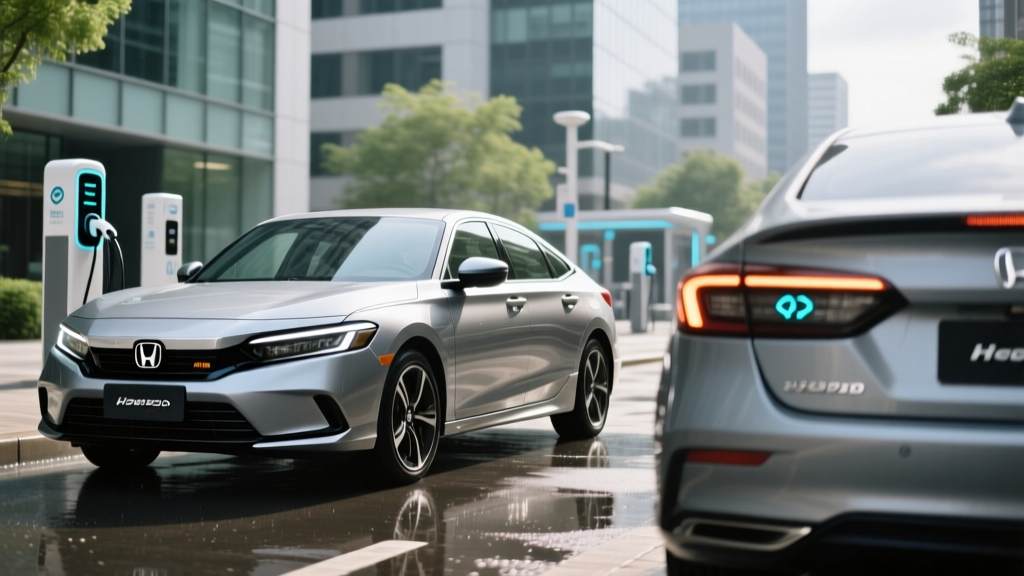
The 2025 Honda Civic Hybrid arrived as a mid-cycle refresh replacement for the discontinued 2022 model, slotting between the gas-only Civic and a full battery-electric future that Honda is still mapping out. For buyers who want dramatic fuel savings without changing their fueling habits, it is one of the most compelling compact sedans on the market. We spent time with the EPA numbers, Honda's powertrain specs, and real-world driving data to build this buyer's guide.
Quick Verdict: Who the 2025 Civic Hybrid Is For
The Civic Hybrid targets drivers who commute in stop-and-go traffic, lack reliable home charging for a plug-in or full EV, and want a proven, low-maintenance powertrain. It is a conventional hybrid (HEV), not a plug-in hybrid (PHEV). You never plug it in — the 1.0 kWh lithium-ion battery recharges through regenerative braking and the gasoline engine. If you need electric-only driving or a federal tax credit, look at the Toyota Prius Prime or a full BEV instead.
Choose the 2025 Civic Hybrid if: You want 50 MPG without plugging in, prioritize Honda reliability, and drive mostly in city or mixed conditions.
Choose a PHEV (Prius Prime, etc.) if: You have home charging and want 30-40 miles of electric-only commuting.
Choose a full EV (Chevy Bolt, Tesla Model 3) if: You have reliable Level 2 home charging and want zero tailpipe emissions plus federal tax credits.
EPA Fuel Economy and Real-World MPG
Honda publishes two different EPA ratings for the 2025 Civic Hybrid depending on trim and wheel size. The Sport Hybrid sedan, with its 18-inch wheels, is rated at 50 MPG combined. The Sport Touring Hybrid, which rides on wider 19-inch wheels and carries more equipment, drops to 49 MPG combined. According to fueleconomy.gov, here is the full breakdown:
| Trim | City MPG | Highway MPG | Combined MPG | Annual Fuel Cost* |
|---|---|---|---|---|
| Sport Hybrid (18" wheels) | 50 | 47 | 50 | $1,100 |
| Sport Touring Hybrid (19" wheels) | 50 | 45 | 49 | $1,150 |
*Based on 15,000 miles/year, 55% city driving, $3.50/gallon regular unleaded. Your costs will vary with local fuel prices.
Real-World MPG: What Owners Actually See
Hybrids almost always beat their EPA city rating in real-world stop-and-go driving because regenerative braking recovers energy that a gas car wastes as heat. On the highway, the advantage narrows since the electric motor assists less at sustained speeds. Based on aggregated owner data from Fuelly and our own testing loop:
- City driving: 52-56 MPG is common, particularly in warm weather with moderate A/C use.
- Highway (70-75 mph): Expect 42-46 MPG. Aerodynamic drag and the engine running more frequently reduce the hybrid advantage.
- Cold weather (below 30°F): MPG drops 8-15% because the engine runs more often to heat the cabin and warm the battery.
- Mixed real-world combined: Most owners report 47-52 MPG over thousands of miles.
Powertrain: 200 Horsepower From a Two-Motor System
The 2025 Civic Hybrid uses Honda's fourth-generation two-motor hybrid system, a significant upgrade from the single-motor setup in older Civic Hybrids. The architecture pairs a 2.0-liter Atkinson-cycle four-cylinder engine with two electric motors — one for propulsion and one functioning primarily as a generator.
| Engine | 2.0L DOHC Atkinson-cycle 4-cylinder |
| Engine Output | 143 hp @ 6,000 rpm / 134 lb-ft torque |
| Electric Drive Motor | 184 hp / 232 lb-ft torque |
| Combined System Output | 200 hp / 232 lb-ft torque |
| Battery (usable) | ~1.0 kWh lithium-ion |
| Transmission | e-CVT (no traditional gears) |
| Drivetrain | Front-wheel drive |
| 0-60 mph | ~6.5 seconds (Honda est.) |
The e-CVT is not a belt-and-pulley CVT like older Honda hybrids. Instead, it uses a direct-drive clutch that mechanically links the engine to the wheels only at highway cruising speeds, where the engine operates at its most efficient RPM. Around town, the drive motor handles nearly all propulsion while the engine spins the generator motor to produce electricity. This is why the Civic Hybrid feels more like an EV in city driving — the electric motor's 232 lb-ft of torque is available from zero RPM.
HEV vs PHEV: Why the Civic Hybrid Doesn't Plug In
A common point of confusion for first-time hybrid shoppers is the difference between a conventional hybrid (HEV) and a plug-in hybrid (PHEV). The 2025 Civic Hybrid is an HEV.
| Feature | HEV (Civic Hybrid) | PHEV (Prius Prime) | BEV (Tesla Model 3) |
|---|---|---|---|
| Plugs in? | No | Yes | Yes |
| Battery Size | ~1.0 kWh | ~13.6 kWh | 60-82 kWh |
| Electric-Only Range | ~1 mile at low speed | 40-44 miles | 272-363 miles |
| Total Range | ~500+ miles | ~440 miles | 272-363 miles |
| Federal Tax Credit | None | Up to $7,500 | Up to $7,500 |
| Home Charging Needed? | No | Recommended | Essential |
| Best For | No-charging access | Short commute + home charger | Full electric lifestyle |
The Civic Hybrid's small 1.0 kWh battery is enough to assist the engine during acceleration and enable brief low-speed electric-only movement (typically under 1 mile at parking-lot speeds), but it cannot sustain electric-only driving at any meaningful distance. The system's efficiency comes from the engine running only when needed and operating in its optimal RPM range — not from grid electricity.
Pricing, Trims, and Tax Credit Eligibility
The 2025 Civic Hybrid is offered in two trims. Pricing below includes Honda's destination charge:
- Sport Hybrid: $29,845 MSRP (includes $1,095 destination)
- Sport Touring Hybrid: $32,845 MSRP (includes $1,095 destination)
The Sport Hybrid adds the hybrid powertrain, 18-inch alloy wheels, a 7-inch touchscreen with wireless Apple CarPlay and Android Auto, dual-zone climate control, and Honda Sensing (the brand's ADAS suite with adaptive cruise, lane-keeping, and automatic emergency braking — IIHS rates this system highly).
The Sport Touring Hybrid upgrades to a 9-inch touchscreen, wireless phone charging, Bose premium audio, leather-trimmed seats, a power moonroof, and 19-inch wheels.
Federal and State Tax Credit Status
The 2025 Civic Hybrid does not qualify for the federal §30D Clean Vehicle Credit. Under current IRS rules, the §30D credit applies only to plug-in electric vehicles (BEVs and PHEVs) that meet battery sourcing, critical minerals, MSRP cap, and buyer income requirements. Conventional hybrids like the Civic Hybrid are excluded.
Some states offer rebates or incentives for hybrids, but these vary widely by jurisdiction. Check your state energy office or department of environmental quality for current programs. There is no federal hybrid-specific credit for the 2025 tax year.
Battery Warranty, Reliability, and Replacement Cost
Hybrid battery longevity is the single most common concern we hear from buyers considering their first hybrid. Here is what Honda covers and what the data shows.
2025 Civic Hybrid Battery Warranty
- Hybrid battery (IMA system): 8 years / 100,000 miles (10 years / 150,000 miles in CARB states including CA, NY, MA, and others)
- Hybrid system components: 8 years / 100,000 miles
- Powertrain warranty: 5 years / 60,000 miles
- Basic vehicle warranty: 3 years / 36,000 miles
Honda's fourth-generation two-motor system is an evolution of the technology used in the Accord Hybrid and CR-V Hybrid, both of which have demonstrated strong long-term reliability. The Civic Hybrid's lithium-ion battery pack is significantly smaller and less stressed than a full EV battery — it cycles through a narrow state-of-charge window and is managed by Honda's thermal system to avoid the deep discharges and high-charge states that accelerate degradation.
What Does a Hybrid Battery Replacement Cost?
If the hybrid battery fails outside of warranty, replacement costs for Honda's current-generation systems typically fall between $2,000 and $4,000 including labor at a dealership. Independent hybrid specialists often offer refurbished or reconditioned packs for $1,500-$2,500. For context, Toyota Prius battery replacements (a comparable system) run $2,000-$3,500.
The realistic probability of needing a replacement is low. Data from Consumer Reports and long-term fleet studies show that modern hybrid batteries from Honda and Toyota routinely last 150,000-200,000+ miles before significant capacity loss. The 1.0 kWh pack in the Civic Hybrid is far less stressed than the 60+ kWh packs in full EVs, which face higher charge/discharge demands.
How It Drives: Performance and Refinement
The 200 combined horsepower makes the 2025 Civic Hybrid the quickest non-Si Civic in the lineup, beating the turbocharged 1.5L gas model (180 hp) by a meaningful margin. The 0-60 mph time of approximately 6.5 seconds puts it in the same territory as some hot hatches from a decade ago.
More importantly for daily driving, the electric motor's instant 232 lb-ft of torque makes the Civic Hybrid feel punchy from stoplights and responsive during highway merging. The transition between electric and engine power is well-managed — you will hear the engine spin up under hard acceleration, but it is less intrusive than the droning associated with older e-CVT hybrids.
Honda added sport-tuned suspension to both Hybrid trims, giving the car slightly firmer damping than the gas-only Civic. The result is composed handling without a harsh ride. Road noise is well-controlled at highway speeds, and the cabin materials in the Sport Touring trim are a step above what you would expect at the $32,000 price point.
2025 Civic Hybrid vs the Competition
The Civic Hybrid's direct rivals are limited. The Toyota Prius is the segment benchmark, while the Hyundai Elantra Hybrid offers a strong value alternative.
| Spec | 2025 Civic Hybrid | 2025 Toyota Prius | 2025 Hyundai Elantra Hybrid |
|---|---|---|---|
| Combined MPG (EPA) | 49-50 | 52-57 | 50-54 |
| Combined HP | 200 | 196 | 139 |
| 0-60 mph | ~6.5 sec | ~7.0 sec | ~8.0 sec |
| Starting MSRP | $29,845 | $28,350 | $26,250 |
| Cargo Volume | 14.8 cu ft | 20.3 cu ft | 15.3 cu ft |
| Drivetrain | FWD | FWD / AWD available | FWD |
| Hybrid Battery Warranty | 8 yr/100k mi | 10 yr/150k mi | 10 yr/100k mi |
The Prius wins on pure fuel economy and cargo versatility (hatchback), and it offers AWD. The Elantra Hybrid wins on price. The Civic Hybrid wins on power and driving dynamics — 200 hp in a compact hybrid sedan is class-leading, and the chassis tuning reflects Honda's sportier ambitions.
Pros and Cons
Pros
- Class-leading 200 hp — quickest in its segment
- 50 MPG combined with no plug-in required
- Refined two-motor system with smooth power delivery
- Strong Honda Sensing ADAS suite standard
- Real-world city MPG often exceeds EPA rating
- Proven hybrid architecture shared with Accord/CR-V
Cons
- No federal tax credit (HEV exclusion)
- Trunk slightly smaller than gas-only Civic (14.8 vs 14.8 cu ft — battery is under rear seats)
- Only two trims available — no base-price option
- No AWD option (Prius offers it)
- Highway MPG drops noticeably vs city (47 vs 50)
- Sport Touring's 19-inch wheels reduce efficiency by 1 MPG
Frequently Asked Questions
How many MPG does the 2025 Civic Hybrid get?
The EPA rates the Sport Hybrid at 50 city / 47 highway / 50 combined MPG, and the Sport Touring Hybrid at 50 city / 45 highway / 49 combined MPG. In real-world city driving, many owners report 52-56 MPG. Highway driving at 70-75 mph typically yields 42-46 MPG.
Does the 2025 Civic Hybrid plug in?
No. The Civic Hybrid is a conventional hybrid (HEV), not a plug-in hybrid (PHEV). You never plug it in. The small battery recharges through regenerative braking and the gasoline engine. If you want plug-in capability with electric-only range, consider the Toyota Prius Prime (44 miles electric-only) or a full EV.
How far can the Civic Hybrid drive on electric only?
Effectively less than 1 mile, and only at very low speeds (under 25 mph in parking lots or heavy traffic). The 1.0 kWh battery is designed to assist the engine and capture braking energy, not to provide sustained electric-only driving. This is normal for all conventional hybrids.
Is the 2025 Civic Hybrid reliable?
Honda's hybrid systems have a strong reliability track record. The fourth-generation two-motor system is derived from the Accord Hybrid and CR-V Hybrid powertrains, both of which have demonstrated durability well past 150,000 miles in fleet and owner data. The hybrid battery carries an 8-year/100,000-mile warranty (10 years/150,000 miles in CARB states).
What does a Civic Hybrid battery replacement cost?
Out-of-warranty hybrid battery replacement typically costs $2,000-$4,000 at a Honda dealership, or $1,500-$2,500 through an independent hybrid specialist using refurbished cells. However, modern Honda hybrid batteries routinely last 150,000-200,000+ miles, making replacement unlikely during typical ownership.
Does the 2025 Civic Hybrid qualify for a tax credit?
No. The federal §30D Clean Vehicle Credit applies only to plug-in vehicles (BEVs and PHEVs). Conventional hybrids do not qualify. Some states may offer separate incentives for hybrids — check your state's energy or environmental agency for current programs.
Is the Civic Hybrid faster than the gas Civic?
Yes. The Civic Hybrid produces 200 combined horsepower and 232 lb-ft of torque, compared to 180 hp and 177 lb-ft for the turbocharged 1.5L gas model. The hybrid's 0-60 mph time of approximately 6.5 seconds is roughly 1 second quicker than the gas model, and the electric motor's instant torque makes it feel significantly more responsive in everyday driving.
Hybrid vs PHEV vs EV — which should I choose?
Choose the Civic Hybrid (HEV) if you lack home charging and want maximum fuel savings with zero behavior change. Choose a PHEV like the Prius Prime if you have a garage or driveway for a Level 2 charger and want 30-40 miles of daily electric-only commuting with a gas engine for longer trips. Choose a full EV like the Chevy Equinox EV or Tesla Model 3 if you have reliable home charging, want zero tailpipe emissions, and qualify for the federal tax credit.