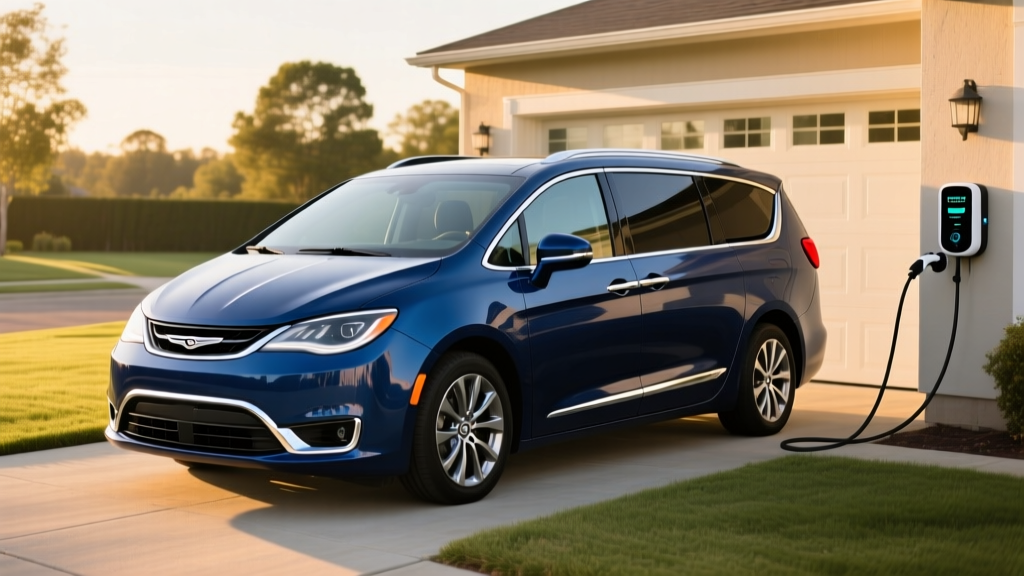
The minivan segment hasn't gone fully electric yet, and the 2025 Chrysler Pacifica Hybrid remains the only plug-in hybrid minivan you can buy in the United States. For families who need three rows, serious cargo space, and the ability to do school runs on battery power alone, it occupies a unique lane. But with a starting price pushing past $50,000 and a 16-kWh battery that limits electric-only driving to 32 EPA-rated miles, the Pacifica Hybrid demands a careful look at whether its PHEV powertrain actually saves you money — or just adds complexity.
I've spent time analyzing the Pacifica Hybrid's powertrain behavior, charging characteristics, and ownership economics to give you the numbers that matter beyond the brochure. Here's what real buyers need to know.
PHEV vs. HEV: What the Pacifica Hybrid Actually Is
First, a critical distinction. The Pacifica Hybrid is a plug-in hybrid electric vehicle (PHEV), not a conventional hybrid (HEV) like the Toyota Sienna. This matters enormously for how you use it and what you pay.
| Feature | HEV (e.g., Toyota Sienna) | PHEV (2025 Pacifica Hybrid) |
|---|---|---|
| Battery size | ~1.6 kWh (small buffer) | 16 kWh usable |
| Electric-only range | None (motor assists engine) | 32 miles EPA |
| Plug-in charging | No — regenerates only | Yes — Level 1 & Level 2 |
| Gas engine | Always available, seamlessly blended | Always available after battery depletes |
| Federal tax credit | None (no §30D eligibility) | Previously eligible; check current §30D rules |
| Ideal use case | Drivers who can't charge at home | Drivers with home charging + short daily commutes |
A conventional hybrid never plugs in — it uses regenerative braking and the gas engine to keep a small battery charged, and the electric motor simply assists for better fuel economy. The Pacifica Hybrid's larger 16-kWh battery lets you drive on electricity alone for a meaningful distance before the 3.6-liter V6 kicks in. But you must plug it in regularly to capture that benefit. If you never charge, you're hauling around a heavy battery and two electric motors for nothing, and your fuel economy drops below that of a lighter conventional hybrid.
Electric-Only Range and Total Driving Range
Real-World Expectation: 25–30 miles in mixed driving; 20–24 miles in cold weather or at sustained highway speeds
Total Combined Range (Electric + Gas): ~520 miles
The 32-mile EPA electric rating is measured under ideal blended conditions. In practice, the Pacifica Hybrid's electric range is highly sensitive to three factors:
- Temperature: Below 40°F, expect a 20–30% reduction. The battery's lithium-ion chemistry (NMC) loses efficiency in cold, and cabin heating draws heavily from the pack. A 32-mile range becomes roughly 22–25 miles on a cold winter morning.
- Speed: Electric-only range drops significantly above 55 mph. The Pacifica Hybrid's aerodynamic profile (it's a minivan) and 5,000+ lb curb weight demand more energy at highway speeds. City and suburban driving under 45 mph is where you'll see the full 30+ miles.
- HVAC load: Running the air conditioning or heater pulls directly from the 16-kWh battery, reducing range by 3–6 miles depending on intensity.
For many families, 25–30 real-world electric miles covers the daily school run, grocery trips, and local errands — which is exactly the PHEV use case. Once the battery depletes, the Pacifica Hybrid operates as a conventional hybrid, with the V6 and electric motors working together.
Fuel Economy: EPA Ratings and Real-World MPG
| Mode | City | Highway | Combined |
|---|---|---|---|
| Electric + Gas (MPGe) | — | — | 82 MPGe |
| Gas-only (after battery depletion) | 29 MPG | 30 MPG | 30 MPG |
The 82 MPGe figure applies only when you're driving within the battery's electric range and regularly recharging. MPGe (miles per gallon equivalent) converts electricity consumption into a gasoline-equivalent number for comparison — it does not mean you'll get 82 MPG from the gas tank.
Once the battery is depleted and you're running on the 3.6L V6 hybrid system alone, the Pacifica returns 30 MPG combined. That's a strong number for a 5,000-lb minivan, but it's notably lower than the Toyota Sienna Hybrid's 36 MPG combined — because the Sienna is a lighter, purpose-built HEV without the Pacifica's heavy PHEV battery and charging hardware.
Real-world MPG vs. EPA: Hybrid systems typically exceed their EPA city ratings because regenerative braking recaptures more energy in stop-and-go traffic. Expect 31–34 MPG in city driving on gas alone, and 28–30 MPG on the highway, where regen provides less benefit and aerodynamic drag dominates. Drivers who charge nightly and commute under 30 miles may use very little gasoline during the work week.
Powertrain, Battery, and Charging Specs
| Engine | 3.6L Pentastar V6 (Atkinson cycle) |
| Electric motors | Two integrated motors (via eFlite EVT) |
| Combined system horsepower | 260 hp |
| Drivetrain | Front-wheel drive (AWD not available on PHEV) |
| Battery capacity | 16 kWh usable (NMC lithium-ion) |
| EPA electric range | 32 miles |
| EPA gas-only MPG | 30 combined (29 city / 30 highway) |
| Level 1 charging (120V) | ~14 hours (0–100%) |
| Level 2 charging (240V) | ~2 hours (0–100%) |
| DC fast charging | Not supported |
| Charge port | J1772 (Level 1/2) |
| 0–60 mph | ~7.1 seconds |
| Towing capacity | Not rated (PHEV); gas Pacifica: 3,600 lbs |
| Cargo volume (behind 3rd row) | 32.3 cu ft |
| Stow 'n Go seating | 3rd row only (2nd row does not fold into floor on PHEV) |
A few things jump out from this spec sheet:
No DC fast charging. The Pacifica Hybrid accepts only Level 1 (120V household) and Level 2 (240V) AC charging. Its 16-kWh battery is small enough that Level 2 fills it in about 2 hours, which is practical for overnight home charging or topping up during a workday. But you won't find rapid 30-minute fills at a DC fast charger — the hardware simply isn't there.
No AWD. Chrysler offers all-wheel drive on the gas-only Pacifica, but the PHEV variant is front-wheel drive only. The electric motors and battery packaging occupy the space needed for a rear driveshaft. If you need AWD in a minivan, you're looking at the Sienna (standard AWD available) or the gas Pacifica.
Compromised Stow 'n Go. The PHEV battery sits under the second-row floor, which means the second-row seats cannot fold into the floor like they do in the gas Pacifica. You get removable captain's chairs instead, and the third row still stows. Cargo flexibility is reduced — a meaningful trade-off for minivan buyers who prioritize a flat load floor.
Pricing, Trims, and Federal Tax Credit Eligibility
The 2025 Chrysler Pacifica Hybrid starts at approximately $51,095 (including destination) for the Select trim and climbs to around $57,895 for the Pinnacle trim. That's a significant premium over the gas-only Pacifica and the Toyota Sienna Hybrid.
The Pacifica Hybrid's federal tax credit eligibility has changed under updated IRS rules. Under current IRS §30D guidelines, PHEV eligibility depends on:
- Battery capacity ≥ 7 kWh (Pacifica Hybrid qualifies at 16 kWh)
- Vehicle assembled in North America (qualifies — assembled in Windsor, Ontario)
- Critical minerals and battery component sourcing thresholds (subject to annual tightening)
- Buyer income caps: $150,000 single / $300,000 married filing jointly
- MSRP cap: $80,000 for vans/SUVs (Pacifica Hybrid qualifies)
- Gross vehicle weight rating under 14,000 lbs (qualifies)
Important: Battery sourcing requirements tighten each year. Consult a tax professional and verify current eligibility on IRS.gov before purchasing. The credit may be up to $7,500 if all sourcing requirements are met, or a partial credit if only some are satisfied. Point-of-sale transfer is available if eligible.
Even with a potential $7,500 credit, the Pacifica Hybrid commands a premium over non-plug-in alternatives. The question is whether your driving patterns justify it.
Battery Warranty, Reliability, and Replacement Cost
Warranty coverage: Defects and capacity loss below a defined threshold (typically ~70% state of health)
Powertrain warranty: 5 years / 60,000 miles
Battery replacement cost (out of warranty): Estimated $6,000–$9,000 including labor
Chrysler backs the Pacifica Hybrid's 16-kWh battery with a 10-year/100,000-mile warranty, which is standard across the industry for hybrid and PHEV battery packs. This covers manufacturing defects and significant capacity degradation — generally defined as the battery falling below 60–70% of its original capacity.
Reliability track record: The Pacifica Hybrid's powertrain has been in production since the 2017 model year, giving it one of the longer real-world track records among PHEVs. Early model years (2017–2019) saw some recalls related to the battery pack and 12V electrical system. Chrysler issued software updates and hardware revisions. The 2025 model benefits from nearly a decade of refinement, though it's worth checking NHTSA recall data for the specific VIN you're considering.
Will you need a battery replacement? Statistically, most PHEV batteries outlast their warranty periods with manageable degradation. NMC chemistry in a 16-kWh pack that's regularly cycled between 20–100% SoC should retain roughly 80–85% of its original capacity after 10 years of typical use. The larger risk is the eFlite continuously variable transmission and the dual-motor assembly — complex components that are covered under the 5-year powertrain warranty but could be expensive to repair afterward.
Who Should Buy the Pacifica Hybrid vs. a Full EV or Gas Minivan
- You can charge at home (Level 2, 240V) every night
- Your daily driving is under 35 miles round-trip
- You need a three-row minivan but want to minimize gasoline use on local trips
- You regularly take road trips where a full EV's charging logistics would be inconvenient
- You want the only PHEV minivan on the market (no direct competitor exists)
- You want zero gasoline use and lower maintenance costs
- Your daily range needs fit within 250+ miles
- You want access to DC fast charging for road trips
- You want a flat load floor and maximum cargo flexibility
- You cannot charge at home or at work
- You want better gas-only MPG (36 vs. 30 combined)
- You want a lower purchase price ($37,000+ starting)
- You want AWD availability
- You don't want to manage plug-in charging routines
The Pacifica Hybrid's ideal owner has a garage with a 240V outlet, a commute under 30 miles, and a family that takes occasional road trips where stopping for gas is simpler than planning DC fast-charger routes. It's a bridge vehicle — not as clean as a full EV, but far more versatile for families who aren't ready to commit to battery-only driving.
- Only PHEV minivan available — no direct competition
- 32-mile electric range covers most daily family errands
- Smooth, quiet electric driving in EV mode
- Strong 260 hp combined output for confident merging
- 10-year/100,000-mile battery warranty
- Premium interior on Pinnacle trim rivals luxury SUVs
- High starting price ($51,095) before options
- No DC fast charging capability
- No AWD option (gas Pacifica and Sienna offer it)
- Second-row Stow 'n Go eliminated by battery placement
- Gas-only MPG (30 combined) trails Sienna Hybrid (36)
- Tax credit eligibility uncertain under tightening sourcing rules
Frequently Asked Questions
How many MPG does the 2025 Chrysler Pacifica Hybrid get?
The Pacifica Hybrid is rated at 82 MPGe combined when operating on both electricity and gasoline within its battery range. Once the 16-kWh battery is depleted and you're driving on the gas engine alone, it returns 30 MPG combined (29 city / 30 highway). Real-world gas-only driving typically yields 31–34 MPG in city conditions thanks to regenerative braking, and 28–30 MPG on the highway.
How far can the Pacifica Hybrid go on electric only?
The EPA rates the Pacifica Hybrid at 32 miles of electric-only range. In real-world conditions, expect 25–30 miles in moderate weather with mixed city/suburban driving. Cold weather (below 40°F), sustained highway speeds above 60 mph, and heavy HVAC use can reduce this to 20–24 miles.
Does the 2025 Pacifica Hybrid qualify for a federal tax credit?
Eligibility depends on current IRS §30D rules, which include battery sourcing requirements that tighten annually. The Pacifica Hybrid meets the battery capacity (16 kWh), North American assembly, MSRP cap ($80,000 for vans), and buyer income thresholds. However, critical minerals and battery component sourcing may reduce or eliminate the credit. Verify current eligibility on IRS.gov and consult a tax professional before purchasing. The maximum potential credit is $7,500, available as a point-of-sale transfer if eligible.
Is the Pacifica Hybrid reliable, and what does battery replacement cost?
The Pacifica Hybrid's PHEV powertrain has been in production since 2017, with early recalls addressed through software and hardware updates. The battery is warrantied for 10 years / 100,000 miles. Out-of-warranty battery replacement is estimated at $6,000–$9,000. Most PHEV batteries retain 80%+ capacity after a decade of normal use. Check NHTSA for any open recalls on your specific VIN.
Can the Pacifica Hybrid DC fast charge?
No. The Pacifica Hybrid supports only Level 1 (120V, ~14 hours for a full charge) and Level 2 (240V, ~2 hours) AC charging. There is no DC fast-charge port. Given the small 16-kWh battery, Level 2 overnight charging is sufficient to start every morning with a full battery.
Does the Pacifica Hybrid have AWD?
No. The PHEV powertrain's battery and motor packaging precludes all-wheel drive. If AWD is essential, the gas-only Pacifica offers it, as does the Toyota Sienna Hybrid (available AWD on certain trims).
Hybrid vs. PHEV vs. full EV — which minivan should I buy?
If you can charge at home and drive under 35 miles daily, the Pacifica PHEV lets you run most errands on electricity while keeping gas for road trips. If you can't charge at home, the Toyota Sienna HEV delivers better fuel economy (36 MPG) with zero plug-in hassle at a lower price. A full-electric minivan doesn't exist yet in the US market as of early 2026, so families needing three rows and zero emissions must wait or look at large electric SUVs like the Rivian R1S or Kia EV9.
Bottom Line: A Niche PHEV With Real Utility
The 2025 Chrysler Pacifica Hybrid isn't trying to be a Tesla. It's a practical family hauler that lets you electrify the school run and grocery trips while keeping a gas tank for the 400-mile holiday road trip. At $51,000+ before incentives, it's expensive — and the compromises (no AWD, no Stow 'n Go second row, no DC fast charging) are real. But if your daily mileage fits within its 25–30 real-world electric miles and you have reliable home charging, the Pacifica Hybrid can cut your gasoline consumption by 60–80% on weekdays without any range anxiety. For a specific type of family, it's still the only minivan that does this.