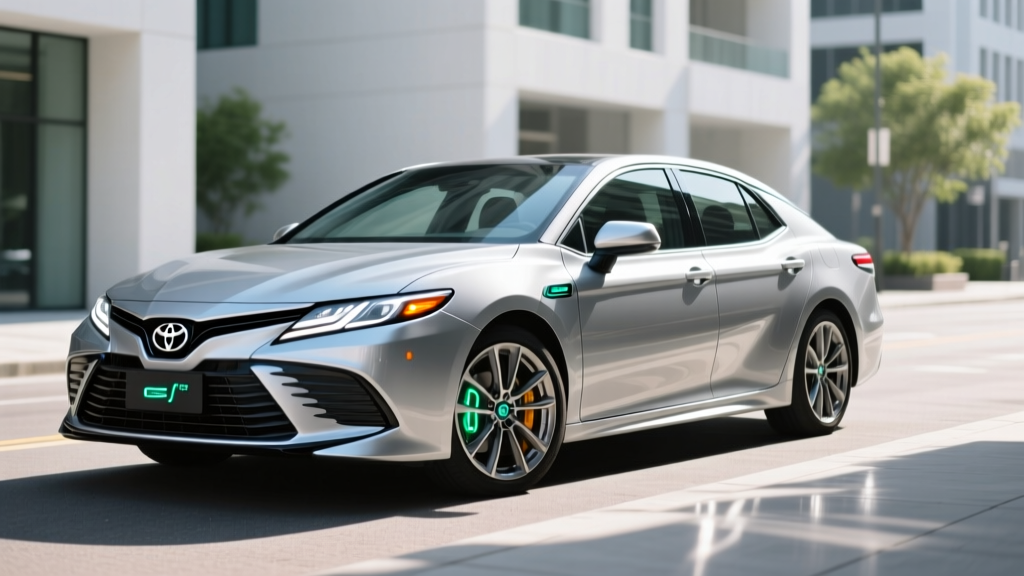
The 2025 Toyota Camry went all-hybrid for its ninth generation, and the XSE trim sits at the sporty end of the lineup. With a 225-horsepower powertrain, standard all-wheel drive, and an EPA-estimated 44 MPG combined, the 2025 Camry XSE Hybrid targets drivers who want sedan practicality and fuel savings without plugging in. This is a conventional hybrid (HEV), not a plug-in — it charges its own battery through regenerative braking and the gasoline engine, so there's no cord to manage and no electric-only range to monitor.
Below, we break down every number that matters: EPA fuel economy versus what you'll actually see at the pump, the fifth-generation hybrid powertrain specs, battery longevity and warranty coverage, pricing by trim configuration, and whether any federal or state incentives apply.
HEV vs. PHEV: Where the Camry XSE Hybrid Fits
Before getting into specs, it's worth clarifying what the Camry XSE Hybrid is — and isn't. Toyota offers the Camry exclusively as a conventional hybrid (HEV) for 2025. There is no plug-in hybrid (PHEV) Camry variant. If you want electric-only driving from Toyota in a similarly sized package, you'd look at the discontinued Prius Prime (now redesigned) or the RAV4 Prime SUV.
Conventional Hybrid (HEV) vs. Plug-In Hybrid (PHEV)
| Feature | HEV (Camry XSE Hybrid) | PHEV (e.g., RAV4 Prime) |
|---|---|---|
| Plugs in? | No | Yes (Level 1 or Level 2) |
| Electric-only range | None (EV mode at very low speeds only) | Typically 25–42 miles |
| Battery size | ~1.0 kWh (small, self-charging) | 15–20 kWh usable |
| Federal tax credit | Not eligible (§30D requires plug-in) | Up to $7,500 if sourcing/income rules met |
| Best for | Drivers without home charging access | Drivers with home charging + short commutes |
The Camry XSE Hybrid's value proposition is simplicity: you fuel it like a gas car, it returns dramatically better mileage, and you never think about charging infrastructure. For apartment dwellers, street parkers, and high-mileage commuters without garage access, this is a significant advantage over any PHEV or BEV.
Fuel Economy: EPA Ratings and Real-World MPG
The 2025 Camry XSE Hybrid comes with standard electronic on-demand all-wheel drive, which slightly reduces fuel economy compared to the front-wheel-drive SE Hybrid. Here's the EPA breakdown:
| Trim / Drivetrain | City | Highway | Combined |
|---|---|---|---|
| XSE Hybrid (AWD) | 44 MPG | 43 MPG | 44 MPG |
| SE Hybrid (AWD) | 46 MPG | 46 MPG | 46 MPG |
| LE Hybrid (FWD) | 53 MPG | 50 MPG | 52 MPG |
Source: EPA Fuel Economy
Real-World MPG vs. EPA Sticker
Toyota's hybrid system excels in stop-and-go city driving, where regenerative braking recaptures energy constantly. In real-world mixed driving, expect the XSE AWD to deliver 41–46 MPG combined depending on conditions. City-heavy commutes often exceed the EPA rating by 1–3 MPG. Sustained highway driving at 75+ MPH may drop to 39–41 MPG, as the gasoline engine carries more of the load at higher speeds. Cold weather (below 30°F) can reduce fuel economy by 5–10% due to engine warm-up cycles and reduced battery efficiency — a pattern consistent across all hybrids. The larger 19-inch wheels and sport-tuned suspension on the XSE trim cost you roughly 2 MPG combined versus the LE Hybrid, a trade-off for the sharper handling and aesthetics.
At 12,000 miles per year and $3.40/gallon regular unleaded, the XSE Hybrid's 44 MPG combined works out to roughly $927 annually in fuel. A comparable gas-only midsize sedan averaging 28 MPG combined would cost about $1,457 — a savings of over $500 per year with the Camry Hybrid.
Powertrain: 225 HP From Toyota's Fifth-Gen Hybrid System
The 2025 Camry XSE Hybrid uses Toyota's fifth-generation hybrid synergy drive, pairing a 2.5-liter four-cylinder engine with two motor-generators and an electronically controlled CVT (eCVT). The AWD model adds a rear-mounted electric motor for on-demand rear traction.
| Specification | 2025 Camry XSE Hybrid |
|---|---|
| Engine | 2.5L inline-4 (A25A-FXS, Atkinson cycle) |
| Engine output | 184 hp / 163 lb-ft torque |
| Front electric motor | 100 kW (134 hp) |
| Rear electric motor (AWD) | 30 kW (40 hp) |
| Net combined horsepower | 225 hp (AWD) |
| Transmission | eCVT (planetary gearset, not a belt CVT) |
| Drivetrain | Electronic on-demand AWD (standard on XSE) |
| 0–60 mph | ~6.9 seconds (est.) |
| Hybrid battery | Lithium-ion, ~1.0 kWh (bipolar design) |
| Fuel type | Regular unleaded (87 octane) |
| Fuel tank | 13.2 gallons |
| Total driving range | ~580 miles (at 44 MPG combined) |
The fifth-generation system is lighter and more compact than its predecessor. Toyota switched to a bipolar nickel-metal hydride design in some trims and lithium-ion in others; the key takeaway is that the pack is small (roughly 1 kWh) because it doesn't need to store plug-in energy. It buffers regenerative braking captures and assists during acceleration. The eCVT uses a planetary gearset — not a rubber-belt CVT — so there's no slippage, no drone, and proven long-term durability.
On the road, the 225 hp output makes the XSE Hybrid feel genuinely quick off the line. Electric motor torque fills in the low-end gap that a naturally aspirated four-cylinder typically leaves, and the transition between electric and gas power is nearly imperceptible. The XSE's sport-tuned suspension, 19-inch alloy wheels, and paddle-shift-modeled regenerative braking settings give it a more engaging character than the LE or SE trims, though ride quality is firmer over rough pavement.
Pricing and Tax Credit Eligibility
The 2025 Camry XSE Hybrid starts at an MSRP of approximately $35,495 (including destination charge). Options like the panoramic roof, premium audio, and advanced technology packages can push a loaded XSE above $40,000.
Federal Tax Credit: Not Eligible
The Camry XSE Hybrid is a conventional hybrid (HEV) and does not qualify for the federal §30D Clean Vehicle Credit. That credit — up to $7,500 — applies only to plug-in electric vehicles (BEVs and PHEVs) with sufficient battery capacity and compliant battery mineral sourcing, per current IRS rules. Conventional hybrids like the Camry are ineligible regardless of price or buyer income. Some states and utilities offer small rebates for hybrids (typically $250–$1,000), but these vary by jurisdiction — check your state energy office or utility provider for current programs.
While the lack of a federal credit stings compared to a qualifying PHEV or BEV, the Camry Hybrid's lower purchase price (versus, say, a $45,000+ RAV4 Prime or $42,000+ Tesla Model 3) means your out-of-pocket cost may still be lower even without the incentive. The fuel savings alone — roughly $500/year over a gas equivalent — add up to $2,500+ over five years of ownership.
Battery Longevity, Warranty, and Replacement Cost
Toyota Hybrid Battery Warranty
- Coverage: 10 years / 150,000 miles (whichever comes first)
- Applies to: Hybrid battery pack, hybrid control module, inverter
- Transferable: Yes, to subsequent owners
- Threshold: Covers failure and significant capacity loss below functional specifications
Source: Toyota Warranty Guide
The hybrid battery concern is the single most common question from first-time hybrid buyers. Here's what the data shows: Toyota's hybrid battery packs — across Prius, Camry, RAV4, and Highlander — have an exceptional longevity record. Real-world failure data from fleet operators and long-term owners indicates most Toyota hybrid batteries last 150,000–200,000+ miles before needing replacement, with many exceeding the vehicle's useful life entirely.
The fifth-generation lithium-ion pack in the 2025 Camry is smaller, lighter, and runs at more moderate temperatures than earlier NiMH packs, which should further extend lifespan. Toyota's 10-year/150,000-mile hybrid battery warranty is among the best in the industry and fully transferable to second owners, supporting resale value.
If replacement is ever needed out of warranty, expect a cost of $2,000–$4,000 for a new OEM hybrid battery pack (installed). Refurbished packs are available for $1,000–$2,000. Individual module replacement (only the degraded cells) can cost $500–$1,200 at a hybrid specialist shop. For context, a timing belt or transmission replacement on a conventional gas sedan can cost similarly — the hybrid battery isn't the financial liability many assume.
Who Should Choose the Camry XSE Hybrid?
Strengths
- 44 MPG combined with AWD — excellent for the class
- No plug-in required — ideal without home charging
- 225 hp provides confident acceleration
- 10-year/150,000-mile hybrid battery warranty
- ~580-mile total range between fill-ups
- Strong resale value and Toyota reliability reputation
- Sport-tuned suspension and 19" wheels on XSE
Limitations
- No federal tax credit (HEV, not PHEV/BEV)
- 2 MPG penalty vs. SE Hybrid AWD; 8 MPG vs. LE FWD
- Firmer ride on 19" XSE wheels over rough roads
- No electric-only driving mode for zero-emission zones
- AWD system is traction-assist, not off-road capable
- Higher MSRP than base LE Hybrid ($28,495)
Camry XSE Hybrid vs. PHEV vs. Full EV: Which Fits You?
Choosing between the Camry XSE Hybrid, a plug-in hybrid like the Toyota RAV4 Prime or Hyundai Tucson PHEV, and a full battery electric vehicle (BEV) like the Tesla Model 3 or Hyundai Ioniq 6 depends on three factors: charging access, daily mileage, and budget.
Choose the Camry XSE Hybrid if: You don't have reliable access to home or workplace charging. You drive a mix of city and highway miles. You want maximum simplicity — fuel up at any gas station and go. You prioritize a lower purchase price over incentive eligibility. You live in an apartment or park on the street.
Choose a PHEV if: You have Level 2 home charging and a commute under 30–40 miles round trip. You want electric-only daily driving with the gas engine as backup for road trips. You qualify for the §30D federal credit (check income caps: $150K single / $300K joint, and MSRP caps: $55K sedans / $80K SUVs). You want to reduce tailpipe emissions on most daily trips without range anxiety.
Choose a full BEV if: You have reliable home charging (Level 2) and your daily driving is under 200 miles. You want the lowest per-mile fuel cost (~$0.04–$0.06/mile on home electricity vs. $0.08–$0.10/mile for the Camry Hybrid). You want to eliminate oil changes, spark plugs, and transmission fluid entirely. You qualify for the full $7,500 federal credit and your state offers additional EV incentives.
Frequently Asked Questions
How many MPG does the 2025 Camry XSE Hybrid get?
The XSE Hybrid with standard AWD is EPA-rated at 44 city / 43 highway / 44 combined MPG. In real-world driving, expect 41–46 MPG combined depending on conditions. City-heavy routes tend to exceed the EPA rating; sustained 75+ MPH highway driving may drop to 39–41 MPG.
Does the Camry XSE Hybrid need to be plugged in?
No. The Camry XSE Hybrid is a conventional hybrid (HEV). Its small lithium-ion battery charges exclusively through regenerative braking and the gasoline engine. There is no plug, no charging cable, and no electric-only driving range. You fuel it at any gas station with regular 87-octane unleaded.
Is the 2025 Camry Hybrid reliable, and what does battery replacement cost?
Toyota's hybrid powertrains have a two-decade track record of exceptional reliability. The hybrid battery is warrantied for 10 years / 150,000 miles. Real-world data shows most Toyota hybrid batteries last 150,000–200,000+ miles. If replacement is needed out of warranty, expect $2,000–$4,000 for a new OEM pack, or $1,000–$2,000 for a refurbished unit.
Does the Camry XSE Hybrid qualify for any tax credit?
No federal tax credit applies. The IRS §30D Clean Vehicle Credit requires a plug-in vehicle (BEV or PHEV) with minimum battery capacity and compliant critical mineral sourcing. Conventional hybrids are excluded. Some state utilities offer small hybrid rebates ($250–$1,000) — check your local programs.
How does the XSE Hybrid compare to the Camry LE Hybrid?
The LE Hybrid is FWD-only and rated at 52 MPG combined — 8 MPG better than the XSE AWD. It starts at $28,495, about $7,000 less. However, the LE lacks the XSE's sport-tuned suspension, 19-inch wheels, leather-trimmed seats, and AWD traction. If fuel economy and value are your top priorities, the LE wins. If you want AWD, sportier dynamics, and premium features, the XSE is the pick.
What is the total driving range on a full tank?
With a 13.2-gallon fuel tank and 44 MPG combined, the Camry XSE Hybrid delivers approximately 580 miles of total range between fill-ups. In city-heavy driving where real-world MPG can reach 46+, range can exceed 600 miles.
Specifications sourced from Toyota's official 2025 Camry Hybrid page and fueleconomy.gov. Tax credit information reflects current IRS §30D rules as published on irs.gov. Always verify eligibility with a tax professional before purchasing.