Quick Verdict: The 2025 Camry SE Hybrid at a Glance
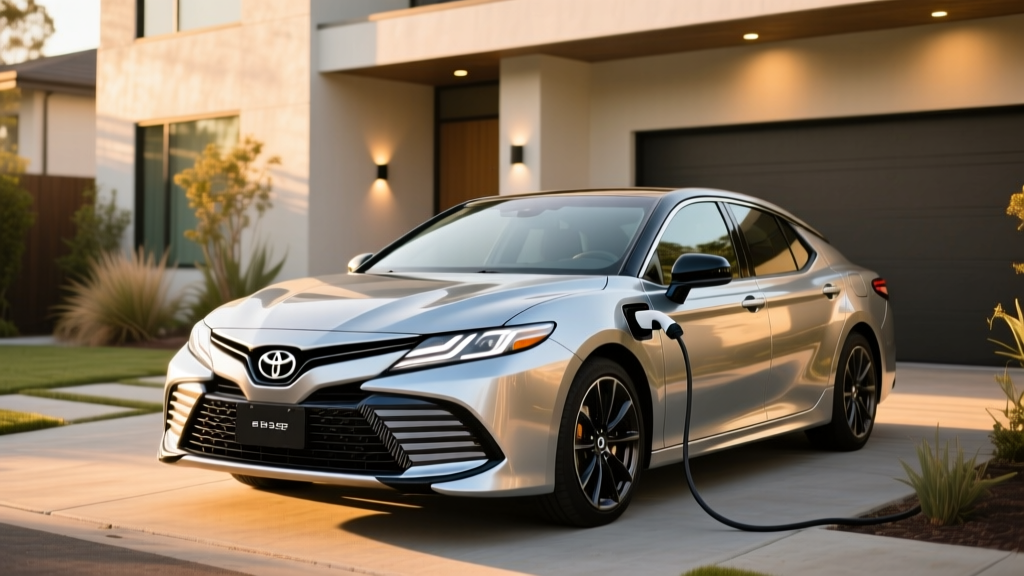
The 2025 Toyota Camry SE Hybrid sits in the sweet spot of Toyota's all-hybrid ninth-generation Camry lineup. It pairs sport-tuned suspension and styling with a 225-horsepower fifth-generation hybrid system that achieves an EPA-estimated 51 MPG combined on the front-wheel-drive variant. For buyers who want midsize-sedan practicality without ever plugging in, the SE Hybrid remains one of the most efficient and proven choices on the market.
But the Camry is a conventional hybrid (HEV), not a plug-in hybrid (PHEV) or battery-electric vehicle (BEV). That distinction matters for your daily routine, your fuel budget, and whether you qualify for federal tax credits. This guide breaks down every number that matters.
| Spec | FWD | AWD |
|---|---|---|
| Powertrain | 2.5L 4-cyl + 2 electric motors | 2.5L 4-cyl + 3 electric motors |
| Combined Horsepower | 225 hp | 232 hp |
| EPA City / Highway / Combined | 53 / 50 / 51 MPG | 51 / 49 / 50 MPG |
| Fuel Tank Capacity | 13.2 gal | 13.2 gal |
| Est. Total Range | ~673 miles | ~660 miles |
| 0–60 mph (est.) | ~7.2 sec | ~7.0 sec |
| Drivetrain | FWD | AWD (electronic rear motor) |
| Starting MSRP | $30,495 | $31,895 |
| Hybrid Battery Warranty | 10 years / 150,000 miles | |
How Many MPG Does the 2025 Camry SE Hybrid Actually Get?
The EPA rates the FWD Camry SE Hybrid at 53 city / 50 highway / 51 combined MPG. The AWD variant drops slightly to 51 / 49 / 50 MPG. These numbers come from fueleconomy.gov and represent the official federal test-cycle estimates.
| Configuration | City MPG | Highway MPG | Combined MPG |
|---|---|---|---|
| FWD | 53 | 50 | 51 |
| AWD | 51 | 49 | 50 |
Real-World MPG vs. the EPA Sticker
Toyota's hybrid system thrives in stop-and-go city driving, where the electric motors handle low-speed propulsion and regenerative braking recaptures energy that a gas-only car would waste as heat. In real-world mixed commuting, many Camry Hybrid owners report matching or slightly exceeding the EPA combined figure — particularly on routes under 45 mph with frequent stops.
On sustained highway trips above 70 mph, expect the FWD model to return roughly 46–49 MPG. Aerodynamic drag dominates at higher speeds, and the 2.5L Atkinson-cycle engine carries more of the load. In cold weather (below 35°F), the engine runs more frequently to heat the cabin and maintain catalyst temperature, which can drop observed city MPG into the mid-to-upper 40s until the powertrain reaches operating temperature.
Bottom line: plan for 48–52 MPG in typical mixed driving. That translates to roughly 630–690 miles per tank on the 13.2-gallon fuel tank.
Hybrid (HEV) vs. Plug-In Hybrid (PHEV): What's the Difference Here?
The 2025 Camry is offered exclusively as a conventional hybrid (HEV). There is no plug-in hybrid (PHEV) version of the ninth-generation Camry as of the 2025 model year. Toyota discontinued the Camry Hybrid plug-in concept years ago and instead channels buyers who want electric-only driving toward the Toyota Prius Prime (PHEV) or the Toyota bZ4X (BEV).
| Feature | HEV (Camry Hybrid) | PHEV (e.g., Prius Prime) | BEV (e.g., Tesla Model 3) |
|---|---|---|---|
| Plug in to charge? | No — regenerative braking + engine | Yes — Level 1 or Level 2 | Yes — Level 2 or DC fast |
| Electric-only range | ~1 mile at low speed | 44 miles (EPA) | 272–363 miles (EPA) |
| Total range | ~670 miles | ~480 miles (EV + gas) | 272–363 miles |
| Fuel/energy cost per mile | ~$0.07 (gas) | ~$0.04 (electric) / $0.07 (gas) | ~$0.04–$0.06 (electric) |
| Federal tax credit (§30D) | Not eligible | Up to $7,500 (if eligible) | Up to $7,500 (if eligible) |
| Home charging needed? | No | Recommended for max savings | Essential for convenience |
If your commute is under 40 miles round-trip and you can install a Level 2 charger at home, a PHEV like the Prius Prime lets you drive most weekdays on electricity alone while retaining gas flexibility for road trips. If you lack home charging access or simply want maximum range without thinking about plugs, the Camry HEV is the more practical choice.
Powertrain Deep Dive: Fifth-Generation Hybrid System
The 2025 Camry SE Hybrid uses Toyota's fifth-generation hybrid synergy drive, a substantial update over the previous generation. The 2.5-liter Dynamic Force four-cylinder engine operates on the Atkinson cycle for maximum thermal efficiency (approximately 41%), producing 184 hp on its own. Two front-mounted motor-generators supplement output for a combined system rating of 225 hp (FWD) or 232 hp (AWD, which adds a dedicated rear electric motor).
The SE trim specifically gets a sport-tuned suspension with stiffer damping and a slightly lower ride height compared to the LE Hybrid. It also includes paddle shifters that let you simulate stepped gear ratios through the eCVT, giving a more engaged driving feel without the rubber-band effect that older Toyota hybrids exhibited.
Acceleration to 60 mph takes approximately 7.2 seconds in FWD form — brisk enough for confident highway merging and passing. The AWD variant's rear motor provides up to 100 hp to the rear axle when traction demands it, though it disengages during steady-state cruising to preserve efficiency.
Pricing, Trims, and Tax Credit Eligibility
The 2025 Camry SE Hybrid starts at $30,495 (FWD) including destination charge, per Toyota's official specifications. Adding AWD costs $1,400, bringing the SE AWD Hybrid to $31,895. Optional packages — such as the SE Convenience Package with heated seats and a power moonroof — can push the price into the mid-$34,000 range.
Federal Tax Credit: Does the Camry Hybrid Qualify?
No. The 2025 Camry Hybrid is a conventional HEV and does not qualify for the IRS §30D Clean Vehicle Credit. That credit applies only to plug-in electric vehicles (PHEVs and BEVs) with sufficient battery capacity and compliant battery-mineral sourcing.
IRS §30D Eligibility Summary (2025–2026 tax years):
- Vehicle must be a PHEV or BEV with ≥7 kWh battery capacity
- MSRP cap: $55,000 (sedans) / $80,000 (SUVs, trucks, vans)
- Buyer income cap: $150,000 single / $300,000 joint AGI
- Battery components and critical minerals must meet phased domestic-sourcing thresholds
- Point-of-sale transfer available at participating dealers
Source: IRS.gov — Clean Vehicle Credit. Consult a tax professional for personal eligibility.
Some states offer separate rebates for hybrids, though these are less common than EV incentives. Check your state energy office or the Alternative Fuels Data Center for current local programs.
Battery Warranty, Lifespan, and Replacement Cost
Hybrid battery longevity is consistently the top concern among first-time hybrid buyers. Toyota addresses this with a 10-year / 150,000-mile hybrid battery warranty (whichever comes first) across all 50 states. This covers defects and capacity loss that prevents the vehicle from operating normally.
Toyota Hybrid Battery Warranty:
- Coverage: 10 years or 150,000 miles
- Applies to: Hybrid battery pack, inverter, control modules
- Transferable: Yes, to subsequent owners
- Battery chemistry: Nickel-metal hydride (NiMH) in the Camry Hybrid
How Long Do Camry Hybrid Batteries Last?
Real-world data from fleet operators and long-term owners shows Toyota hybrid batteries routinely lasting 150,000–200,000+ miles before significant degradation. The Camry's NiMH pack is less energy-dense than the lithium-ion packs in EVs, but it is also less stressed — it never fully charges or fully depletes, operating in a narrow state-of-charge window (roughly 40–80%) that dramatically extends cycle life.
If replacement becomes necessary out of warranty, a new OEM hybrid battery pack for the Camry Hybrid typically costs between $2,500 and $4,000 installed at a Toyota dealer. Independent hybrid specialists often offer reconditioned packs for $1,500–$2,500. This is a fraction of the $10,000–$20,000+ that a full EV battery replacement can cost.
Who Should Choose the 2025 Camry SE Hybrid?
Choose the Camry SE Hybrid if:
- You want maximum fuel efficiency without plugging in or changing your routine
- Your annual mileage is high (15,000+ miles/year) and fuel cost matters
- You lack access to home or workplace charging
- You want proven long-term reliability with a 10-year battery warranty
- You need 600+ miles of total range for road trips without route-planning
Consider a PHEV instead if:
- Your daily commute is under 40 miles round-trip and you can charge at home
- You want to drive on electricity most days while keeping gas flexibility
- You qualify for the $7,500 federal tax credit on a PHEV like the Prius Prime
Consider a full BEV instead if:
- You have reliable Level 2 home charging and your trips rarely exceed 250 miles
- You want the lowest per-mile energy cost (~$0.04/mi vs. ~$0.07/mi for hybrid)
- You want zero tailpipe emissions and minimal drivetrain maintenance
Real-World Ownership Costs: 5-Year Estimate
At 15,000 miles per year and $3.40/gallon regular unleaded, the Camry SE Hybrid's 51 MPG combined yields an annual fuel cost of approximately $1,000. A comparable gas-only midsize sedan averaging 30 MPG combined would cost roughly $1,700/year — a $3,500 fuel savings over five years with the hybrid.
Toyota's hybrid system adds virtually no maintenance cost: there is no alternator, no starter motor, no accessory belt, and regenerative braking extends pad life significantly. Oil changes remain at the standard 10,000-mile interval. Insurance premiums for the Camry Hybrid are generally in line with the gas Camry, typically $1,300–$1,600/year depending on your profile.
Pros and Cons
Pros
- 51 MPG combined — among the best of any midsize sedan
- 225 hp provides confident passing and merging
- 10-year / 150,000-mile hybrid battery warranty
- No plug-in charging required — zero lifestyle change
- 670+ mile total range eliminates refueling anxiety
- SE sport suspension adds genuine handling composure
Cons
- Not eligible for the $7,500 federal EV tax credit
- No PHEV variant available — can't drive on electric only
- eCVT still drones under hard acceleration
- Rear seat is tighter than some competitors (38.0" legroom)
- AWD adds $1,400 and costs 1 MPG combined
Frequently Asked Questions
How many MPG does the 2025 Camry SE Hybrid get?
The FWD model is EPA-rated at 53 city / 50 highway / 51 combined MPG. The AWD variant achieves 51 / 49 / 50 MPG. In real-world mixed driving, expect 48–52 MPG depending on speed, terrain, and temperature.
Does the 2025 Camry Hybrid need to be plugged in?
No. The Camry Hybrid is a conventional HEV. It charges its battery entirely through regenerative braking and the gasoline engine. You never plug it in — just fill it with regular 87-octane gasoline.
Is there a plug-in hybrid (PHEV) version of the Camry?
No. Toyota does not offer a Camry PHEV for the 2025 model year. If you want a Toyota with plug-in capability, the closest alternatives are the Prius Prime (44 miles electric-only, ~$33,000) or the RAV4 Prime (42 miles electric-only, ~$44,000).
How reliable is the Camry Hybrid battery and what does replacement cost?
Toyota's hybrid batteries are among the most durable in the industry, routinely lasting 150,000–200,000+ miles. The battery is covered by a 10-year / 150,000-mile warranty. Out-of-warranty replacement runs $2,500–$4,000 for an OEM pack, or $1,500–$2,500 for a reconditioned unit.
Does the 2025 Camry Hybrid qualify for any tax credit?
The Camry Hybrid does not qualify for the federal IRS §30D Clean Vehicle Credit, which is limited to plug-in vehicles (PHEVs and BEVs). Some states may offer hybrid-specific incentives — check the Alternative Fuels Data Center for local programs.
How does the Camry SE Hybrid compare to the Honda Accord Hybrid?
The 2025 Accord Hybrid Sport achieves 46 MPG combined (48 city / 44 highway) with 204 hp. The Camry SE Hybrid's 51 MPG combined and 225 hp give it a clear efficiency and power advantage on paper, though the Accord offers a slightly roomier rear seat and a more refined interior. Both carry strong reliability reputations and similar battery warranties.