Quick Verdict: The 2025 Camry LE Hybrid at a Glance
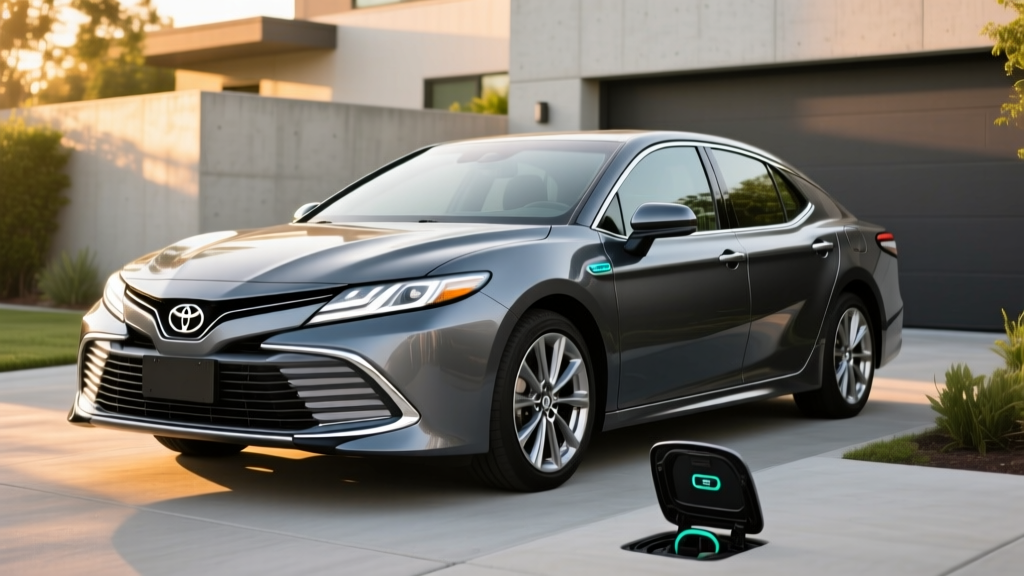
The 2025 Toyota Camry LE Hybrid is the volume-selling trim of Toyota's ninth-generation midsize sedan — and for the first time, every Camry is a hybrid. The LE trim pairs a 2.5-liter four-cylinder engine with Toyota's fifth-generation hybrid system to produce 225 combined horsepower and an EPA-estimated 51 MPG combined. Starting at roughly $29,490 (including destination), it undercuts many compact sedans on a cost-per-mile basis while delivering interior space and refinement that rival entry-level luxury cars.
If you're searching for the 2025 Camry LE Hybrid, you're likely weighing it against plug-in hybrids, full EVs, or the remaining gas-only midsize sedans on the market. This guide breaks down the exact numbers — fuel economy, powertrain specs, real-world efficiency, battery longevity, warranty coverage, and total ownership cost — so you can make an informed decision.
| Spec | Value |
|---|---|
| Powertrain | 2.5L 4-cyl + 2 electric motors (FWD) |
| Combined Horsepower | 225 hp |
| EPA MPG (City / Hwy / Combined) | 53 / 50 / 51 |
| Fuel Tank Capacity | 13.2 gallons |
| Total Driving Range | ~673 miles (EPA est.) |
| 0–60 mph | ~7.1 seconds (est.) |
| Drivetrain | Front-wheel drive (AWD optional on other trims) |
| Hybrid Battery Type | Lithium-ion (bipolar) |
| Starting MSRP (incl. destination) | ~$29,490 |
| Hybrid Battery Warranty | 10 years / 150,000 miles |
| Federal Tax Credit Eligibility | Not eligible (HEV, not PHEV/BEV) |
HEV vs PHEV vs EV: Where the Camry Hybrid Fits
Before diving into fuel economy, it's worth clarifying what the 2025 Camry LE Hybrid actually is — because the terminology matters for your wallet and daily routine.
Conventional Hybrid (HEV) — This is the Camry
The Camry LE Hybrid is a conventional hybrid (HEV). It has a small lithium-ion battery that charges itself through regenerative braking and the gasoline engine. You never plug it in. The battery assists the engine during acceleration and enables brief low-speed electric-only driving (typically under 1 mile at low speeds), but the gasoline engine does the vast majority of the work. The benefit: dramatically improved fuel economy with zero change to your refueling habits.
Plug-In Hybrid (PHEV) — Not the Camry
A plug-in hybrid, like the Toyota RAV4 Prime or Hyundai Tucson PHEV, carries a much larger battery (typically 15–20 kWh) that you plug into a wall outlet or Level 2 charger. PHEVs offer 25–42 miles of pure electric driving before the gas engine kicks in. Toyota does not currently offer a Camry PHEV in the U.S. market. If electric-only commuting is a priority, you'd need to look at a different model.
Battery Electric Vehicle (BEV)
A full EV like the Tesla Model 3 or Hyundai Ioniq 6 has no gasoline engine at all. It runs entirely on a large battery pack (60–100+ kWh) and must be charged from an external source. EVs offer the lowest per-mile energy cost but require access to home or workplace charging and involve longer refueling times on road trips.
The bottom line: The Camry LE Hybrid is ideal if you want maximum fuel efficiency without changing your routine — no plugs, no range planning, no charging apps. If you have reliable home charging and a short commute, a PHEV or BEV may save more on fuel. If you lack charging access or take frequent long road trips, the Camry HEV is the pragmatic pick.
Fuel Economy: EPA Ratings and Real-World MPG
The 2025 Camry LE Hybrid carries EPA-estimated ratings of 53 MPG city, 50 MPG highway, and 51 MPG combined, according to fueleconomy.gov. These are class-leading numbers for a midsize sedan.
| Driving Condition | EPA MPG |
|---|---|
| City | 53 MPG |
| Highway | 50 MPG |
| Combined | 51 MPG |
Real-World MPG: What Owners Actually See
Toyota's hybrid system excels in city driving, where regenerative braking and electric-motor assist do the most work. Many Camry Hybrid owners report real-world city MPG in the mid-to-upper 50s, occasionally exceeding the EPA city estimate — a rarity in the auto industry. Highway driving is where hybrids lose their edge somewhat: sustained high-speed cruising relies more heavily on the gasoline engine, and real-world highway MPG tends to land in the mid-to-upper 40s, slightly below the EPA highway figure.
Factors that affect your real-world numbers:
- Cold weather: Expect a 5–10% MPG drop in winter. The engine runs more often to provide cabin heat and warm up the catalytic converter.
- Aggressive acceleration: Heavy throttle use engages the gas engine more frequently, reducing the hybrid system's efficiency advantage.
- Terrain: Hilly routes can reduce MPG, though regenerative braking on descents partially recovers energy.
- Climate control: Running A/C has a smaller impact on hybrids than on gas cars (the electric compressor is more efficient), but it still costs 1–3 MPG in hot weather.
For a driver covering 15,000 miles per year with a 60/40 city/highway split, the Camry LE Hybrid will consume roughly 294 gallons annually at the combined 51 MPG rate. At $3.40 per gallon (2026 national average), that's approximately $999 per year in fuel — roughly half what a comparable gas-only midsize sedan (30 MPG combined) would cost.
Powertrain Deep Dive: How Toyota's Fifth-Gen Hybrid System Works
The 2025 Camry rides on Toyota's updated TNGA-K platform and uses the fifth generation of the Toyota Hybrid System (THS). Here's what's under the hood:
- Engine: 2.5-liter Dynamic Force inline-4, producing approximately 184 hp and 163 lb-ft of torque on its own. This is an Atkinson-cycle engine optimized for thermal efficiency (up to 41%), not peak power.
- Electric Motors: Two motor-generators (MG1 and MG2) integrated into the transaxle. MG2 drives the wheels; MG1 acts as a starter, generator, and speed controller for the planetary gearset.
- Combined Output: 225 hp (system net). This represents the combined power available when both the engine and electric motor contribute simultaneously.
- Hybrid Battery: A compact lithium-ion bipolar battery pack mounted under the rear seat. Toyota has not published an exact kWh capacity for the HEV battery (it's small — typically around 1.0–1.6 kWh in Toyota's HEV systems), because the battery is designed for rapid charge/discharge cycling rather than energy storage.
- Transmission: Electronically controlled continuously variable transmission (eCVT) using a planetary gearset — not a belt-and-pulley CVT. This design is extremely durable and has no belts or cones to wear out.
The result is a 0–60 mph time of approximately 7.1 seconds — adequate for confident highway merging and passing. The electric motor's instant torque fills in the low-end response that smaller Atkinson-cycle engines typically lack, making the Camry feel quicker off the line than its horsepower figure suggests.
AWD Availability
The LE trim is front-wheel drive only. If you need all-wheel drive, you'll need to step up to the SE, XLE, or XSE trims, which offer Toyota's electronic AWD system (an additional rear-mounted electric motor providing up to 50% rear torque distribution). AWD-equipped Camry Hybrids are rated at 232 hp combined but carry a 1–2 MPG penalty.
Pricing, Trim Positioning, and Tax Credit Eligibility
The 2025 Camry LE Hybrid starts at approximately $29,490 including destination charges. This positions it competitively against the Honda Accord Hybrid (~$33,000), Hyundai Sonata Hybrid (~$31,000), and even non-hybrid midsize sedans.
Federal Tax Credit: Not Eligible
Because the Camry LE Hybrid is a conventional hybrid (HEV) and not a plug-in vehicle, it does not qualify for the IRS §30D Clean Vehicle Credit. That credit — up to $7,500 for new vehicles — applies only to battery electric vehicles (BEVs) and plug-in hybrids (PHEVs) that meet battery sourcing, MSRP cap, and buyer income requirements per current IRS rules.
However, the Camry Hybrid's lower purchase price and strong fuel economy often result in a lower total cost of ownership than a more expensive PHEV or EV — especially for buyers who don't qualify for the full federal credit or who lack home charging infrastructure.
State and Local Incentives
Some states offer rebates or HOV lane access for hybrids, but these programs vary widely and change frequently. Check your state's energy office or department of environmental quality for current programs. A few states (e.g., California, Colorado) have had hybrid-specific incentives in the past, but many have shifted focus to PHEVs and BEVs.
Battery Longevity, Warranty, and Replacement Cost
Battery lifespan is consistently the top concern among first-time hybrid buyers. Here's what the data shows for Toyota's hybrid systems:
2025 Camry Hybrid Battery Warranty
Coverage: 10 years or 150,000 miles (whichever comes first) for the hybrid battery and all hybrid-system components, including the inverter, motor-generators, and control modules.
Transferability: The hybrid warranty is fully transferable to subsequent owners at no cost, which supports strong resale values.
Threshold: Toyota warrants the battery against defects and against capacity loss below a specified threshold (typically 60–70% of original capacity, though exact terms vary by model year).
Real-World Battery Lifespan
Toyota's hybrid batteries have an excellent longevity track record. Data from fleet operators and long-term owners indicates that Toyota hybrid batteries routinely last 150,000 to 200,000+ miles before requiring replacement. The Prius, which uses a similar system, has documented cases of original batteries exceeding 300,000 miles. The Camry's lithium-ion bipolar battery (new for the ninth generation) is more energy-dense and runs cooler than older nickel-metal hydride packs, which should further support longevity.
Replacement Cost If Needed
If the hybrid battery does fail outside of warranty, replacement costs for a Toyota Camry Hybrid battery typically range from $2,000 to $4,000 (parts and labor) at a dealership. Independent hybrid specialists often offer refurbished or reconditioned batteries for $1,000–$2,500. Given that most Camry Hybrids will be well past 150,000 miles before a battery replacement is needed, this is a manageable long-term cost — and one that many owners never face.
Reliability and Safety
Toyota's hybrid powertrain is one of the most proven in the industry, with over 25 years of continuous production since the 1997 Prius. The eCVT planetary gearset has no friction bands, belts, or clutch packs to wear out, making it inherently more durable than conventional automatic or belt-type CVT transmissions. Consumer Reports and J.D. Power consistently rank Toyota among the top brands for long-term reliability, and the Camry specifically has been a perennial top pick.
For safety, the 2025 Camry comes standard with Toyota Safety Sense 3.0, which includes:
- Pre-Collision System with Pedestrian Detection
- Lane Departure Alert with Steering Assist
- Lane Tracing Assist
- Dynamic Radar Cruise Control (full-speed adaptive cruise)
- Road Sign Assist
- Automatic High Beams
- Proactive Driving Assist (gentle braking/deceleration support in certain scenarios)
Note: Toyota Safety Sense is a Level 2 driver-assistance system per the SAE automation scale. The driver must remain fully engaged, hands on the wheel, eyes on the road at all times. It is not autonomous or self-driving. For full crash-test ratings, check the NHTSA and IIHS databases once testing is complete for the 2025 model year.
Who Should Buy the 2025 Camry LE Hybrid?
Choose the Camry LE Hybrid If:
- You want maximum MPG without plugging in or changing your routine
- You drive 12,000–20,000+ miles per year (high mileage maximizes fuel savings)
- You take frequent road trips and don't want to plan around charging stations
- You want a proven, low-risk powertrain with a 10-year/150,000-mile hybrid warranty
- Your budget is under $32,000 and you want a midsize sedan with modern safety tech
Consider a PHEV Instead If:
- You have a short commute (under 35 miles) and reliable home Level 2 charging
- You want to drive on electricity most days and only use gas for road trips
- You want to qualify for the up-to-$7,500 federal §30D tax credit (income and sourcing rules apply)
Consider a Full EV Instead If:
- You have home charging and want the lowest possible per-mile energy cost (~$0.04–0.06/mile vs ~$0.07–0.10/mile for the Camry Hybrid)
- You want zero tailpipe emissions and minimal drivetrain maintenance (no oil changes, no spark plugs)
- You're eligible for the full federal tax credit and your state offers additional EV incentives
Pros
- Class-leading 51 MPG combined — real-world city driving often exceeds EPA
- No plug-in required — zero lifestyle change vs. a gas car
- 673-mile total range eliminates refueling stops on most road trips
- Strong 10-year/150,000-mile hybrid system warranty
- Competitive starting price (~$29,490) undercuts Accord Hybrid and Sonata Hybrid
- Standard Toyota Safety Sense 3.0 with comprehensive ADAS suite
Cons
- Not eligible for the federal §30D tax credit (HEV, not PHEV/BEV)
- FWD only on the LE trim — AWD requires stepping up to SE/XLE/XSE
- eCVT drone under hard acceleration (common to all Toyota hybrids)
- Base LE trim has cloth seats and fewer premium features
- Highway MPG (50) trails city MPG (53) — the opposite of gas cars
- No PHEV Camry variant available for electric-only commuting
Frequently Asked Questions
How many MPG does the 2025 Camry LE Hybrid get?
The EPA rates the 2025 Camry LE Hybrid at 53 MPG city, 50 MPG highway, and 51 MPG combined. In real-world city driving, many owners report achieving mid-to-upper 50s MPG. Highway driving tends to land in the mid-to-upper 40s, particularly at speeds above 70 mph or in cold weather.
Does the 2025 Camry Hybrid need to be plugged in?
No. The Camry LE Hybrid is a conventional hybrid (HEV). The battery charges itself through regenerative braking and the gasoline engine. You simply fill up at a gas station like any other car. There is no plug, no charging cable, and no electric-only range to manage.
How far can the Camry Hybrid drive on electric only?
The Camry Hybrid can creep short distances (roughly 0.5–1 mile) at very low speeds (under 25 mph) on electric power alone, such as in a parking lot or heavy stop-and-go traffic. However, it is not designed for meaningful electric-only driving. If you want 25–40 miles of electric-only range, you need a plug-in hybrid (PHEV), which Toyota does not currently offer in the Camry lineup.
Is the Camry Hybrid reliable, and what does battery replacement cost?
Toyota's hybrid system has over 25 years of proven reliability. The hybrid battery is warranted for 10 years or 150,000 miles. Real-world data shows Toyota hybrid batteries commonly lasting 150,000–200,000+ miles. If replacement is needed out of warranty, expect to pay $2,000–$4,000 at a dealer or $1,000–$2,500 through an independent hybrid specialist.
Does the 2025 Camry Hybrid qualify for any tax credit?
No. The federal §30D Clean Vehicle Credit applies only to plug-in hybrids (PHEVs) and battery electric vehicles (BEVs). The Camry LE Hybrid is a conventional hybrid (HEV) and does not qualify. Some states may offer minor incentives for hybrids, but these vary by jurisdiction and change frequently. Consult your state energy office or a tax professional for current eligibility.
How does the Camry Hybrid compare to the Honda Accord Hybrid?
The 2025 Camry LE Hybrid (51 MPG combined, ~$29,490) edges out the Accord Hybrid (48 MPG combined, ~$33,000) on both fuel economy and starting price. The Accord offers slightly more rear-seat legroom and a more polished interior in higher trims. Both are excellent choices, but the Camry wins on pure efficiency and value at the base trim level.
What's the total annual fuel cost for the Camry LE Hybrid?
At 15,000 miles per year and $3.40 per gallon (2026 national average), the Camry LE Hybrid costs approximately $999 per year in fuel. A comparable gas-only midsize sedan at 30 MPG combined would cost roughly $1,700 — a savings of about $700 per year, or $3,500 over five years.