The ninth-generation Toyota Camry went all-hybrid for 2025, and the XSE trim sits at the top of the lineup as the sportiest expression of Toyota's fifth-generation hybrid system. If you've been searching for a 2025 Camry Hybrid XSE, you're likely weighing its 44 MPG EPA combined rating against its $33,000+ starting price and wondering whether the sport-tuned suspension, 19-inch wheels, and AWD system justify the premium over the SE or LE trims. This guide breaks down the exact powertrain specs, real-world fuel economy data, battery longevity expectations, and ownership economics you need before signing a purchase agreement.
2025 Camry Hybrid XSE Powertrain and Performance Specs
The 2025 Camry Hybrid XSE pairs a 2.5-liter four-cylinder Dynamic Force engine with Toyota's fifth-generation hybrid transaxle. Front-wheel-drive models use a single front motor, while the available Electronic On-Demand AWD adds a second 40-hp rear-mounted electric motor — no mechanical driveshaft connecting the axles. Combined system output is 225 horsepower for FWD and 232 hp for AWD.
| Specification | FWD | AWD |
|---|---|---|
| Combined Horsepower | 225 hp | 232 hp |
| Engine | 2.5L 4-cyl Dynamic Force (184 hp) | |
| Front Electric Motor | 100 kW (134 hp) | |
| Rear Electric Motor (AWD only) | N/A | 30 kW (40 hp) |
| Hybrid Battery | 1.1 kWh lithium-ion (sealed NiMH replaced in gen 5) | |
| Transmission | eCVT (planetary gearset) | |
| 0–60 mph (est.) | ~7.0 sec | ~6.8 sec |
| Base MSRP | $33,400 | $34,900 |
Acceleration is brisk for a midsize sedan. The electric motor's instant torque fills the low-rpm gap that naturally aspirated four-cylinders typically struggle with, making the XSE feel quicker in city driving than its 7-second 0–60 time suggests. The eCVT is a planetary gearset, not a belt-driven unit, so there's no rubber-band effect — just seamless ratio blending.
EPA Fuel Economy and Real-World MPG
The 2025 Camry Hybrid XSE carries EPA ratings that vary slightly by drivetrain. Here's the official breakdown from fueleconomy.gov:
| Drivetrain | City MPG | Highway MPG | Combined MPG |
|---|---|---|---|
| FWD (18" wheels) | 48 | 41 | 44 |
| AWD (19" wheels) | 46 | 39 | 43 |
The XSE trim's larger 19-inch alloy wheels and wider tires cost you 1 MPG combined compared to the SE's 18-inch setup, which returns 44 MPG combined for FWD. That's the trade-off for the XSE's sharper handling and more aggressive stance.
This Is a Conventional Hybrid (HEV), Not a Plug-In
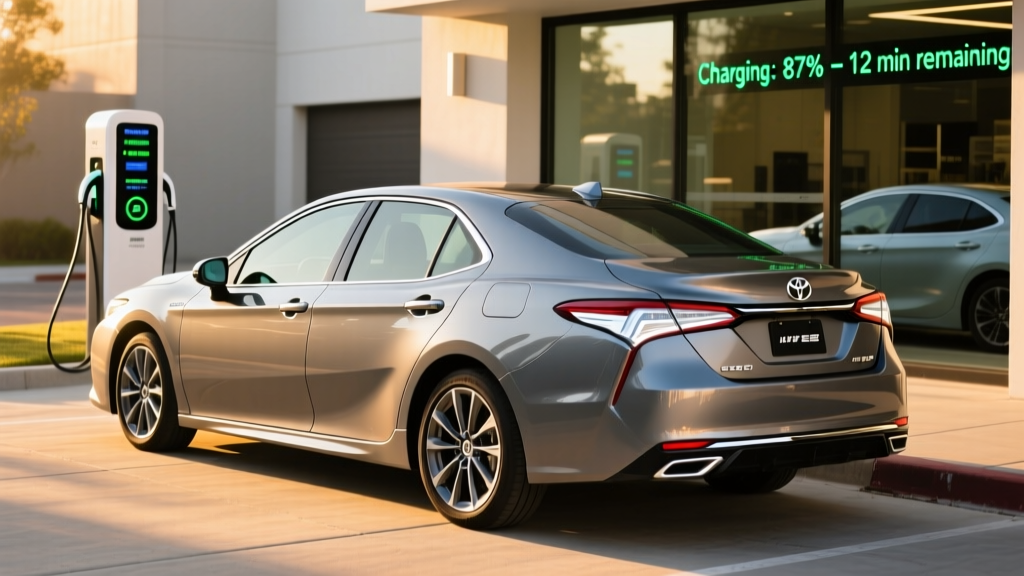
A common source of confusion: the 2025 Camry Hybrid is a conventional hybrid electric vehicle (HEV), not a plug-in hybrid (PHEV). You never plug it in. The 1.1 kWh lithium-ion battery recharges exclusively through regenerative braking and engine-driven generation. There is no electric-only driving mode and no external charge port.
| Factor | HEV (Camry Hybrid) | PHEV (e.g., RAV4 Prime) | BEV (e.g., Model 3) |
|---|---|---|---|
| Plug-in required? | No | Yes (Level 1/2) | Yes (Level 2 + DC fast) |
| Electric-only range | None | 25–42 mi | 250–360 mi |
| Home charging needed | No | Recommended | Essential |
| Federal tax credit (§30D) | Not eligible | Up to $7,500* | Up to $7,500* |
| Maintenance complexity | Low (gas + hybrid) | Moderate (gas + EV systems) | Low (no engine) |
| Best for | No home charging, long highway miles | Short commute + road trips | Home charging access, daily driving <250 mi |
*§30D credit eligibility depends on MSRP caps ($55,000 for sedans), buyer income limits ($150K single / $300K joint AGI), and battery critical-mineral sourcing requirements. Verify current-year rules at irs.gov.
The Camry Hybrid XSE makes sense if you lack access to home or workplace charging, regularly drive 400+ miles between fill-ups, or live in an apartment where installing a Level 2 charger isn't feasible. If you have a garage outlet and a commute under 35 miles, a PHEV like the RAV4 Prime delivers most trips on electricity alone while keeping the gas engine as a backup.
Pricing, Trims, and Tax Credit Eligibility
The 2025 Camry Hybrid XSE starts at $33,400 MSRP for FWD and $34,900 for AWD, including the $1,195 destination charge. Key standard equipment includes:
- 19-inch dark-gray alloy wheels
- Sport-tuned suspension with stiffer dampers
- 12.3-inch Toyota Audio Multimedia touchscreen
- Wireless Apple CarPlay and Android Auto
- Toyota Safety Sense 3.0 (adaptive cruise, lane tracing, pre-collision with pedestrian detection)
- Heated front seats and leather-trimmed SofTex upholstery
- Dual-zone automatic climate control
Adding AWD costs $1,500. The optional Premium package ($2,760) adds a panoramic glass roof, JBL 9-speaker audio, and a 10-inch head-up display. A fully loaded XSE AWD with the Premium package lands near $39,160 before dealer adjustments.
Battery Warranty, Longevity, and Replacement Cost
Hybrid battery anxiety is the number-one concern we hear from first-time hybrid buyers. Here's what the data shows:
Toyota's fifth-generation hybrid system uses a compact lithium-ion pack that's smaller, lighter, and more energy-dense than the nickel-metal hydride batteries in older Camry Hybrids. Real-world longevity data from the millions of Toyota hybrids on the road (the Prius alone has sold over 5 million units globally) shows that most hybrid batteries last 150,000–200,000 miles before needing replacement. Many original batteries in 2010-era Priuses are still functional at 250,000+ miles.
If the battery does eventually need replacement out of warranty, a new OEM hybrid battery for the Camry Hybrid runs approximately $2,500–$3,500 for the part, with labor adding $300–$500. Independent hybrid shops and refurbished battery options can bring the total down to $1,500–$2,200. This is dramatically less than a full EV battery replacement, which can exceed $12,000–$18,000 for large packs.
Unlike EVs, the hybrid battery doesn't experience meaningful range degradation because it operates in a narrow state-of-charge window (roughly 40–80% SoC). The system never fully charges or fully depletes the pack, which dramatically extends cycle life. You won't notice any performance change as the battery ages — if it fails, the car simply won't operate and the warranty covers it.
Driving Dynamics: What the XSE Trim Adds
The XSE is the Camry Hybrid for drivers who care about steering feel and cornering composure. Toyota's engineers fitted it with a sport-tuned suspension that uses firmer dampers and a slightly stiffer rear stabilizer bar compared to the LE and SE trims. The result is noticeably less body roll in corners and a more planted feel during lane changes at highway speed.
The 19-inch wheels wrapped in 235/40R19 all-season tires provide more grip than the SE's 18-inch setup, though ride quality on broken pavement is firmer — you'll feel expansion joints and pothole patches more acutely. If your daily commute includes rough secondary roads, the SE's taller sidewall may be the more comfortable choice.
The AWD system's rear electric motor activates automatically during acceleration from a stop and in low-traction conditions. It doesn't transform the Camry into an off-roader, but it provides meaningful stability in rain and light snow. The system adds roughly 165 pounds and costs you 1 MPG combined, but the traction benefit in northern climates justifies the trade-off for many buyers.
Who Should Buy the 2025 Camry Hybrid XSE?
Choose the Camry Hybrid XSE If:
- You want 44+ MPG without ever plugging in
- You lack home or workplace charging access
- You drive 15,000+ miles per year and want to minimize fuel costs
- You prefer a sport-tuned ride over a comfort-oriented suspension
- You need a midsize sedan with strong resale value and a proven hybrid powertrain
- You live in a region with cold winters where EV range loss is a concern
Look Elsewhere If:
- You have home charging and a short commute (consider a PHEV or BEV for lower operating costs)
- You want the $7,500 federal tax credit (not available on conventional hybrids)
- You prioritize ride comfort over handling (choose the LE or SE trim)
- You need more than 15.1 cu-ft of trunk space (the hybrid battery slightly reduces cargo volume vs. prior gas Camry generations)
- You want a silent, engine-free driving experience (the 2.5L engine is audible under hard acceleration)
At roughly $33,400 to start, the XSE competes with the Honda Accord Hybrid Sport-L ($34,990, 43 MPG combined) and the Hyundai Sonata Hybrid Limited ($37,250, 44 MPG combined). The Camry's advantage is Toyota's hybrid reliability track record and AWD availability — neither competitor offers all-wheel drive.
Frequently Asked Questions
How many MPG does the 2025 Camry Hybrid XSE get?
The FWD XSE is EPA-rated at 48 city / 41 highway / 44 combined MPG. The AWD version drops slightly to 46 / 39 / 43 MPG combined. In real-world city driving, many owners report 50+ MPG in warm weather. Highway driving at 75+ mph typically yields 37–40 MPG.
Does the Camry Hybrid XSE need to be plugged in?
No. The 2025 Camry Hybrid is a conventional HEV, not a plug-in hybrid. The battery recharges through regenerative braking and engine power. There is no charge port and no electric-only driving mode.
Is the Camry Hybrid XSE reliable, and what does battery replacement cost?
Toyota's hybrid powertrain has one of the strongest reliability records in the industry, with millions of units on the road. The hybrid battery is covered for 10 years / 150,000 miles. Out-of-warranty replacement costs approximately $2,500–$3,500 for the OEM battery, or $1,500–$2,200 through independent hybrid specialists using refurbished units.
Does the 2025 Camry Hybrid qualify for any tax credit?
No. The federal §30D Clean Vehicle Credit applies only to plug-in vehicles (PHEVs and BEVs). The Camry Hybrid's 1.1 kWh battery and lack of a charge port make it ineligible. Check your state energy office for any local hybrid rebate programs, as these vary by jurisdiction.
How does the XSE compare to the Camry Hybrid SE?
The XSE adds 19-inch wheels (vs. 18-inch), sport-tuned suspension, leather-trimmed SofTex seats, a 12.3-inch screen (vs. 8-inch on SE), wireless phone charging, and ambient interior lighting. The SE returns 44 MPG combined (FWD) vs. the XSE's 44 MPG — identical for FWD. The XSE costs approximately $2,600 more than the SE at base MSRP.
Should I get the Camry Hybrid XSE or a full EV?
If you have reliable home Level 2 charging, drive under 250 miles daily, and want the lowest per-mile fuel cost (~$0.04–$0.06/mi on home electricity vs. ~$0.08–$0.10/mi for the hybrid at 44 MPG), a BEV like the Tesla Model 3 or Hyundai Ioniq 6 will save more on fuel over five years. If you lack charging access, regularly take 400+ mile road trips, or live in extreme cold, the Camry Hybrid XSE eliminates range and charging concerns entirely while still cutting your fuel bill roughly in half compared to a gas-only midsize sedan.