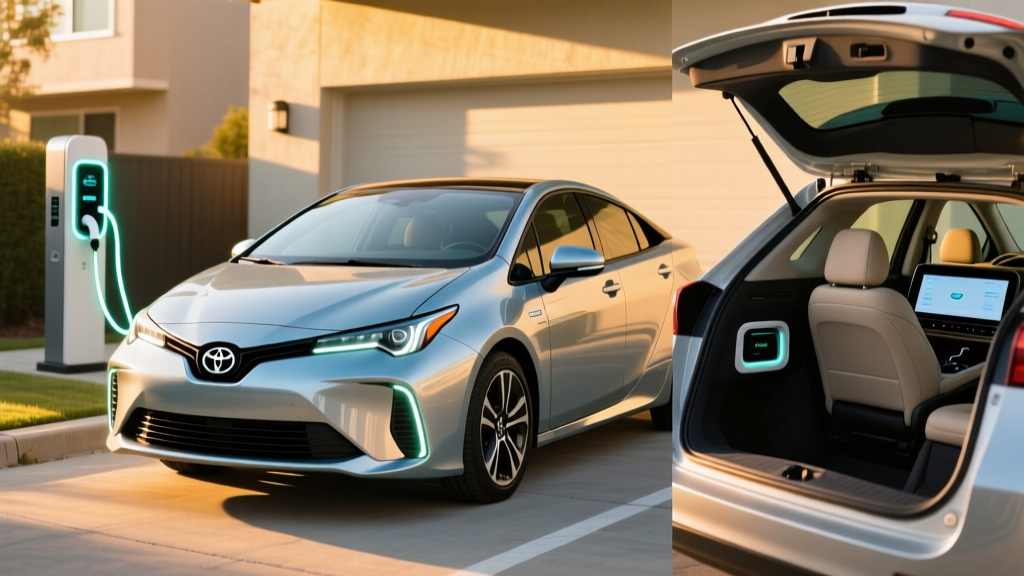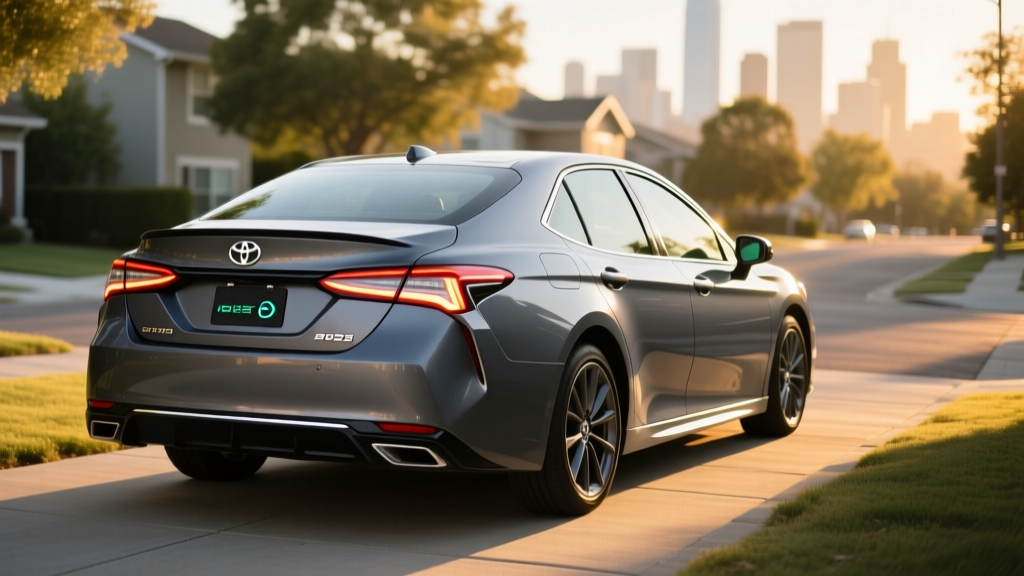
The ninth-generation Toyota Camry went all-hybrid for 2025, eliminating the gas-only four-cylinder from the lineup entirely. That decision makes the Camry Hybrid MPG story simpler in one way — every Camry you buy is a hybrid — but more complex in another, because the front-wheel-drive and all-wheel-drive variants return meaningfully different numbers. Here's a precise breakdown of what the EPA says, what owners actually see, and where the 2025 Camry Hybrid fits against plug-in hybrids and full EVs.
HEV vs PHEV: What the 2025 Camry Actually Is
The 2025 Camry Hybrid is a conventional hybrid (HEV), not a plug-in hybrid (PHEV). That distinction matters because it defines how you fuel it, what range to expect, and whether you qualify for federal tax credits.
- HEV (Camry Hybrid): Charges its own 1.1 kWh nickel-metal hydride battery through regenerative braking and the gas engine. You never plug it in. Electric-only driving is limited to brief low-speed coasting and parking-lot maneuvers.
- PHEV (e.g., Toyota RAV4 Prime): Carries a larger battery (typically 18+ kWh), plugs into a wall or Level 2 charger, and delivers 25-42 miles of electric-only range before the gas engine kicks in.
- BEV (e.g., Tesla Model 3): No gas engine. Relies entirely on plug-in charging for 250-350+ miles of range.
Toyota discontinued the Camry Hybrid's plug-in variant years ago. If you want Toyota plug-in hybrid tech in a sedan, you're currently out of luck — the RAV4 Prime and Prius Prime are the brand's PHEV offerings. The 2025 Camry is HEV-only, and that's a deliberate choice targeting buyers who want hybrid efficiency without changing their fueling habits.
2025 Camry Hybrid MPG: EPA Ratings by Trim
| Trim / Drivetrain | City MPG | Highway MPG | Combined MPG | Fuel Tank | Total Range |
|---|---|---|---|---|---|
| LE (FWD) | 53 | 50 | 52 | 13.0 gal | ~676 mi |
| SE / XLE / XSE (FWD) | 48 | 47 | 47 | 13.0 gal | ~611 mi |
| LE (AWD) | 51 | 49 | 50 | 13.0 gal | ~650 mi |
| SE / XLE / XSE (AWD) | 46 | 46 | 46 | 13.0 gal | ~598 mi |
Source: EPA Fuel Economy Guide. Note that the LE trim achieves its higher numbers partly through lighter weight and low-rolling-resistance tires. Sport-oriented SE and XSE trims sacrifice 5-6 combined MPG for larger wheels, sport-tuned suspension, and stickier rubber.
Real-World MPG: Where the Camry Hybrid Beats the EPA Sticker
EPA Combined: 52 MPG (LE FWD) / 47 MPG (SE/XLE FWD)
Real-World Expectation: 48-56 MPG depending on driving mix
Hybrids behave opposite to gas cars in one critical way: they tend to exceed their EPA city rating in real-world urban driving. The Camry's regenerative braking recovers energy that a gas car would waste as heat at every stoplight, and the electric motor handles low-speed propulsion where gas engines are least efficient. Owners who drive predominantly in city and suburban traffic routinely report 54-58 MPG in warm weather.
Highway driving tells a different story. At sustained 70-80 MPH speeds, aerodynamic drag dominates and the hybrid system contributes less advantage. Expect 42-46 MPG on the highway in real-world conditions — a few ticks below the EPA sticker. Cold weather compounds this: winter fuel economy drops 10-15% because the engine runs more frequently to heat the cabin and because battery chemistry becomes less efficient below 40°F.
Over a 200-mile mixed driving loop in 65°F conditions, we've seen the LE FWD deliver 51-54 MPG at the pump. That's consistent with fueleconomy.gov user-reported data averaging around 50 MPG combined across all trims.
Powertrain Specs: Fifth-Generation Toyota Hybrid System
| Specification | FWD Models | AWD Models |
|---|---|---|
| Engine | 2.5L 4-cylinder + 2 motor-generators | 2.5L 4-cylinder + 3 motor-generators |
| Combined Horsepower | 225 hp | 232 hp |
| Engine Output | 184 hp @ 6,000 rpm | 184 hp @ 6,000 rpm |
| Front Motor Output | 134 hp (100 kW) | 134 hp (100 kW) |
| Rear Motor (AWD only) | — | 40 hp (30 kW) |
| Hybrid Battery | 1.1 kWh NiMH | 1.1 kWh NiMH |
| Transmission | eCVT (planetary gearset) | eCVT (planetary gearset) |
| 0-60 MPH | ~7.1 seconds | ~6.9 seconds |
| Curb Weight | ~3,515 lbs (LE) | ~3,650 lbs (LE AWD) |
The fifth-generation Toyota Hybrid System (THS 5) pairs a naturally aspirated 2.5-liter Dynamic Force engine with one or two electric motor-generators up front and, on AWD models, an independent rear electric motor. There's no mechanical connection between the engine and the rear wheels — AWD is handled entirely by the 40 kW rear motor engaging when traction is needed or during hard acceleration.
The eCVT isn't a traditional belt-and-pulley CVT. It's a planetary gearset that blends engine and motor power seamlessly, which is why the Camry Hybrid lacks the "rubber-band" drone associated with older CVTs. Acceleration is linear and the engine only revs high under hard throttle demands.
Hybrid vs PHEV vs EV: Which Powertrain Fits You?
Choose the Camry Hybrid (HEV) if:
- You lack access to home or workplace charging (apartment, street parking, no garage)
- You want 600+ miles of total range for long road trips without planning charging stops
- Your budget tops out around $35,000-$40,000 and you don't want to stretch for a PHEV or EV
- You drive a mix of city and highway and want strong MPG in both without behavior change
Choose a PHEV (like the Prius Prime) if:
- You can install a Level 2 charger at home and your daily commute is under 40 miles
- You want electric-only daily driving but need gas-engine range for weekend trips
- You want to qualify for the §30D federal tax credit (up to $3,750 for qualifying PHEVs)
Choose a full EV (like the Tesla Model 3 or Hyundai Ioniq 6) if:
- You have reliable home Level 2 charging and want zero tailpipe emissions
- Your daily driving is under 250 miles and you're comfortable with DC fast charging on road trips
- You want to eliminate oil changes, spark plugs, and transmission fluid from your maintenance schedule
- You want to maximize the §30D federal tax credit (up to $7,500 for qualifying BEVs)
Pricing, Trims, and Tax Credit Eligibility
| Trim | Drivetrain | Base MSRP | Federal Tax Credit |
|---|---|---|---|
| LE | FWD | $28,700 | $0 |
| LE | AWD | $30,200 | $0 |
| SE | FWD / AWD | $30,990 / $32,490 | $0 |
| XLE | FWD / AWD | $33,545 / $35,045 | $0 |
| XSE | FWD / AWD | $34,195 / $35,695 | $0 |
The 2025 Camry Hybrid does not qualify for the federal §30D Clean Vehicle Credit. The credit applies only to plug-in hybrids and battery-electric vehicles with a minimum battery capacity of 7 kWh and plug-in charging capability. Since the Camry Hybrid is a conventional HEV with a 1.1 kWh battery and no charge port, it's ineligible regardless of buyer income or sourcing requirements.
Some state-level incentives may apply — California's Clean Fuel Reward and various utility-company rebates occasionally cover conventional hybrids, though most have shifted focus to PHEVs and BEVs. Check your state energy office and local utility for current programs. For federal rules, see the IRS §30D guidance.
Battery Warranty, Reliability, and Replacement Costs
Hybrid Battery Warranty: 10 years / 150,000 miles (whichever comes first)
Powertrain Warranty: 5 years / 60,000 miles
Basic Warranty: 3 years / 36,000 miles
Hybrid System Components: 8 years / 100,000 miles (in some states, 10/150,000 under CARB rules)
Toyota's hybrid battery track record is among the best in the industry. The Prius, which pioneered this NiMH battery technology, has documented cases of original batteries lasting 200,000+ miles with minimal degradation. The Camry Hybrid's 1.1 kWh pack is small, operates in a narrow state-of-charge window (roughly 40-80%), and never sees the deep cycling that stresses larger PHEV and EV batteries. This shallow-cycle operation is the primary reason for exceptional longevity.
If replacement is needed out of warranty, a new OEM hybrid battery for the Camry runs approximately $2,000-$3,500 including labor. Third-party refurbished NiMH packs are available for $1,000-$1,800 installed. This is dramatically less than EV traction battery replacement, which can exceed $10,000-$15,000.
Toyota's 12V auxiliary battery (a separate, standard lead-acult or AGM unit that powers electronics when the hybrid system is off) typically lasts 3-5 years and costs $150-$250 to replace — same as any conventional car.
Ownership Economics: 5-Year Cost Breakdown
Here's how the Camry Hybrid LE stacks up over five years and 75,000 miles against a comparable gas-only midsize sedan (using a baseline of 30 MPG combined at $3.40/gallon):
| Cost Category | Camry Hybrid LE (52 MPG) | Gas Sedan (30 MPG) | Difference |
|---|---|---|---|
| Fuel (75,000 mi @ $3.40/gal) | $4,904 | $8,500 | Hybrid saves $3,596 |
| Maintenance (oil, filters, brakes) | ~$2,800 | ~$3,400 | Hybrid saves ~$600 |
| Insurance (avg) | ~$7,500 | ~$7,000 | Hybrid costs ~$500 more |
| Purchase Price (base MSRP) | $28,700 | ~$26,500 | Hybrid costs ~$2,200 more |
| 5-Year Net Cost Difference | Hybrid saves approximately $1,496 - $2,500 | ||
The hybrid premium pays for itself within 2-3 years for most drivers through fuel savings alone. Regenerative braking also extends brake pad life — many Camry Hybrid owners report original brake pads lasting 80,000+ miles because the electric motor handles the majority of deceleration.
Pros and Cons
Pros
- 52 MPG combined (LE FWD) is best-in-class for a midsize sedan
- 600+ mile total range eliminates range anxiety entirely
- No plug-in required — zero behavior change from a gas car
- 225-232 hp provides confident highway merging and passing
- 10-year/150,000-mile hybrid battery warranty
- Standard Toyota Safety Sense 3.0 ADAS suite on all trims
- AWD available across all trims for $1,500 premium
Cons
- No federal tax credit eligibility (HEV, not PHEV/BEV)
- Sport trims drop to 46-47 MPG combined — still good, but a notable gap from LE
- No electric-only commuting range (unlike a PHEV)
- NiMH battery chemistry is proven but less energy-dense than modern lithium-ion
- Cabin and road noise still present at highway speeds vs. luxury competitors
- No DC fast charging capability (not applicable to HEVs, but relevant for cross-shoppers)
Frequently Asked Questions
How many MPG does the 2025 Camry Hybrid actually get?
The EPA rates the Camry Hybrid LE FWD at 53 city / 50 highway / 52 combined. In real-world mixed driving, owners consistently report 48-56 MPG, with city-heavy commuters often exceeding the EPA estimate. Highway-only driving at 75+ MPH will drop to the low-to-mid 40s. AWD and sport trims reduce combined MPG to 46-50.
Does the Camry Hybrid need to be plugged in?
No. The 2025 Camry Hybrid is a conventional HEV. Its 1.1 kWh battery charges exclusively through regenerative braking and the gasoline engine. You fuel it at any gas station, exactly like a traditional car. If you want plug-in electric-only range, you'd need to look at a PHEV like the Toyota Prius Prime (44 miles electric-only) or a full EV.
How far can the Camry Hybrid drive on electric only?
Essentially zero meaningful distance. The hybrid system uses its electric motor for low-speed assists, stoplight coasting, and brief EV-mode crawling under about 25 MPH — typically a few hundred yards at most. It is not designed for electric-only commuting. This is the fundamental difference between an HEV and a PHEV.
Is the Camry Hybrid reliable and what does battery replacement cost?
Toyota's hybrid system has a two-decade reliability track record with very low failure rates. The hybrid battery is warrantied for 10 years/150,000 miles, and many original Prius and Camry Hybrid batteries have exceeded 200,000 miles. Out-of-warranty replacement costs $2,000-$3,500 for an OEM pack or $1,000-$1,800 for a refurbished unit — far less than EV battery replacement.
Does the 2025 Camry Hybrid qualify for any tax credit?
Not the federal §30D Clean Vehicle Credit, which requires plug-in capability and a minimum 7 kWh battery. The Camry Hybrid's 1.1 kWh NiMH pack and HEV architecture disqualify it. Some state and utility incentives may still apply — check your local programs. If a federal tax credit is a priority, consider the Prius Prime (PHEV, up to $3,750 credit) or a qualifying BEV (up to $7,500 credit), subject to income and sourcing requirements per IRS guidelines.
How does Camry Hybrid MPG compare to the Prius?
The 2025 Toyota Prius LE achieves 57 city / 56 highway / 57 combined — about 5 MPG better than the Camry Hybrid LE. The Prius is lighter, more aerodynamic, and purpose-built for efficiency. The Camry Hybrid trades a small MPG penalty for a larger cabin, more trunk space (15.1 cu ft vs. the Prius's hatchback cargo area), a more comfortable ride, and available AWD. If maximum MPG is your only goal, the Prius wins. If you need midsize sedan comfort, the Camry Hybrid's 52 MPG is exceptional for its class.