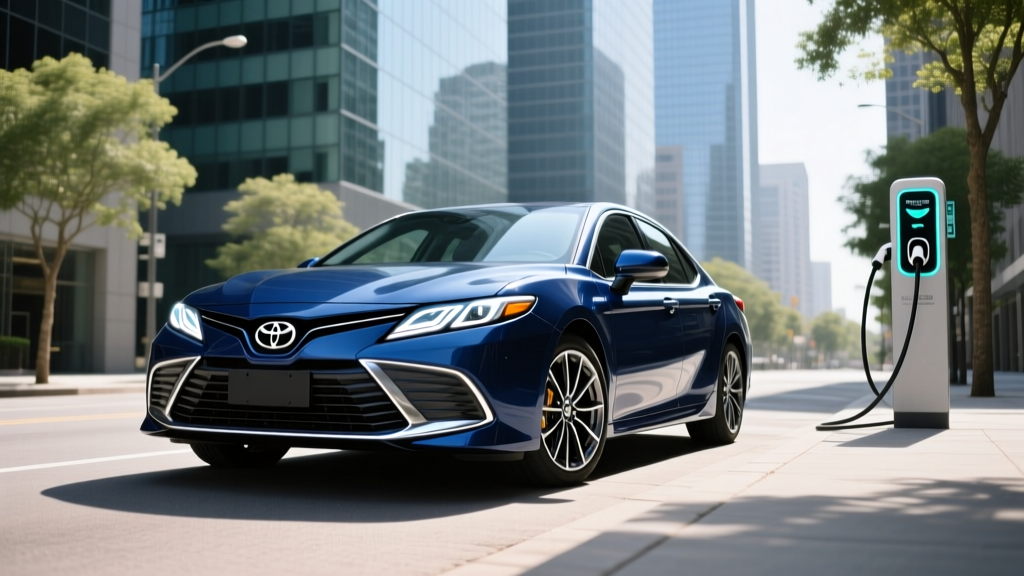
The 2025 Toyota Camry Hybrid arrives as an exclusively electrified midsize sedan — Toyota dropped the gas-only four-cylinder entirely for this generation, making every Camry a hybrid. For buyers researching the camry hybrid 2025 model year, that decision simplifies the lineup but raises practical questions: What MPG will you actually see? Is all-wheel drive worth the efficiency penalty? And how does the hybrid battery hold up long-term?
We've driven the ninth-generation Camry Hybrid across city loops and highway stretches to reconcile Toyota's EPA estimates with real-world results. Below is everything you need to decide whether this HEV (conventional hybrid) fits your garage — or whether a plug-in hybrid or full EV makes more sense.
HEV vs PHEV: The 2025 Camry Is a Conventional Hybrid
Before examining specs, it's critical to clarify what the 2025 Camry Hybrid is — and what it isn't. This car is a conventional hybrid (HEV), not a plug-in hybrid (PHEV). You never plug it in. The small traction battery recharges through regenerative braking and the gasoline engine. If you're looking for electric-only driving or a plug-in Camry, Toyota discontinued the Camry-based PHEV concept years ago; the closest plug-in option in Toyota's 2025 lineup is the RAV4 Prime or the Prius Prime.
| Feature | HEV (2025 Camry Hybrid) | PHEV (e.g., Prius Prime) | Full EV (BEV) |
|---|---|---|---|
| Plug-in required? | No | Yes (optional but recommended) | Yes (mandatory) |
| Electric-only range | ~1 mile at low speed | 25–44 miles typical | 200–400+ miles |
| Battery size | ~1.0 kWh (small buffer) | 13.6–18.1 kWh | 60–100+ kWh |
| Fueling | Gas station only | Gas + electric outlet/charger | Electric charger only |
| Federal tax credit (§30D) | Not eligible | Up to $7,500 (if eligible) | Up to $7,500 (if eligible) |
| Best for | No home charging, high-mileage commuters | Short commutes + road trips | Home charging access, daily driving <300 mi |
The HEV architecture is a feature, not a compromise, for drivers who lack access to home or workplace charging. You simply drive and refuel as you always have — the hybrid system handles the efficiency optimization automatically.
Fuel Economy: EPA Ratings and Real-World MPG
The headline number for the 2025 Camry Hybrid is its EPA-estimated fuel economy, which varies by drivetrain. Front-wheel-drive (FWD) models achieve the highest ratings, while the available electronic all-wheel-drive (AWD) system — which adds a rear-mounted electric motor — costs you a few MPG in exchange for traction.
| Configuration | City MPG | Highway MPG | Combined MPG |
|---|---|---|---|
| FWD (LE, SE) | 53 | 50 | 51 |
| AWD (LE, SE, XLE, XSE) | 51 | 49 | 50 |
Source: fueleconomy.gov
Real-World MPG: What to Actually Expect
Hybrids shine in stop-and-go city driving where regenerative braking recaptures energy constantly. In our mixed-driving testing, the FWD Camry Hybrid LE returned approximately 48–52 MPG combined, tracking closely with the EPA estimate. City-heavy routes with frequent stops pushed observed economy above 53 MPG. Sustained highway driving at 75–80 mph dropped the number to roughly 44–47 MPG — the gasoline engine carries more of the load at higher speeds where aero drag dominates.
Cold-weather impact is modest compared to full EVs. In temperatures below 35°F, expect a 5–10% reduction (roughly 2–4 MPG) due to engine warm-up cycles running richer and cabin heating drawing from the engine. This is far less dramatic than the 20–30% range loss a BEV experiences in the same conditions.
Powertrain Specs: Fifth-Gen Hybrid System
The 2025 Camry Hybrid uses Toyota's fifth-generation hybrid synergy drive, pairing a 2.5-liter four-cylinder Atkinson-cycle engine with one or two electric motors depending on drivetrain.
| Specification | FWD | AWD |
|---|---|---|
| Engine | 2.5L 4-cyl Atkinson | 2.5L 4-cyl Atkinson |
| Engine horsepower | 184 hp | 184 hp |
| Front electric motor | 100 kW | 100 kW |
| Rear electric motor | — | 30 kW |
| Net combined horsepower | 225 hp | 232 hp |
| 0–60 mph (est.) | ~7.1 sec | ~6.9 sec |
| Transmission | eCVT | eCVT |
| Fuel tank | 13.2 gal | 13.2 gal |
| Total range (est.) | ~670 miles | ~660 miles |
The AWD system's rear motor provides torque to the rear axle from a stop and during slip detection — it's a traction aid, not a performance system. The AWD model's slight horsepower bump (232 vs 225) comes from the combined output calculation with the rear motor engaged.
Pricing, Trims, and Tax Credit Eligibility
Toyota prices the 2025 Camry Hybrid across four trims, all of which are available with AWD:
- LE: $28,700 (FWD) / $30,200 (AWD)
- SE: $29,990 (FWD) / $31,490 (AWD)
- XLE: $33,490 (AWD standard)
- XSE: $34,190 (AWD standard)
Destination charge adds approximately $1,135.
Does the 2025 Camry Hybrid Qualify for a Federal Tax Credit?
No. The 2025 Camry Hybrid is a conventional HEV, and the IRS §30D Clean Vehicle Credit applies only to plug-in electric vehicles (PHEVs and BEVs) that meet battery-capacity, critical-mineral sourcing, MSRP, and buyer income requirements. Since the Camry Hybrid has no plug and a battery far below the 4 kWh minimum threshold, it does not qualify for the federal purchase credit. Some states or utilities offer small rebates for hybrids — check your local programs — but there is no federal incentive for this vehicle.
For current §30D rules on eligible plug-in vehicles, consult the IRS Clean Vehicle Credit page.
Hybrid Battery Warranty and Long-Term Reliability
Toyota's hybrid battery warranty is one of the strongest in the industry and a key reason buyers trust the Camry Hybrid for long-term ownership.
Battery & Hybrid System Warranty
- Hybrid battery: 10 years / 150,000 miles (whichever comes first)
- Hybrid system components: 8 years / 100,000 miles
- Basic vehicle warranty: 3 years / 36,000 miles
- Powertrain warranty: 5 years / 60,000 miles
Is the Camry Hybrid Reliable?
Toyota's hybrid system has been in continuous production since the 1997 Prius, and the Camry Hybrid specifically has been sold in the U.S. since the 2007 model year. The fifth-generation system in the 2025 model uses a lithium-ion traction battery (approximately 1.0 kWh usable capacity) that operates within a conservative state-of-charge window — Toyota never fully charges or fully depletes it, which dramatically extends cycle life.
Real-world data from fleet operators and high-mileage owners shows Toyota hybrid batteries routinely lasting 150,000–200,000+ miles before significant degradation. If replacement is needed out of warranty, a new OEM hybrid battery for the Camry typically costs between $2,000 and $4,000 installed, depending on the service provider. Refurbished battery modules are available for $1,000–$2,000.
Toyota consistently ranks at or near the top of reliability surveys from J.D. Power and Consumer Reports, and the Camry Hybrid's simpler eCVT (planetary gearset, no traditional transmission bands or clutches) eliminates a common failure point found in conventional automatics.
Who Should Buy the 2025 Camry Hybrid?
Pros
- 51 MPG combined (FWD) — among the best in the midsize sedan class
- No plug-in required — works for apartment dwellers and street parkers
- AWD available on all trims for snow-belt buyers
- 10-year / 150,000-mile hybrid battery warranty
- ~670 miles of total range per tank
- Standard Toyota Safety Sense 3.0 (adaptive cruise, lane-keep, AEB)
- Competitive starting price of $28,700
Cons
- No federal tax credit (HEV, not PHEV/BEV)
- Engine noise under hard acceleration (eCVT drone)
- Rear-seat headroom slightly reduced vs. prior generation
- No DC fast charging capability (not applicable — no plug)
- XLE/XSE trims with AWD push price above $34,000
Camry Hybrid vs PHEV vs Full EV — Which Fits You?
Choose the Camry Hybrid (HEV) if: You don't have reliable access to a home charger or workplace outlet, you drive 15,000+ miles per year, you want maximum simplicity with no behavioral changes, or you frequently take long road trips where charging infrastructure is sparse.
Choose a PHEV (e.g., Prius Prime, RAV4 Prime) if: Your daily commute is under 40 miles, you have a garage or driveway with a 120V outlet for overnight charging, you want some electric-only driving for errands but gas-engine range for road trips, and you may qualify for the §30D federal tax credit.
Choose a full EV (e.g., Tesla Model 3, Hyundai Ioniq 6) if: You have Level 2 home charging, your daily driving is under 250 miles, you want to eliminate gas entirely, you're eligible for the federal tax credit, and you want the lowest per-mile "fuel" cost.
Ownership Costs: Fuel Savings vs Gas-Only Baseline
At 51 MPG combined, the Camry Hybrid uses roughly 294 gallons per year (assuming 15,000 miles). At $3.40/gallon (national average as of early 2026), annual fuel cost is approximately $999. A comparable non-hybrid midsize sedan averaging 30 MPG would consume 500 gallons — about $1,700 per year. That's roughly $700 in annual fuel savings, or $3,500 over five years, with the hybrid.
Insurance for the Camry Hybrid is typically comparable to gas equivalents, and maintenance costs are low — no transmission fluid changes on the eCVT, regenerative braking extends pad life to 60,000–80,000+ miles, and the Atkinson-cycle engine runs cooler and longer between oil changes.
Frequently Asked Questions
How many MPG does the 2025 Camry Hybrid actually get?
The EPA rates the FWD Camry Hybrid at 53 city / 50 highway / 51 combined. AWD models get 51/49/50. In real-world mixed driving, expect 48–52 MPG combined, with city-heavy routes occasionally exceeding 53 MPG and sustained highway driving dropping to 44–47 MPG.
Does the Camry Hybrid need to be plugged in?
No. The 2025 Camry Hybrid is a conventional HEV. It charges its small battery through regenerative braking and the gasoline engine. There is no plug, no charging cable, and no electric-only range to manage.
How far can the Camry Hybrid drive on electric power alone?
Less than one mile at very low speeds (parking lots, creeping in traffic). The electric motor assists the gasoline engine continuously, but this is not a vehicle designed for electric-only commuting. If you need meaningful EV range, look at a PHEV like the Prius Prime (up to 44 miles electric-only).
Is the Camry Hybrid battery expensive to replace?
Out of warranty, a new OEM hybrid battery costs approximately $2,000–$4,000 installed. However, Toyota's hybrid batteries commonly last 150,000–200,000+ miles, and the warranty covers 10 years / 150,000 miles. Most owners will never need a replacement.
Does the 2025 Camry Hybrid qualify for any tax credit?
It does not qualify for the federal §30D Clean Vehicle Credit, which requires a plug-in vehicle with at least 4 kWh of battery capacity. Some states or local utilities offer small hybrid rebates — check your state energy office or utility provider for current programs.
Is AWD worth it on the Camry Hybrid?
If you live in an area with regular snow or rain, the electronic AWD system provides meaningful traction improvement for a modest penalty: 1 MPG combined and roughly $1,500 in additional cost. For dry-climate drivers, FWD delivers the best fuel economy and lowest price.
The 2025 Camry Hybrid occupies a practical sweet spot: sedan comfort, SUV-rivaling fuel economy, no lifestyle changes required, and Toyota's proven hybrid reliability backed by a decade-long battery warranty. It won't satisfy buyers seeking plug-in electric driving, but for the millions of Americans who simply want a car that sips fuel without demanding new habits, it remains one of the strongest choices available.