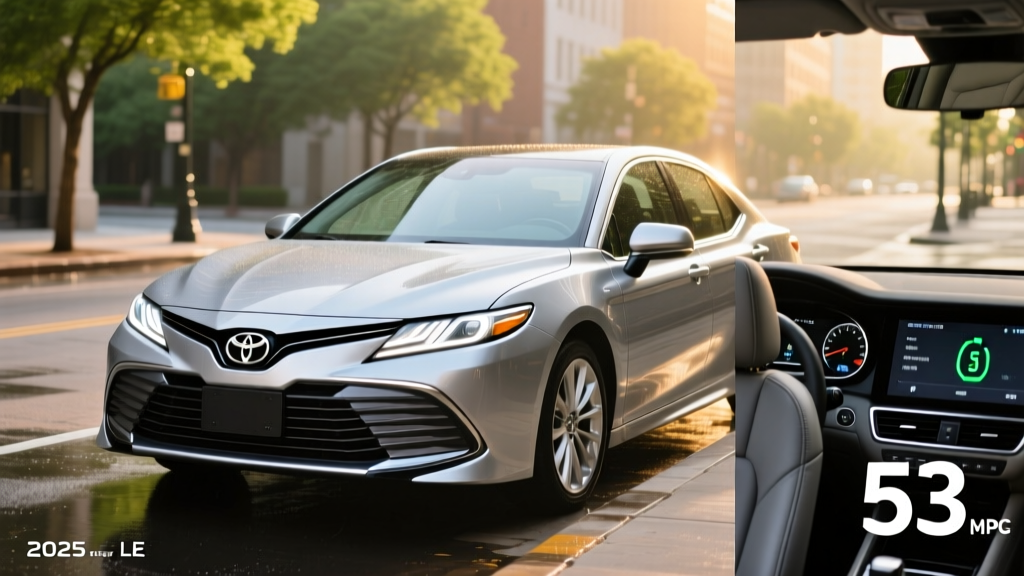
The 2025 Toyota Camry Hybrid LE occupies a specific and increasingly crowded niche: a midsize sedan that sips fuel without asking you to change how you drive. There's no plug, no range anxiety, and no learning curve. For the 2025 model year, Toyota made a consequential decision — every Camry is now a hybrid. The gas-only four-cylinder is gone. That makes the base LE trim the entry point not just into the Camry lineup, but into Toyota's hybrid-electric strategy for its best-selling sedan.
We've spent time analyzing the EPA data, cross-referencing owner-reported fuel economy, and parsing Toyota's powertrain specs to give you a buyer's-guide-level breakdown of what the 2025 Camry Hybrid LE actually delivers — and where its limitations sit.
2025 Camry Hybrid LE: Quick Verdict
The Camry Hybrid LE is a conventional hybrid electric vehicle (HEV). It cannot be plugged in. It generates and recovers its own electricity through the gasoline engine and regenerative braking, storing energy in a small lithium-ion battery. The result is an EPA-estimated 51 MPG combined — a number that, in real-world city driving, many owners actually exceed.
At a starting MSRP around $29,490 (including destination), it undercuts most midsize hybrid rivals on price while delivering top-tier fuel economy. It does not qualify for the federal §30D EV tax credit because it is not a plug-in vehicle. For buyers who want maximum efficiency without plugging in, this is arguably the best value in the segment.
Fuel Economy: EPA Numbers vs. Real-World MPG
| Metric | Value |
|---|---|
| City MPG | 53 |
| Highway MPG | 50 |
| Combined MPG | 51 |
| Fuel Tank Capacity | 13.2 gallons |
| Total Estimated Range | ~673 miles |
Source: fueleconomy.gov
HEV vs. PHEV vs. EV: Where Does the Camry Hybrid Fit?
This is the most common point of confusion for shoppers entering the electrified-vehicle market. Here's how the three categories differ, and why it matters for your purchase decision:
| Feature | HEV (Camry Hybrid) | PHEV (e.g., Prius Prime) | BEV (e.g., Tesla Model 3) |
|---|---|---|---|
| Plug-in charging? | No | Yes | Yes |
| Electric-only range | ~1 mile at low speed | 25–45 miles typical | 250–360+ miles |
| Gas engine? | Yes | Yes | No |
| Battery size | ~1.1 kWh | 13–18 kWh | 50–82 kWh |
| Federal tax credit | No | Up to $7,500* | Up to $7,500* |
| Home charger needed? | No | Recommended | Essential |
*Federal §30D credit eligibility depends on MSRP caps, buyer income limits, and battery component/critical mineral sourcing requirements. Verify current rules at IRS.gov.
The Camry Hybrid LE is a self-charging HEV. You fuel it with gasoline and never think about charging. The electric motor assists the gas engine during acceleration, captures energy during braking, and enables brief engine-off coasting — but it cannot drive meaningful distances on electricity alone. This is fundamentally different from a PHEV like the Toyota Prius Prime, which offers roughly 40 miles of electric-only range before the gas engine engages, or a full BEV that runs exclusively on battery power.
Powertrain: Fifth-Generation Hybrid System
The 2025 Camry Hybrid LE uses Toyota's fifth-generation hybrid synergy drive, pairing a 2.5-liter four-cylinder engine with two electric motor-generators through an electronically controlled continuously variable transmission (eCVT).
| Specification | Value |
|---|---|
| Engine | 2.5L inline-4 (A25A-FXS, Atkinson cycle) |
| Engine horsepower | 184 hp @ 5,700 rpm |
| Electric motor output | 134 hp |
| Net combined system horsepower | 208 hp (FWD) |
| Drivetrain | Front-wheel drive |
| Transmission | eCVT |
| 0–60 mph (est.) | ~7.1 seconds |
| Hybrid battery type | Lithium-ion |
| Hybrid battery capacity | ~1.1 kWh (nominal) |
The 208-horsepower combined output (FWD) is a meaningful upgrade from previous Camry Hybrid generations. The eCVT is not a belt-driven CVT — it uses a planetary gearset to blend engine and motor power, which eliminates the rubber-band feel associated with older CVT designs. Acceleration is linear and confident for highway merging. An AWD variant is available on higher trims (adding a rear-mounted electric motor for 218 hp combined), but the LE is FWD only.
Battery Warranty, Lifespan, and Replacement Cost
Battery longevity is consistently the top concern among first-time hybrid buyers. Here's what the data shows:
- Expected lifespan: Toyota's hybrid batteries in the Camry and Prius platforms routinely last 150,000–200,000+ miles before significant degradation. Many original batteries in 2010-era Prius vehicles are still in service.
- Failure mode: Hybrid batteries typically degrade gradually (losing capacity over time) rather than failing catastrophically. You may notice slightly reduced fuel economy before a failure warning.
- Replacement cost: A new OEM hybrid battery replacement from Toyota runs approximately $2,500–$4,000 installed. Refurbished or reconditioned batteries are available for $1,000–$2,000. Individual module replacement (if only one cell group fails) can cost $500–$1,000 at a specialist shop.
- Context: At 51 MPG, the Camry Hybrid saves roughly $600–$900 per year in fuel costs versus a comparable 30 MPG gas sedan (assuming 12,000 miles/year and $3.50/gallon). That savings alone would cover a battery replacement within 3–6 years if one were needed out of warranty.
Pricing, Trims, and Tax Credit Eligibility
| Trim | MSRP (incl. destination) | Drivetrain |
|---|---|---|
| LE | $29,490 | FWD |
| SE | $31,090 | FWD / AWD |
| XLE | $34,490 | FWD / AWD |
| XSE | $35,890 | FWD / AWD |
Federal tax credit: The 2025 Camry Hybrid LE does not qualify for the IRS §30D New Clean Vehicle Credit. That credit is reserved for plug-in electric vehicles (PHEVs and BEVs) with sufficient battery capacity and compliant sourcing. As a conventional HEV, the Camry Hybrid is ineligible regardless of buyer income or purchase price.
State incentives: A small number of states and utilities offer modest rebates for conventional hybrids, but these are increasingly rare as incentive programs shift toward plug-in vehicles. Check your state energy office or utility provider for current programs.
Total cost context: Without a tax credit, the Camry Hybrid LE's value proposition rests entirely on fuel savings and Toyota's reliability reputation. Over five years and 60,000 miles at 51 MPG and $3.50/gallon, you'd spend approximately $4,100 on fuel. A comparable 28 MPG gas midsize sedan would cost roughly $7,500 — a $3,400 gap that nearly closes the price premium over the cheapest gas-only competitors.
Pros and Cons at a Glance
- 51 MPG combined — best in midsize sedan class
- No plug-in required — zero lifestyle change
- 208 hp is genuinely adequate for highway driving
- 10-year/150,000-mile hybrid battery warranty
- ~$29,500 starting price is competitive
- Toyota Safety Sense 3.0 standard (AEB, LTA, DRCC)
- 673-mile total range per tank
- No federal tax credit eligibility
- FWD only on LE trim (AWW requires higher trims)
- Cannot drive on electric-only power beyond ~1 mile
- eCVT drone under hard acceleration
- Base LE interior uses cloth seats and basic infotainment
- No DC fast charging capability (not applicable to HEV)
- Rear-seat headroom slightly reduced vs. prior generation
Who Should Buy the 2025 Camry Hybrid LE?
- You want maximum MPG with zero charging infrastructure or behavior changes
- You drive 12,000–20,000+ miles per year and fuel cost is a primary concern
- You live in an apartment or lack access to home/workplace charging (making a PHEV or BEV impractical)
- You plan to own the vehicle 8–10+ years and value Toyota's long-term reliability record
- You want a proven, low-risk electrified powertrain without paying a PHEV or BEV premium
- You have home charging and a short commute — a PHEV like the Prius Prime lets you drive 40+ miles on electricity daily, using zero gas on most days
- You want a fully electric driving experience with instant torque and one-pedal driving — consider a BEV like the Hyundai Ioniq 6 or Tesla Model 3
- You need AWD — step up to the Camry Hybrid SE or higher for the electronic AWD option
- You want to claim the $7,500 federal tax credit — you need a qualifying PHEV or BEV
Frequently Asked Questions
How many MPG does the 2025 Camry Hybrid LE get?
The EPA rates the 2025 Camry Hybrid LE at 53 MPG city, 50 MPG highway, and 51 MPG combined. In real-world driving, city-heavy commuters often report 50–55 MPG, while sustained highway driving at high speeds yields 44–47 MPG. Cold weather reduces efficiency by roughly 5–10%.
Does the Camry Hybrid need to be plugged in?
No. The Camry Hybrid LE is a conventional hybrid (HEV), not a plug-in hybrid (PHEV). It charges its own battery through regenerative braking and the gasoline engine. You never plug it in — you only refuel at a gas station.
Is the hybrid battery reliable, and what does replacement cost?
Toyota's hybrid batteries have an exceptional reliability record, routinely lasting 150,000–200,000+ miles. The battery is warranted for 10 years or 150,000 miles. If replacement is needed out of warranty, expect $2,500–$4,000 for a new OEM battery, or $1,000–$2,000 for a refurbished unit.
Does the 2025 Camry Hybrid qualify for any tax credit?
No. The federal §30D New Clean Vehicle Credit requires a plug-in vehicle (PHEV or BEV) with a battery capacity of at least 7 kWh. The Camry Hybrid's ~1.1 kWh battery does not meet this threshold. It is not eligible for the $7,500 federal credit. Some state or utility hybrid incentives may exist — check local programs.
Camry Hybrid vs. Prius: which is more efficient?
The 2025 Toyota Prius (LE trim) achieves an EPA-estimated 57 MPG combined, slightly beating the Camry Hybrid LE's 51 MPG. However, the Prius is a compact liftback with less rear-seat room and cargo space. If you need midsize sedan comfort and trunk volume, the Camry Hybrid is the better fit. If pure MPG is your only priority, the Prius wins by 6 MPG.
Can I get AWD on the Camry Hybrid LE?
No. The LE trim is front-wheel drive only. Electronic all-wheel drive (which adds a rear electric motor for 218 combined hp) is available starting with the SE trim.