Quick Verdict: The Luxury PHEV That Actually Makes Sense
The 2025 BMW X5 xDrive50e is one of the few luxury plug-in hybrids that genuinely bridges the gap between a daily electric commuter and a long-distance SUV. With an EPA-rated 38 miles of electric-only range, 483 combined horsepower, and a starting MSRP around $72,100, it targets buyers who want EV-like city driving without range anxiety on road trips. But does the math work when you factor in charging logistics, real-world efficiency, and federal tax credit eligibility? Let's break down every number that matters.
| Spec | Value |
|---|---|
| Powertrain | 3.0L turbocharged inline-6 + electric motor (8-speed auto, AWD) |
| Combined Horsepower | 483 hp / 516 lb-ft torque |
| Battery (usable) | 25.7 kWh (NMC lithium-ion) |
| EPA Electric Range | 38 miles |
| EPA MPGe (combined) | 50 MPGe |
| EPA MPG (gas only, combined) | 22 MPG |
| Total Range | ~440 miles |
| Max AC Charging | 7.4 kW (Level 2) |
| DC Fast Charging | Not available |
| 0-60 mph | 4.6 seconds |
| Base MSRP | ~$72,100 |
| Federal Tax Credit (§30D) | Up to $7,500 (eligibility varies) |
| Battery Warranty | 8 years / 80,000 miles |
HEV vs PHEV: What's the Difference and Why It Matters for the X5
Before diving into the X5 xDrive50e specifics, it's worth clarifying the distinction between conventional hybrids and plug-in hybrids, because BMW's lineup can create confusion.
| Feature | HEV (e.g., Toyota RAV4 Hybrid) | PHEV (e.g., BMW X5 xDrive50e) |
|---|---|---|
| Plug-in charging | No — charges via regen and engine | Yes — plug in to access full electric range |
| Electric-only range | 0–2 miles at low speed | 30–40+ miles at highway speed |
| Battery size | 1–2 kWh | 15–30 kWh |
| Fuel economy (charge-depleted) | 35–45 MPG combined typical | 20–25 MPG combined typical |
| Tax credit eligible | Generally no | Potentially yes (§30D) |
| Ideal use case | No home charging, want better MPG | Home charging available, short daily commute |
The 2025 BMW X5 xDrive50e is strictly a plug-in hybrid. There is no conventional HEV version of the current-generation X5 sold in the US. If you cannot install a home charger or regularly access Level 2 charging, a PHEV's advantage erodes rapidly — you'll be hauling a heavy battery pack and a gasoline engine without capturing the electric-only efficiency benefit. If that describes your situation, a conventional hybrid from another brand may serve you better.
Electric Range, MPG, and Real-World Efficiency
The EPA rates the 2025 BMW X5 xDrive50e at 38 miles of electric-only range and 50 MPGe when operating in blended electric/gas mode. Once the battery is depleted, the gasoline engine takes over and the EPA estimates 22 MPG combined (roughly 21 city / 24 highway, per fueleconomy.gov).
| Mode | City | Highway | Combined |
|---|---|---|---|
| Electric-only (MPGe) | — | — | 50 MPGe |
| Gasoline-only (MPG) | ~21 | ~24 | ~22 |
The 38-mile EPA electric range assumes moderate temperatures, mixed driving, and a full charge. In cold weather (below 32°F), expect electric range to drop to approximately 28–32 miles due to battery resistance and cabin heating demands. On highway-only trips at 75+ mph, electric range may shrink to 30–33 miles. Gasoline-only MPG on long highway cruises tends to land between 23–26 MPG in real-world driving, slightly above the EPA estimate, while aggressive city driving can dip below 20 MPG once the battery is depleted.
The X5 xDrive50e's total combined range (electric + gasoline) is approximately 440 miles, giving it genuine road-trip capability. The 18.5-gallon fuel tank is the key enabler here — unlike smaller PHEVs with 10-gallon tanks, you won't be hunting for gas stations on interstate drives.
For context, owners who charge nightly and commute under 35 miles round-trip report using gasoline only on weekend trips, effectively achieving 80–100+ MPGe over a month of mixed use. Those who never plug in are essentially driving a heavy, less-efficient gasoline SUV at 22 MPG — worse than a conventional 4-cylinder hybrid.
Powertrain Deep Dive: 483 HP From Inline-6 + Electric Motor
The 2025 X5 xDrive50e pairs BMW's B58 3.0-liter turbocharged inline-6 engine with an electric motor integrated into the 8-speed automatic transmission housing. The engine produces approximately 312 hp on its own, while the electric motor adds roughly 184 hp, for a combined system output of 483 horsepower and 516 lb-ft of torque.
This is a significant upgrade over the previous-generation X5 xDrive45e (389 hp). The 0-60 mph time drops to 4.6 seconds, placing it firmly in performance-SUV territory. BMW's xDrive all-wheel-drive system distributes torque between axles, and the electric motor can independently drive the front wheels at low speeds for electric-only operation.
The driving modes include:
- Electric — pure EV operation up to ~87 mph, prioritizes battery use
- Hybrid — system blends gas and electric for optimal efficiency
- Sport — combined powertrain output for maximum acceleration
- Battery Control — reserves or recharges the battery using the engine (useful before entering an EV-only zone or city center)
The 25.7 kWh usable battery (approximately 29.5 kWh gross) uses NMC (nickel-manganese-cobalt) chemistry, which offers high energy density but requires careful thermal management. BMW's liquid-cooling system maintains battery temperature during both driving and charging.
Charging: Level 2 Only, No DC Fast Charging
This is the X5 xDrive50e's most significant practical limitation. The vehicle supports only AC Level 2 charging at up to 7.4 kW. There is no DC fast charging capability — you will not find a CCS or NACS port capable of accepting 50+ kW from a highway fast charger.
| Charging Level | Power | 0–100% Time | Practicality |
|---|---|---|---|
| Level 1 (120V outlet) | ~1.4 kW | ~18–20 hours | Emergency/top-up only |
| Level 2 (240V, 32A) | 7.4 kW | ~4 hours | Daily home charging (overnight) |
| DC Fast Charge | N/A | N/A | Not supported |
For most PHEV owners, the lack of DC fast charging is manageable because the battery is small enough to refill overnight on Level 2. A full charge in roughly 4 hours on a 240V/32A home charger means you can easily replenish during the workday if you have workplace charging, or overnight at home. However, on road trips, you cannot quickly top up the battery at a DC fast-charging station — the gasoline engine handles long-distance driving exclusively.
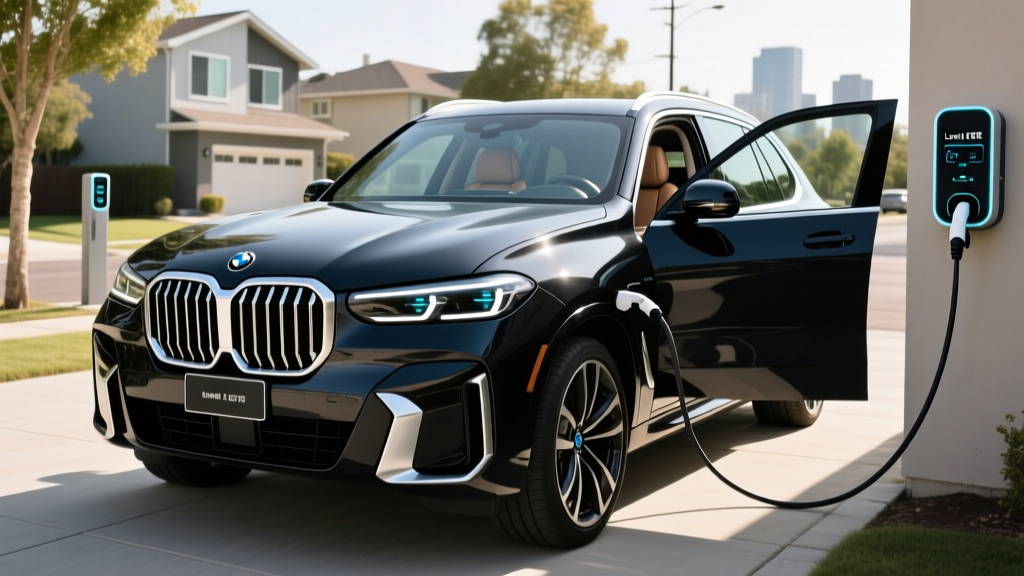
BMW includes a portable charging cable (Mode 2) with the vehicle, and the J1772 connector is standard for Level 2 AC charging in the US. If you're installing a home Level 2 charger, a 40-amp circuit (delivering 32A continuous to the car) is sufficient to hit the 7.4 kW maximum. Budget approximately $500–$1,500 for a quality Level 2 home charger and professional installation, depending on your electrical panel proximity and local permit costs.
Pricing, Trims, and Federal Tax Credit Eligibility
The 2025 BMW X5 xDrive50e starts at an MSRP of approximately $72,100 (including destination). BMW offers it in a single well-equipped trim, though option packages (Premium, Executive, M Sport) can push the price above $85,000.
Federal §30D Tax Credit Eligibility (2025 Rules)
The X5 xDrive50e has historically qualified for partial or full federal tax credits, but eligibility depends on several factors that change frequently. Per the IRS §30D guidelines, key requirements include:
- MSRP Cap: SUVs must be under $80,000 MSRP — the base X5 xDrive50e qualifies, but heavily optioned units may exceed the cap
- Buyer Income Cap: Modified AGI must not exceed $150,000 (single) / $300,000 (joint filing)
- Battery Sourcing: Critical minerals and battery components must meet phased percentage thresholds from US or FTA-partner countries — BMW's supply chain sourcing determines eligibility year to year
- Point-of-Sale Transfer: As of 2024+, you can transfer the credit to the dealer at purchase for an immediate price reduction, rather than waiting to claim it on your tax return
- Credit Amount: Up to $7,500 ($3,750 for critical minerals + $3,750 for battery components) — the X5 may qualify for $3,750 or $7,500 depending on current-year sourcing rules
Always verify current eligibility on fueleconomy.gov before purchasing, as battery sourcing compliance can change between model years. Consult a tax professional for your specific situation.
If the X5 xDrive50e qualifies for the full $7,500 credit, the effective starting price drops to approximately $64,600 — competitive with a well-equipped gasoline X5 xDrive40i once you factor in fuel savings for a commuter who charges regularly.
Battery Warranty, Reliability, and Replacement Costs
8 years or 80,000 miles (whichever comes first), covering defects and capacity loss below 70% of original capacity. This is standard for the PHEV/EV industry and aligns with federal emissions warranty requirements.
BMW's inline-6 B58 engine has a strong reliability track record in both conventional and hybrid applications since its introduction. The electric motor integrated into the ZF 8-speed transmission is a proven design shared across BMW's PHEV lineup. The primary reliability question centers on the high-voltage battery pack.
NMC batteries in PHEVs typically experience slower degradation than in full EVs because the battery is smaller and the system maintains a larger buffer (the X5 uses roughly 25.7 kWh of a ~29.5 kWh gross pack). Real-world data from the previous-generation X5 xDrive45e suggests capacity retention of 90%+ after 5 years of regular use. However, if the battery does fail outside warranty, replacement costs are estimated between $8,000 and $14,000 including labor — a significant expense that buyers should factor into long-term ownership planning.
BMW's standard limited warranty covers 4 years / 50,000 miles bumper-to-bumper, with the hybrid-specific components (battery, electric motor, power electronics) covered under the 8-year / 80,000-mile warranty. Scheduled maintenance for the first 3 years or 36,000 miles is included.
Who Should Buy the X5 PHEV — And Who Shouldn't
Pros
- 38 miles EV range covers most daily commutes
- 483 hp with seamless gas/electric transitions
- 440+ mile total range eliminates road-trip anxiety
- Qualifies for up to $7,500 federal tax credit (verify sourcing)
- Luxury interior, strong cargo capacity (33.9 cu ft rear seats up)
- No range anxiety — gas engine is always a backup
Cons
- No DC fast charging — road trips run on gas only
- 22 MPG gas-only is mediocre for the class
- Heavy: ~5,400 lbs affects tire wear and braking
- Premium fuel required (91+ octane)
- Home Level 2 charging is nearly mandatory for value
- Options push price past $80K tax-credit cap
Decision Framework: Is the X5 xDrive50e Right for You?
Choose the BMW X5 xDrive50e PHEV if:
- You have home or workplace Level 2 charging access
- Your daily round-trip commute is under 40 miles
- You want a luxury SUV that can also handle 400-mile road trips
- You want to reduce gas consumption without committing to a full EV
- You qualify for the §30D tax credit based on income and sourcing
Choose a full EV (e.g., BMW iX, Tesla Model X) if:
- You want zero gasoline use and DC fast charging for road trips
- Your daily commute is longer than 40 miles and you want all-electric operation
- You want lower long-term maintenance costs (no engine oil, spark plugs, or exhaust system)
Choose a conventional hybrid (e.g., Volvo XC90 Recharge alternative, or Toyota/Lexus hybrid SUV) if:
- You cannot install a home charger or access regular plug-in charging
- You want better fuel economy without changing your fueling habits
- You want a lower purchase price
Choose the gasoline X5 xDrive40i if:
- You drive predominantly long highway distances where PHEV advantages disappear
- You want a lower starting price and don't care about electric-only driving
Hybrid vs PHEV vs EV: Which Fits Your Lifestyle?
The X5 xDrive50e sits in the middle of the electrification spectrum. Here's how it compares to the broader options available to luxury SUV buyers in 2025:
| Factor | X5 xDrive50e (PHEV) | BMW iX xDrive50 (EV) | X5 xDrive40i (Gas) |
|---|---|---|---|
| Starting MSRP | ~$72,100 | ~$87,250 | ~$65,200 |
| Electric range | 38 mi | ~307 mi (EPA) | 0 mi |
| DC fast charging | No | Yes (up to ~150 kW) | N/A |
| Fuel cost (annual, 15K mi) | ~$900–$1,400* | ~$500–$800 | ~$2,200–$2,600 |
| Maintenance complexity | Engine + EV systems | EV only (simpler) | Engine only |
| Best for | Short commute + road trips | Home charging + daily EV | No charging access |
*Fuel cost for PHEV varies dramatically based on how often you charge. Assumes nightly charging and occasional gas use.
Frequently Asked Questions
How many MPG does the 2025 BMW X5 plug-in hybrid get?
The EPA rates the X5 xDrive50e at 50 MPGe combined when using both electric and gasoline power. Once the battery is depleted, it returns approximately 22 MPG combined on gasoline alone (roughly 21 city / 24 highway). Real-world results vary significantly: owners who charge daily and commute under 38 miles may use almost no gasoline, while those who never charge will see 20–24 MPG — worse than many conventional 4-cylinder hybrids.
How far can the BMW X5 xDrive50e go on electric only?
The EPA rates it at 38 miles of electric-only range. In real-world conditions, expect 30–38 miles depending on temperature, driving style, and terrain. Cold weather (below freezing) can reduce this to 28–32 miles. The electric motor can propel the X5 up to approximately 87 mph before the gasoline engine engages.
Does the 2025 BMW X5 PHEV qualify for a federal tax credit?
The X5 xDrive50e may qualify for up to $7,500 under the IRS §30D clean vehicle credit, but eligibility depends on current-year battery sourcing requirements, your income (under $300,000 joint / $150,000 single), and the vehicle's MSRP staying under the $80,000 SUV cap. The base model qualifies on MSRP, but heavily optioned units may not. Always check fueleconomy.gov for the latest eligibility data before purchasing, and consult a tax professional.
Is the BMW X5 hybrid reliable, and what does a battery replacement cost?
BMW's B58 inline-6 is widely regarded as one of the most reliable engines in the luxury segment, and the ZF 8-speed hybrid transmission is a proven design. The high-voltage battery carries an 8-year / 80,000-mile warranty. If replacement is needed outside warranty, expect $8,000–$14,000. However, PHEV batteries tend to degrade slowly because the system uses a partial state-of-charge window, reducing stress on the cells. Most owners report minimal degradation in the first 5 years.
Can the BMW X5 xDrive50e charge at Tesla Superchargers or DC fast chargers?
No. The X5 xDrive50e supports only AC Level 2 charging (up to 7.4 kW via J1772 connector). It cannot accept DC fast charging from any network — Tesla Superchargers, Electrify America, EVgo, or otherwise. On road trips, the gasoline engine handles all propulsion once the battery is depleted. This is standard for most PHEVs; DC fast charging is typically reserved on full EVs with larger battery packs.
Do I need to install a home charger for the X5 PHEV?
While not technically required, home Level 2 charging is strongly recommended. Without regular plug-in charging, you lose the primary efficiency and cost advantage of the PHEV powertrain and are left with a heavier, less-efficient gasoline SUV. A basic 240V / 32A home charger installation typically costs $500–$1,500 (equipment + electrician), and a full charge takes approximately 4 hours.