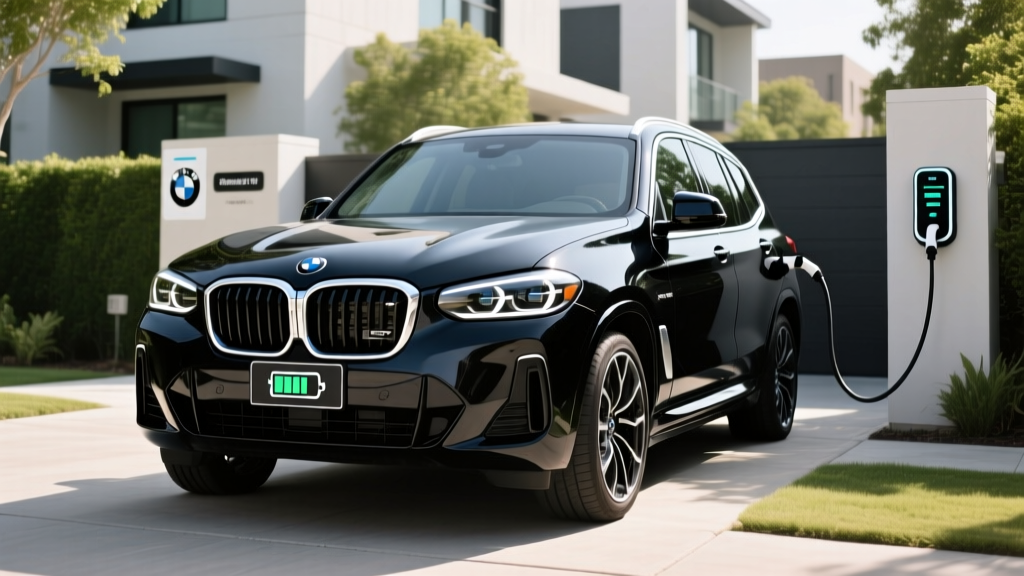
The 2025 BMW X3 Hybrid: A PHEV That Finally Gets It Right
When BMW redesigned the X3 for the 2025 model year, the plug-in hybrid variant — now badged the X3 xDrive50e — received the most dramatic upgrade in the lineup. The previous-generation X3 xDrive30e managed just 19 miles of electric range and felt like a compromise. The 2025 X3 xDrive50e is a fundamentally different proposition: nearly double the electric-only range, a vastly more powerful combined output, and the ability to handle most daily commutes without burning a drop of gasoline.
But how does it stack up against a full EV like the BMW iX3 or a conventional hybrid SUV? And does it still qualify for the federal tax credit? This guide breaks down every spec that matters.
HEV vs PHEV: What the 2025 BMW X3 Hybrid Actually Is
The 2025 BMW X3 xDrive50e is a plug-in hybrid electric vehicle (PHEV), not a conventional hybrid (HEV). This distinction matters for ownership:
| Feature | Conventional Hybrid (HEV) | Plug-In Hybrid (PHEV) — X3 xDrive50e |
|---|---|---|
| Plug-in charging | No — charges via regenerative braking and engine | Yes — plug in to access full electric range |
| Electric-only driving | Very short distances at low speed | Up to 38 miles at highway speeds |
| Battery size | ~1–2 kWh | 22.0 kWh (19.7 kWh usable) |
| Federal tax credit | None | Eligible under §30D (see details below) |
| Best for | Drivers who can't plug in at home | Drivers with home/work charging and short commutes |
If you cannot install a Level 2 charger at home or lack workplace charging, the PHEV's electric range advantage shrinks considerably — you'll drive it mostly as a heavy hybrid. BMW does not currently offer a conventional HEV version of the 2025 X3 in the US market; the lineup consists of the mild-hybrid xDrive30 (gasoline), the xDrive50e PHEV, and the fully electric iX3.
EPA Fuel Economy and Real-World MPG
The EPA rates the 2025 BMW X3 xDrive50e at the following fuel economy figures:
| Metric | City | Highway | Combined |
|---|---|---|---|
| Charge-sustaining MPG (gas only) | 33 | 37 | 35 |
| MPGe (gas + electric combined) | 68 MPGe | ||
| Electric-only efficiency | 2.1 kWh/mile | ||
Real-world expectations: PHEVs are uniquely sensitive to how you use them. If you charge nightly and commute under 38 miles, your effective fuel consumption approaches zero — you might visit a gas station once a month. On a long road trip with a depleted battery, expect the 35 MPG combined figure to hold fairly close; BMW's 2.0-liter turbo four is efficient under load, and the 8-speed automatic keeps revs low. In cold weather (below 30°F), electric-only range drops roughly 20–30%, meaning you'll see closer to 26–30 miles on battery alone before the engine kicks in. Source: fueleconomy.gov.
Electric-Only Range, Battery, and Charging
The xDrive50e packs a 22.0 kWh lithium-ion battery (NMC chemistry, 19.7 kWh usable) mounted beneath the rear seat and cargo floor. This is a significant increase from the prior generation's 12.0 kWh pack, and it directly translates to the headline number:
EPA electric-only range: 38 miles
Real-world expectation: 30–35 miles in mixed driving; 26–30 miles in cold weather or sustained highway use above 70 mph.
Total combined range (electric + gas): approximately 430 miles with a full tank and full battery.
Charging capabilities:
| Charging Level | Power | Time (0–100%) | Notes |
|---|---|---|---|
| Level 1 (120V household) | ~1.4 kW | ~14 hours | Overnight top-up only |
| Level 2 (240V home/public) | 7.4 kW | ~2.75 hours | Primary charging method |
| DC fast charging | Not available | N/A | No CCS/CHAdeMO port |
The absence of DC fast charging is a notable limitation. On a road trip, you cannot top up the battery at a highway Electrify America or Tesla Supercharger station. However, for a PHEV whose battery is designed to be replenished overnight at home, this is typical — most PHEVs in this class (Volvo XC60 Recharge, Lincoln Corsair Grand Touring) also lack DC fast charging.
Preconditioning tip: The X3 xDrive50e supports scheduled preconditioning via the My BMW app. Setting a departure time warms or cools the cabin using grid power rather than battery energy, preserving your full 38-mile electric range for actual driving.
Powertrain: 483 Horsepower From a 2.0-Liter
The xDrive50e pairs a turbocharged 2.0-liter inline-four gasoline engine with an electric motor integrated into the 8-speed automatic transmission housing. Combined output:
- Gasoline engine: 255 hp / 295 lb-ft torque
- Electric motor: 184 hp / 184 lb-ft torque
- Combined system output: 483 hp / 516 lb-ft torque
- 0–60 mph: 4.9 seconds
- Drivetrain: xDrive all-wheel drive (standard)
- Transmission: 8-speed automatic with integrated electric motor
This is a substantial power increase over the previous-generation xDrive30e (288 hp combined). In practice, the electric motor provides instant torque from a standstill, making the X3 xDrive50e feel considerably quicker than its 4.9-second 0–60 time suggests in city driving. The transition between electric and gas power is seamless — BMW's powertrain integration is among the smoothest in the PHEV segment.
Driving modes: The X3 xDrive50e offers Hybrid (default, blends gas and electric), Electric (battery-only up to 84 mph), and Sport (maximum combined output with sharper throttle mapping). A Battery Hold mode preserves charge for later use — useful if you're highway-driving and want to save electric range for city traffic at your destination.
Pricing, Trims, and Federal Tax Credit Eligibility
The 2025 BMW X3 xDrive50e is offered in a single, well-equipped trim:
| Trim | Base MSRP | Destination | Total Starting Price |
|---|---|---|---|
| X3 xDrive50e | $52,575 | $1,175 | $53,750 |
Federal §30D tax credit eligibility: The BMW X3 xDrive50e is assembled in Spartanburg, South Carolina. However, eligibility for the full $7,500 federal tax credit under current IRS rules depends on several factors that can change throughout the model year:
- MSRP cap: The X3 xDrive50e must remain at or below the $80,000 SUV/van MSRP cap — the base trim qualifies, but heavily optioned examples may approach or exceed this limit.
- Buyer income cap: Modified adjusted gross income must not exceed $150,000 (single), $225,000 (head of household), or $300,000 (joint filers).
- Battery sourcing: A percentage of critical minerals and battery components must meet North American sourcing requirements. BMW's supply chain has been evolving, and the credit amount may be $3,750 or $7,500 depending on current compliance — verify at the time of purchase.
- Point-of-sale transfer: Eligible buyers can transfer the credit to the dealer at purchase, reducing the out-of-pocket price immediately rather than waiting for a tax refund.
Always confirm current eligibility on irs.gov or with your tax professional before purchasing. State incentives (such as California's CVRP or Colorado's innovative motor vehicle credit) may stack on top of the federal credit — check your state's energy office for current programs.
Battery Warranty, Reliability, and Replacement Cost
BMW PHEV Battery Warranty: 8 years / 80,000 miles (whichever comes first), covering defects and capacity loss below 70% of original capacity.
Powertrain warranty: 4 years / 50,000 miles
Limited vehicle warranty: 4 years / 50,000 miles
Reliability outlook: BMW's PHEV powertrains have proven reasonably reliable since the introduction of the G01-generation X3 xDrive30e in 2020. The electric motor and power electronics have few moving parts and rarely fail. The primary concern is the complexity of managing two complete powertrains — if the high-voltage system develops a fault, diagnosis requires a BMW-certified technician with PHEV training.
Battery replacement cost: Out of warranty, a full high-voltage battery replacement for the X3 xDrive50e is estimated at $8,000–$12,000 including parts and labor. However, PHEV batteries experience less stress than full EV batteries due to their smaller size and more frequent shallow cycling — degradation data from the previous-generation xDrive30e suggests minimal capacity loss (5–8%) over 100,000 miles. BMW also allows individual module replacement in some cases, which can reduce out-of-warranty costs.
The 8-year/80,000-mile battery warranty is federally mandated for PHEVs and provides solid protection. Most buyers will trade or sell the vehicle before this warranty expires.
Who Should Choose the X3 xDrive50e vs. a Full EV or Gas SUV?
Choose the BMW X3 xDrive50e PHEV if:
- You can charge at home (Level 2) and your daily round-trip commute is under 35 miles
- You want electric daily driving but also need to take occasional long road trips without charging-infrastructure planning
- You live in a region with harsh winters where EV range loss is a concern
- You want BMW's driving dynamics and interior quality in a compact luxury SUV
Choose a full EV (BMW iX3 or equivalent) if:
- You have reliable home charging and your daily driving exceeds 38 miles (a full EV's 250+ mile range covers everything)
- You want minimal maintenance — no oil changes, no engine, no transmission fluid
- You want to maximize fuel cost savings (electricity at $0.14/kWh costs roughly $0.04/mile vs. $0.14/mile for gas at 35 MPG)
Choose a conventional gas or mild-hybrid SUV if:
- You cannot charge at home or work — a PHEV driven only on gas is just a heavier, more expensive hybrid
- Your budget is under $45,000 and you don't qualify for tax credits
- You prioritize lowest upfront cost over long-term efficiency
Pros
- 38-mile electric range covers most commutes gas-free
- 483 hp provides genuine performance; 4.9s to 60 mph
- Smooth gas-electric transitions; no range anxiety on road trips
- Qualifies for up to $7,500 federal tax credit (verify eligibility)
- Premium interior with BMW's latest iDrive 9 infotainment
- 35 MPG combined on gas alone is strong for a 4,800-lb luxury SUV
Cons
- No DC fast charging — road-trip battery replenishment relies on the gas engine
- $53,750 starting price is steep before options
- Cargo space reduced slightly vs. gas-only X3 due to battery placement
- Electric range drops to ~26–30 miles in cold weather
- Requires home charging access to realize full PHEV benefit
Frequently Asked Questions
How many MPG does the 2025 BMW X3 hybrid get?
The EPA rates the X3 xDrive50e at 33 city / 37 highway / 35 combined MPG when operating on gasoline alone (charge-sustaining mode). When factoring in electric driving, the combined rating is 68 MPGe. Your actual fuel consumption depends entirely on how often you charge — daily chargers with short commutes may use almost no gasoline.
How far can the BMW X3 xDrive50e go on electric only?
The EPA-rated electric-only range is 38 miles. In real-world mixed driving, expect 30–35 miles; in cold weather or sustained highway driving, expect 26–30 miles. The electric motor can propel the X3 up to 84 mph in Electric mode, so highway merging is not an issue.
Does the 2025 BMW X3 PHEV qualify for the federal tax credit?
The X3 xDrive50e may qualify for up to $7,500 under the IRS §30D Clean Vehicle Credit, subject to buyer income limits ($150K single / $300K joint), the $80,000 MSRP cap for SUVs, and battery component/critical mineral sourcing requirements. Because these rules are complex and subject to change, verify current eligibility on fueleconomy.gov or consult a tax professional before purchase.
Is the BMW X3 PHEV reliable?
BMW's PHEV system has proven reasonably reliable since its 2020 debut in the X3. The high-voltage battery is warranted for 8 years/80,000 miles. The main reliability risk is the complexity of two powertrains — maintenance costs can be higher than a pure EV. Out-of-warranty battery replacement is estimated at $8,000–$12,000, though individual module repair may reduce this.
Can the BMW X3 xDrive50e DC fast charge?
No. The X3 xDrive50e supports Level 1 (120V) and Level 2 (240V, up to 7.4 kW) AC charging only. A full Level 2 charge takes approximately 2 hours and 45 minutes. There is no DC fast-charging port — this is typical for PHEVs in this segment.
How long does it take to charge the X3 xDrive50e at home?
On a 240V Level 2 home charger (such as a BMW Wallbox or ChargePoint Home Flex), a full 0–100% charge takes approximately 2 hours and 45 minutes at 7.4 kW. On a standard 120V household outlet (Level 1), a full charge takes roughly 14 hours — sufficient for overnight replenishment but slow for same-day turnaround.