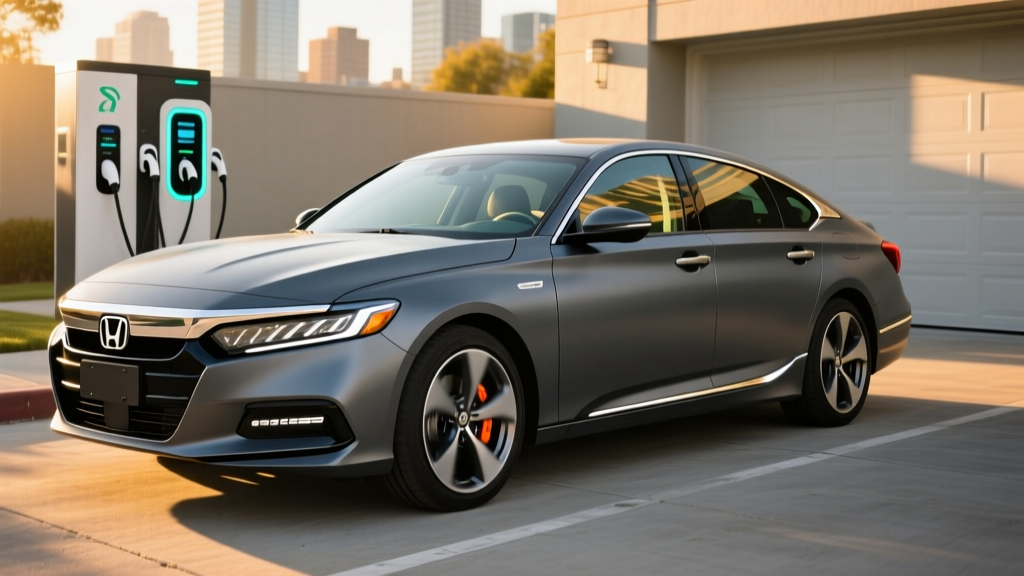
The 2025 Honda Accord Touring Hybrid sits at the top of a sedan lineup that has gone fully hybrid for its eleventh generation. There is no gas-only Accord anymore — every 2025 model uses Honda's two-motor hybrid system. The Touring trim is the loaded flagship, packing a 204-horsepower powertrain, Google Built-in infotainment, and a full Honda Sensing suite into a midsize sedan that still prioritizes fuel sipping over performance theatrics. For buyers weighing the Accord Touring Hybrid against plug-in hybrids or full battery-electric sedans, the value proposition is straightforward: no plug required, no range anxiety, and real-world efficiency that often beats the EPA sticker in city driving.
This review breaks down exactly what the 2025 Accord Touring Hybrid delivers — EPA and real-world MPG, powertrain specs, battery longevity, warranty coverage, pricing, and tax-credit eligibility — so you can decide whether this conventional hybrid (HEV) is the right electrified vehicle for your garage.
HEV vs PHEV: What the Accord Touring Hybrid Actually Is
Before diving into specs, it is essential to understand what the 2025 Accord Touring Hybrid is not: it is not a plug-in hybrid (PHEV). You cannot plug it in, and it has no meaningful electric-only driving range. It is a conventional hybrid (HEV), meaning its small lithium-ion battery recharges exclusively through regenerative braking and the gasoline engine.
HEV vs PHEV — Quick Distinction
| Feature | Conventional Hybrid (HEV) | Plug-in Hybrid (PHEV) |
|---|---|---|
| Plugs in to charge? | No — self-charging via regen + engine | Yes — Level 1/2 AC charging |
| Electric-only range | ~1 mile at very low speed | 20–50 miles typical |
| Battery size | ~1 kWh (small buffer) | 13–25 kWh usable |
| Federal tax credit (§30D) | Not eligible | Up to $7,500 (if sourcing/income rules met) |
| Best for | Drivers without home charging access | Drivers with home charging + short commutes |
If you were searching for an Accord PHEV, Honda does not currently offer one in the US market. The Accord lineup is HEV-only. If plug-in capability is a dealbreaker, competitors like the Toyota Prius Prime or Hyundai Tucson PHEV (in crossover form) offer that functionality — but in the midsize sedan segment, the conventional hybrid Accord is one of the most efficient options available.
Fuel Economy: EPA Ratings and Real-World MPG
The 2025 Accord Hybrid (all trims, including Touring) carries an EPA rating of 46 MPG city / 41 MPG highway / 44 MPG combined, according to fueleconomy.gov. Honda's two-motor hybrid system excels in stop-and-go traffic, where the electric motor handles most low-speed propulsion while the 2.0-liter Atkinson-cycle four-cylinder acts primarily as a generator.
| Metric | City | Highway | Combined |
|---|---|---|---|
| EPA Rating | 46 MPG | 41 MPG | 44 MPG |
| Real-World Expectation | 47–52 MPG | 38–42 MPG | 42–48 MPG |
| Annual Fuel Cost (15k mi/yr) | ~$1,350 at $3.50/gal regular unleaded | ||
Compared to the pre-2023 gas-only Accord 1.5T (which rated around 30 MPG combined), the hybrid system delivers roughly a 47% improvement in combined fuel economy — a meaningful reduction in both fuel cost and tailpipe CO₂.
Powertrain Specs: 204 HP Two-Motor Hybrid System
The 2025 Accord Touring Hybrid uses Honda's fourth-generation two-motor hybrid system, paired with a 2.0-liter DOHC Atkinson-cycle inline-four. Here is the complete powertrain breakdown:
| Spec | Value |
|---|---|
| Engine | 2.0L DOHC Atkinson-cycle I-4 |
| Engine Output | 146 hp @ 6,100 rpm / 134 lb-ft @ 4,500 rpm |
| Drive Motor Output | 181 hp / 247 lb-ft |
| Combined System Output | 204 hp / 247 lb-ft |
| Transmission | e-CVT (single-speed direct drive, no belt) |
| Drivetrain | Front-wheel drive |
| 0–60 MPH | ~7.5 seconds (est.) |
| Hybrid Battery | Lithium-ion, ~1.06 kWh (small buffer, not plug-charged) |
| Fuel Tank | 12.8 gallons (regular unleaded) |
| Total Driving Range | ~560 miles (at 44 MPG combined) |
The e-CVT in the Accord is not a traditional belt-driven CVT. Honda's system uses a clutch-based direct-drive mechanism at highway speeds, mechanically linking the engine to the wheels for improved efficiency. This eliminates the "rubber-band" feel that plagues some CVT-equipped hybrids. Acceleration from the electric motor is immediate and linear — the 247 lb-ft of torque from the drive motor is available from near zero RPM, making the Accord Touring Hybrid feel peppy in city driving despite its 204 hp combined rating.
One tradeoff: there is no all-wheel-drive option. If AWD is essential for your climate, the Toyota Camry Hybrid (available with AWD) or a crossover like the Honda CR-V Hybrid AWD may be more appropriate.
Reliability, Battery Warranty, and Replacement Costs
Hybrid battery longevity is consistently the top concern for hybrid buyers, and Honda addresses it with substantial warranty coverage.
Battery & Powertrain Warranty — 2025 Accord Hybrid
- Hybrid Battery Warranty: 10 years / 150,000 miles (in CARB states) or 8 years / 100,000 miles (non-CARB states) — whichever applies based on registration state
- Powertrain Warranty: 5 years / 60,000 miles
- Limited Vehicle Warranty: 3 years / 36,000 miles
- Hybrid System Components: Covered under the hybrid battery warranty period, including the IPU (Intelligent Power Unit), inverter, and drive motor
Honda's hybrid systems have an excellent track record. The two-motor architecture has been in production since 2014 (Accord Hybrid, then CR-V Hybrid, Civic Hybrid), and widespread battery failures are rare. The ~1 kWh battery in the Accord HEV undergoes relatively shallow charge/discharge cycles — it rarely drops below 20% or above 80% state of charge — which dramatically extends cell life compared to a full EV battery that cycles through a much wider range.
If replacement is needed out of warranty, a Honda hybrid battery pack typically costs $2,000–$4,000 for parts and labor at a dealership, though third-party refurbished options are emerging in the $1,200–$2,000 range. This is far less than a full EV battery replacement ($8,000–$20,000+), and the smaller battery is less likely to need replacement within the vehicle's useful life.
Honda's overall reliability ratings remain strong. The brand consistently ranks in the top tier of Consumer Reports reliability surveys, and the Accord nameplate has decades of proven durability data. The hybrid system adds complexity (two motors, inverter, IPU) but eliminates others — there is no traditional automatic transmission, no torque converter, no starter motor, and no alternator to fail.
Pricing, Trims, and Tax Credit Eligibility
The 2025 Accord Hybrid is available in four trims: Sport Hybrid, Sport-L Hybrid, EX-L Hybrid, and Touring Hybrid. The Touring is the top-tier model.
| Trim | MSRP | Key Additions over Sport |
|---|---|---|
| Sport Hybrid | $32,995 | Base hybrid, 19" wheels, heated seats |
| Sport-L Hybrid | $34,635 | Leather-trimmed seats, wireless CarPlay/Android Auto |
| EX-L Hybrid | $36,190 | Moonroof, power passenger seat, upgraded audio |
| Touring Hybrid | $39,395 | Google Built-in, Bose 12-speaker audio, ventilated front seats, heated rear seats, wireless charging, low-speed braking control |
All prices include Honda's destination charge of $1,195.
Federal Tax Credit: Not Eligible
Under current IRS §30D rules, conventional hybrids (HEVs) do not qualify for the federal EV tax credit. The credit applies only to plug-in electric vehicles — battery-electric vehicles (BEVs) and plug-in hybrids (PHEVs) that meet battery-sourcing, critical-mineral, MSRP cap, and buyer income requirements. The 2025 Accord Touring Hybrid, as a self-charging HEV, is excluded entirely.
Some states and local utilities offer rebates for hybrid vehicles, but these are typically smaller ($500–$1,500) and vary widely by jurisdiction. Check your state's energy office or utility provider for current programs. For authoritative federal credit rules, consult the IRS clean vehicle credits page.
Touring Trim Features: What the Flagship Gets You
The Touring trim justifies its ~$6,400 premium over the Sport Hybrid with a comprehensive feature list that eliminates most optional-equipment decisions:
- Infotainment: 12.3-inch touchscreen with Google Built-in (Google Maps, Google Assistant, Google Play Store), wireless Apple CarPlay and Android Auto
- Audio: Bose Premium 12-speaker sound system
- Comfort: Ventilated front seats, heated rear outboard seats, heated steering wheel
- Convenience: Wireless phone charging, front and rear parking sensors, low-speed braking control
- Wheels: 19-inch alloy wheels with all-season tires
- Safety (Honda Sensing): Adaptive cruise control with low-speed follow, lane-keeping assist, road-departure mitigation, collision mitigation braking, traffic-sign recognition, blind-spot monitoring with cross-traffic alert
The Honda Sensing suite on the 2025 Accord is a Level 2 driver-assistance system under SAE classification — meaning it provides steering and acceleration/braking support, but the driver must remain fully engaged with hands on the wheel and eyes on the road. It is not a self-driving system.
Accord Touring Hybrid vs EV vs PHEV: Which Fits You?
Choosing between a conventional hybrid, a plug-in hybrid, and a full battery-electric vehicle depends on your charging access, driving patterns, and budget. Here is a practical decision framework:
Choose the Accord Touring Hybrid (HEV) if:
- You lack access to home or workplace charging (apartment, street parking)
- You want maximum simplicity — no plug, no charging apps, no route planning
- Your annual mileage is high (15,000+ mi/yr) and fuel savings matter
- You want a proven, low-risk powertrain with a 10-year battery warranty
- Upfront cost matters — $39,395 vs $45,000+ for most EV sedans
Choose a PHEV if:
- You have Level 2 home charging and a commute under 30–40 miles
- You want electric-only daily driving but gas flexibility for road trips
- You qualify for the §30D federal tax credit (up to $7,500)
- You want to reduce gasoline use by 60–80% without full EV commitment
Choose a Full EV (BEV) if:
- You have reliable home Level 2 charging (or workplace charging)
- Your daily driving is under 200 miles and you road-trip infrequently
- You want the lowest per-mile fuel cost (~$0.04–$0.06/mi on home electricity)
- You qualify for the full §30D credit, narrowing the price gap
- You want zero tailpipe emissions and minimal drivetrain maintenance
The Accord Touring Hybrid's total cost of ownership over five years is competitive with many EVs once you factor in the lack of a federal tax credit for the Honda and the higher purchase price of comparable EV sedans. At 44 MPG combined and $3.50/gallon gas, annual fuel cost runs roughly $1,350. A comparable EV like the Tesla Model 3 or Hyundai Ioniq 6 might cost $500–$700 per year in electricity (home charging at $0.14/kWh), but their higher purchase price and insurance premiums narrow the gap significantly without a tax credit.
Pros and Cons: 2025 Accord Touring Hybrid
Pros
- 44 MPG combined EPA — regularly exceeds in city driving
- No plug-in required; works with any lifestyle or parking situation
- 10-year/150k-mile hybrid battery warranty (CARB states)
- Smooth e-CVT with direct-drive highway clutch — no CVT drone
- 247 lb-ft electric torque makes city driving feel responsive
- Touring trim is fully loaded — no packages to add
- 560+ mile total range per tank
Cons
- No federal tax credit eligibility (HEV, not PHEV/BEV)
- Front-wheel drive only — no AWD option
- Highway MPG drops to ~38–40 at sustained 75+ MPH
- Touring trim at $39,395 approaches entry-luxury pricing
- No meaningful electric-only driving (mild EV mode, ~1 mi max)
- Rear visibility is compromised by the sloping roofline
- Infotainment learning curve with Google Built-in for non-Android users
Frequently Asked Questions
How many MPG does the 2025 Accord Touring Hybrid get?
The EPA rates it at 46 MPG city, 41 MPG highway, and 44 MPG combined. In real-world city and suburban driving, many owners report 47–52 MPG thanks to the hybrid system's regenerative braking advantage in stop-and-go traffic. Highway driving at 75+ MPH typically yields 38–40 MPG.
Can the 2025 Accord Hybrid drive on electric power only?
Only in very limited circumstances. The hybrid system can propel the car on electric power alone at low speeds (under ~25 MPH) for roughly one mile or less, such as creeping through a parking lot. It is not a plug-in hybrid and has no meaningful electric-only range for commuting.
Does the 2025 Accord Touring Hybrid qualify for a tax credit?
No. Under current IRS §30D rules, conventional hybrids (HEVs) are not eligible for the federal clean vehicle tax credit. Only plug-in hybrids and battery-electric vehicles qualify. Some state or utility rebates may apply — check your local programs.
How long will the Accord Hybrid battery last, and what does replacement cost?
Honda warranties the hybrid battery for 10 years/150,000 miles in CARB states (including CA, NY, MA, and others) or 8 years/100,000 miles elsewhere. The small ~1 kWh battery undergoes shallow charge cycles, which promotes longevity. Out-of-warranty replacement typically costs $2,000–$4,000 at a dealer, with refurbished options available for less. Widespread failures are uncommon based on historical data from Honda's hybrid lineup.
Is the Accord Hybrid better than a full EV for my situation?
If you cannot charge at home (apartment living, street parking, no garage outlet), the Accord Hybrid is almost certainly the better choice. You get 44 MPG combined with zero lifestyle changes — no charging apps, no route planning, no public-charger reliability concerns. If you do have home Level 2 charging and drive under 200 miles daily, a full EV like the Tesla Model 3 or Chevrolet Equinox EV will deliver lower per-mile fuel costs and qualify for federal tax credits that the Accord cannot.
Does the 2025 Accord Hybrid require premium fuel?
No. The 2.0-liter Atkinson-cycle engine runs on regular unleaded (87 octane), keeping fuel costs low.
What is the towing capacity of the Accord Touring Hybrid?
Honda does not rate the Accord Hybrid for towing. It is a passenger sedan designed for efficiency, not hauling. If towing is a priority, consider a hybrid crossover like the Honda CR-V Hybrid (1,500 lb rating) or a larger SUV.
Sources: EPA fuel economy data via fueleconomy.gov, Honda Newsroom official specifications, IRS §30D clean vehicle credit guidelines via irs.gov. Pricing and specifications reflect 2025 model year as published. Tax credit rules are subject to change — verify current eligibility with a tax professional.