Quick Verdict: The 2025 Accord Hybrid Sport at a Glance
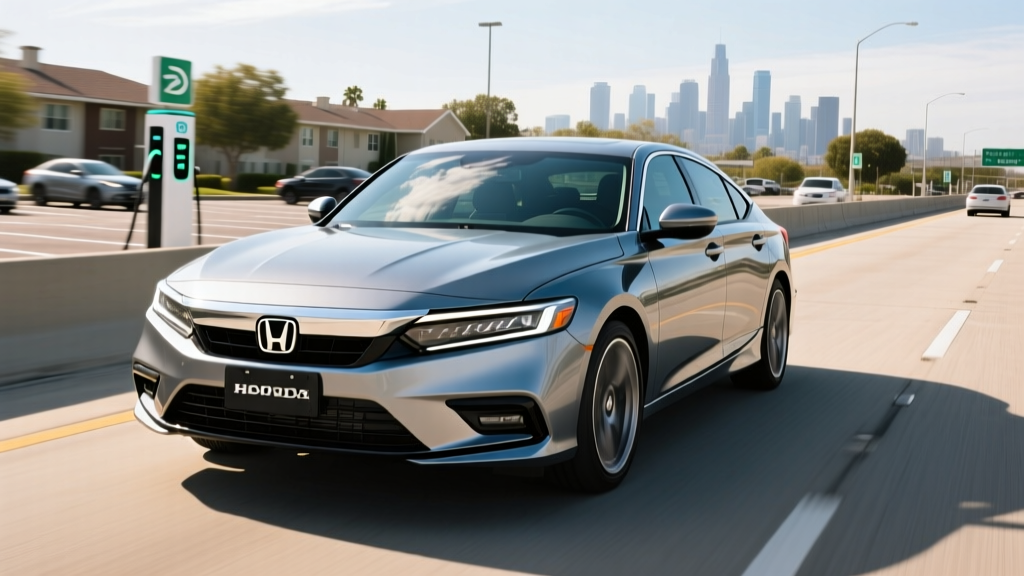
The 2025 Honda Accord Hybrid Sport occupies a narrow but compelling lane in the midsize sedan market: it delivers near-50 MPG city efficiency with a 192-hp dual-motor powertrain, sport-tuned suspension, and a base MSRP of $33,655 — all without requiring a charging cable. For buyers who want EV-like city efficiency but aren't ready to commit to plug-in infrastructure, this conventional hybrid (HEV) is one of the strongest options on the road.
The Sport trim specifically adds 19-inch alloy wheels, a black decklid spoiler, heated front seats, and paddle shifters that let you modulate regenerative braking intensity — a feature Honda calls deceleration selectors. It's the most driver-oriented hybrid Accord you can buy short of stepping up to the Sport-L or Touring trims.
| Specification | 2025 Accord Hybrid Sport |
|---|---|
| Powertrain | 2.0L Atkinson-cycle 4-cyl + 2 electric motors |
| Combined Horsepower | 192 hp (net system) |
| Engine Torque | 134 lb-ft (engine) / 247 lb-ft (drive motor) |
| Transmission | eCVT (no traditional gears) |
| EPA MPG (City / Hwy / Combined) | 46 / 41 / 44 |
| Fuel Tank Capacity | 12.8 gallons |
| Total EPA Range | ~563 miles |
| 0–60 mph | ~6.5 seconds (est.) |
| Drivetrain | Front-wheel drive |
| Base MSRP | $33,655 (incl. $1,150 destination) |
| Hybrid Battery Warranty | 8 years / 100,000 miles |
| Powertrain Warranty | 5 years / 60,000 miles |
How Many MPG Does the 2025 Accord Hybrid Sport Get?
The EPA rates the 2025 Accord Hybrid Sport at 46 MPG city, 41 MPG highway, and 44 MPG combined. Note that the Sport trim's 19-inch wheels and sportier tires reduce efficiency slightly versus the base Hybrid (EX-L), which achieves 51/44/48 MPG — a 4-MPG combined penalty for the larger wheels and stickier rubber.
| Trim | City MPG | Highway MPG | Combined MPG |
|---|---|---|---|
| Accord Hybrid (EX-L) | 51 | 44 | 48 |
| Accord Hybrid Sport | 46 | 41 | 44 |
| Accord Hybrid Sport-L | 46 | 41 | 44 |
| Accord Hybrid Touring | 46 | 41 | 44 |
Source: fueleconomy.gov — U.S. Environmental Protection Agency
Real-World MPG vs. EPA Sticker
Honda's two-motor hybrid system excels in stop-and-go driving, where the electric drive motor handles low-speed propulsion and the gas engine primarily acts as a generator. In real-world city driving, many owners report matching or slightly exceeding the 46 MPG city EPA figure, particularly in warm weather with moderate acceleration.
Highway driving tells a different story. At sustained 75–80 mph speeds, expect 38–40 MPG — the Atkinson-cycle engine is less efficient under high-load, high-speed conditions where aerodynamic drag dominates. In cold weather (below 35°F), city efficiency drops to roughly 40–42 MPG as the engine runs more frequently for cabin heat and battery conditioning.
HEV vs. PHEV vs. EV: Which Powertrain Fits You?
The 2025 Accord Hybrid is a conventional hybrid (HEV), meaning it has no plug and no meaningful electric-only range. It recovers energy through regenerative braking and the gas engine, storing it in a small ~1.06 kWh lithium-ion battery. That battery assists acceleration and enables brief electric-only crawling at low speeds (typically under 1–2 miles at parking-lot speeds), but it cannot sustain highway driving on electricity alone.
This is a critical distinction from a plug-in hybrid (PHEV) like the Toyota RAV4 Prime or Hyundai Tucson PHEV, which carries a larger battery (typically 13–20 kWh) and can travel 25–45 miles on electricity before the gas engine engages. Honda does not currently offer a PHEV version of the Accord in the U.S. market.
| Factor | HEV (Accord Hybrid) | PHEV (e.g., RAV4 Prime) | BEV (e.g., Tesla Model 3) |
|---|---|---|---|
| Plug Required? | No | Yes (optional benefit) | Yes (mandatory) |
| Electric-Only Range | <2 mi (low speed) | 25–45 mi | 250–360+ mi |
| Home Charging Needed? | No | Recommended | Essential |
| City Efficiency | 46 MPG | 94 MPGe (EV mode) | 132 MPGe |
| Total Range | ~530 mi | ~400–550 mi combined | 250–360 mi |
| Federal Tax Credit (§30D) | Not eligible | Up to $7,500* | Up to $7,500* |
| Starting Price Range | $33,655 | $44,000–$50,000 | $38,990+ |
* Federal §30D credit eligibility depends on MSRP caps, buyer income limits, battery critical-mineral sourcing, and point-of-sale transfer rules. Always verify current rules at irs.gov and consult a tax professional.
Powertrain Deep Dive: How the Two-Motor System Works
The Accord Hybrid's powertrain pairs a 2.0-liter Atkinson-cycle four-cylinder engine (146 hp, 134 lb-ft) with two electric motors in Honda's fourth-generation two-motor hybrid system. The propulsion motor produces 181 hp and 247 lb-ft of torque, driving the front wheels directly. A second, smaller generator motor is connected to the engine and serves two functions: it converts engine output to electricity for the drive motor, and it starts the engine.
Under normal city driving, the gas engine spins the generator, which feeds electricity to the drive motor — essentially operating as a series hybrid (similar to the original Chevy Volt's architecture). At highway speeds (roughly above 45 mph under light load), a lock-up clutch connects the engine directly to the wheels for more efficient cruising. This parallel mode is where Honda's eCVT differs from Toyota's planetary-gear hybrid system.
The combined system output is 192 net horsepower. Because the electric drive motor delivers peak torque from 0 RPM, the Accord Hybrid Sport pulls briskly from a stop — Honda estimates 0–60 mph in approximately 6.5 seconds, competitive with many turbocharged gas midsize sedans.
Regenerative Braking and Paddle Shifters
The Sport trim's steering-wheel-mounted paddle shifters don't change gears — there are none. Instead, they cycle through four levels of regenerative braking intensity. At the maximum setting, the Accord Hybrid approaches one-pedal driving behavior in city traffic, slowing significantly when you lift off the accelerator. However, it does not come to a complete stop without touching the brake pedal, unlike full EVs or some PHEVs with true one-pedal modes.
Pricing, Trims, and Tax Credit Eligibility
The 2025 Honda Accord Hybrid is available in four trims. All share the same powertrain; differences are in equipment, wheels, and interior materials:
| Trim | MSRP (incl. destination) | Key Features |
|---|---|---|
| Hybrid (base/EX-L equivalent) | $33,655 | 17-inch wheels, 48 MPG combined, leather-trimmed seats |
| Sport | $34,655 | 19-inch wheels, black spoiler, heated seats, paddle shifters |
| Sport-L | $36,155 | Sport equipment + leather-trimmed interior, wireless CarPlay/Android Auto |
| Touring | $39,655 | Full LED headlights, Bose 12-speaker audio, heated rear seats, head-up display |
Does the 2025 Accord Hybrid Qualify for Any Tax Credit?
No. The Accord Hybrid is a conventional HEV — it does not have a plug, does not have sufficient battery capacity, and is not eligible for the federal §30D Clean Vehicle Credit. That credit applies only to plug-in vehicles (PHEVs and BEVs) meeting battery capacity, MSRP, income, and sourcing requirements.
Some states and local utilities offer modest rebates for conventional hybrids (typically $250–$500), but these vary widely by jurisdiction. Check your state energy office or utility provider for current programs. Honda has not structured any Accord Hybrid trim to qualify for federal incentives.
Reliability, Battery Warranty, and Replacement Costs
Honda's fourth-generation two-motor hybrid system has been in production since the 2023 model year (11th-gen Accord) and builds on over a decade of hybrid engineering from the Insight and earlier Accord Hybrid generations. The system is mechanically simpler than a traditional automatic transmission — no torque converter, no planetary gearsets, no multi-speed shifting — which reduces failure points.
What Does a Hybrid Battery Replacement Cost?
Out of warranty, a full hybrid battery replacement for the current-generation Accord Hybrid typically runs $2,500–$4,500 including labor at a Honda dealership. Independent hybrid specialists may offer refurbished pack installations for $1,800–$3,000. However, Honda's hybrid batteries have demonstrated strong longevity — the vast majority of Honda hybrid owners never require a replacement during the vehicle's typical ownership cycle.
The Accord Hybrid's battery is relatively small (~1.06 kWh), which reduces both replacement cost and the thermal stress per cell compared to larger PHEV or BEV packs. The battery management system keeps cells within a conservative state-of-charge window, further extending cycle life.
Overall Reliability Outlook
The 11th-generation Accord (2023+) has earned strong reliability marks. IIHS awarded the 2025 Accord the Top Safety Pick+ designation with acceptable or good ratings across all crashworthiness tests. The hybrid powertrain's reduced brake wear (regenerative braking handles much of the deceleration) means brake pad replacements are less frequent than on gas-only models — often 80,000+ miles before the first pad change.
Who Should Buy the Accord Hybrid Sport — and Who Shouldn't?
Pros
- 44 MPG combined (46 city) — excellent for a 3,400-lb sedan
- 247 lb-ft electric motor torque for responsive city acceleration
- No charging infrastructure required — just fill up with gas
- 563-mile EPA total range; ~500+ real-world
- Sport-tuned suspension and 19-inch wheels for sharper handling
- 8-year/100,000-mile hybrid battery warranty
- Competitive $34,655 MSRP for equipment level
Cons
- 4-MPG penalty vs. base Hybrid trim (19-inch wheels)
- No plug-in (PHEV) option — no electric-only commuting
- No federal tax credit eligibility
- Highway MPG drops to ~38–40 at 75+ mph
- FWD only — no AWD option (unlike Toyota Camry Hybrid)
- Regen doesn't bring car to a full stop (not true one-pedal)
- eCVT drone under hard acceleration (no simulated shifts)
Decision Framework
Choose the 2025 Accord Hybrid Sport if: You commute in mixed city/highway traffic, don't have access to home charging, want a sporty-looking midsize sedan with low fuel costs, and plan to keep the car 5–8 years. The hybrid system pays for itself versus the gas Accord 1.5T in roughly 3–4 years at current fuel prices for a 15,000-mile/year driver.
Choose a PHEV instead if: You have a garage or driveway where you can install a Level 2 charger, your daily commute is under 30 miles, and you want to drive mostly on electricity during the week while keeping gas flexibility for road trips.
Choose a full EV instead if: You have reliable home charging, your daily driving is under 250 miles, you want to eliminate gas entirely, and you qualify for the $7,500 federal credit (which would make vehicles like the Tesla Model 3 or Hyundai Ioniq 6 comparably priced).
Ownership Costs: Accord Hybrid Sport vs. Gas Accord vs. EV
To put the Accord Hybrid Sport's economics in perspective, here's a 5-year cost comparison assuming 15,000 miles/year, $3.50/gallon regular gas, and $0.14/kWh home electricity:
| Cost Factor (5 Years / 75k Miles) | Accord Hybrid Sport | Accord 1.5T (Gas) | Tesla Model 3 RWD |
|---|---|---|---|
| Fuel/Energy | ~$5,965 | ~$8,750 | ~$3,150 |
| Estimated Maintenance | ~$2,200 | ~$3,000 | ~$1,500 |
| Base MSRP | $34,655 | $31,655 | $38,990 |
| Federal Tax Credit | $0 | $0 | Up to $7,500* |
| Est. 5-Year Depreciation | ~$14,500 | ~$14,000 | ~$16,500 |
| Approx. 5-Year Total | ~$57,320 | ~$57,405 | ~$52,640 |
* Tesla Model 3 RWD eligibility for the §30D credit depends on current-year battery sourcing, MSRP, and buyer income rules. Verify at irs.gov. Depreciation estimates based on industry averages; individual results vary by market.
The Accord Hybrid Sport essentially breaks even with the gas Accord over five years — the higher MSRP is offset by fuel savings and lower brake maintenance. The real financial advantage comes in years 6–10, when cumulative fuel savings widen and the hybrid battery remains under warranty. A full EV pulls ahead financially if the buyer qualifies for the federal credit and has access to affordable home charging.
Frequently Asked Questions
Does the 2025 Accord Hybrid Sport need to be plugged in?
No. The Accord Hybrid Sport is a conventional hybrid (HEV). It charges its small lithium-ion battery through regenerative braking and the gasoline engine. You never plug it in — just fill it at a gas station like any conventional car.
How far can the Accord Hybrid Sport drive on electric power alone?
Effectively less than 1–2 miles, and only at very low speeds (under 25 mph, light throttle). The hybrid battery is approximately 1.06 kWh — far too small to sustain highway-speed electric-only driving. If you want meaningful electric-only range for commuting, you need a PHEV or a full BEV.
Is the Accord Hybrid Sport slower than the gas Accord?
No. The hybrid's combined 192 hp and instant electric torque (247 lb-ft) give it a 0–60 time of approximately 6.5 seconds, which is comparable to or slightly quicker than the 1.5T gas Accord (~7.0 seconds). The hybrid actually feels more responsive in city driving due to the electric motor's immediate torque delivery.
What is the difference between the Accord Hybrid Sport and the base Hybrid?
The Sport trim adds 19-inch alloy wheels (vs. 17-inch), a black decklid spoiler, heated front seats, paddle-mounted regenerative braking selectors, and sport-tuned suspension. The trade-off is a 4-MPG combined reduction (44 vs. 48 MPG) due to the larger, heavier wheels and stickier tires. Both trims share the identical 192-hp hybrid powertrain.
How long will the Accord Hybrid battery last?
Honda's hybrid batteries are designed to last the life of the vehicle under normal use. The battery is warrantied for 8 years/100,000 miles (10 years/150,000 miles in CARB states). Real-world data from earlier Honda hybrids (Insight, previous Accord Hybrid generations) shows most packs lasting 150,000–200,000+ miles before significant capacity loss. The small ~1.06 kWh pack operates in a conservative charge window, reducing degradation.
Does the Accord Hybrid Sport have all-wheel drive?
No. All 2025 Accord Hybrid trims are front-wheel drive only. If AWD is a priority in a hybrid midsize sedan, the Toyota Camry Hybrid offers electronic AWD (with a slight efficiency trade-off). Alternatively, the Toyota Prius AWD and various hybrid SUVs provide all-weather capability.
Can I get a federal tax credit for buying the 2025 Accord Hybrid?
No. The federal §30D Clean Vehicle Credit applies only to plug-in electric vehicles (PHEVs and BEVs) with battery capacities of at least 7 kWh. The Accord Hybrid's ~1.06 kWh battery and lack of plug-in capability disqualify it entirely. Check with your state energy office for any local hybrid incentives, which are typically modest ($250–$500).