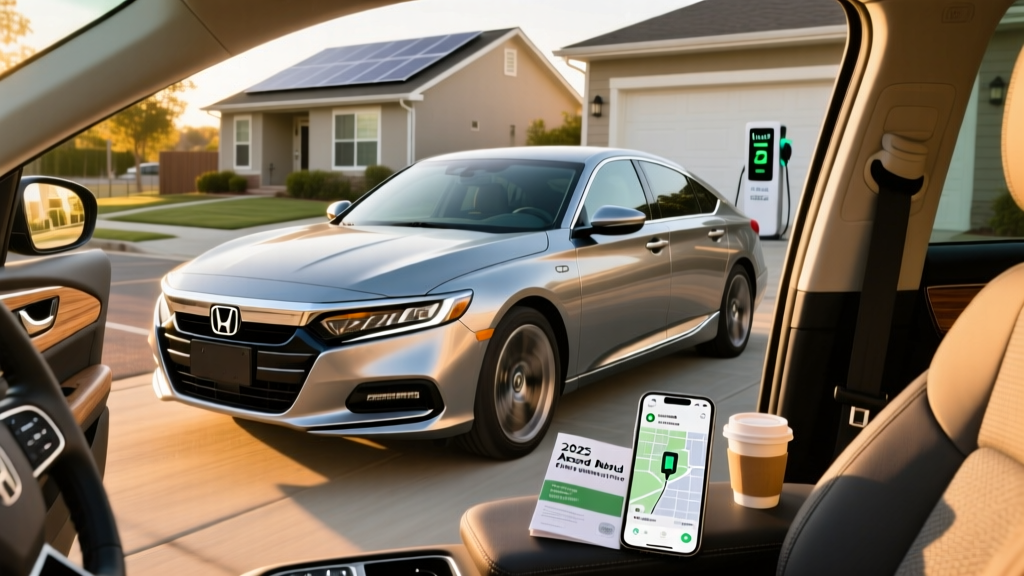
The 2025 Honda Accord Hybrid remains one of the smartest midsize sedan buys for drivers who want electric-motor efficiency without plugging in. Honda's two-motor hybrid system delivers seamless low-speed electric propulsion, strong regenerative braking, and an EPA-estimated 48 MPG combined — numbers that rival many plug-in hybrids once you factor in real-world city driving where the Accord Hybrid routinely exceeds its sticker.
This guide covers everything a research-heavy buyer needs: exact fuel economy by trim, the two-motor powertrain architecture, real-world MPG expectations, battery longevity, and where the Accord Hybrid fits against plug-in hybrids and full battery-electric vehicles.
HEV vs PHEV: Why the Accord Hybrid Doesn't Plug In
Before diving into specs, it's worth clarifying what the 2025 Accord Hybrid is — and isn't. It is a conventional hybrid electric vehicle (HEV), not a plug-in hybrid (PHEV). That distinction matters for your daily routine and your wallet.
| Feature | 2025 Accord Hybrid (HEV) | Typical Midsize PHEV |
|---|---|---|
| Plug-in charging required? | No — self-charging via engine & regen | Yes — Level 1 or Level 2 |
| Electric-only range | ~1 mile at low speeds (EV mode) | 25–40 miles typical |
| Battery size | ~1.1 kWh (small buffer) | 13–20 kWh |
| Federal tax credit (§30D) | Not eligible | Up to $7,500 if criteria met |
| Home charging install needed? | No | Often yes ($500–$2,000) |
| Best for | No home charging access; long highway commutes | Home chargers; short daily commutes |
The Accord Hybrid recovers energy through regenerative braking and its gasoline engine to keep a small lithium-ion battery charged. You never plug it in. You simply fuel it at any gas station and drive. For buyers without access to home or workplace Level 2 charging, this is a significant practical advantage over any PHEV or BEV.
Fuel Economy: EPA Ratings and Real-World MPG
The 2025 Accord Hybrid's fuel economy varies slightly by trim due to wheel size and curb weight. Here's the EPA breakdown as published on fueleconomy.gov:
| Trim | City MPG | Highway MPG | Combined MPG |
|---|---|---|---|
| Sport Hybrid / Sport-L Hybrid | 51 | 44 | 48 |
| EX-L Hybrid / Touring Hybrid | 51 | 44 | 48 |
Real-World MPG Expectations: The Accord Hybrid's two-motor system excels in stop-and-go city driving, where the electric motor handles most low-speed propulsion. Owners frequently report 50–55 MPG in urban and suburban conditions. Highway-only driving at 75+ MPH tends to drop to 38–43 MPG, as the gasoline engine operates more directly without the benefit of regenerative braking. In cold weather (below 32°F), expect a 5–10% reduction as the engine runs more frequently for cabin heat and battery warmup. A realistic blended expectation for mixed driving is 44–50 MPG.
With a 12.8-gallon fuel tank, that translates to roughly 560–640 miles of real-world range per fill-up — enough for most drivers to visit a gas station once every two to three weeks.
Powertrain: Two-Motor Hybrid System Explained
The 2025 Accord Hybrid uses Honda's fourth-generation two-motor hybrid system, which operates more like a series hybrid (similar to a range-extended EV) at low speeds and switches to a parallel configuration at highway cruising.
| Specification | Detail |
|---|---|
| Engine | 2.0L DOHC 4-cylinder (Atkinson cycle) |
| Engine output | 146 hp / 134 lb-ft torque |
| Drive motor output | 184 hp / 247 lb-ft torque |
| Combined system horsepower | 204 hp |
| Transmission | e-CVT (no traditional gears) |
| Drivetrain | Front-wheel drive |
| 0–60 mph | ~7.0 seconds (est.) |
| Battery type | Lithium-ion, ~1.1 kWh capacity |
| Towing capacity | Not rated for towing |
The system's brilliance is in its operating modes. Below ~45 mph, the gasoline engine primarily acts as a generator, producing electricity that powers the drive motor. This gives the Accord Hybrid the smooth, instant-torque feel of an EV in city driving. At highway speeds, a lockup clutch connects the engine directly to the wheels for efficient cruising. The result is the best of both worlds: EV-like responsiveness in town, efficient direct-drive on the open road.
2025 Accord Hybrid Trims and Pricing
Honda offers the Accord Hybrid across four trims for 2025. All share the same powertrain and EPA ratings. Pricing below includes the $1,095 destination charge:
| Trim | MSRP (incl. destination) | Key Features |
|---|---|---|
| Sport Hybrid | $34,695 | 19" alloy wheels, heated front seats, wireless Apple CarPlay/Android Auto, Honda Sensing suite |
| Sport-L Hybrid | $36,350 | Leather-trimmed seats, wireless phone charger, heated rear seats, power moonroof |
| EX-L Hybrid | $37,695 | Leather interior, 12-speaker Bose audio, heated steering wheel, low-speed braking control |
| Touring Hybrid | $40,695 | Adaptive dampers, ventilated front seats, heated rear seats, Google built-in, 19" machine-finish wheels |
Federal and State Tax Credit Eligibility
The 2025 Accord Hybrid does not qualify for the federal §30D Clean Vehicle Credit (up to $7,500). That credit applies only to plug-in electric vehicles — both BEVs and PHEVs — that meet battery sourcing, MSRP cap, and buyer income requirements as defined by the IRS. Because the Accord Hybrid is a conventional HEV with no plug-in capability, it falls outside §30D eligibility.
Some states offer their own incentives for high-efficiency hybrids, but these vary widely by jurisdiction and change frequently. Check your state's energy or environmental agency for current programs. The Accord Hybrid's value proposition rests on its low purchase price, excellent fuel economy, and zero charging infrastructure requirements — not tax incentives.
Battery Warranty, Lifespan, and Replacement Cost
Battery longevity is the single most common concern among first-time hybrid buyers. Honda addresses this with robust warranty coverage:
Hybrid Battery Warranty: Honda covers the Accord Hybrid's lithium-ion battery pack for 8 years or 100,000 miles (whichever comes first) in most states. In California Air Resources Board (CARB) states — including CA, CT, ME, MA, NJ, NY, OR, RI, VT, and WA — coverage extends to 10 years or 150,000 miles.
The warranty covers battery capacity degradation below a specified threshold and defects. Honda does not publish the exact degradation percentage trigger, but industry practice sets it around 60–70% of original capacity.
How Long Do Accord Hybrid Batteries Actually Last?
Real-world data from Honda's third-generation Accord Hybrid (2018–2022) and similar two-motor systems in the CR-V Hybrid and Insight shows that the vast majority of hybrid battery packs last well beyond the warranty period. The small ~1.1 kWh battery undergoes shallow charge/discharge cycles — it never fully depletes or fully charges, which dramatically reduces stress on the cells. Many Accord and Insight owners report 150,000–200,000+ miles on the original battery pack with no degradation issues.
Battery Replacement Cost
If replacement is needed outside warranty, a Honda Accord Hybrid battery pack currently costs between $2,000 and $4,000 for the part, with labor adding $300–$600. Third-party refurbished packs are increasingly available for $1,500–$2,500. This is far less expensive than BEV battery replacements, which can exceed $10,000–$20,000, because the Accord's hybrid battery is small and relatively simple.
Reliability and Safety Ratings
Honda's two-motor hybrid system has a strong reliability track record. The elimination of a traditional multi-speed transmission (the e-CVT has no belts, pulleys, or gear sets to wear) removes one of the most failure-prone components in conventional vehicles. Consumer Reports has consistently rated recent Accord Hybrid model years as above-average for predicted reliability.
Safety is equally strong. The 2025 Accord earned a 5-Star Overall Safety Rating from NHTSA and was named an IIHS Top Safety Pick+ when equipped with specific headlights. The Honda Sensing suite — standard on all trims — includes adaptive cruise control, lane-keeping assist, collision mitigation braking, traffic sign recognition, and traffic jam assist.
Accord Hybrid vs PHEV vs Full EV: Which Should You Choose?
The right electrified vehicle depends on your charging access, commute pattern, and budget. Here's a practical decision framework:
Choose the Accord Hybrid (HEV) if:
- You lack reliable access to home or workplace Level 2 charging
- Your commute includes heavy stop-and-go traffic (where hybrids shine)
- You want EV-like city efficiency with zero behavior change
- Your budget is under $41,000 and you want a loaded midsize sedan
- You regularly take long road trips and don't want to plan charging stops
Choose a PHEV (e.g., Toyota Prius Prime, Hyundai Tucson PHEV) if:
- You have home Level 2 charging and a daily commute under 35 miles
- You want electric-only driving for daily errands but gas flexibility for road trips
- You want to qualify for the federal §30D tax credit (up to $7,500, subject to income and sourcing rules)
Choose a full EV (e.g., Tesla Model 3, Hyundai Ioniq 6) if:
- You have reliable home charging and want to eliminate gas entirely
- Your daily driving is under 250 miles and you're comfortable with DC fast charging on road trips
- You want the lowest per-mile fuel cost (electricity at $0.12–0.18/kWh vs. gas at $3.00–$4.00/gal)
- You want maximum federal and state incentives
5-Year Fuel Cost Comparison
Using EPA assumptions of 15,000 miles/year, $3.50/gallon regular gasoline, and $0.15/kWh electricity:
| Vehicle | 5-Year Fuel Cost (est.) | Annual Fuel Cost |
|---|---|---|
| 2025 Accord Hybrid (48 MPG) | $5,469 | $1,094 |
| 2025 Accord 1.5T Gas (33 MPG combined) | $7,955 | $1,591 |
| 2025 Tesla Model 3 RWD (132 MPGe) | $2,976 | $595 |
| 2025 Toyota Prius Prime PHEV (52 MPG + 44 mi EV) | $3,100–$4,200* | $620–$840* |
*PHEV cost depends heavily on how often you charge. If you charge daily and commute under 40 miles, most driving is electric.
The Accord Hybrid saves roughly $2,500 over five years compared to the gas-only Accord 1.5T. A full EV saves even more, but requires charging infrastructure. The Accord Hybrid occupies the practical middle ground: meaningful savings with zero lifestyle change.
Pros and Cons at a Glance
Pros
- 48 MPG combined EPA; routinely exceeds 50 MPG in city driving
- No plug-in charging required — works with existing gas infrastructure
- EV-like smoothness and instant torque at low speeds
- Spacious cabin with 16.7 cu ft trunk (no battery intrusion)
- Strong safety ratings: NHTSA 5-star, IIHS Top Safety Pick+
- 8-year/100,000-mile hybrid battery warranty (10/150k in CARB states)
- Competitive pricing: loaded Touring trim under $41,000
Cons
- No federal tax credit eligibility (HEV, not PHEV/BEV)
- Highway MPG drops to 38–43 at sustained 75+ MPH
- Front-wheel drive only — no AWD option unlike the Toyota Camry Hybrid
- Modest 204 hp; adequate but not sporty for a 3,500-lb sedan
- Road noise on coarse pavement (improved from prior gen, still noticeable)
- Not rated for towing
Frequently Asked Questions
How many MPG does the 2025 Accord Hybrid get?
The EPA rates the 2025 Accord Hybrid at 51 city / 44 highway / 48 combined MPG across all trims. In real-world city driving, many owners report 50–55 MPG. Highway-only driving at high speeds typically yields 38–43 MPG.
Does the 2025 Accord Hybrid need to be plugged in?
No. The Accord Hybrid is a conventional HEV, not a plug-in hybrid. Its small lithium-ion battery recharges through regenerative braking and the gasoline engine. You never plug it in — you simply fill it with regular unleaded gasoline.
Is the 2025 Accord Hybrid a plug-in hybrid (PHEV)?
No. Honda does not offer a plug-in hybrid version of the Accord in the US market. The Accord Hybrid is strictly a self-charging HEV. If you want a Honda PHEV, the closest option is the Honda Clarity Plug-In Hybrid, which was discontinued after the 2022 model year. For a current midsize PHEV, consider the Toyota Prius Prime or Hyundai Sonata PHEV.
Does the 2025 Accord Hybrid qualify for any tax credit?
The Accord Hybrid does not qualify for the federal §30D Clean Vehicle Credit, which is limited to plug-in electric vehicles (BEVs and PHEVs). Some states may offer incentives for high-efficiency hybrids, but these vary by jurisdiction. Consult your state's energy office or a tax professional for current eligibility.
How long will the Accord Hybrid battery last, and what does replacement cost?
Honda warranties the hybrid battery for 8 years/100,000 miles (10 years/150,000 miles in CARB states). Real-world data suggests most packs last 150,000–200,000+ miles. Out-of-warranty replacement costs $2,000–$4,000 for the battery plus $300–$600 in labor. Refurbished packs are available for less.
Is the Accord Hybrid better than the gas-only Accord?
For most buyers, yes. The hybrid costs roughly $1,500–$2,000 more upfront but saves approximately $500/year in fuel, paying back the premium in 3–4 years. You also get smoother low-speed acceleration, quieter operation in EV mode, and significantly lower emissions. The only scenario where the gas-only 1.5T might make sense is if you drive predominantly highway miles at high speed, where the hybrid's advantage narrows.
Does the 2025 Accord Hybrid have AWD?
No. The 2025 Accord Hybrid is front-wheel drive only. If all-wheel drive is a priority in a hybrid midsize sedan, the Toyota Camry Hybrid offers available AWD with a rear-mounted electric motor, though its combined rating drops slightly to 44–52 MPG depending on trim.