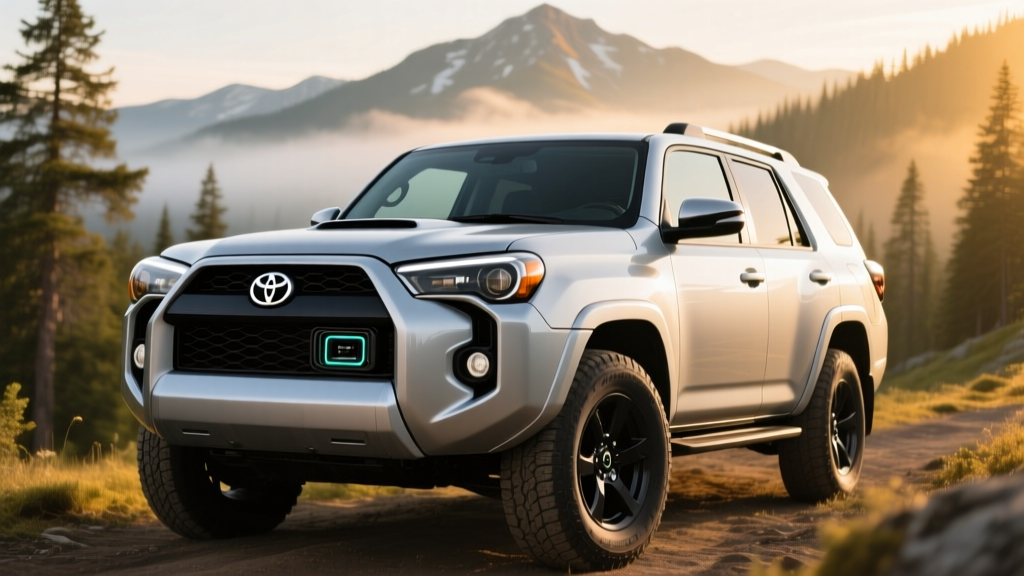
The sixth-generation Toyota 4Runner finally ditched its ancient 4.0L V6 for the i-FORCE MAX hybrid powertrain, and the result is a midsize SUV that sips fuel like a crossover while retaining the off-road chops the nameplate is known for. If you've been searching for 2025 4Runner hybrid MPG figures, you're not alone — this is the most significant powertrain change in the 4Runner's history, and the efficiency gains are substantial.
After digging into EPA data, real-world owner reports, and Toyota's official specs, here's everything you need to know about the 4Runner's fuel economy, hybrid system, and whether it's the right fit compared to a PHEV or full EV.
EPA MPG Ratings: What the Sticker Says
The 2025 Toyota 4Runner is offered with two powertrains: the standard i-FORCE 2.4L turbocharged four-cylinder and the i-FORCE MAX hybrid, which pairs that same 2.4L turbo with an electric motor integrated into the transmission. The hybrid is available on TRD Off-Road, Limited, TRD Pro, and Platinum trims.
| Powertrain | Drivetrain | City MPG | Highway MPG | Combined MPG |
|---|---|---|---|---|
| i-FORCE 2.4L Turbo (gas) | RWD | 20 | 26 | 22 |
| i-FORCE 2.4L Turbo (gas) | 4WD | 19 | 25 | 21 |
| i-FORCE MAX Hybrid | 4WD | 30 | 32 | 31 |
| i-FORCE MAX Hybrid (TRD Pro/Platinum w/ larger tires) | 4WD | 28 | 30 | 29 |
The headline number is 31 MPG combined for the i-FORCE MAX hybrid on standard trims — a roughly 48% improvement over the gas-only 4WD model. That puts the 4Runner hybrid in the same efficiency ballpark as a Toyota RAV4 Hybrid, despite being a body-on-frame SUV with genuine off-road hardware.
i-FORCE MAX Powertrain: How the Hybrid System Works
The i-FORCE MAX is Toyota's full hybrid system (not a mild hybrid). It uses a 1.87 kWh nickel-metal hydride (NiMH) battery pack positioned under the rear seats, a 48-horsepower electric motor sandwiched between the 2.4L turbo-four and the 8-speed automatic transmission, and a conventional torque-converter automatic — not a CVT.
| Specification | Detail |
|---|---|
| Engine | 2.4L turbocharged inline-4 |
| Electric Motor | 48 HP / 184 lb-ft (integrated in transmission) |
| Combined System Output | 326 HP / 465 lb-ft of torque |
| Transmission | 8-speed automatic (Direct Shift-8AT) |
| Hybrid Battery | 1.87 kWh NiMH (sealed, self-charging) |
| Drivetrain | Part-time 4WD with low range (TRD Off-Road, TRD Pro) / Full-time 4WD (Limited, Platinum) |
| 0–60 MPH | ~6.0 seconds (Toyota est.) |
| Towing Capacity | 6,000 lbs (hybrid trims) |
This is a conventional hybrid (HEV), not a plug-in hybrid. You never plug it in. The battery charges through regenerative braking and engine-driven generation. There is no electric-only driving mode of meaningful distance — the electric motor assists the gas engine during acceleration and can power the vehicle at very low speeds for brief distances (under a mile), but the 4Runner hybrid cannot operate as an EV for any practical commute.
The 326 combined horsepower and massive 465 lb-ft of torque represent a dramatic upgrade from the outgoing 4Runner's 270 HP V6. This is the most powerful 4Runner ever sold, and the torque delivery is notably more responsive thanks to the electric motor's instant output.
HEV vs. PHEV vs. Full EV: Which Fits Your Situation?
The 4Runner is only available as a conventional hybrid (HEV). Toyota does not offer a plug-in hybrid (PHEV) variant, and a fully electric 4Runner does not exist. Here's how to think about the distinction:
| Feature | HEV (4Runner i-FORCE MAX) | PHEV (e.g., RAV4 Prime) | Full EV (e.g., Tesla Model Y) |
|---|---|---|---|
| Plug-in Required? | No — self-charging | Yes — plug in for EV range | Yes — plug in for all driving |
| Electric-Only Range | Negligible (<1 mi at low speed) | 25–42 miles typical | 250–350+ miles |
| Gas Engine? | Yes, primary power source | Yes, kicks in after battery depletes | None |
| Fuel/Energy Cost per Mile | ~$0.12–$0.15 | ~$0.04 (EV mode) / ~$0.12 (gas mode) | ~$0.03–$0.06 |
| Home Charging Needed? | No | Recommended (Level 2) | Essential (Level 2) |
| Federal Tax Credit | Not eligible | Up to $7,500 (if eligible) | Up to $7,500 (if eligible) |
Choose the 4Runner HEV if: You want a rugged, body-on-frame SUV with off-road capability and towing, you don't have reliable access to home charging, and you want significant fuel savings without changing your refueling habits.
Choose a PHEV (like the RAV4 Prime or Jeep Wrangler 4xe) if: You have a short commute (under 30 miles), can install a Level 2 charger at home, and want to drive mostly on electricity while keeping a gas engine for road trips.
Choose a full EV if: You have home charging, your daily driving is under 250 miles, and you want the lowest per-mile operating cost with no oil changes or emissions system maintenance.
Pricing, Trims, and Tax Credit Eligibility
The i-FORCE MAX hybrid powertrain is standard on Limited and Platinum trims and available as an option on TRD Off-Road and TRD Pro. Here's the MSRP breakdown:
| Trim | MSRP (incl. destination) | Hybrid Standard? |
|---|---|---|
| TRD Off-Road (hybrid opt.) | ~$47,495 (hybrid adds ~$2,200) | Optional |
| Limited (hybrid std.) | ~$57,995 | Yes |
| TRD Pro (hybrid std.) | ~$66,495 | Yes |
| Platinum (hybrid std.) | ~$62,995 | Yes |
Federal tax credit: The 4Runner i-FORCE MAX is a conventional hybrid (HEV), not a plug-in vehicle. Under IRS §30D rules, the federal EV tax credit of up to $7,500 applies only to battery electric vehicles (BEVs) and plug-in hybrids (PHEVs) with sufficient battery capacity. The 4Runner hybrid does not qualify for the §30D federal tax credit. There is currently no federal tax credit for conventional hybrids. Some states may offer minor incentives for hybrid purchases — check your state's energy office or department of revenue for current programs.
For buyers considering a PHEV alternative in this price range, the IRS clean vehicle credit page details the income caps ($150K single / $300K joint), MSRP caps ($80K for SUVs), and battery sourcing requirements that apply to eligible plug-in vehicles.
Reliability, Battery Warranty, and Replacement Costs
Toyota's hybrid systems are among the most proven in the industry. The Prius has been using a similar NiMH battery architecture for over 25 years, and Toyota's hybrid battery packs routinely exceed 150,000–200,000 miles before significant degradation. The i-FORCE MAX system in the 4Runner shares core architecture with the Tacoma hybrid and Tundra hybrid, both of which use the same 1.87 kWh NiMH pack and electric motor integration.
Toyota covers the hybrid battery and hybrid system components for 10 years or 150,000 miles (whichever comes first) from the date of first use. This applies to the hybrid battery pack, the electric motor, the inverter, and related control modules. This warranty is transferable to subsequent owners. — Toyota Warranty Information
Hybrid battery replacement cost: If the battery fails outside of warranty, a replacement NiMH pack for the i-FORCE MAX system is estimated at $2,500–$4,000 for the part, plus $500–$800 in labor. This is significantly less than a full EV battery replacement (which can exceed $10,000–$20,000) because the 4Runner's hybrid battery is small (1.87 kWh). Independent hybrid repair shops can often replace individual battery modules for $800–$1,500 rather than replacing the entire pack.
For context, the 1.87 kWh NiMH battery in the 4Runner is under far less stress than a PHEV or EV battery. It never deep-cycles (it operates in a narrow state-of-charge window, typically 40–80%), it's thermally managed by the cabin HVAC system, and it's never subjected to high-rate DC fast charging. These factors contribute to the long lifespan Toyota's hybrid batteries are known for.
Real-World Ownership: What to Expect
The 4Runner hybrid's efficiency advantage is most pronounced in city and suburban driving. Toyota's hybrid system excels in stop-and-go conditions where regenerative braking constantly recaptures energy and the electric motor handles low-speed acceleration. Highway fuel economy is closer to the gas model because at sustained speeds, the turbo-four does most of the work and aerodynamic drag dominates.
Annual fuel cost comparison (15,000 miles/year, $3.50/gallon regular):
- Old 4Runner V6 (4WD, 17 MPG combined): ~$3,088/year
- 2025 4Runner gas turbo (4WD, 21 MPG combined): ~$2,500/year
- 2025 4Runner i-FORCE MAX hybrid (31 MPG combined): ~$1,694/year
The hybrid saves approximately $800–$1,400 per year in fuel compared to the gas-only turbo model, and nearly $1,400/year compared to the outgoing V6. Over a 5-year ownership period, that's $4,000–$7,000 in fuel savings — which largely offsets the ~$2,200 hybrid option premium on the TRD Off-Road trim.
Other ownership considerations:
- Insurance: Hybrid trims may carry a 3–7% insurance premium over gas models due to higher MSRP and specialized components. Get quotes before purchasing.
- Maintenance: The hybrid system adds virtually no maintenance. Toyota's hybrid systems don't have additional fluid changes or filter replacements. The regenerative braking system actually extends brake pad life — many owners report 80,000+ miles on original pads.
- Resale value: Toyota 4Runners historically hold their value better than nearly any other SUV. The hybrid's improved fuel economy should further support strong resale, particularly as fuel prices fluctuate.
Pros and Cons at a Glance
✓ Pros
- 31 MPG combined — 48% better than gas model
- 326 HP / 465 lb-ft — most powerful 4Runner ever
- No plug-in charging required
- 10-year / 150,000-mile hybrid battery warranty
- 6,000-lb towing capacity maintained
- Proven Toyota hybrid reliability
- Significant annual fuel savings ($800–$1,400/yr vs gas)
✗ Cons
- No electric-only driving range (this is an HEV, not a PHEV)
- Not eligible for $7,500 federal EV tax credit
- Hybrid adds ~$2,200 on TRD Off-Road trim
- Highway MPG advantage is modest (~30 MPG)
- 1.87 kWh battery is small — limited electric assist at high speeds
- TRD Pro and Platinum trims push past $60K
Frequently Asked Questions
How many MPG does the 2025 4Runner hybrid get?
The EPA rates the 2025 4Runner i-FORCE MAX hybrid at 30 city / 32 highway / 31 combined MPG on standard trims (TRD Off-Road, Limited). The TRD Pro and Platinum trims with larger all-terrain tires are rated slightly lower at 28 city / 30 highway / 29 combined. Real-world results typically fall between 28–33 MPG combined depending on driving style, terrain, and climate.
Does the 4Runner hybrid need to be plugged in?
No. The 4Runner i-FORCE MAX is a conventional hybrid (HEV), not a plug-in hybrid. The battery charges automatically through regenerative braking and the gas engine. You fuel it exactly like any other gas vehicle — just at the pump less often.
Can the 4Runner hybrid drive on electric power alone?
Only for very short distances (under a mile) at very low speeds (under 25 mph), such as creeping through a parking lot or in heavy stop-and-go traffic. There is no meaningful electric-only range. If electric-only commuting is a priority, look at PHEVs like the Toyota RAV4 Prime (42 miles EV range) or a full EV.
Is the 4Runner hybrid reliable? What if the battery dies?
Toyota's hybrid systems are among the most reliable powertrains on the road, with millions of Prius, Camry Hybrid, and Highlander Hybrid units running well past 200,000 miles. The hybrid battery is covered by a 10-year / 150,000-mile warranty. Out-of-warranty replacement costs are estimated at $2,500–$4,000 for the pack, which is modest given the small 1.87 kWh capacity.
Does the 2025 4Runner hybrid qualify for any tax credit?
No. The federal §30D clean vehicle tax credit applies only to plug-in electric vehicles (BEVs and PHEVs). Because the 4Runner i-FORCE MAX is a self-charging conventional hybrid with no plug-in capability, it is not eligible for the federal EV tax credit. Some states may offer minor hybrid incentives — check your local programs.
How does the 4Runner hybrid compare to a Wrangler 4xe or RAV4 Prime?
The Jeep Wrangler 4xe is a PHEV with ~22 miles of electric-only range and requires plug-in charging to realize its efficiency benefits. The RAV4 Prime offers 42 miles of EV range but is a unibody crossover without the 4Runner's body-on-frame durability, low-range transfer case, or 6,000-lb towing capacity. The 4Runner hybrid trades electric-only capability for simplicity, off-road ruggedness, and no charging infrastructure requirements.