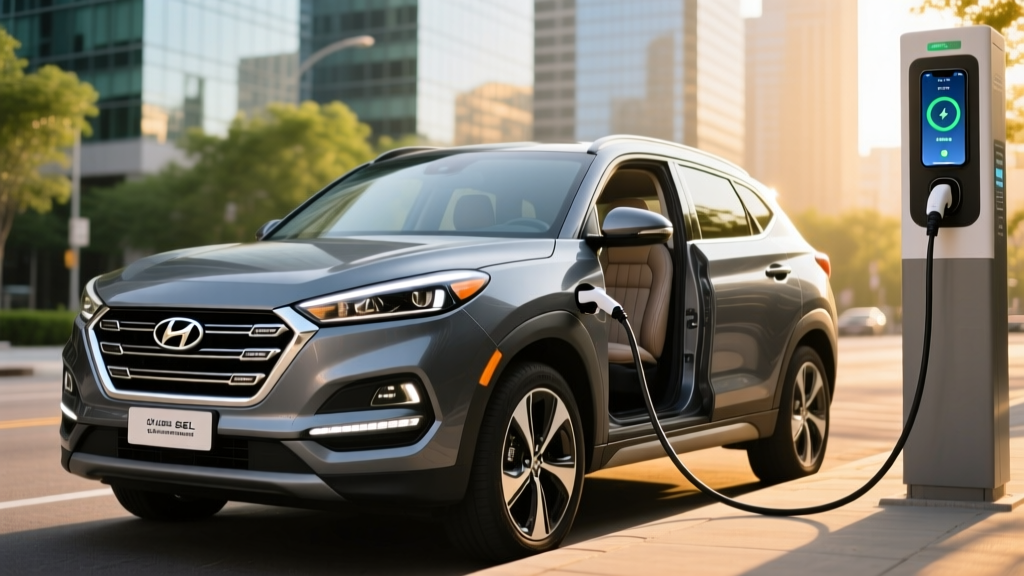
The 2024 Hyundai Tucson Hybrid SEL Convenience occupies a specific niche: a compact SUV that doesn't need a plug, doesn't sacrifice cargo space, and delivers fuel economy that embarrasses many smaller sedans. For buyers in 2026 who aren't ready to commit to a full battery-electric vehicle—whether due to apartment living, road-trip habits, or charging-infrastructure gaps—this conventional hybrid (HEV) remains one of the most practical electrified options on the market.
But how does the SEL Convenience trim stack up in real-world driving, and how does it compare to the Tucson PHEV or a full EV like the Ioniq 5? This guide breaks down every number that matters.
HEV vs. PHEV: Which Tucson Hybrid Are We Talking About?
Hyundai sells the Tucson in three powertrain flavors: a conventional gas model, a conventional hybrid (HEV), and a plug-in hybrid (PHEV). The SEL Convenience is an HEV—meaning it generates all its electricity internally through regenerative braking and the gasoline engine. You never plug it in.
| Attribute | Tucson Hybrid (HEV) | Tucson Plug-In Hybrid (PHEV) |
|---|---|---|
| Plug-in charging required? | No | Yes (Level 1/Level 2) |
| Battery capacity | 1.49 kWh (small buffer) | 13.8 kWh |
| Electric-only range | N/A (motor assists engine) | 33 miles (EPA) |
| EPA combined MPG / MPGe | 38 MPG | 80 MPGe (elec) / 35 MPG (gas) |
| Federal tax credit (§30D) | Not eligible | Eligible (up to $7,500, subject to rules) |
| Starting MSRP (2024) | ~$32,750 (SEL Convenience) | ~$39,900 (SEL) |
The PHEV is a different animal entirely—it gives you 33 miles of electric-only driving before the gas engine kicks in, making it ideal for commuters who can charge at home. The HEV, by contrast, is simpler: just fill up and drive, with the hybrid system silently cutting fuel consumption by roughly 35–40% compared to the gas-only Tucson.
Fuel Economy: EPA Numbers and Real-World MPG
The 2024 Tucson Hybrid with all-wheel drive (standard on all hybrid trims) carries the following EPA ratings, as listed on fueleconomy.gov:
| Cycle | EPA Rating |
|---|---|
| City | 38 MPG |
| Highway | 38 MPG |
| Combined | 38 MPG |
Unlike conventional gas cars, hybrids often match or even exceed their EPA city rating in real-world stop-and-go driving, because regenerative braking recovers energy that would otherwise be lost. In mixed suburban and city driving, owners frequently report 39–42 MPG. Highway-only trips at 75+ mph tend to dip to 33–35 MPG, since the electric motor provides less assistance at sustained high speeds and aerodynamic drag dominates.
Real-world expectation: Plan on 36–40 MPG for typical mixed driving. If your commute is predominantly city, you may see the low 40s. Heavy highway use or cold-weather operation (below 30°F) can pull numbers into the low-to-mid 30s.
Powertrain: 226 HP From a Turbo Hybrid Setup
The Tucson Hybrid pairs a 1.6-liter turbocharged four-cylinder engine with a 44 kW (59 HP) electric motor integrated into the six-speed automatic transmission. Combined system output is 226 horsepower and 258 lb-ft of torque.
| Spec | Value |
|---|---|
| Engine | 1.6L turbocharged GDI 4-cylinder |
| Engine output | 178 HP / 195 lb-ft |
| Electric motor | 44 kW (59 HP) / 195 lb-ft |
| Combined system output | 226 HP / 258 lb-ft |
| Transmission | 6-speed automatic |
| Drivetrain | AWD (standard, HTRAC) |
| Battery | 1.49 kWh lithium-ion polymer |
| 0–60 mph | ~7.1 seconds (est.) |
| Towing capacity | 2,000 lbs |
The result is a compact SUV that feels genuinely quick off the line—the electric motor fills in torque before the turbo spools, eliminating the lag you'd feel in the gas-only 1.6T. The six-speed automatic is a welcome change from the CVTs found in the Toyota RAV4 Hybrid and Honda CR-V Hybrid, delivering more natural shift feel under hard acceleration.
SEL Convenience Trim: What You Get for the Money
The SEL Convenience sits in the middle of the Tucson Hybrid lineup, above the base Blue and SEL trims. For 2024, it carried an MSRP of approximately $37,260 (including destination). Key equipment includes:
- 19-inch alloy wheels
- Power liftgate
- SynTex leatherette seats with heated front seats
- 10.25-inch digital instrument cluster and 10.25-inch touchscreen with navigation
- Wireless Apple CarPlay and Android Auto
- Hyundai SmartSense ADAS suite (forward collision-avoidance, lane-keeping, blind-spot monitoring, rear cross-traffic avoidance)
- Dual-zone automatic climate control
- Highway Driving Assist (HDA) — a Level 2 driver-assistance system combining adaptive cruise with lane-centering
Compared to the Limited trim (~$41,000), you give up ventilated seats, a panoramic sunroof, and the premium Bose audio system. For most buyers, the SEL Convenience hits the feature-to-price sweet spot.
Tax Credits and Incentives: What Applies to the HEV?
Here's a critical distinction: the Tucson Hybrid (HEV) does not qualify for the federal §30D Clean Vehicle Credit. That credit—up to $7,500 with point-of-sale transfer—is reserved for plug-in vehicles (BEVs and PHEVs) that meet battery-sourcing, critical-mineral, MSRP, and buyer-income requirements as defined by the IRS.
The Tucson PHEV may qualify, depending on your income, the vehicle's MSRP (must be ≤$80,000 for SUVs), and the battery-component and critical-mineral sourcing requirements in effect for the model year. Always verify current eligibility on the IRS website or with a tax professional before purchasing.
Some states and utilities offer separate rebates for conventional hybrids, but these are less common and vary widely. Check your state energy office or utility provider for local programs.
Battery Warranty, Reliability, and Replacement Cost
Hyundai Hybrid Battery Warranty: 10 years / 100,000 miles (whichever comes first) for the hybrid battery pack. The hybrid system components (motor, inverter, etc.) are covered under the same 10-year/100,000-mile powertrain warranty. This applies to the original owner; subsequent owners receive 5 years / 60,000 miles unless the vehicle was certified pre-owned through Hyundai.
The 1.49 kWh battery in the Tucson HEV is small and operates within a narrow state-of-charge window—typically between 40% and 60%—which dramatically reduces degradation stress. Hyundai has been building hybrids since the Ioniq in 2017, and large-scale battery failures in their HEV lineup have been rare.
If replacement is needed outside warranty, a hybrid battery for the Tucson HEV typically costs $2,000–$3,500 including labor at a dealership. Independent hybrid specialists may offer refurbished units for less. Compare this to the $10,000–$20,000+ replacement costs for full-EV traction batteries—the HEV's small pack is far cheaper to replace.
For reliability data, the Tucson Hybrid has earned favorable ratings from Consumer Reports and scored well in IIHS testing, where it was named a Top Safety Pick when equipped with specific headlights.
Hybrid vs. PHEV vs. Full EV: Which Fits Your Life?
Choose the Tucson Hybrid (HEV) if:
- You can't charge at home (apartment, street parking, no garage outlet)
- You take frequent long road trips and don't want to plan around charging stops
- You want lower fuel costs without changing any habits
- Your budget is under $40,000
Choose the Tucson PHEV if:
- You can install a Level 2 charger at home
- Your daily commute is under 30 miles round-trip (you'll rarely use gas)
- You qualify for the federal tax credit, effectively narrowing the price gap with the HEV
Choose a full EV (e.g., Hyundai Ioniq 5) if:
- You have reliable home charging and your daily driving is under 250 miles
- You want the lowest per-mile energy cost and minimal maintenance
- You're eligible for the full $7,500 federal credit and any state incentives
Pros and Cons at a Glance
Pros
- 38 MPG combined — real-world often higher in city driving
- No plug-in charging required; zero behavior change
- 226 HP with instant electric torque fill
- Strong safety tech standard (SmartSense + HDA)
- 10-year / 100,000-mile hybrid battery warranty
- Practical cargo space (38.7 cu ft behind rear seats)
Cons
- Not eligible for federal §30D tax credit
- Highway MPG drops at sustained 75+ mph speeds
- No DC fast charging capability (not applicable for HEV)
- SEL Convenience pricing pushes near $38K with options
- 6-speed auto is smooth but not as efficient as a CVT at constant low speeds
Frequently Asked Questions
How many MPG does the 2024 Tucson Hybrid SEL Convenience get?
The EPA rates it at 38 MPG city, 38 MPG highway, and 38 MPG combined. In real-world city-heavy driving, owners commonly report 39–42 MPG. Highway-only driving at high speeds may yield 33–35 MPG.
Does the Tucson Hybrid need to be plugged in?
No. The Tucson Hybrid (HEV) charges its small 1.49 kWh battery internally through regenerative braking and the gasoline engine. You simply fill up at any gas station. If you want plug-in capability, look at the Tucson PHEV instead.
Is the Tucson Hybrid reliable, and what does a battery replacement cost?
Hyundai's hybrid system has proven reliable since its 2017 debut. The hybrid battery is covered by a 10-year/100,000-mile warranty. Out-of-warranty replacement runs approximately $2,000–$3,500—significantly less than a full EV battery.
Does the Tucson Hybrid qualify for any federal tax credit?
No. The conventional hybrid (HEV) does not qualify for the §30D Clean Vehicle Credit, which is limited to plug-in vehicles. The Tucson PHEV may qualify, subject to IRS income, MSRP, and battery-sourcing rules. Consult IRS guidelines for current eligibility.
How does the Tucson Hybrid compare to the RAV4 Hybrid?
The Toyota RAV4 Hybrid is rated at 41 MPG combined versus the Tucson's 38 MPG. However, the Tucson offers more standard horsepower (226 vs. 219), a conventional 6-speed automatic instead of a CVT, and Hyundai's longer 10-year powertrain warranty. Cargo space is comparable. The choice often comes down to brand preference and dealer availability.
Can the Tucson Hybrid run on electric power alone?
Only at very low speeds (under ~25 mph) for short distances, such as creeping through a parking lot. The 1.49 kWh battery isn't large enough for sustained electric-only driving. For meaningful electric-only range, the Tucson PHEV offers 33 miles on a full charge.