The i-FORCE MAX Powertrain: A Full Hybrid, Not a Plug-In
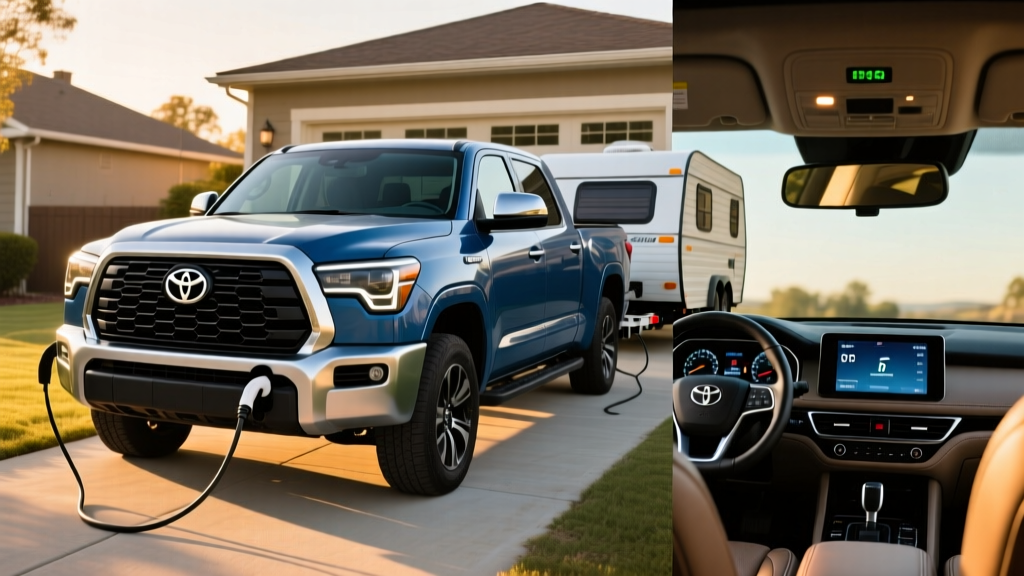
The 2024 Toyota Tundra Hybrid uses Toyota's i-FORCE MAX powertrain — a conventional full hybrid electric vehicle (HEV) that never needs to be plugged in. This is a critical distinction for truck shoppers cross-shopping electrified options. Unlike a plug-in hybrid (PHEV) such as the Ford F-150 PowerBoost (which also operates as an HEV without plugging in) or the upcoming Ramcharger EREV, the Tundra Hybrid generates all its electrical energy onboard through regenerative braking and engine-driven generation. There is no charging port, no electric-only driving mode of meaningful distance, and no dependency on charging infrastructure.
HEV vs PHEV: Where the Tundra Fits
| Feature | Tundra Hybrid (HEV) | PHEV Truck (e.g., F-150 PHEV concepts) | Full EV Truck (e.g., F-150 Lightning) |
|---|---|---|---|
| Plug-in required | No | Optional (for EV range) | Yes |
| Electric-only range | ~0.5 mi at low speed | 20–40 mi (typical PHEV) | 230–320+ mi |
| Battery size | 1.87 kWh (NiMH) | 12–20 kWh (Li-ion) | 98–131 kWh (Li-ion) |
| Fueling | Gas only | Gas + optional plug | Electricity only |
| Towing impact on range | MPG drops modestly | EV range eliminated under load | Range drops 40–60% |
The Tundra Hybrid's 1.87 kWh nickel-metal hydride (NiMH) battery pack is small by electrified standards — it exists to buffer energy for torque assist, regenerative braking capture, and brief low-speed electric motor operation. You will never see a "miles of EV range" figure because this system isn't designed for that. It's designed to supplement a twin-turbo V6 with instantaneous electric torque and to recapture energy during deceleration.
Fuel Economy: EPA Ratings vs Real-World MPG
The EPA rates the 2024 Toyota Tundra Hybrid at 22 MPG combined, with a breakdown of 22 MPG city and 22 MPG highway for 4x2 models, according to fueleconomy.gov. The 4x4 variants drop slightly to 21 MPG combined (20 city / 22 highway). For a full-size, body-on-frame pickup producing 437 horsepower, these numbers represent a meaningful improvement over the non-hybrid i-FORCE twin-turbo V6, which returns 19–20 MPG combined depending on configuration.
| Configuration | EPA City | EPA Highway | EPA Combined | Real-World Expectation |
|---|---|---|---|---|
| Tundra Hybrid 4x2 | 22 MPG | 22 MPG | 22 MPG | 20–23 MPG |
| Tundra Hybrid 4x4 | 20 MPG | 22 MPG | 21 MPG | 19–22 MPG |
| Tundra i-FORCE (non-hybrid) 4x4 | 17 MPG | 22 MPG | 19 MPG | 17–20 MPG |
Real-World MPG: What Owners Actually Report
Hybrid trucks often match or slightly exceed their EPA city ratings in stop-and-go driving because regenerative braking recaptures energy that a conventional powertrain wastes as heat. On the highway, the advantage narrows — the electric motor's contribution at sustained 70–80 mph cruising is minimal, and the twin-turbo V6 is doing most of the work. Owner-reported data on forums and fuel-tracking apps clusters around 19–21 MPG for 4x4 models in mixed driving, with some drivers seeing 23+ MPG in city-heavy commutes.
If you tow frequently, expect a significant drop. Hybrid towing MPG typically falls to 12–15 MPG with a loaded trailer — better than many non-hybrid competitors under the same conditions, but the battery-assist advantage diminishes under sustained heavy load. The hybrid system's real towing benefit is low-speed maneuvering and initial trailer acceleration, where the electric motor's instant 583 lb-ft of combined torque eliminates the turbo lag you'd feel in a non-hybrid setup.
Powertrain Specs: 437 HP and 583 lb-ft of Torque
| Specification | 2024 Tundra Hybrid (i-FORCE MAX) |
|---|---|
| Engine | 3.4L twin-turbo V6 + electric motor |
| Combined horsepower | 437 hp |
| Combined torque | 583 lb-ft |
| Transmission | 10-speed automatic |
| Hybrid battery | 1.87 kWh NiMH |
| 0–60 mph | ~5.7 seconds |
| Max towing capacity | 12,000 lbs (properly equipped) |
| Max payload | 1,940 lbs |
| Drivetrain | RWD or part-time 4WD |
The i-FORCE MAX places the electric motor between the engine and the transmission (a P2 hybrid architecture). This means the motor can assist the engine, operate the truck briefly at very low speeds on electric power alone (such as creeping through a parking lot), and capture energy during braking — all without a dedicated EV mode button. The system is seamless and requires zero behavioral change from the driver.
Peak output of 437 hp and 583 lb-ft puts the Tundra Hybrid in the upper tier of half-ton trucks for stock power, trailing only the high-output variants from Ford and Ram. The torque figure is particularly relevant for truck buyers: 583 lb-ft is available low in the rev range thanks to the electric motor's contribution, which translates to confident merging with a loaded bed and strong initial pull when starting with a trailer.
Pricing, Trims, and Tax Credit Eligibility
The hybrid i-FORCE MAX powertrain is available on Tundra trims from the Limited upward for the 2024 model year. It is not offered on the base SR or mid-tier SR5, which restricts entry pricing:
| Trim | MSRP (approx.) | i-FORCE MAX Available |
|---|---|---|
| Limited | ~$59,000 | Yes (standard on some configs) |
| Platinum | ~$67,000 | Yes |
| 1794 Edition | ~$67,500 | Yes |
| TRD Pro | ~$72,000 | Yes (standard) |
| Capstone | ~$78,000 | Yes (standard) |
Federal Tax Credit: Does the Tundra Hybrid Qualify?
Short answer: No. The 2024 Toyota Tundra Hybrid does not qualify for the IRS §30D Clean Vehicle Credit. Under current IRS rules, the §30D credit of up to $7,500 applies only to plug-in electric vehicles (BEVs and PHEVs) that meet battery capacity, critical mineral sourcing, MSRP cap, and buyer income requirements. Conventional hybrids (HEVs) like the Tundra i-FORCE MAX have no plug and no meaningful battery capacity, placing them outside the credit's scope entirely.
Some states may offer their own incentives for hybrid purchases — check your state energy office or department of revenue for specifics. Toyota dealers may also offer manufacturer rebates or financing promotions that effectively reduce the hybrid premium.
Battery Warranty, Lifespan, and Replacement Cost
Toyota Hybrid Battery Warranty
Toyota covers the Tundra Hybrid's battery pack under its Hybrid System Warranty: 10 years or 150,000 miles (whichever comes first), transferable to subsequent owners. This warranty covers the hybrid battery, battery control module, hybrid control module, and inverter with converter — essentially the entire high-voltage hybrid system.
The 1.87 kWh NiMH battery in the Tundra Hybrid is a proven design shared in concept with Toyota's long-running hybrid lineup (the Prius has used similar NiMH packs for over two decades). NiMH chemistry is less energy-dense than lithium-ion but extremely durable, with excellent cycle-life stability and minimal degradation concerns under normal use. Unlike the large lithium-ion packs in BEVs and PHEVs, this small battery isn't subjected to deep discharge cycles — it operates in a narrow state-of-charge window managed by the hybrid control system, which is why Toyota can confidently offer a decade-long warranty.
Replacement Cost If Out of Warranty
Should the hybrid battery require replacement beyond the warranty period, expect a cost in the range of $3,000–$5,000 including parts and labor at a Toyota dealership. This is significantly less than a BEV traction battery replacement ($10,000–$20,000+) because the pack is small and the NiMH chemistry is less expensive. Independent hybrid specialists may offer refurbished pack replacements for $2,000–$3,000. For context, this is roughly equivalent to a major transmission service on a conventional truck — a meaningful but not catastrophic repair cost.
Reliability and Long-Term Ownership
Toyota's hybrid systems carry one of the strongest reliability reputations in the industry, built on billions of cumulative miles across the Prius, Camry Hybrid, RAV4 Hybrid, and Highlander Hybrid lineages. The Tundra's i-FORCE MAX uses a newer, more powerful iteration of this architecture, but the fundamental components — motor-generator, power control unit, NiMH pack — are evolutionary rather than experimental.
The twin-turbo V6 engine is the newer variable in this equation. Toyota's 3.4L V6 (designated V35A-FTS) debuted in the current-generation Tundra and Land Cruiser, and early reliability data has been generally positive, though some owners have reported isolated issues with turbo wastegate actuators and oil consumption in high-mileage examples. The hybrid system itself has not emerged as a reliability concern in owner surveys or technical service bulletins.
For buyers prioritizing long-term dependability in a full-size truck, the Tundra Hybrid's combination of a proven hybrid system with a relatively new engine platform represents a calculated bet — the hybrid components are unlikely to fail, while the turbo engine is still building its long-term track record.
Who Should Choose the Tundra Hybrid vs an EV or Gas Truck?
Choose the Tundra Hybrid If:
- You want better fuel economy in a full-size truck without changing your fueling habits
- You tow regularly and want electric torque assist for low-speed trailer maneuvering
- You lack home charging access and can't practically own a PHEV or BEV
- You drive 15,000+ miles per year and want to reduce fuel costs vs a non-hybrid V6 or V8
- You value Toyota's hybrid reliability track record and 10-year battery warranty
Look Elsewhere If:
- You want electric-only commuting (consider a PHEV or BEV)
- You need the federal $7,500 tax credit (HEVs don't qualify)
- You want one-pedal driving or a full EV experience
- You prioritize maximum fuel savings above all else (a BEV costs less per mile to "fuel")
- You need the absolute lowest entry price (the hybrid is restricted to $59K+ trims)
The Decision Framework
Choose the Tundra Hybrid over gas if you drive more than 12,000 miles annually, especially in mixed city/highway conditions where the 2–3 MPG improvement over the non-hybrid i-FORCE translates to $300–$500 in annual fuel savings. At current fuel prices, the hybrid premium pays for itself in roughly 3–5 years for high-mileage drivers.
Choose a full EV truck instead if you have reliable Level 2 home charging, drive under 300 miles daily, rarely tow over 7,000 lbs, and want to access the $7,500 federal credit (on eligible models like the F-150 Lightning). BEVs deliver dramatically lower per-mile energy costs ($0.04–$0.06/mi vs $0.18–$0.22/mi for the Tundra Hybrid) but require infrastructure commitment and accept towing-range compromises.
Choose a PHEV truck (as options expand) if you want 20–40 miles of electric-only commuting during the week with gas-engine range for weekend towing and road trips — the best of both worlds, if you can plug in at home.
Frequently Asked Questions
How many MPG does the 2024 Toyota Tundra Hybrid get?
The EPA rates the Tundra Hybrid at 22 MPG combined (4x2) and 21 MPG combined (4x4). Real-world results typically fall between 19–23 MPG depending on driving mix, with city-heavy commutes often matching or slightly exceeding EPA estimates thanks to regenerative braking. Towing drops fuel economy to 12–15 MPG.
Does the Tundra Hybrid need to be plugged in?
No. The Tundra Hybrid is a conventional full hybrid (HEV). It charges its own small battery through regenerative braking and engine-driven generation. There is no charging port and no plug-in requirement.
How far can the Tundra Hybrid drive on electric power alone?
Less than one mile at very low speeds (under 15 mph). The system isn't designed for meaningful EV-only driving — the electric motor exists to assist the gas engine, capture braking energy, and provide instant torque, not to replace the engine for extended distances.
Does the 2024 Tundra Hybrid qualify for any tax credit?
Not the federal §30D Clean Vehicle Credit, which requires plug-in capability (BEV or PHEV). Some state-level incentives may apply to hybrid purchases — check your state's energy office. Toyota may also offer manufacturer incentives that reduce the effective price.
Is the Tundra Hybrid battery reliable and what does replacement cost?
Toyota's hybrid battery systems have an industry-leading reliability record. The Tundra Hybrid's NiMH pack is covered by a 10-year/150,000-mile warranty. Out-of-warranty replacement costs approximately $3,000–$5,000 at a dealership — far less than a BEV battery replacement.
How does the Tundra Hybrid compare to the Ford F-150 PowerBoost hybrid?
The F-150 PowerBoost produces 430 hp and 570 lb-ft (slightly less than the Tundra's 437 hp / 583 lb-ft) and is rated at 22–23 MPG combined depending on configuration. The Ford offers a Pro Power Onboard generator feature and is available on more trims at lower price points. Both are conventional HEVs with no plug-in requirement, though Ford has announced future PHEV truck plans.
What is the towing capacity of the Tundra Hybrid?
Up to 12,000 lbs when properly equipped (4x2 models). The 4x4 hybrid tows up to approximately 11,175 lbs. The hybrid's electric torque assist is particularly beneficial for low-speed trailer starts and parking-lot maneuvering with a heavy load.