Quick Verdict: The Tacoma Hybrid Delivers Torque, Not Just MPG
The 2024 Toyota Tacoma Hybrid (badged i-FORCE MAX) is not your typical fuel-sipping hybrid. Toyota engineered this powertrain primarily for torque — 465 lb-ft of it — with improved fuel economy as a secondary benefit. Available exclusively on higher trims (TRD Off-Road, TRD Sport, Limited, and Trailhunter), the i-FORCE MAX pairs a turbocharged 2.4-liter four-cylinder with an electric motor integrated into the eight-speed automatic transmission. The result is a midsize truck that pulls hard, tows up to 6,000 pounds, and returns a meaningful MPG bump over its gasoline-only sibling.
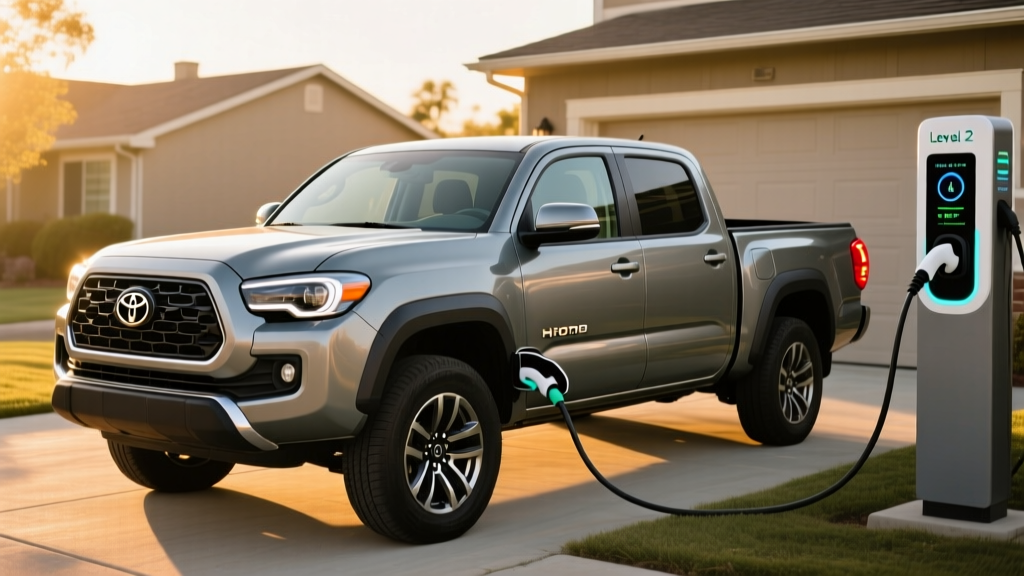
This is a conventional hybrid (HEV), not a plug-in hybrid (PHEV). You never plug it in. The small battery recharges through regenerative braking and engine power, making it a seamless transition for truck buyers who want electrified efficiency without any change to their fueling routine.
i-FORCE MAX Powertrain: How the Hybrid System Works
The i-FORCE MAX combines a 278-horsepower turbocharged 2.4L four-cylinder engine with a 48-horsepower electric motor positioned between the engine and transmission. Combined system output reaches 326 horsepower and 465 lb-ft of torque — the latter figure rivaling many V6 and even some V8 truck engines.
| Specification | Value |
|---|---|
| Engine | 2.4L turbocharged inline-4 |
| Engine Output | 278 hp / 317 lb-ft |
| Electric Motor Output | 48 hp / 184 lb-ft |
| Combined System Output | 326 hp / 465 lb-ft |
| Transmission | 8-speed automatic |
| Hybrid Battery | ~1.87 kWh (NiMH), sealed |
| Drivetrain | 4WD (part-time or full-time, trim-dependent) |
| Max Towing Capacity | 6,000 lbs (properly equipped) |
| Max Payload | ~1,700 lbs (varies by trim) |
The hybrid battery pack is modest — roughly 1.87 kWh of nickel-metal hydride (NiMH) chemistry. This is far smaller than a PHEV or BEV battery because its role is fundamentally different: it provides brief torque assist during acceleration, captures energy during braking, and enables low-speed electric-only crawling in stop-and-go traffic. There is no meaningful electric-only driving range; the system is designed to supplement the gas engine, not replace it.
HEV vs PHEV vs EV: Which Tacoma Buyer Should Care?
Understanding where the Tacoma Hybrid fits in the broader electrified-vehicle landscape prevents costly misalignment with your needs.
- HEV (Hybrid Electric Vehicle): No plug. Small battery recharges via regen and engine. Improves MPG modestly. The Tacoma i-FORCE MAX is an HEV.
- PHEV (Plug-in Hybrid): Plugs in. Larger battery (typically 10–20 kWh) provides 20–40 miles of electric-only range before the gas engine takes over. Toyota does not offer a Tacoma PHEV.
- BEV (Battery Electric Vehicle): Fully electric, no gas engine. Requires home or public charging infrastructure. Examples: Rivian R1T, Ford F-150 Lightning, Chevrolet Silverado EV.
Choose the Tacoma Hybrid (HEV) if: You want a midsize truck with strong towing/payload, you lack reliable home charging access, you frequently drive in remote areas without charging infrastructure, or you want electrified efficiency gains without any behavioral change.
Consider a full EV truck if: You have home Level 2 charging, your daily driving stays within 200–300 miles, you want to eliminate fuel costs entirely, and you qualify for the federal §30D tax credit (up to $7,500 for eligible new EVs, subject to MSRP caps, income limits, and battery-sourcing requirements per the IRS).
EPA Fuel Economy: City, Highway, and Combined MPG
The i-FORCE MAX hybrid is available on 4WD double-cab and crew-cab configurations. EPA estimates vary slightly by trim and tire configuration.
| Configuration | City MPG | Highway MPG | Combined MPG |
|---|---|---|---|
| TRD Off-Road / Sport (18" wheels) | 23 | 27 | 25 |
| Limited (20" wheels) | 22 | 26 | 24 |
| Trailhunter (all-terrain tires) | 22 | 25 | 23 |
Source: fueleconomy.gov
For comparison, the non-hybrid 2.4L turbo 4WD Tacoma returns 20 city / 26 highway / 22 combined on most trims. The hybrid's biggest advantage emerges in city driving: the electric motor's low-end torque assist and regenerative braking recover energy that a conventional truck would waste as heat at every stoplight.
Real-World MPG: What to Expect Beyond the EPA Sticker
Hybrid trucks tend to match or slightly exceed EPA estimates in city driving because stop-and-go traffic maximizes regenerative braking opportunities. Highway driving, where the electric motor contributes less and aerodynamic drag dominates, often yields MPG at or slightly below the EPA highway number.
Based on owner-reported data and third-party testing:
- City driving: Expect 23–26 MPG, with some drivers reporting 27+ MPG in heavy stop-and-go conditions.
- Highway driving (70–75 mph): Expect 24–26 MPG on standard trims; Trailhunter's aggressive all-terrain tires and roof rack accessories may reduce this to 22–24 MPG.
- Towing: When towing near the 6,000-lb limit, expect 12–16 MPG depending on trailer profile, terrain, and speed. The hybrid system's torque assist helps the engine work less under load, but towing remains fuel-intensive.
- Cold weather (below 32°F): Expect a 10–15% MPG reduction as the engine runs more frequently to provide cabin heat and the battery's charge/discharge efficiency decreases in low temperatures.
Over 15,000 miles of mixed driving annually, the hybrid's 2–3 MPG advantage over the gas-only Tacoma translates to roughly 60–90 fewer gallons consumed per year — saving approximately $200–$350 at $3.50/gallon fuel prices.
Pricing, Trim Availability, and Tax Credit Eligibility
The i-FORCE MAX hybrid powertrain is not available on base SR or SR5 trims. It is offered on the following 2024 Tacoma configurations:
| Trim | Approximate MSRP |
|---|---|
| TRD Sport i-FORCE MAX | $42,800 |
| TRD Off-Road i-FORCE MAX | $44,400 |
| Limited i-FORCE MAX | $50,600 |
| Trailhunter i-FORCE MAX | $52,800 |
| TRD Pro i-FORCE MAX | $62,900 |
Prices are approximate base MSRPs before destination charges and options. Verify current pricing at Toyota.com.
The 2024 Toyota Tacoma Hybrid is a conventional hybrid (HEV), not a plug-in electric vehicle. It does not qualify for the IRS §30D Clean Vehicle Credit (up to $7,500 for new EVs/PHEVs). The §30D credit requires a minimum battery capacity of 7 kWh and plug-in charging capability — neither of which the Tacoma HEV meets.
There is currently no federal tax credit specifically for conventional hybrids. Some states offer modest rebates for HEVs; check your state energy office for current programs.
Battery Warranty, Reliability, and Replacement Cost
- Coverage: 10 years / 150,000 miles (whichever comes first) on the hybrid battery and all hybrid-system components, including the electric motor, inverter, and control modules.
- Applies to: All 2024 Tacoma i-FORCE MAX models, regardless of state.
- Capacity threshold: Toyota warrants the hybrid battery against defects and abnormal loss of capacity. Unlike BEV warranties (which specify a minimum State of Health percentage), HEV battery warranties focus on functional failure rather than gradual degradation, since the small battery is continuously cycled at shallow depth.
Toyota's hybrid system reliability is well-documented across millions of vehicles spanning the Prius, Camry Hybrid, RAV4 Hybrid, and Highlander Hybrid lineages. The NiMH chemistry in the Tacoma's hybrid pack is mature technology with decades of field data. Shallow charge/discharge cycles (the battery rarely drops below 40% or exceeds 80% State of Charge) minimize stress and extend lifespan.
Hybrid battery replacement cost: If the battery fails outside the warranty period, replacement runs approximately $2,000–$4,000 including parts and labor. However, given the 10-year/150,000-mile warranty and Toyota's track record of hybrid battery longevity (many Prius batteries exceed 200,000 miles without replacement), out-of-pocket replacement is uncommon during typical ownership.
The broader powertrain — the turbocharged 2.4L engine and eight-speed transmission — carries Toyota's standard 5-year/60,000-mile powertrain warranty. The turbocharger is a newer addition to Toyota's truck lineup (the previous Tacoma used a naturally aspirated V6), and long-term turbo reliability data on this specific engine is still accumulating.
Who Should Buy the Tacoma Hybrid — And Who Shouldn't
- You tow or haul regularly and want maximum torque at low RPM
- You lack home charging access and cannot use a PHEV or BEV
- You want a modest MPG improvement (2–4 MPG) without any charging routine
- You drive in remote or rural areas where charging infrastructure is sparse
- You value Toyota's long-term reliability reputation and strong resale value
- You want significant fuel savings — the hybrid premium (~$2,000–$3,000 over gas trims) takes years to recoup at current fuel prices
- You want electric-only driving for short commutes (consider a PHEV like the Toyota RAV4 Prime or a BEV)
- You prioritize maximum payload — the hybrid battery adds weight, slightly reducing payload versus gas-only models
- You want the lowest entry price — the i-FORCE MAX is unavailable on base SR/SR5 trims
- You need a full-electric truck for fleet emissions compliance or HOV lane access (requirements vary by state)
Frequently Asked Questions
How many MPG does the 2024 Toyota Tacoma Hybrid get?
The EPA rates the Tacoma i-FORCE MAX 4WD at 23 city / 27 highway / 25 combined on trims with 18-inch wheels (TRD Off-Road, TRD Sport). The Limited drops to 22/26/24, and the Trailhunter rates 22/25/23. Real-world city driving often matches or slightly exceeds EPA estimates, while highway towing significantly reduces MPG.
Does the Tacoma Hybrid need to be plugged in?
No. The Tacoma i-FORCE MAX is a conventional hybrid (HEV). The small battery recharges automatically through regenerative braking and the gasoline engine. You fuel it exactly like a standard truck — at the gas pump.
How far can the Tacoma Hybrid drive on electric power alone?
The Tacoma Hybrid is not designed for meaningful electric-only driving. At very low speeds (under ~15 mph) in stop-and-go traffic, the electric motor can propel the truck for short distances (roughly 0.5–1 mile at most), but the system is engineered to assist the gas engine, not replace it. If electric-only commuting is your goal, look at a PHEV (like the Ford Escape PHEV) or a full BEV.
Does the 2024 Toyota Tacoma Hybrid qualify for a federal tax credit?
No. The §30D Clean Vehicle Credit requires plug-in capability and a minimum battery capacity of 7 kWh. The Tacoma Hybrid's ~1.87 kWh NiMH battery and conventional HEV architecture do not meet these thresholds. No federal tax credit currently exists for conventional hybrids. Consult a tax professional or check the IRS Clean Vehicle Credit page for the latest rules.
Is the Tacoma Hybrid reliable? What does battery replacement cost?
Toyota's hybrid systems have an extensive reliability track record across millions of vehicles. The Tacoma's hybrid battery is covered by a 10-year/150,000-mile warranty. Out-of-warranty replacement costs approximately $2,000–$4,000, but failure before 200,000 miles is historically rare for Toyota NiMH hybrid packs. The turbocharged 2.4L engine is newer to the Tacoma lineup, and long-term turbo durability data is still being established.
How much does the hybrid powertrain add to the Tacoma's price?
The i-FORCE MAX hybrid is typically a $2,000–$3,000 premium over the equivalent gas-only i-FORCE turbo powertrain on the same trim. At a 2–3 MPG improvement and $3.50/gallon fuel, the payback period is roughly 5–8 years for an average driver covering 15,000 miles annually. The real value proposition is the 465 lb-ft of torque for towing and off-road performance, not fuel-cost savings alone.