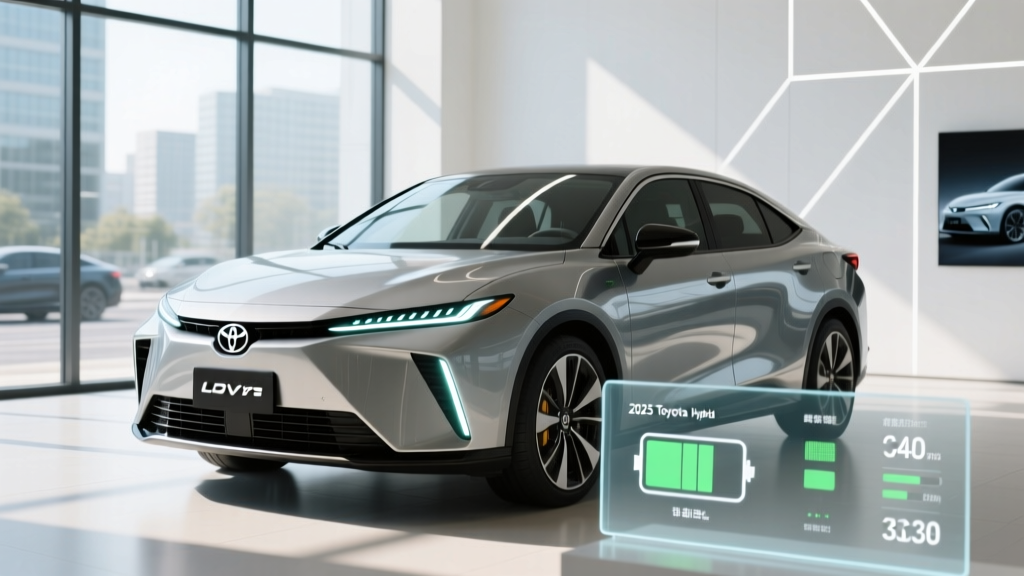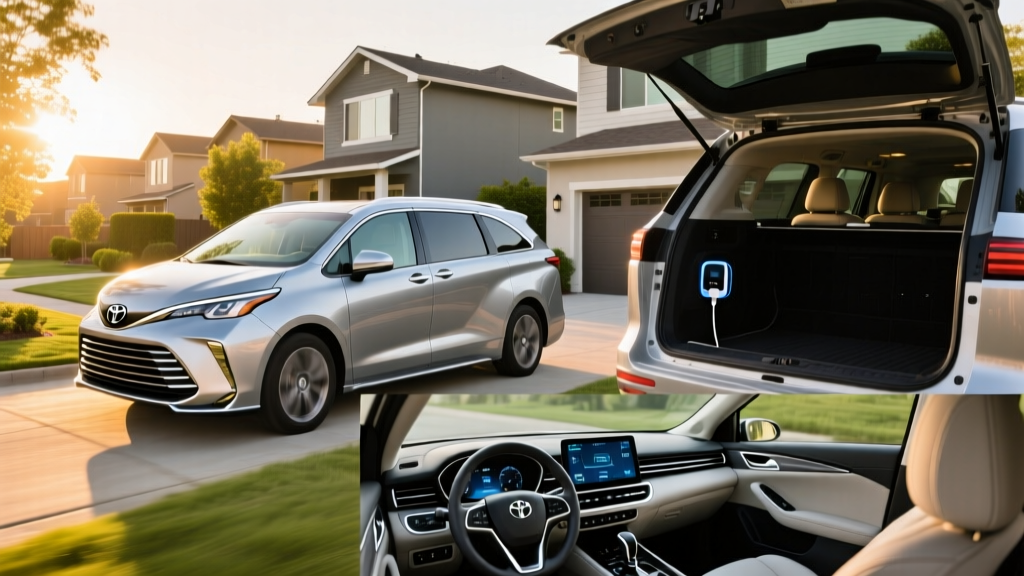
The minivan segment has largely abandoned electrification, which makes the 2024 Toyota Sienna Hybrid a standout. Unlike its competitors — the Honda Odyssey and Chrysler Pacifica — every Sienna sold since the 2021 redesign comes exclusively as a hybrid. There is no gas-only variant. For families weighing a three-row hauler against the rising cost of fuel, the Sienna's standard hybrid powertrain and 36 MPG combined EPA rating make it one of the most efficient vehicles in its class, full stop.
This guide breaks down exactly what you get: real-world fuel economy data, powertrain specs, battery longevity, pricing by trim, and how the Sienna stacks up against plug-in hybrid and fully electric alternatives in 2026.
HEV vs PHEV: The Sienna Is a Conventional Hybrid
Conventional Hybrid (HEV) — Toyota Sienna: The Sienna uses a self-charging hybrid system. A small 1.6 kWh nickel-metal hydride (NiMH) battery captures energy from regenerative braking and the gasoline engine. You never plug it in. It cannot drive on electric power alone for meaningful distances. The electric motor assists the gas engine to reduce fuel consumption, particularly at low speeds and during stop-and-go driving.
Plug-In Hybrid (PHEV) — Example: Chrysler Pacifica Hybrid: A PHEV carries a much larger battery (the Pacifica Hybrid uses a 16 kWh pack) that you charge via a wall outlet or Level 2 charger. It can drive 30+ miles on electricity alone before the gas engine engages. The Sienna is not a PHEV and does not offer an EV-only mode.
This distinction matters because many shoppers confuse the two. If you want plug-in capability and electric-only commuting, the Sienna is not it. If you want maximum simplicity — no charging cables, no range planning, just fill up with gas and drive — the Sienna's HEV system delivers exactly that.
Powertrain Specs: What's Under the Hood
| Specification | 2024 Toyota Sienna Hybrid |
|---|---|
| Engine | 2.5L 4-cylinder Atkinson-cycle |
| Engine Output | 189 HP / 176 lb-ft torque |
| Electric Motors | 2 (FWD) or 3 (AWD) permanent-magnet |
| Combined System Output | 245 HP (FWD & AWD) |
| Hybrid Battery | 1.6 kWh NiMH (sealed) |
| Transmission | eCVT (planetary gearset, no belt) |
| Drivetrain | FWD standard; electronic AWD available |
| 0–60 mph | ~7.1 seconds (FWD, tested) |
| Towing Capacity | 3,500 lbs (with tow prep package) |
| Cargo Volume (behind 3rd row) | 33.5 cu ft |
| Max Cargo (seats folded) | 101.0 cu ft |
The fourth-generation hybrid system pairs Toyota's proven 2.5L Dynamic Force engine with front and (on AWD models) rear electric motors. The AWD system uses a dedicated 54 HP rear motor — there is no mechanical driveshaft connecting the axles. This electronic AWD engages automatically when slip is detected and operates up to approximately 43 mph before disengaging, which is adequate for rain, light snow, and low-traction launches.
Acceleration is adequate rather than thrilling. The 245 combined horsepower moves the Sienna's ~4,700-lb curb weight competently, and highway passing is confident. The eCVT is smooth and avoids the drone associated with some continuously variable transmissions, thanks to Toyota's use of a physical planetary gearset rather than a rubber-belt design.
Fuel Economy: EPA Ratings and Real-World MPG
| Configuration | City | Highway | Combined |
|---|---|---|---|
| FWD (LE, XLE, Limited, Platinum) | 36 MPG | 36 MPG | 36 MPG |
| AWD (all trims) | 35 MPG | 36 MPG | 35 MPG |
| Woodland Edition (AWD) | 34 MPG | 36 MPG | 35 MPG |
Source: EPA / fueleconomy.gov
The Sienna's EPA ratings are unusually honest for a hybrid. In extensive owner-reported data and independent testing, the Sienna consistently meets or slightly exceeds its EPA city rating — often returning 37–40 MPG in urban and suburban driving with moderate stop-and-go traffic. This is because hybrids recapture energy during braking that gas-only vehicles waste as heat.
Highway fuel economy tends to land closer to 32–34 MPG at sustained 70–75 mph speeds, where regenerative braking contributes less and aerodynamic drag dominates. Cold weather (below 30°F) typically reduces combined economy by 3–5 MPG due to engine warm-up cycles and increased rolling resistance. Owners in mild climates who do mostly city driving regularly report lifetime averages of 37+ MPG.
For context, the non-hybrid Honda Odyssey returns an EPA 22 MPG combined. That's a 14 MPG gap — roughly 60% more fuel consumption for the Odyssey on every trip. At $3.50/gallon and 15,000 miles/year, the Sienna saves approximately $1,200–$1,400 annually in fuel costs versus a comparable gas-only minivan.
Pricing, Trims, and Tax Credit Eligibility
| Trim | MSRP (FWD) | AWD Add-On | Key Features |
|---|---|---|---|
| LE | $37,685 | +$760 | 8-seat, Toyota Safety Sense 2.5, 9" touchscreen |
| XLE | $42,405 | +$760 | SofTex seats, power liftgate, wireless CarPlay |
| XSE | $44,615 | $760 (std AWD) | Sport-tuned suspension, 20" wheels, 7-seat |
| 25th Anniversary | $45,385 | N/A (AWD std) | Special badging, red interior accents |
| Limited | $49,165 | +$760 | Leather, JBL audio, dual sunroofs, HUD |
| Platinum | $52,675 | +$760 | 360° camera, rear entertainment, heated 2nd row |
| Woodland Edition | $48,175 | N/A (AWD std) | Roof rails, tow hitch, all-weather floor mats |
Prices include destination charge. Source: Toyota.com
Federal Tax Credit Status
The 2024 Toyota Sienna Hybrid does not qualify for the federal §30D Clean Vehicle Credit. Under current IRS rules, only battery electric vehicles (BEVs) and plug-in hybrid electric vehicles (PHEVs) with a minimum battery capacity of 7 kWh are eligible. The Sienna's 1.6 kWh NiMH battery falls well below this threshold, and as a conventional HEV, it is categorically excluded from the credit.
- §30D Clean Vehicle Credit: Not eligible (HEV, not PHEV or BEV)
- State Hybrid Incentives: Some states offer rebates for hybrids — check your state energy office
- Used Hybrid Credit (§25E): If buying a qualifying used Sienna Hybrid (model year at least 2 years old, under $25,000), you may be eligible for up to $4,000 under the used clean vehicle credit — though the Sienna's strong resale value makes sub-$25K pricing rare for recent models
- IRS Guidance: Always verify current rules at irs.gov or consult a tax professional
Hybrid Battery Longevity: Warranty, Degradation, and Replacement
- Coverage: 10 years / 150,000 miles (whichever comes first), applicable in all 50 states
- What's covered: Hybrid battery pack, hybrid control module, and related hybrid system components
- Transferable: Yes — warranty follows the vehicle, not the original owner
The Sienna's NiMH battery pack is one of the most proven hybrid battery designs on the road. Toyota has deployed this chemistry across millions of Prius, Camry Hybrid, and Highlander Hybrid vehicles since the late 1990s. Unlike the lithium-ion packs in BEVs and PHEVs, NiMH cells degrade very slowly and are not subject to the same thermal stress or calendar-aging concerns.
Expected Lifespan: Real-world data from high-mileage Toyota hybrids shows the 1.6 kWh NiMH pack routinely lasting 150,000–200,000+ miles with minimal capacity loss. The pack is small enough that even a 20% degradation would barely affect fuel economy, since the battery's primary role is to buffer regenerative energy — not to store large amounts of charge for EV driving.
Replacement Cost: Should the hybrid battery fail outside warranty, a new OEM replacement pack costs approximately $3,000–$4,000 installed at a Toyota dealer. Refurbished packs from independent hybrid specialists run $1,500–$2,500. Individual cell modules can sometimes be replaced for under $500 if only one or two cells are degraded. For most owners, this is a once-in-the-vehicle's-lifetime expense.
Reliability, Safety, and Ownership Costs
The Sienna's reliability record is among the strongest in the minivan class. Toyota's hybrid system has fewer wear items than a conventional powertrain — there is no traditional automatic transmission (the eCVT has no clutch packs or torque converter to fail), the regenerative braking system extends pad life to 80,000+ miles in many cases, and the Atkinson-cycle engine runs under less thermal stress than a conventional Otto-cycle design.
Safety Ratings: The 2024 Sienna earned the IIHS Top Safety Pick+ award (the highest designation) when equipped with specific headlights. Standard Toyota Safety Sense 2.5 includes pre-collision braking with pedestrian detection, full-speed adaptive cruise control, lane departure alert with steering assist, lane tracing assist, and automatic high beams. The NHTSA awarded the Sienna a 5-Star Overall Safety Rating.
Insurance: Average annual insurance for the Sienna runs $1,600–$2,200 depending on trim, location, and driver profile — comparable to the Honda Odyssey and slightly below the Chrysler Pacifica Hybrid. The hybrid system does not carry an insurance premium surcharge.
Maintenance: Toyota recommends synthetic 0W-16 oil changes every 10,000 miles. There is no transmission fluid to service on a routine interval. Total annual maintenance averages $400–$600, which is lower than most three-row SUVs and competitive with other minivans.
Sienna Hybrid vs PHEV vs EV: Which Fits Your Family?
Choose the Toyota Sienna Hybrid (HEV) if:
- You cannot charge at home (no garage, no driveway outlet, apartment living)
- You want a minivan with no behavioral changes — just gas up and drive
- Your annual mileage is high (15,000+ miles) and fuel savings compound quickly
- You want proven long-term reliability with a 10-year hybrid warranty
- You need 8-passenger seating (available on LE and XLE trims)
Choose a PHEV minivan (Chrysler Pacifica Hybrid) if:
- You can install a Level 2 home charger and have a short commute (<30 miles)
- You want to drive most daily trips on electricity with the option of gas for road trips
- You want to qualify for potential state PHEV incentives
- You're willing to accept a smaller cargo area (the Pacifica Hybrid's battery compromises the stow-and-go third row)
Choose a fully electric three-row vehicle (Kia EV9, Tesla Model X) if:
- You have reliable home Level 2 charging
- You want zero tailpipe emissions and the lowest per-mile energy cost
- Your road trips are infrequent or within the vehicle's DC fast-charging range
- You want to qualify for the up-to-$7,500 federal §30D credit (subject to income, MSRP, and sourcing rules)
The honest assessment: for most families without home charging access, the Sienna Hybrid is the lowest-risk, highest-efficiency three-row vehicle available. The Pacifica Hybrid offers electric-only commuting but adds complexity (charging, battery size, reduced cargo flexibility). Full EVs like the Kia EV9 deliver lower running costs but require charging infrastructure and involve range planning on longer trips.
Pros and Cons at a Glance
- 36 MPG combined — best-in-class for a minivan, and it achieves it without plugging in
- Standard hybrid on every trim — no decision fatigue, no premium for electrification
- Available electronic AWD for all-weather capability without a fuel-economy penalty
- 10-year / 150,000-mile hybrid battery warranty — among the longest in the industry
- Strong resale value — Sienna holds value better than Odyssey and Pacifica
- Toyota Safety Sense 2.5 standard on all trims
- 3,500-lb towing capacity covers small trailers and boat rigs
- No plug-in hybrid option — cannot drive on electric-only power
- 245 HP is adequate, not quick — highway merging requires planning when fully loaded
- Infotainment system lags behind competitors in responsiveness and resolution
- No federal tax credit eligibility for the HEV powertrain
- Third-row seat does not fold flat into the floor (unlike Pacifica's stow-and-go)
- Higher starting MSRP than the base Honda Odyssey ($37,685 vs ~$38,000, but Odyssey has a lower entry point on LX trim)
Frequently Asked Questions
How many MPG does the 2024 Toyota Sienna Hybrid get?
The FWD Sienna Hybrid achieves an EPA-estimated 36 MPG city, 36 MPG highway, and 36 MPG combined. The AWD version drops slightly to 35 MPG combined. In real-world city driving, many owners report 37–40 MPG thanks to regenerative braking. Highway driving at 70+ mph typically returns 32–34 MPG.
Does the Sienna Hybrid need to be plugged in?
No. The Sienna is a conventional hybrid (HEV), not a plug-in hybrid (PHEV). Its 1.6 kWh battery recharges through regenerative braking and the gasoline engine. You simply fill it with regular unleaded gasoline and drive — no charging cable, no outlet, no behavior change required.
Is the Toyota Sienna Hybrid reliable?
Yes. Toyota's fourth-generation hybrid system is one of the most proven electrified powertrains in production, with decades of data from Prius and Camry Hybrid vehicles. The Sienna has earned IIHS Top Safety Pick+ and a 5-Star NHTSA rating. The hybrid battery is warrantied for 10 years / 150,000 miles, and real-world data shows these packs routinely lasting 150,000–200,000+ miles.
What does a Sienna hybrid battery replacement cost?
A new OEM hybrid battery replacement runs approximately $3,000–$4,000 installed at a Toyota dealer. Refurbished packs from independent specialists cost $1,500–$2,500. Most owners will never need a replacement within the vehicle's typical ownership period, given the 10-year/150,000-mile warranty and the proven longevity of Toyota's NiMH packs.
Does the 2024 Sienna Hybrid qualify for any tax credit?
No. The federal §30D Clean Vehicle Credit applies only to BEVs and PHEVs with at least 7 kWh of battery capacity. The Sienna's 1.6 kWh NiMH pack and HEV classification make it ineligible. Some states may offer hybrid-specific incentives — check your state energy office. If purchasing a used Sienna Hybrid (at least 2 model years old, under $25,000), you may qualify for the §25E used clean vehicle credit of up to $4,000, though the Sienna's strong resale value makes qualifying examples rare.
How does the Sienna Hybrid compare to the Chrysler Pacifica Hybrid?
The Pacifica Hybrid is a PHEV with a 16 kWh battery and an EPA-estimated 32 miles of electric-only range, plus 30 MPG combined on gas. It qualifies for some state PHEV incentives. However, the Pacifica Hybrid costs more (starting ~$51,000), sacrifices stow-and-go third-row seating due to the battery placement, and requires home charging to realize its EV benefits. The Sienna Hybrid starts ~$13,000 lower, offers more cargo flexibility, and achieves 36 MPG without any plug-in requirement.
Can the Sienna Hybrid tow?
Yes. When equipped with the factory tow prep package (available on most trims), the Sienna Hybrid is rated to tow up to 3,500 lbs — sufficient for a small camping trailer, utility trailer, or light boat. This matches the Honda Odyssey and exceeds most three-row electric SUVs in the same price range.
The 2024 Toyota Sienna Hybrid occupies a rare position: a three-row family vehicle that requires zero compromise on convenience while delivering genuine fuel savings. It won't qualify for federal tax credits, and it won't drive on electric power alone. But for families who want to spend less at the pump without changing how they refuel, the Sienna remains the most practical, efficient minivan on the market.