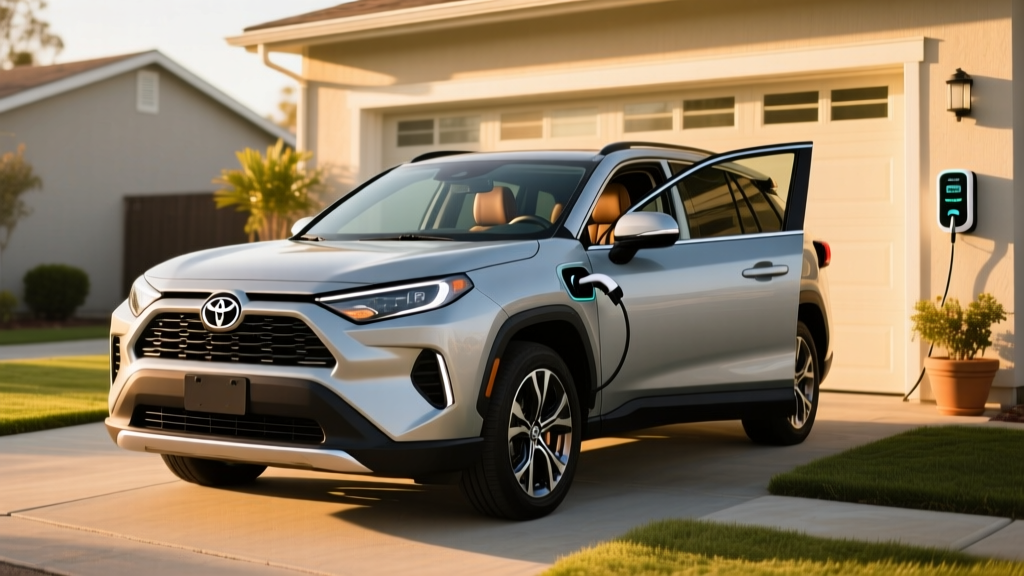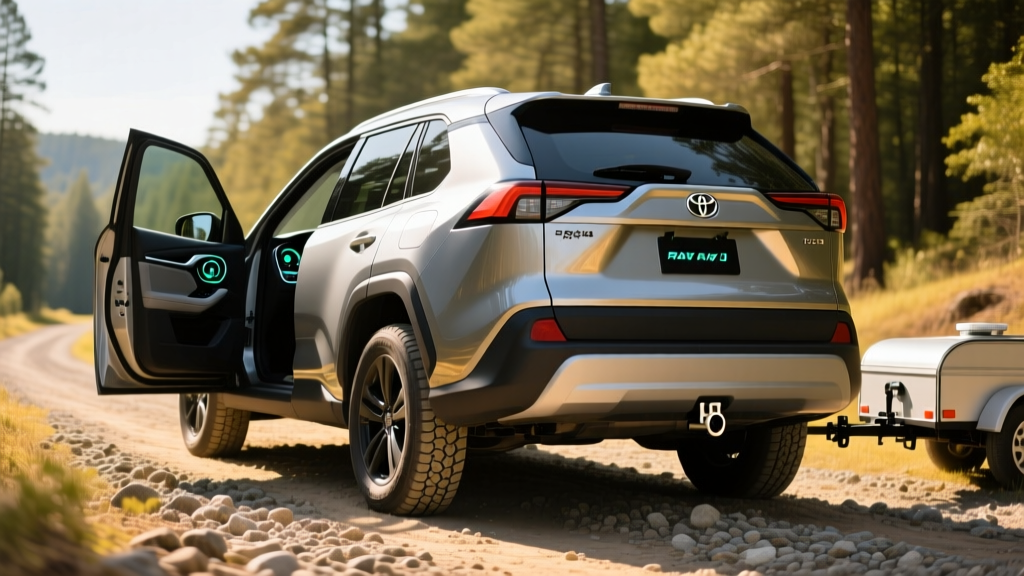
If you've been researching the 2024 Toyota RAV4 Hybrid towing capacity, you've likely encountered conflicting numbers across forums and dealer sites. The short answer: the conventional RAV4 Hybrid (HEV) is rated to tow 1,750 pounds across all trims, while the plug-in RAV4 Prime (PHEV) bumps that to 2,500 pounds. Neither will pull a large travel trailer, but both handle small utility trailers, bike racks, and lightweight campers with ease.
This guide covers everything behind those numbers — powertrain output, real-world fuel economy, the HEV vs. PHEV distinction, battery longevity, and whether the RAV4 Hybrid is the right rig for your needs in 2026.
2024 Toyota RAV4 Hybrid: Powertrain and Towing Specs
The 2024 RAV4 Hybrid pairs a 2.5-liter four-cylinder Atkinson-cycle engine with two electric motors (front and rear) to deliver electronic on-demand all-wheel drive. Here's the full spec breakdown:
| Spec | Value |
|---|---|
| Combined Horsepower | 219 hp (net system) |
| Engine | 2.5L 4-cyl Atkinson-cycle (176 hp / 163 lb-ft) |
| Front Motor | 134 hp / 199 lb-ft |
| Rear Motor | 54 hp / 89 lb-ft |
| Drivetrain | AWD (electronic on-demand) |
| Transmission | eCVT (planetary gearset) |
| Towing Capacity | 1,750 lbs (all trims) |
| Battery | 1.6 kWh (sealed NiMH, self-charging) |
| 0-60 mph | ~7.4 seconds |
| Base MSRP (LE AWD) | $31,725 + $1,350 destination |
The 1,750-pound rating applies uniformly to every 2024 RAV4 Hybrid trim — LE, XLE, XLE Premium, SE, Woodland Edition, XSE, and Limited. Toyota does not offer a factory tow package that increases this number for the HEV. You'll need a dealer- or aftermarket-installed hitch receiver; Toyota's official hitch accessory is a Class II receiver rated for the vehicle's limit.
HEV vs. PHEV: Which RAV4 Is Which?
Toyota sells two electrified RAV4 variants, and confusing them is common. Here's the critical distinction:
RAV4 Hybrid (HEV)
- No plug. The 1.6 kWh battery charges via regenerative braking and the gas engine.
- Drives like a normal SUV — you just fill up with gas.
- Small battery assists acceleration and enables brief low-speed electric-only crawling.
- Towing: 1,750 lbs.
RAV4 Prime (PHEV)
- Plug-in capable. The 18.1 kWh battery charges from a wall outlet or public charger.
- EPA-rated 42 miles of electric-only driving before the gas engine engages.
- 302 combined hp — the most powerful RAV4 variant.
- Towing: 2,500 lbs.
If towing is a priority and you want electric-only commuting, the Prime is the stronger play — but it commands a significant price premium and, as of 2026, may still face limited dealer inventory in some regions.
| Attribute | RAV4 Hybrid (HEV) | RAV4 Prime (PHEV) |
|---|---|---|
| Combined HP | 219 hp | 302 hp |
| Towing Capacity | 1,750 lbs | 2,500 lbs |
| EV-Only Range | N/A (self-charging) | 42 miles (EPA) |
| Battery | 1.6 kWh NiMH | 18.1 kWh lithium-ion |
| Charge Time (120V) | N/A | ~12 hours |
| Charge Time (240V L2) | N/A | ~2.5 hours (6.6 kW) |
| DC Fast Charge | N/A | No |
| EPA Combined MPG/MPGe | 39 MPG | 94 MPGe / 38 MPG (gas-only) |
| Base MSRP | $31,725 | $43,690 |
| Federal Tax Credit | Not eligible (§30D) | Not eligible (credit phased out for Toyota) |
Fuel Economy: EPA Ratings and Real-World MPG
The conventional RAV4 Hybrid carries strong EPA ratings that translate well to daily driving:
| Driving Cycle | MPG |
|---|---|
| City | 41 MPG |
| Highway | 38 MPG |
| Combined | 39 MPG |
Source: fueleconomy.gov
Real-World MPG: What Owners Actually See
Toyota hybrids routinely exceed their EPA city ratings in stop-and-go traffic because regenerative braking recaptures energy that a gas car wastes as heat. In mixed suburban driving, owners on Fuelly and Edmunds report averages of 37–42 MPG, closely tracking the EPA combined figure.
However, towing changes the math significantly. When pulling near the 1,750-lb limit, expect fuel economy to drop to the mid-to-low 20s MPG depending on trailer aerodynamics, terrain, and speed. The hybrid system's regenerative advantage diminishes at sustained highway speeds with a heavy load, where the gas engine does most of the work.
Cold weather also trims efficiency — roughly 5–10% in winter conditions — because the engine runs more frequently to provide cabin heat and maintain battery temperature. This is normal for all hybrids and is less severe than the 20–30% range loss a full EV experiences in freezing temperatures.
RAV4 Prime (PHEV): Electric Range, Charging, and Towing Advantage
If your commute is under 40 miles round-trip and you can charge at home, the RAV4 Prime effectively operates as a daily EV with a gas-engine safety net for longer trips. Here's what the PHEV powertrain delivers:
- Electric-only range: 42 miles (EPA)
- Total combined range: ~600 miles (electric + gas tank)
- Battery capacity: 18.1 kWh (lithium-ion)
- Level 1 charging (120V): ~12 hours from empty
- Level 2 charging (240V, 6.6 kW onboard charger): ~2.5 hours
- DC fast charging: Not supported — the RAV4 Prime uses a J1772 connector only, with no CCS capability
The Prime's 302 combined horsepower and 2,500-lb tow rating make it meaningfully more capable than the HEV when hitched to a trailer. The larger battery and more powerful electric motors provide stronger low-end torque, which matters when pulling away from a stop with weight behind you.
One practical caveat: charging the Prime on a standard 120V outlet takes about 12 hours, which works for overnight top-ups if your daily electric use is modest. For full daily recharges, a 240V Level 2 home charger is strongly recommended. Installation typically runs $500–$2,000 depending on your electrical panel's proximity to the parking spot and whether a panel upgrade is needed.
Towing in Practice: What 1,750 Pounds Actually Gets You
The 2024 RAV4 Hybrid's 1,750-pound limit is modest by truck standards but practical for common light-duty tasks. Here's what fits within the rating:
- Small utility trailer (4×8 ft): ~500–800 lbs loaded with mulch, lumber, or gear
- Bike rack on hitch: ~50–120 lbs for a 2–4 bike platform rack
- Lightweight pop-up camper: Some models weigh 1,200–1,600 lbs dry — feasible but tight, leaving little cargo margin
- Jet ski on single trailer: ~1,000–1,400 lbs total, within limits
- Small boat on trailer: Under ~16 ft aluminum boats typically work
What it cannot tow: enclosed car-hauler trailers, most hard-sided travel trailers (typically 3,000+ lbs), horse trailers, or large boats. If you need to pull 3,500+ lbs regularly, you're shopping in the wrong vehicle class — consider a Toyota Highlander Hybrid (5,000 lbs) or a body-on-frame SUV.
Important towing reminders for the RAV4 Hybrid:
- The 1,750-lb figure is a maximum trailer weight — it does not include passengers and cargo inside the RAV4. The vehicle's Gross Combined Weight Rating (GCWR) is the hard ceiling.
- Toyota recommends a transmission fluid cooler check at scheduled intervals when towing frequently.
- The eCVT does not have traditional "gears" — there's no tow/haul mode in the conventional sense, but the hybrid system manages load automatically.
- Trailer sway control is not factory-equipped on all trims; confirm availability for your configuration.
Pricing, Tax Credits, and Total Cost
The 2024 RAV4 Hybrid lineup spans a wide price range:
| Trim | MSRP (incl. destination) |
|---|---|
| LE | $33,075 |
| XLE | $34,585 |
| XLE Premium | $37,485 |
| SE | $36,885 |
| Woodland Edition | $36,420 |
| XSE | $38,775 |
| Limited | $40,675 |
Federal Tax Credit Eligibility
Neither the RAV4 Hybrid (HEV) nor the RAV4 Prime (PHEV) qualifies for the federal §30D Clean Vehicle Credit as of the 2024 model year. The conventional hybrid has never been eligible — §30D applies only to plug-in vehicles with batteries of at least 7 kWh. The RAV4 Prime, despite having an 18.1 kWh battery, lost eligibility because Toyota exceeded the 200,000-vehicle manufacturer cap that was in effect prior to the Inflation Reduction Act's restructuring of credit rules.
For 2026 buyers looking at new RAV4 Primes, the §30D credit landscape requires careful verification. Current rules impose MSRP caps ($80,000 for SUVs), buyer income limits ($300,000 joint / $150,000 single), and critical-mineral/battery-component sourcing requirements. Always confirm eligibility on irs.gov and consult a tax professional before relying on any credit at point of sale.
Some states offer their own hybrid or PHEV rebates — check your state energy office or DMV for current programs, as these vary widely and change frequently.
Battery Longevity, Warranty, and Replacement Cost
2024 RAV4 Hybrid Battery Warranty
Hybrid battery (HEV): 10 years / 150,000 miles (whichever comes first), transferable to subsequent owners.
Hybrid battery (Prime PHEV): 10 years / 150,000 miles.
Hybrid system components (inverters, converters, control modules): 8 years / 100,000 miles.
Toyota has covered hybrid batteries for over two decades, and the 10-year/150k-mile warranty is among the most generous in the industry. Most RAV4 Hybrid owners will never need a battery replacement during typical ownership.
Real-World Battery Lifespan
Toyota's hybrid battery track record is strong. The Prius — which uses similar NiMH technology — routinely surpasses 200,000 miles on its original battery. The RAV4 Hybrid's smaller 1.6 kWh pack is lightly stressed because it never fully depletes or fully charges; the hybrid system maintains a narrow state-of-charge window to maximize longevity.
For the RAV4 Prime, the 18.1 kWh lithium-ion pack sees deeper cycles during EV-only driving, but Toyota's thermal management and charge-buffer strategy (the system doesn't use the full 18.1 kWh — a portion is reserved to prevent deep discharge) protect against accelerated degradation.
Battery Replacement Cost
If a hybrid battery does fail outside warranty:
- RAV4 Hybrid (HEV) NiMH battery: Approximately $3,000–$4,500 for a new OEM replacement, plus labor (~$500–$800). Refurbished or reconditioned packs are available for $1,500–$2,500 from third-party suppliers.
- RAV4 Prime (PHEV) lithium-ion battery: Approximately $8,000–$12,000 for OEM replacement. This is significantly more expensive due to the larger lithium-ion pack.
These are worst-case scenarios. In practice, hybrid battery failures before 150,000 miles are uncommon, and individual cell modules can sometimes be replaced rather than the entire pack.
Reliability and Ownership Verdict
Toyota's hybrid powertrain is one of the most proven in the automotive industry. The RAV4 Hybrid has consistently earned strong reliability ratings from Consumer Reports and J.D. Power. The eCVT planetary gearset has no traditional belts, clutches, or torque converters to wear out — it's among the simplest and most durable transmissions available.
The 2024 model year carries no major known powertrain issues specific to the hybrid system. Toyota's Safety Sense 2.5+ suite (pre-collision, lane tracing, adaptive cruise) is standard across all trims, and the RAV4 earned an IIHS Top Safety Pick designation.
Pros
- 39 MPG combined — exceptional for an AWD SUV
- Proven hybrid reliability with 10yr/150k battery warranty
- 219 hp provides confident highway merging
- Standard AWD on all hybrid trims
- Strong resale value — RAV4 Hybrid holds value well
- No charging infrastructure needed (HEV)
Cons
- 1,750-lb tow rating is low for buyers who need real hauling
- No DC fast charging (Prime PHEV)
- No federal tax credit for HEV or Prime
- eCVT drone under heavy acceleration or towing
- Dealer markups still affect Prime availability in some markets
- Infotainment system is functional but not class-leading
Hybrid vs. PHEV vs. Full EV: Which RAV4 Fits You?
Choose the RAV4 Hybrid (HEV) if:
- You don't have reliable access to home or workplace charging
- You want maximum simplicity — no plugs, no charging apps, no range planning
- Your towing needs are light (under 1,750 lbs)
- You prioritize the lowest purchase price in the electrified RAV4 lineup
- You drive a mix of city and highway and want consistently strong MPG
Choose the RAV4 Prime (PHEV) if:
- You can install a Level 2 charger at home
- Your daily commute is under ~40 miles round-trip
- You want electric-only daily driving with gas-engine flexibility for road trips
- You need the higher 2,500-lb tow rating
- You want 302 hp and the quickest RAV4 variant
Choose a Full EV (e.g., Tesla Model Y, Hyundai Ioniq 5) if:
- You want zero tailpipe emissions and the lowest per-mile fuel cost
- You have home charging and your trips rarely exceed 250–300 miles without a stop
- You want to eliminate oil changes, spark plugs, and transmission fluid
- You're eligible for the full $7,500 federal EV tax credit on a qualifying model
- You don't need to tow more than ~2,000–3,500 lbs (varies by EV model)
Frequently Asked Questions
How many MPG does the 2024 RAV4 Hybrid get?
The EPA rates the 2024 RAV4 Hybrid at 41 MPG city, 38 MPG highway, and 39 MPG combined. Real-world owner averages cluster around 37–42 MPG in mixed driving. Expect significantly lower numbers — roughly 20–25 MPG — when towing near the 1,750-lb maximum.
How far can the RAV4 Prime go on electric only?
The 2024 RAV4 Prime achieves an EPA-rated 42 miles of electric-only range on a full charge. In real-world conditions, expect 35–40 miles in warm weather and 30–35 miles in freezing temperatures, as cabin heating draws from the battery. Once the battery is depleted, the Prime operates as a conventional hybrid at 38 MPG combined.
Does the 2024 RAV4 Hybrid qualify for any tax credit?
No. The conventional RAV4 Hybrid (HEV) has never been eligible for the federal §30D Clean Vehicle Credit because it is not a plug-in vehicle. The RAV4 Prime (PHEV) also does not qualify, as Toyota surpassed the prior 200,000-vehicle manufacturer cap. Some state-level incentives may apply — check your state's energy or environmental agency for current programs.
Is the RAV4 Hybrid reliable, and what does a battery replacement cost?
Toyota's hybrid system is among the most reliable powertrains in production, with a track record spanning over 25 years since the original Prius. The hybrid battery is warranted for 10 years / 150,000 miles. Out-of-warranty replacement for the HEV's NiMH battery runs approximately $3,000–$4,500 (new OEM); the Prime's lithium-ion pack is roughly $8,000–$12,000. Most owners never face this expense.
Can I increase the RAV4 Hybrid's towing capacity with an aftermarket hitch?
No. The 1,750-pound limit is set by Toyota based on the vehicle's cooling capacity, suspension, braking system, and GCWR. An aftermarket hitch rated for 3,500 lbs does not change the vehicle's rated capacity. Exceeding the manufacturer's tow rating voids warranty coverage and creates safety and liability risks.
Does the RAV4 Hybrid need to be plugged in?
No. The conventional RAV4 Hybrid (HEV) is a self-charging system — the battery is replenished by regenerative braking and the gas engine. You never plug it in. Only the RAV4 Prime (PHEV) requires plugging in to access its 42 miles of electric-only range; if you don't plug in the Prime, it simply operates as a heavier, less efficient hybrid.
How does towing affect the RAV4 Hybrid's warranty?
Towing within the rated 1,750-lb limit does not void any warranty. However, damage caused by exceeding the tow rating or by improper hitch installation may not be covered. Toyota recommends following the towing guidelines in the owner's manual, including speed limits and weight-distribution requirements.
The 2024 RAV4 Hybrid's 1,750-pound towing capacity won't satisfy buyers with heavy hauling needs, but for the vast majority of light-duty tasks — a weekend utility trailer, a bike rack, or a small boat — it's more than adequate. Combined with 39 MPG, standard AWD, and Toyota's proven hybrid reliability, the RAV4 Hybrid remains one of the most practical and efficient compact SUVs you can buy. If you need more towing and electric-only commuting, the RAV4 Prime's 2,500-lb rating and 42-mile EV range make it worth the premium — provided you can charge at home.