Quick Verdict: The Benchmark Compact Hybrid SUV
The 2024 Toyota RAV4 Hybrid remains the compact hybrid SUV to beat. With an EPA-estimated 41 MPG combined, standard electronic all-wheel drive, and 219 combined horsepower, it delivers fuel savings that gas-only rivals simply cannot match — without requiring you to plug in, change your routine, or worry about charging infrastructure. For buyers who want electrified efficiency but aren't ready for a full EV or a plug-in hybrid, the RAV4 Hybrid occupies a practical sweet spot that few competitors have managed to challenge convincingly.
After spending time with the RAV4 Hybrid across city commutes, highway stretches, and mixed-temperature conditions, the numbers tell a compelling story — and the real-world fuel economy often exceeds the EPA sticker in the exact driving scenarios where most owners spend their miles.
HEV vs. PHEV: Which RAV4 Is Right for You?
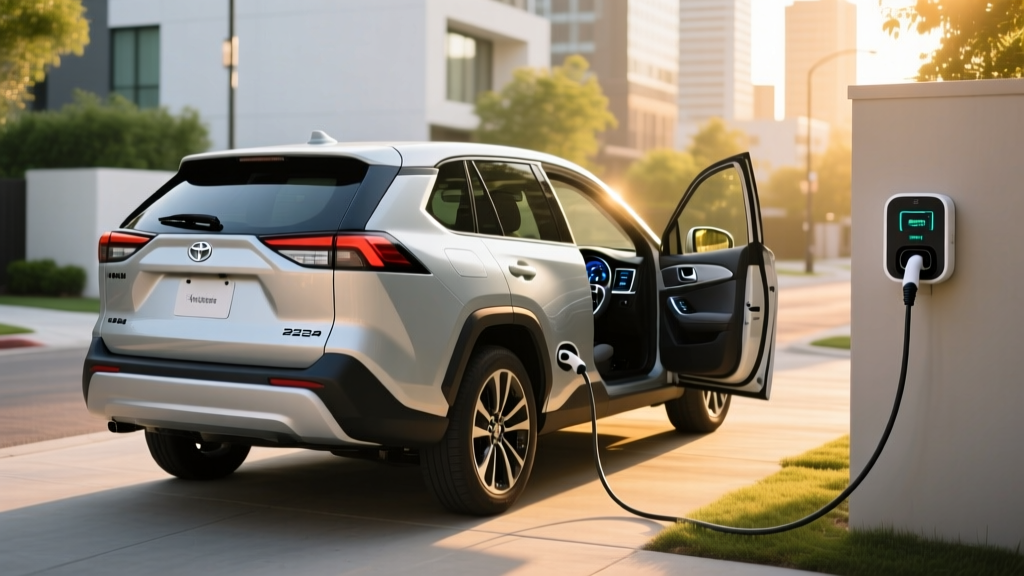
Before diving into specs, it's critical to understand what the 2024 Toyota RAV4 Hybrid is — and what it isn't. Toyota sells two electrified RAV4 variants, and confusing them is a common buyer mistake:
RAV4 Hybrid (HEV) — This Article
- Type: Conventional hybrid (self-charging)
- Plug in? No — regenerative braking and the gas engine charge the small battery
- Electric-only driving: Very short distances at low speed (under ~1 mile)
- Battery: ~1.6 kWh nickel-metal hydride (NiMH)
- Best for: Drivers who want maximum MPG with zero routine change
RAV4 Prime (PHEV) — Separate Model
- Type: Plug-in hybrid
- Plug in? Yes — charges via standard outlet or Level 2 charger
- Electric-only range: EPA-estimated 42 miles
- Battery: 18.1 kWh lithium-ion
- Best for: Drivers with home charging who want EV-like daily commutes plus gas-engine road-trip range
This review focuses on the conventional RAV4 Hybrid (HEV). If you have access to home or workplace charging and a commute under 40 miles, the RAV4 Prime PHEV may serve you better — but it carries a significantly higher starting price (around $43,690 for 2024) and different tax-credit dynamics, which we address below.
Fuel Economy: EPA Estimates and Real-World MPG
The headline number for the 2024 RAV4 Hybrid is its EPA rating. Here's the full breakdown across the lineup:
| Trim | City MPG | Highway MPG | Combined MPG |
|---|---|---|---|
| LE / XLE / XLE Premium / SE / XSE | 41 | 38 | 40 |
| Woodland Edition | 38 | 35 | 37 |
| Limited | 41 | 38 | 40 |
Source: fueleconomy.gov
Toyota's hybrid system excels in stop-and-go city driving, where the electric motor handles low-speed propulsion and regenerative braking recaptures energy. In real-world testing, many owners report 42–45 MPG in predominantly city driving — exceeding the EPA city estimate. Highway driving at 70–80 MPH typically yields 34–37 MPG, slightly below the EPA highway figure, as aerodynamic drag and sustained engine load reduce the hybrid system's advantage.
In cold weather (below 30°F), expect a 3–5 MPG drop during short trips as the engine runs more frequently to provide cabin heat and reach operating temperature. On longer drives in cold conditions, the penalty shrinks to roughly 1–2 MPG.
For context, the gas-only 2024 RAV4 AWD earns an EPA 30 MPG combined — meaning the hybrid delivers roughly 33% better fuel economy in mixed driving. Over 15,000 annual miles at $3.50/gallon, that translates to approximately $550–$650 in annual fuel savings depending on your driving mix.
Powertrain, Performance, and Driving Impressions
| Specification | 2024 RAV4 Hybrid |
|---|---|
| Engine | 2.5L 4-cylinder Atkinson-cycle |
| Front Motor | Permanent-magnet synchronous (134 HP / 199 lb-ft) |
| Rear Motor (AWD) | 54 HP / 89 lb-ft |
| Combined Net Horsepower | 219 HP |
| Transmission | Electronically controlled CVT (eCVT) |
| 0–60 MPH | ~7.4 seconds |
| Drivetrain | Electronic On-Demand AWD (standard all trims) |
| Towing Capacity | 1,750 lbs |
| Battery Type | NiMH, ~1.6 kWh |
The RAV4 Hybrid uses Toyota's fourth-generation hybrid synergy drive. The 2.5-liter Atkinson-cycle engine produces 176 HP on its own, but combined with the front and rear electric motors, net system output reaches 219 HP. The rear motor provides electronic all-wheel drive — there's no mechanical driveshaft connecting the axles. Instead, the rear motor engages automatically when the system detects slip or when additional traction is needed.
The eCVT doesn't behave like a traditional belt-driven CVT. Toyota's planetary gearset design creates seamless power blending between the engine and motors without the rubber-band effect that plagues some competitors. Acceleration from a stop is brisk thanks to instant electric torque, and highway merging is confident. The 7.4-second 0–60 time won't thrill enthusiasts, but it's competitive for the segment and noticeably quicker than the gas-only RAV4 AWD (~8.7 seconds).
Pricing, Trims, and Tax Credit Eligibility
The 2024 RAV4 Hybrid is offered across six trims. Here's the MSRP breakdown (destination charge included at ~$1,350):
- LE: ~$31,725
- XLE: ~$33,235
- XLE Premium: ~$36,125
- SE: ~$35,725
- XSE: ~$37,225
- Woodland Edition: ~$35,425
- Limited: ~$39,925
Source: Toyota.com 2024 RAV4 Hybrid specs
Does the RAV4 Hybrid Qualify for Federal Tax Credits?
No. The conventional RAV4 Hybrid (HEV) does not qualify for the federal §30D Clean Vehicle Credit. That credit — up to $7,500 — applies only to plug-in electric vehicles (BEVs and PHEVs) meeting specific battery sourcing, MSRP, and buyer income requirements under current IRS rules.
The RAV4 Hybrid's small ~1.6 kWh NiMH battery does not meet the minimum 7 kWh battery capacity threshold required by §30D.
The RAV4 Prime (PHEV) does qualify in certain configurations, but eligibility depends on battery component and critical mineral sourcing requirements that shift annually. For 2024 purchases, the Prime may qualify for a partial credit ($3,750) depending on the buyer's income (capped at $150K single / $300K joint) and the vehicle's MSRP (capped at $80,000 for SUVs). Always verify current eligibility on IRS.gov before purchasing, as sourcing rules change.
Some states offer separate rebates or incentives for conventional hybrids — check your state energy office or DMV for local programs.
Battery Longevity, Warranty, and Replacement Costs
- Coverage: 10 years / 150,000 miles (whichever comes first) in all 50 states for 2020+ model years
- What's covered: Defects and capacity loss below a specified threshold (typically ~60–70% of original capacity)
- Additional coverage: Hybrid system components (inverter, control module, motors) — 8 years / 100,000 miles
Toyota's hybrid battery longevity is among the best-documented in the industry. The RAV4 Hybrid uses a nickel-metal hydride (NiMH) pack — a mature, well-understood chemistry that Toyota has refined over two decades of Prius production. Real-world data from fleet operators and long-term owners shows these packs routinely lasting 150,000–200,000+ miles with minimal degradation.
The NiMH chemistry trades energy density for cycle-life durability. Unlike NMC lithium-ion batteries in full EVs, the RAV4 Hybrid's small pack operates within a very narrow state-of-charge window (roughly 40–80% SoC), which dramatically reduces wear. The vehicle's battery management system never allows full charges or deep discharges — the engine and regenerative braking keep the pack in its comfort zone at all times.
What Does Hybrid Battery Replacement Cost?
If a battery replacement is needed outside warranty — typically on vehicles well past 150,000 miles — expect:
- New OEM battery: $3,000–$4,500 (parts + labor at a Toyota dealer)
- Refurbished/remanufactured battery: $1,500–$2,500 (from third-party specialists)
- Individual module replacement: $500–$1,200 (if only specific cells have failed — a common repair for high-mileage hybrids)
For the vast majority of buyers who own the vehicle within the 10-year/150,000-mile warranty window, battery replacement cost is a non-issue. Toyota's hybrid system reliability data from Consumer Reports and J.D. Power consistently ranks the RAV4 Hybrid near the top of its segment for long-term dependability.
RAV4 Hybrid vs. RAV4 Prime vs. Full EV: Decision Framework
| Factor | RAV4 Hybrid (HEV) | RAV4 Prime (PHEV) | Full EV (e.g., Tesla Model Y, Ioniq 5) |
|---|---|---|---|
| Starting MSRP | ~$31,725 | ~$43,690 | ~$42,000–$48,000 |
| EPA Fuel Economy | 40 MPG combined | 94 MPGe (EV mode) / 38 MPG (gas) | 110–130 MPGe |
| Electric-Only Range | N/A (very short low-speed) | 42 miles | 260–330 miles |
| Plug In Required? | No | Recommended (not required) | Yes |
| Home Charging Needed? | No | Strongly recommended | Essential |
| Federal Tax Credit | None | Up to $7,500 (varies) | Up to $7,500 (varies) |
| Maintenance Cost | Low (oil changes, standard) | Low (oil changes + EV systems) | Very low (no oil, fewer moving parts) |
| Road-Trip Convenience | Gas stations everywhere | Gas stations everywhere | Requires DC fast-charging planning |
Choose the RAV4 Hybrid (HEV) if:
- You don't have access to home or workplace charging
- You want lower fuel costs with zero change to your refueling routine
- Your budget is under $35,000–$40,000 and you want AWD
- You drive in extreme cold regularly (hybrids lose less range than EVs in winter)
- You tow occasionally (1,750 lb capacity vs. heavier EVs that may reduce range significantly when towing)
Choose the RAV4 Prime (PHEV) if:
- You can install a Level 2 charger at home
- Your daily commute is under 42 miles round-trip (you'll rarely use gas on weekdays)
- You want the federal tax credit to offset the higher purchase price
- You want 302 combined HP (the Prime is significantly quicker: 0–60 in ~5.7 seconds)
Choose a Full EV if:
- You have reliable home Level 2 charging
- Your daily driving is under 250 miles and you're willing to plan road-trip charging stops
- You want the lowest per-mile energy cost and minimal maintenance
- You want the strongest available tax credits and your income/vehicle qualifies
Pros and Cons
Pros
- 41 MPG city EPA — and real-world city driving often exceeds it
- Standard AWD across all trims with no fuel-economy penalty vs. FWD
- No plug-in charging required — zero routine change from a gas car
- Proven hybrid reliability with 10-year/150,000-mile battery warranty
- Competitive 219 HP and confident eCVT acceleration
- Strong resale value — RAV4 Hybrids hold value exceptionally well
- Comprehensive Toyota Safety Sense 2.5+ suite standard
Cons
- No federal tax credit eligibility (HEV, not PHEV)
- Highway MPG drops below EPA estimate at sustained 75+ MPH speeds
- Cargo space slightly reduced vs. gas RAV4 (battery under rear seat)
- Woodland Edition sacrifices 3 MPG for off-road tires and styling
- Limited trim pushes $40K+ without luxury-brand amenities
- 1,750-lb towing capacity trails some turbocharged gas rivals
- Infotainment, while improved for 2024, still lags some competitors in responsiveness
Frequently Asked Questions
How many MPG does the 2024 Toyota RAV4 Hybrid actually get?
The EPA rates most trims at 41 city / 38 highway / 40 combined. In real-world driving, city-heavy commutes often yield 42–45 MPG, while sustained highway driving at 75+ MPH typically returns 34–37 MPG. Cold weather reduces economy by 3–5 MPG on short trips.
Does the RAV4 Hybrid need to be plugged in?
No. The RAV4 Hybrid is a conventional hybrid (HEV). Its battery charges through regenerative braking and the gasoline engine. You refuel only at gas stations, exactly like a standard car.
Is the RAV4 Hybrid reliable? What about battery replacement?
Toyota's hybrid system is among the most reliable powertrains in the automotive industry. The NiMH battery is warrantied for 10 years / 150,000 miles and routinely lasts 150,000–200,000+ miles. Out-of-warranty replacement runs $3,000–$4,500 for a new OEM pack, or $1,500–$2,500 for a refurbished unit.
Does the RAV4 Hybrid qualify for any tax credit?
The conventional RAV4 Hybrid does not qualify for the federal §30D Clean Vehicle Credit, which requires a minimum 7 kWh battery and plug-in capability. The RAV4 Prime (PHEV) may qualify for up to $7,500 depending on sourcing, income, and MSRP rules. Some states offer hybrid-specific rebates — check your local programs.
How does the RAV4 Hybrid compare to the RAV4 Prime?
The Prime is a plug-in hybrid with 42 miles of electric-only range, 302 combined HP, and a ~$12,000 higher starting price. If you can charge at home and commute under 42 miles daily, the Prime can operate as an EV most weekdays. If you can't charge at home or want a lower purchase price, the standard Hybrid is the better fit.
Is AWD standard on every 2024 RAV4 Hybrid trim?
Yes. Every 2024 RAV4 Hybrid trim comes with electronic on-demand AWD as standard equipment, using a dedicated rear electric motor. There is no FWD-only option for the hybrid, and the AWD system does not reduce the EPA fuel economy rating compared to a hypothetical FWD variant.
What's the difference in annual fuel cost vs. the gas-only RAV4?
At 15,000 miles/year and $3.50/gallon, the gas-only RAV4 AWD (30 MPG combined) costs roughly $1,750/year in fuel. The RAV4 Hybrid (40 MPG combined) costs approximately $1,313/year — a savings of about $437 annually. Over a 5-year ownership period, that's roughly $2,185 in fuel savings, which helps offset the hybrid's modest price premium over the gas model.