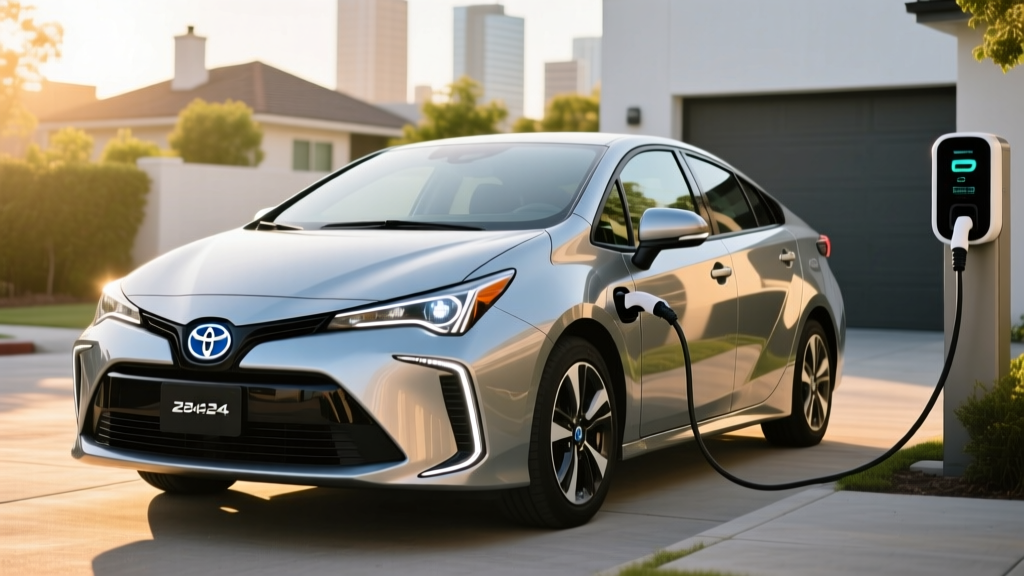
The 2024 Toyota Prius hybrid car arrived with a complete redesign that silenced the lingering stereotype of the Prius as slow and dowdy. Under the sharper sheet metal sits Toyota's fifth-generation hybrid powertrain, delivering up to 196 horsepower and an EPA-estimated 57 MPG combined — numbers that make it one of the most efficient mainstream vehicles on the road. But efficiency is only half the story for buyers cross-shopping between a conventional hybrid (HEV), the plug-in Prius Prime (PHEV), and a full battery-electric vehicle. This guide breaks down every spec, real-world fuel economy expectation, and ownership cost you need to make that decision.
2024 Toyota Prius HEV vs. Prius Prime PHEV: What's the Difference?
Toyota sells the Prius nameplate in two distinct flavors for 2024. Confusing them at the dealership is easy — and costly if you pick the wrong one for your driving pattern.
| Attribute | Prius HEV (Conventional Hybrid) | Prius Prime (Plug-In Hybrid) |
|---|---|---|
| Powertrain | 2.0L 4-cyl + electric motor | 2.0L 4-cyl + larger electric motor |
| Combined Horsepower | 194 hp (FWD) / 196 hp (AWD) | 220 hp |
| Battery | ~1.0 kWh lithium-ion (no plug) | 13.6 kWh lithium-ion (plug-in) |
| Needs to Plug In? | No — charges via regen & engine | Yes — for electric-only driving |
| Electric-Only Range | N/A (EV mode ~1 mi at low speed) | Up to 44 miles (EPA) |
| EPA Combined MPG | 57 MPG (LE FWD) | 52 MPG (hybrid mode) / 127 MPGe |
| 0-60 mph | 7.2 sec (FWD) / 7.0 sec (AWD) | 6.6 sec |
| Starting MSRP | $27,950 (LE) | $32,975 (SE) |
The conventional Prius HEV generates all its electricity onboard through regenerative braking and the gas engine. You never plug it in — just fuel it and drive. The Prius Prime PHEV adds a substantially larger 13.6 kWh battery pack and a more powerful electric motor, giving it 44 miles of pure electric range before the gas engine kicks in. If you can charge at home or work, the Prime effectively functions as a short-range EV for daily commuting, with a gas engine as a safety net for longer trips.
Fuel Economy: EPA Ratings and Real-World MPG
The headline number for the 2024 Toyota Prius hybrid car is its EPA rating, but real-world results depend heavily on your driving mix. Toyota's hybrid system excels in stop-and-go city driving, where regenerative braking recovers energy that a gas car wastes as heat.
| Trim | City MPG | Highway MPG | Combined MPG |
|---|---|---|---|
| Prius LE (FWD) | 57 | 56 | 57 |
| Prius XLE / Limited (FWD) | 52 | 52 | 52 |
| Prius LE / XLE (AWD-e) | 53 | 54 | 54 |
| Prius Prime SE | 127 MPGe (EV) / 52 MPG (gas) | — | 52 combined (gas) |
| Prius Prime XSE / XSE Premium | 114 MPGe (EV) / 50 MPG (gas) | — | 50 combined (gas) |
Real-world expectations: According to fueleconomy.gov, owner-reported fuel economy for the Prius LE clusters around 54-58 MPG combined. Hybrids routinely match or slightly exceed their EPA city ratings because urban driving maximizes regenerative braking. Highway-only driving at 75+ mph typically drops to 48-51 MPG for the LE, and cold weather (below 35°F) can reduce city MPG by 10-15% as the engine runs more frequently for cabin heat. The XLE and Limited trims lose roughly 5 MPG due to wider 19-inch wheels, added weight, and higher rolling resistance.
Total range: The Prius LE's 11.3-gallon fuel tank delivers approximately 640 miles of combined driving range. The Prius Prime adds 44 electric miles to roughly 460 gas-powered miles for a total of around 500 miles before needing fuel or a charge.
Powertrain and Performance Specs
The fifth-generation Prius uses Toyota's latest hybrid architecture, pairing a 2.0-liter four-cylinder engine with one or two electric motors depending on drivetrain. The result is a meaningful power bump over the prior generation's 121 hp.
| Specification | Prius LE FWD | Prius AWD-e | Prius Prime |
|---|---|---|---|
| Engine | 2.0L I4 + 1 motor | 2.0L I4 + 2 motors | 2.0L I4 + 1 motor |
| Combined Output | 194 hp | 196 hp | 220 hp |
| 0-60 mph | 7.2 sec | 7.0 sec | 6.6 sec |
| Drivetrain | FWD | AWD-e (electronic rear) | FWD |
| Transmission | eCVT | eCVT | eCVT |
| Towing Capacity | Not rated | Not rated | Not rated |
| Cargo Volume (rear seats up) | 20.3 cu ft | 20.3 cu ft | ~17.4 cu ft |
The AWD-e system uses a small independent rear electric motor that engages automatically during acceleration from a stop and in low-traction conditions — it does not provide continuous all-wheel drive. The Prius Prime's 220 hp makes it the quickest Prius ever sold, and its electric-only mode delivers smooth, silent acceleration up to highway speeds without the engine firing.
Prius Prime Charging: Battery, Speed, and Setup
If you're considering the plug-in Prius Prime, understanding charging logistics is essential. The Prime's 13.6 kWh lithium-ion battery pack is sized for daily electric commuting, not road-trip fast charging.
| Charging Level | Power (kW) | Time to Full (0-100%) | Connector |
|---|---|---|---|
| Level 1 (120V household outlet) | ~1.4 kW | ~11 hours | Standard J1772 |
| Level 2 (240V home/public) | ~3.3 kW (onboard limit) | ~4 hours | J1772 |
| DC Fast Charging | Not supported | N/A | N/A |
The Prime does not support DC fast charging — a deliberate trade-off to keep weight and cost down. With only 44 miles of electric range, the use case is overnight home charging on a standard 120V outlet or a Level 2 wallbox. A 120V outlet replenishes the battery in about 11 hours (plug in at 8 PM, full by 7 AM), while a 240V Level 2 station cuts that to roughly 4 hours. For most Prime owners, Level 1 charging is perfectly adequate given the small battery.
kW vs. kWh reminder: kW (kilowatts) measures charging power — how fast energy flows. kWh (kilowatt-hours) measures battery energy capacity — how much is stored. The Prime has a 13.6 kWh battery and charges at up to 3.3 kW on Level 2.
Pricing, Trims, and Tax Credit Eligibility
The 2024 Toyota Prius hybrid car is priced to undercut most competitors in the hybrid compact segment, while the Prime commands a premium for its plug-in capability.
| Trim | MSRP | Key Features |
|---|---|---|
| Prius LE (FWD) | $27,950 | 17" wheels, TSS 3.0, 8" touchscreen |
| Prius LE (AWD-e) | $29,350 | Electronic AWD, heated front seats |
| Prius XLE (FWD) | $31,195 | 19" wheels, synthetic leather, wireless charging |
| Prius Limited (FWD) | $34,610 | Fixed glass roof, JBL audio, heated/vented seats |
| Prius Prime SE | $32,975 | 44 mi EV range, 17" wheels |
| Prius Prime XSE | $35,675 | 19" wheels, heated seats, power liftgate |
| Prius Prime XSE Premium | $39,675 | Solar roof option, premium audio, nav |
Federal Tax Credit for the Prius Prime (PHEV Only)
Under current IRS §30D Clean Vehicle Credit rules, the conventional Prius HEV does not qualify for any federal tax credit — it lacks the minimum 7 kWh battery capacity required for PHEVs. The Prius Prime, however, meets the battery-size threshold, but eligibility depends on several conditions:
- Battery capacity: Prime's 13.6 kWh exceeds the 7 kWh minimum ✓
- MSRP cap: Must be under $55,000 for sedans — all Prime trims qualify ✓
- Buyer income cap: AGI must not exceed $150,000 (single) / $300,000 (joint) — verify with your tax professional
- Battery component sourcing: Must meet critical mineral and battery component requirements (phased thresholds increase annually; check IRS guidance for current-year rules)
- Point-of-sale transfer: Eligible buyers can transfer the credit to the dealer for an immediate price reduction at purchase
The maximum credit is up to $7,500, split between $3,750 for critical-minerals sourcing and $3,750 for battery-component manufacturing. Because sourcing requirements tighten each year, confirm current eligibility on fueleconomy.gov before purchasing. The conventional Prius HEV receives no federal credit, though some states offer hybrid rebates — check your state energy office.
Battery Warranty, Reliability, and Replacement Cost
Battery longevity remains the top concern for hybrid buyers. Toyota has built an industry-leading track record here, with Prius taxis routinely surpassing 300,000 miles on original hybrid batteries.
Hybrid Battery Warranty: Toyota covers the hybrid battery in both the Prius HEV and Prius Prime for 10 years or 150,000 miles, whichever comes first, in all 50 states. This warranty guarantees the battery will retain sufficient capacity to operate the hybrid system. Coverage includes the battery control module, inverter, and related hybrid-system components.
Replacement cost: If the hybrid battery fails outside warranty, a new OEM replacement for the Prius HEV runs approximately $2,500-$3,500 including labor at a Toyota dealer. The Prime's larger 13.6 kWh pack costs more — roughly $5,000-$7,000. Independent hybrid shops often offer refurbished battery replacements for $1,200-$2,000 (HEV) with 1-3 year warranties.
Reliability data: The Prius consistently earns top marks from Consumer Reports and J.D. Power for dependability. The 2024 model carries a predicted reliability rating of 4/5 from Consumer Reports. Toyota Safety Sense 3.0 — standard on all trims — includes automatic emergency braking, lane-keeping assist, adaptive cruise control, and road-sign assist. The NHTSA awarded the Prius a 5-Star Overall Safety Rating.
Who Should Buy the 2024 Prius — and Who Shouldn't?
Choose the Prius HEV if:
- You cannot charge at home or work (apartment, street parking)
- You want maximum MPG with zero behavioral change — no plugs, no apps
- Your daily driving is unpredictable and exceeds 40+ miles regularly
- You want the lowest purchase price starting under $28,000
Choose the Prius Prime PHEV if:
- You have reliable Level 1 or Level 2 charging at home
- Your daily commute is under 44 miles round-trip (run mostly on electricity)
- You want EV-like quietness for daily driving but gas flexibility for road trips
- You may qualify for the up-to-$7,500 federal tax credit, offsetting the price premium
Choose a full EV (like a Tesla Model 3 or Hyundai Ioniq 6) if:
- You have home Level 2 charging and want zero gasoline use
- Your daily driving is under 250 miles and you rarely take long road trips
- You want the lowest per-mile fuel cost (~$0.04-$0.06/mi on home electricity vs. ~$0.08-$0.10/mi for the Prius HEV at 57 MPG with $3.50/gal gas)
Pros
- Best-in-class fuel economy: 57 MPG EPA combined (LE FWD)
- Dramatically improved performance: 194-220 hp, 6.6-7.2 sec 0-60
- 10-year / 150,000-mile hybrid battery warranty in all states
- Standard Toyota Safety Sense 3.0 suite
- Attractive redesign — no longer the "boring" hybrid
- Prius Prime offers 44 mi electric-only range for daily EV commuting
Cons
- AWD-e is electronic only — not a substitute for true AWD in deep snow
- Cargo space is modest at 20.3 cu ft (less in Prime due to larger battery)
- XLE/Limited trims lose ~5 MPG to 19-inch wheels
- Prius Prime does not support DC fast charging
- No federal tax credit for the conventional HEV
- Rear headroom is tight for passengers over 6 feet
Frequently Asked Questions
How many MPG does the 2024 Toyota Prius hybrid car get?
The Prius LE (FWD) is EPA-rated at 57 MPG city / 56 highway / 57 combined. The XLE and Limited trims are rated at 52 combined, and AWD-e models at 54 combined. Real-world owner reports on fueleconomy.gov average 54-58 MPG for the LE, with city driving often matching or exceeding the EPA estimate thanks to regenerative braking.
How far can the Prius Prime go on electric only?
The 2024 Prius Prime SE is EPA-rated for 44 miles of electric-only range. The XSE and XSE Premium trims are rated for 39-40 miles due to larger 19-inch wheels and added weight. Once the battery depletes, the Prime operates as a conventional hybrid at 50-52 MPG.
Does the 2024 Prius qualify for any tax credit?
The conventional Prius HEV does not qualify for the federal §30D Clean Vehicle Credit because its battery is below the 7 kWh PHEV minimum. The Prius Prime qualifies for up to $7,500, subject to buyer income limits ($150K single / $300K joint), MSRP caps (under $55K for sedans), and battery-sourcing requirements that change annually. Verify current eligibility on fueleconomy.gov and consult a tax professional.
Is the Prius hybrid battery reliable, and what does replacement cost?
Toyota's hybrid batteries are among the most reliable in the industry, with many lasting well beyond 200,000 miles. The warranty covers 10 years or 150,000 miles in all states. Out-of-pocket replacement runs $2,500-$3,500 for the HEV and $5,000-$7,000 for the Prime at a dealer, with refurbished options available for less.
Do I need to plug in the regular Prius?
No. The conventional Prius HEV charges its small battery entirely through regenerative braking and the gas engine. You never plug it in. Only the Prius Prime PHEV requires plug-in charging to access its electric-only range.
Is the Prius HEV, Prime PHEV, or a full EV the best choice for me?
If you lack home charging, the HEV is the clear winner — zero infrastructure needed, 57 MPG. If you can charge at home and commute under 44 miles, the Prime lets you drive electric daily while keeping a gas engine for longer trips. If you have reliable home charging, drive under 250 miles daily, and want the lowest fuel cost, a full EV eliminates gasoline entirely.