Quick Verdict: The Midsize Hybrid SUV Benchmark
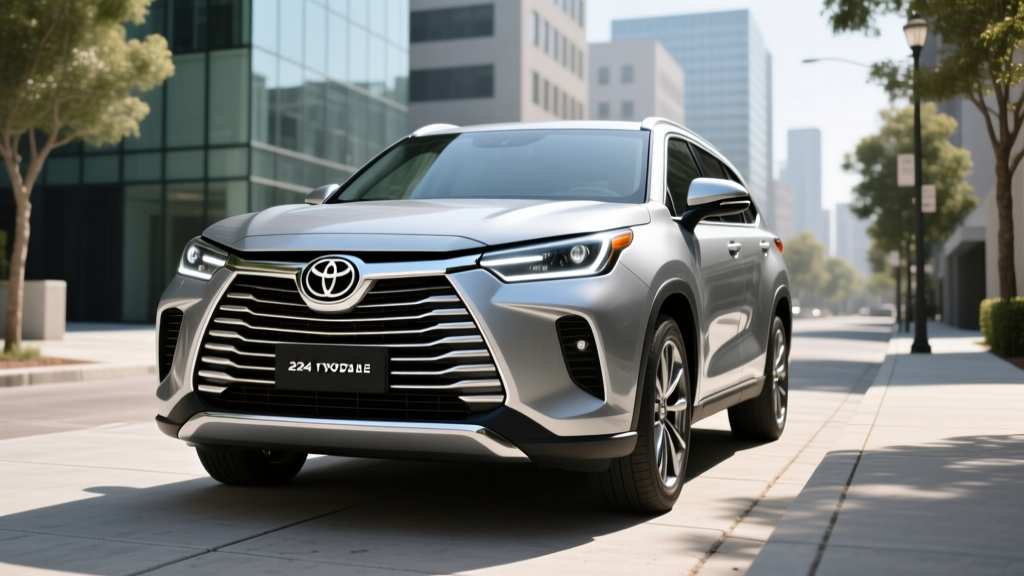
The 2024 Toyota Highlander Hybrid XLE sits in a narrow but valuable lane: three-row family hauler with genuine fuel economy credentials and Toyota's long-hybrid heritage. It is a conventional hybrid electric vehicle (HEV), not a plug-in hybrid (PHEV) — meaning it never needs to be plugged in and has no electric-only driving range. The gas engine and regenerative braking system recharge the small traction battery automatically.
For buyers weighing a three-row SUV, the XLE trim strikes the practical sweet spot above the base LE but below the pricier Limited and Platinum. You get SofTex-trimmed heated front seats, a power liftgate, wireless Apple CarPlay/Android Auto on the 8-inch touchscreen, and Toyota Safety Sense 2.5+ as standard. The trade-off: this is not a performance SUV, and highway passing power feels adequate rather than eager.
HEV vs PHEV: What the Highlander Hybrid Actually Is
Before examining the numbers, it's critical to understand what you're buying. The Highlander Hybrid is a conventional self-charging hybrid (HEV). Toyota does not currently sell a plug-in hybrid (PHEV) Highlander in the U.S. market. Here's what that distinction means for your daily driving:
| Feature | Highlander Hybrid (HEV) | Typical PHEV (e.g., RAV4 Prime) | Full EV (e.g., Tesla Model Y) |
|---|---|---|---|
| Plug-in charging required? | No — self-charging | Yes — for max efficiency | Yes — always |
| Electric-only range | ~1 mile at low speed | 30–42 miles typical | 250–330 miles |
| Fuel needed? | Yes — regular unleaded | Yes — for trips beyond EV range | No |
| Federal tax credit (§30D)? | No | No (as of 2024–2026 sourcing rules) | Up to $7,500 if eligible |
| Home charger needed? | No | Recommended (Level 2) | Essential (Level 2) |
The HEV architecture makes the Highlander Hybrid ideal for buyers without home charging access — apartment dwellers, street parkers, or those who simply want better fuel economy without changing their refueling habits.
Fuel Economy: EPA Ratings vs Real-World MPG
The 2024 Highlander Hybrid comes exclusively with all-wheel drive (AWD-i), which slightly impacts efficiency compared to a hypothetical FWD-only configuration. Here's the official EPA breakdown per fueleconomy.gov:
| Driving Cycle | EPA MPG | Real-World Expectation |
|---|---|---|
| City | 35 MPG | 33–37 MPG (hybrids often beat EPA in city) |
| Highway | 35 MPG | 30–34 MPG (highway negates regen advantage) |
| Combined | 35 MPG | 32–36 MPG depending on driving mix |
Several factors shift real-world numbers from the sticker:
- City-heavy driving: Expect to match or slightly exceed 35 MPG. The electric motors handle low-speed propulsion while the 2.5-liter four-cylinder stays off or acts as a generator. Regenerative braking recovers energy at every stop.
- Highway cruising at 70–80 mph: Expect 30–33 MPG. At sustained highway speed, the gas engine carries most of the load, and aerodynamic drag dominates. The hybrid system's advantage diminishes significantly above 65 mph.
- Cold weather (below 35°F): Expect a 5–12% drop, landing around 30–33 MPG combined. The engine runs more often to provide cabin heat and maintain battery temperature.
- Mountainous terrain: Climbing passes will show 22–26 MPG on the trip computer, but regenerative braking on descents partially recovers the deficit.
Annual Fuel Cost Estimate
At 15,000 miles/year and $3.40/gallon (national average regular unleaded), the Highlander Hybrid costs approximately $1,457/year in fuel. The gas-only Highlander AWD (24 MPG combined) would cost roughly $2,125/year — a difference of about $668 annually in the hybrid's favor.
Powertrain and Performance Specifications
| Specification | 2024 Highlander Hybrid XLE |
|---|---|
| Engine | 2.5L 4-cylinder Atkinson-cycle |
| Electric motors | Front motor + rear motor (AWD-i) |
| Combined net horsepower | 243 hp |
| Transmission | eCVT (electronically controlled) |
| Drivetrain | Electronic On-Demand AWD |
| 0–60 mph (est.) | ~7.8 seconds |
| Towing capacity | 3,500 lbs |
| Hybrid battery | 1.87 kWh (nickel-metal hydride), sealed |
| Fuel tank | 17.1 gallons |
| Total driving range | ~598 miles (EPA combined) |
| Fuel requirement | Regular unleaded (87 octane) |
| Seating | 8 passengers (2nd-row bench) or 7 (captain's chairs) |
| Cargo (behind 3rd row) | 16.1 cu ft |
| Cargo (all rows folded) | 84.3 cu ft |
The 243 hp combined output sounds sufficient on paper, but the eCVT's linear delivery and the vehicle's 4,500-lb curb weight mean acceleration feels deliberate rather than quick. Merging onto fast-moving highways requires planning. The AWD-i system uses the rear electric motor to provide torque to the rear wheels when slip is detected — there is no mechanical driveshaft connecting the engine to the rear axle. This is effective for rain and light snow but not a substitute for a dedicated off-road system.
The eCVT is not a traditional belt-and-pulley CVT. It uses a planetary gearset to blend engine and motor power, which eliminates the rubber-band effect that plagues some competitors. There are no fixed gear ratios, so the engine can operate at its most efficient RPM for a given power demand.
Pricing, Trims, and Tax Credit Eligibility
The 2024 Highlander Hybrid XLE carries an MSRP of $42,820 (including destination charge). Adding captain's chairs in the second row (reducing seating from 8 to 7) is a no-cost option. Popular add-ons include the panoramic roof ($1,600) and the JBL audio upgrade bundled with navigation.
Here's the 2024 Highlander Hybrid trim ladder:
- LE: $39,720 — base hybrid, cloth seats, 8-inch screen
- XLE: $42,820 — SofTex heated seats, power liftgate, wireless CarPlay
- Limited: $47,270 — leather, 12.3-inch screen, panoramic roof available
- Platinum: $51,075 — head-up display, panoramic roof standard, ventilated front seats
Federal Tax Credit Status
The 2024 Toyota Highlander Hybrid does not qualify for the federal §30D clean vehicle tax credit. Under current IRS rules, only plug-in electric vehicles (BEVs and PHEVs with ≥7 kWh battery capacity) are eligible. Conventional hybrids like this one are excluded regardless of price or buyer income. See the IRS clean vehicle credits page for full eligibility details.
Some states offer separate rebates for hybrid purchases, but these vary widely by jurisdiction and change frequently. Check your state's energy office or environmental agency for current programs.
Reliability, Battery Warranty, and Long-Term Costs
Toyota's hybrid system has an extensive real-world track record spanning over 25 years since the original Prius. The Highlander Hybrid's powertrain is mechanically simpler than a conventional automatic transmission — the eCVT has no clutches, bands, or torque converter to wear out. There is no alternator, starter motor, or accessory belt to replace.
Hybrid Battery Warranty Coverage
- Duration: 10 years / 150,000 miles (whichever comes first)
- Coverage: Defects and capacity loss below functional threshold
- Transferable: Yes — to subsequent owners, which supports resale value
- Replacement cost (out of warranty): $3,000–$4,500 including labor at a Toyota dealer
- Real-world lifespan: Most Toyota hybrid batteries last 150,000–200,000+ miles based on fleet data and owner reports
The 2024 Highlander Hybrid uses a nickel-metal hydride (NiMH) battery pack rather than lithium-ion. While NiMH is older technology with lower energy density, it has proven exceptionally durable in Toyota's hybrid applications. The battery is located under the second-row seat, preserving cargo space.
Beyond the hybrid battery, Toyota covers the vehicle with a 3-year/36,000-mile basic warranty and 5-year/60,000-mile powertrain warranty. The hybrid system components (inverter, transaxle, control module) fall under the 10-year/150,000-mile hybrid warranty.
For context on long-term ownership, the IIHS rated the 2024 Highlander as a Top Safety Pick+ with Good ratings across all crash test categories.
Who Should Choose the Highlander Hybrid vs an EV or Gas SUV?
Choose the Highlander Hybrid XLE If:
- You need three rows but can't install a home Level 2 charger
- Your commute is city-heavy (where hybrid efficiency peaks)
- You take regular road trips exceeding 300 miles and don't want to plan charging stops
- You want a proven, low-risk powertrain with 10-year battery coverage
- You live in an area with limited public DC fast charging infrastructure
Consider a Full EV (e.g., Kia EV9) or PHEV Instead If:
- You have reliable home Level 2 charging and want near-zero fuel costs
- Your state offers substantial EV rebates that offset the higher purchase price
- You want the instant torque and quiet operation of electric motors
- You want federal §30D tax credit eligibility (up to $7,500 on qualifying BEVs)
- Your daily driving is under 40 miles round-trip (a PHEV covers this on electricity alone)
The Decision Framework
Gas-only Highlander makes sense only if the ~$3,100 price premium of the hybrid over the gas LE is a dealbreaker and you drive mostly highway miles where the hybrid advantage is smallest.
Highlander Hybrid is the default recommendation for three-row buyers who lack home charging, want Toyota reliability, and drive a mixed city/highway cycle.
Full EV three-row (Kia EV9, Rivian R1S) wins on operating cost and performance but demands a $60,000+ budget, home charging installation, and willingness to plan longer road trips around DC fast chargers.
Frequently Asked Questions
How many MPG does the 2024 Highlander Hybrid actually get?
The EPA rates it at 35 MPG city / 35 MPG highway / 35 MPG combined. In real-world mixed driving, expect 32–36 MPG. City-heavy routes can push it to 37 MPG; sustained 80-mph highway driving drops it to around 30 MPG. Cold weather reduces efficiency by 5–12%.
Does the Highlander Hybrid need to be plugged in?
No. This is a conventional hybrid (HEV). The 1.87 kWh battery recharges through regenerative braking and the gas engine. There is no charge port and no electric-only driving mode beyond very low-speed parking-lot maneuvering.
How far can it drive on electric power alone?
Effectively less than one mile, and only at speeds below ~25 mph. The battery is too small (1.87 kWh) to provide meaningful electric-only range. If electric-only commuting is a priority, you need a PHEV like the Toyota RAV4 Prime (42 miles EV range) or a full BEV.
Is the hybrid battery expensive to replace?
Out-of-warranty replacement runs $3,000–$4,500 at a Toyota dealership. However, the battery is warrantied for 10 years/150,000 miles, and real-world data shows most Toyota NiMH hybrid packs last well beyond 150,000 miles. Many first-generation Prius batteries (2001–2003) exceeded 200,000 miles before significant degradation. The risk is real but statistically low within a typical ownership period.
Does the 2024 Highlander Hybrid qualify for any tax credit?
It does not qualify for the federal §30D clean vehicle credit, which is limited to plug-in vehicles (BEVs and qualifying PHEVs). Some states or local utilities may offer rebates for hybrid purchases — check your state energy office for current programs. The gas-only Highlander also receives no federal credit.
How does the Highlander Hybrid compare to the Grand Highlander Hybrid?
The Grand Highlander Hybrid (introduced for 2024) offers significantly more third-row legroom and cargo space, with a Hybrid MAX powertrain option producing 362 hp. The standard Grand Highlander Hybrid achieves 34 MPG combined (1 MPG less) and starts around $44,405. If third-row usability is a priority, the Grand Highlander is the stronger choice; if you want a slightly lower price and a more compact footprint, the standard Highlander Hybrid XLE remains competitive.
What maintenance does the hybrid system require?
Beyond standard maintenance (oil changes every 10,000 miles, cabin air filter, brake fluid), the hybrid system requires no special service. The hybrid battery cooling system has an air filter that should be cleaned periodically — your dealer checks this during routine service. Brake pads typically last 80,000–100,000 miles thanks to regenerative braking reducing friction-brake usage.