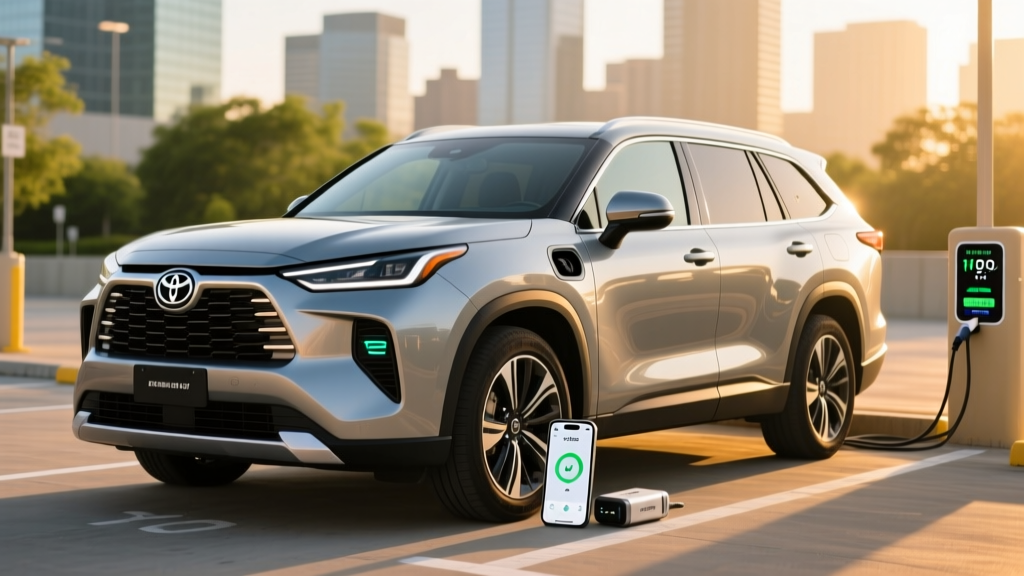
The 2024 Toyota Grand Highlander Hybrid is a three-row SUV built for families who need maximum cargo and passenger space without the fuel bill of a traditional V6 or turbocharged gas hauler. With seating for up to eight and a hybrid powertrain that delivers up to 36 MPG combined, it occupies a specific niche: full-size utility with mid-size fuel consumption. This guide breaks down every spec that matters — EPA fuel economy, real-world MPG expectations, powertrain options, battery warranty, pricing, and whether this HEV makes more sense than a plug-in hybrid or full EV for your household.
HEV vs PHEV: What the Grand Highlander Hybrid Actually Is
Conventional Hybrid (HEV): The 2024 Grand Highlander Hybrid is a self-charging hybrid. It uses a gasoline engine paired with electric motors and a small battery that recharges through regenerative braking and the engine. You never plug it in. You simply fuel up at any gas station and drive.
Plug-in Hybrid (PHEV): Toyota does not offer a plug-in hybrid version of the Grand Highlander for the 2024 model year. If you want a Toyota PHEV with three rows, the closest option is the RAV4 Prime (two-row) or the Sienna (minivan, HEV only). For a true three-row PHEV, you'd need to look at competitors like the Mazda CX-90 PHEV or the Jeep Grand Cherokee 4xe.
This distinction matters because conventional hybrids like the Grand Highlander Hybrid do not qualify for the federal §30D new clean vehicle tax credit, which requires a minimum battery capacity of 7 kWh and plug-in capability. We'll cover pricing implications below.
Fuel Economy: EPA Ratings and Real-World MPG
The 2024 Grand Highlander Hybrid comes in two distinct powertrain configurations, and the fuel economy difference between them is substantial.
| Powertrain | Drivetrain | EPA City | EPA Highway | EPA Combined | Fuel Tank | Est. Total Range |
|---|---|---|---|---|---|---|
| Hybrid (2.5L I4) | FWD | 37 MPG | 34 MPG | 36 MPG | 17.1 gal | ~615 miles |
| Hybrid (2.5L I4) | AWD (AWD-i) | 36 MPG | 33 MPG | 35 MPG | 17.1 gal | ~598 miles |
| Hybrid MAX (2.4L Turbo) | AWD | 27 MPG | 28 MPG | 27 MPG | 17.1 gal | ~462 miles |
Source: fueleconomy.gov (EPA estimates). Actual mileage will vary.
Real-World MPG vs EPA Sticker
Toyota's 2.5L hybrid system is one of the most proven in the industry, and real-world results tend to align closely with — or even exceed — EPA estimates in city driving. Here's what to expect based on owner reports and testing patterns for this platform:
- City driving: The standard Hybrid frequently achieves 37-40 MPG in stop-and-go traffic, where regenerative braking and electric motor assist do the most work. This is where hybrids shine.
- Highway cruising (70-75 mph): Expect 30-33 MPG. The aerodynamic profile of a large three-row SUV and the engine running at sustained load reduce the hybrid advantage. This is consistent with EPA highway estimates.
- Cold weather (below 30°F): Budget for a 10-15% fuel economy drop. The engine runs more frequently to provide cabin heat and maintain battery temperature, reducing electric-only operation.
- Hybrid MAX: The turbocharged 2.4L engine prioritizes performance over efficiency. Real-world mixed driving typically yields 24-27 MPG. If fuel economy is your primary motivation, the standard Hybrid is the clear choice.
Powertrain Specs: Two Hybrid Systems Compared
| Specification | Hybrid (2.5L) | Hybrid MAX (2.4L Turbo) |
|---|---|---|
| Engine | 2.5L inline-4 | 2.4L turbocharged inline-4 |
| Combined Horsepower | 245 hp | 362 hp |
| Combined Torque | 173 lb-ft (engine) | 400 lb-ft |
| Electric Motors | Front + rear (AWD-i) | Front + rear (Direct AWD) |
| Transmission | eCVT | 6-speed automatic |
| 0-60 mph (est.) | ~7.8 sec | ~5.6 sec |
| Drivetrain | FWD or AWD-i | AWD only |
| Towing Capacity | 3,500 lbs | 5,000 lbs |
| Battery Type | Nickel-metal hydride (NiMH) | Nickel-metal hydride (NiMH) |
The standard Hybrid uses Toyota's familiar power-split eCVT system, seamlessly blending engine and electric motor power. It's optimized for efficiency, not acceleration. The Hybrid MAX pairs a turbocharged engine with a more powerful electric motor and a traditional 6-speed automatic — it trades MPG for genuine passing power and a higher tow rating, making it the choice for buyers who haul boats or trailers.
Battery Warranty and Long-Term Reliability
Hybrid Battery Warranty: Toyota covers the Grand Highlander Hybrid battery with a 10-year / 150,000-mile warranty (whichever comes first) in all 50 states. This applies to both the standard Hybrid and Hybrid MAX powertrains.
Hybrid System Components: The hybrid control module, inverter, and related components are also covered under the same 10-year/150,000-mile terms.
General Powertrain Warranty: 5 years / 60,000 miles.
How Long Will the Hybrid Battery Last?
Toyota's hybrid battery track record is among the best in the industry. The Prius, Camry Hybrid, and Highlander Hybrid have demonstrated that NiMH hybrid batteries routinely last 150,000-200,000+ miles before significant degradation. Unlike full EV batteries, hybrid batteries are relatively small (roughly 1.6 kWh in this application) and are never deeply discharged — the system keeps the battery in a narrow state-of-charge window (roughly 40-80%), which dramatically extends cycle life.
Hybrid Battery Replacement Cost
If the battery does eventually need replacement outside warranty coverage, expect to pay between $2,500 and $4,500 for a new OEM hybrid battery pack, including labor. Refurbished or reconditioned packs are available for $1,500-$2,500. Individual battery modules can sometimes be replaced for $500-$1,000 if only a few cells have degraded. Given the 10-year/150,000-mile warranty and Toyota's reliability history, most original owners will never face this expense.
Pricing, Trims, and Tax Credit Eligibility
| Trim Level | Powertrain | MSRP (2024) |
|---|---|---|
| XLE (FWD) | Hybrid 2.5L | $44,670 |
| XLE (AWD) | Hybrid 2.5L | $46,470 |
| Limited (AWD) | Hybrid 2.5L | $51,405 |
| Platinum (AWD) | Hybrid 2.5L | $55,070 |
| Limited (AWD) | Hybrid MAX | $54,040 |
| Platinum (AWD) | Hybrid MAX | $58,125 |
Prices include destination charge. Source: Toyota.com
Does the Grand Highlander Hybrid Qualify for a Federal Tax Credit?
No. The 2024 Toyota Grand Highlander Hybrid is a conventional hybrid (HEV), not a plug-in vehicle. Under current IRS §30D rules, the federal new clean vehicle credit requires a battery capacity of at least 7 kWh and external charging capability. The Grand Highlander Hybrid's ~1.6 kWh NiMH battery does not meet these thresholds.
Some states offer their own incentives for conventional hybrids, though these are increasingly rare as state programs shift focus to plug-in vehicles. Check your state's energy or environmental agency website for current programs. Toyota does offer periodic manufacturer incentives and lease deals — check Toyota's current offers page for regional promotions.
Grand Highlander Hybrid vs EV vs PHEV: Which Fits Your Family?
Choose the Grand Highlander Hybrid (HEV) if:
- You don't have access to home or workplace charging
- You regularly drive 400+ miles between fuel stops (road trips, rural areas)
- You want three-row seating and maximum cargo space (97.5 cu ft behind front seats)
- You prefer the lowest-maintenance electrified option — no charging cables, no range planning
- Your budget is under $55K and you want predictable fuel costs at ~$0.14/mile (at $3.50/gal, 36 MPG)
Choose a three-row PHEV (e.g., Mazda CX-90 PHEV, Kia Sorento PHEV) if:
- You have reliable home Level 2 charging
- Most daily trips are under 30 miles (you can run primarily on electricity)
- You want the federal §30D tax credit (up to $7,500, subject to income and sourcing rules)
- You want the option of electric-only commuting with gas backup for long trips
Choose a three-row EV (e.g., Kia EV9, Tesla Model X) if:
- You have home charging and your daily driving is under 250 miles
- You want the lowest per-mile fuel cost (~$0.04-0.06/mile on home electricity)
- You want zero tailpipe emissions and minimal drivetrain maintenance
- You're comfortable planning charging stops on road trips of 300+ miles
Operating Cost Comparison
At 15,000 miles per year, here's how annual fuel/energy costs compare:
- Grand Highlander Hybrid (36 MPG, $3.50/gal): ~$1,458/year
- Gas-only 3-row SUV (22 MPG, $3.50/gal): ~$2,386/year
- PHEV (30 mi electric + 28 MPG gas, $0.15/kWh): ~$1,100-1,300/year (varies by electric vs gas ratio)
- Full EV (3.5 mi/kWh, $0.15/kWh home charging): ~$643/year
The Grand Highlander Hybrid saves roughly $900/year over a comparable gas-only three-row SUV. Over 10 years, that's approximately $9,000 in fuel savings — a meaningful offset against the hybrid's slightly higher purchase price.
Pros and Cons at a Glance
Pros
- 36 MPG combined in a genuine 8-passenger, 3-row SUV — class-leading efficiency
- 615-mile total range means fewer fuel stops on long road trips
- 10-year/150,000-mile hybrid battery warranty
- Hybrid MAX option offers 362 hp and 5,000-lb towing for performance-oriented buyers
- Proven Toyota hybrid reliability — minimal long-term maintenance risk
- Spacious third row fits adults; 97.5 cu ft cargo volume with seats folded
Cons
- No plug-in hybrid option — cannot access federal §30D tax credit
- Standard Hybrid's 245 hp feels adequate but not quick for a 4,700-lb vehicle
- Hybrid MAX drops to 27 MPG — negating much of the hybrid fuel advantage
- No DC fast charging capability (not applicable — HEV doesn't plug in)
- Starting MSRP near $45K is a significant investment vs non-hybrid competitors
- CVT drone under hard acceleration (standard Hybrid only)
Frequently Asked Questions
How many MPG does the 2024 Toyota Grand Highlander Hybrid get?
The standard 2.5L Hybrid achieves 37 city / 34 highway / 36 combined MPG with FWD, and 36/33/35 MPG with AWD. The Hybrid MAX with the turbocharged 2.4L engine gets 27 city / 28 highway / 27 combined MPG.
Does the Grand Highlander Hybrid need to be plugged in?
No. The Grand Highlander Hybrid is a conventional hybrid (HEV). It charges its own battery through regenerative braking and the gasoline engine. You never plug it in — you simply fill up at a gas station like any other car.
Is the Grand Highlander Hybrid reliable?
Toyota's hybrid powertrains have an exceptional reliability track record spanning over 25 years since the original Prius. The hybrid system has fewer wear components than a conventional gas powertrain (no traditional starter motor, no alternator, regenerative braking reduces brake wear). The IIHS has evaluated the Grand Highlander for safety, and Toyota's hybrid battery is backed by a 10-year/150,000-mile warranty.
What is the hybrid battery replacement cost?
A new OEM hybrid battery replacement runs $2,500-$4,500 including labor. Refurbished packs are available for $1,500-$2,500. However, Toyota's NiMH hybrid batteries routinely last 150,000-200,000+ miles, and the 10-year/150,000-mile warranty means most owners will never pay for a replacement.
Does the 2024 Grand Highlander Hybrid qualify for any tax credit?
It does not qualify for the federal §30D new clean vehicle tax credit, which requires plug-in capability and a minimum 7 kWh battery. As a conventional hybrid, the Grand Highlander Hybrid does not meet these criteria. Some states may offer minor hybrid incentives — check your state's energy office for current programs.
How does the Grand Highlander Hybrid compare to the regular Highlander Hybrid?
The Grand Highlander is approximately 6.5 inches longer than the standard Highlander, providing a genuinely usable third row and 50% more cargo space behind the third row (20.6 cu ft vs 13.7 cu ft). Fuel economy is nearly identical (36 vs 35 MPG combined). If you regularly carry passengers in the third row or need maximum cargo volume, the Grand Highlander is the clear upgrade.
Can the Hybrid MAX tow more than the standard Hybrid?
Yes. The Hybrid MAX is rated for 5,000 lbs of towing capacity compared to 3,500 lbs for the standard 2.5L Hybrid. If you tow a small boat, utility trailer, or camper, the Hybrid MAX's additional torque (400 lb-ft) and higher tow rating justify the fuel economy trade-off.
The 2024 Toyota Grand Highlander Hybrid occupies a practical sweet spot: genuine three-row, eight-passenger capability with fuel economy that undercuts most compact crossovers. It doesn't offer plug-in electric range or federal tax credits, but for buyers without home charging access — or those who regularly drive long distances where EV range and charging logistics become a burden — it remains one of the most efficient and reliable family haulers available.