Quick Verdict: The Efficiency Benchmark for Compact Hybrids
The 2024 Toyota Corolla Hybrid delivers an EPA-estimated 50 MPG combined in its LE front-wheel-drive trim — a number that places it among the most fuel-efficient non-plug-in vehicles sold in the United States. With a starting MSRP of $23,500 (including destination), it undercuts most competitors on price while offering standard all-wheel-drive availability and Toyota's proven hybrid powertrain. For buyers researching 2024 Toyota Corolla Hybrid MPG figures, the short answer is: this sedan sips fuel at a rate that makes the math overwhelmingly favorable versus gas-only alternatives, without the charging logistics of a plug-in hybrid or full EV.
| Specification | LE (FWD) | LE (AWD) | SE (AWD) |
|---|---|---|---|
| EPA City MPG | 53 | 51 | 50 |
| EPA Highway MPG | 46 | 44 | 43 |
| EPA Combined MPG | 50 | 47 | 47 |
| Combined Horsepower | 138 hp | 138 hp | 138 hp |
| Powertrain | 1.8L I4 + 2 motors | 1.8L I4 + 3 motors | 1.8L I4 + 3 motors |
| Drivetrain | FWD | AWD (e-motor rear) | AWD (e-motor rear) |
| 0–60 mph | ~9.1 sec | ~9.0 sec | ~9.0 sec |
| Base MSRP | $23,500 | $25,000 | $27,500 |
| Hybrid Battery Warranty | 10 years / 150,000 miles | ||
Source: fueleconomy.gov, Toyota Motor Corporation
HEV vs PHEV: What the Corolla Hybrid Is (and Isn't)
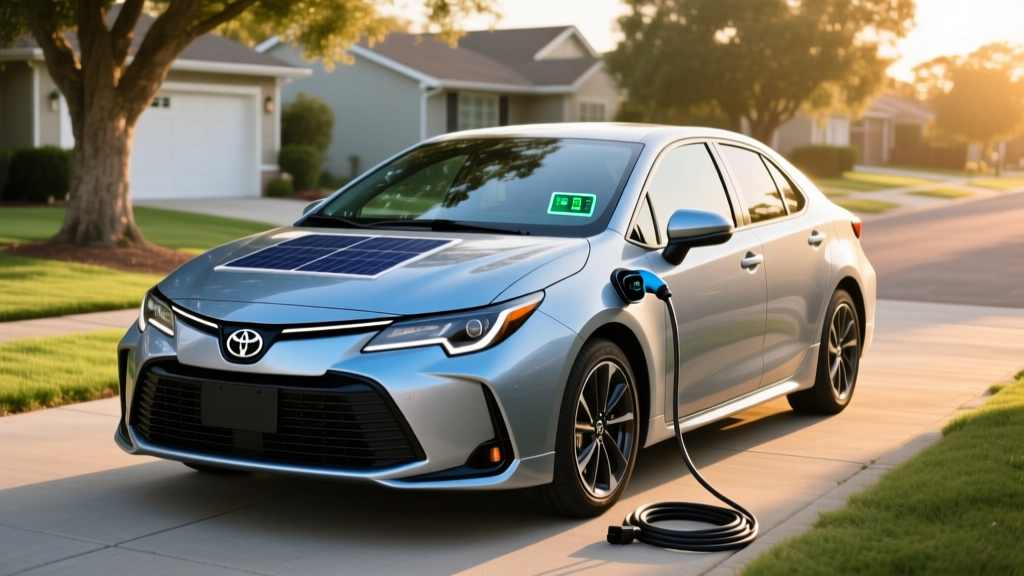
The 2024 Corolla Hybrid is a conventional hybrid electric vehicle (HEV). It does not plug in. There is no charging port, no electric-only driving mode of meaningful distance, and no kWh battery you charge from a wall outlet. Instead, the car recovers energy through regenerative braking and the gasoline engine to keep a small (~1.3 kWh) nickel-metal hydride (NiMH) traction battery topped up. That battery assists the 1.8-liter four-cylinder engine during acceleration, enables brief low-speed electric-only creeping, and allows the engine to shut off at stops.
This is fundamentally different from a plug-in hybrid (PHEV) like the Toyota Prius Prime, which carries an 11.4 kWh lithium-ion battery, offers 44 miles of EPA electric-only range, and requires a J1772 plug for Level 2 charging. The Corolla Hybrid has none of that infrastructure dependency — you fuel it like any conventional car, and the hybrid system works invisibly in the background.
| Attribute | Corolla Hybrid (HEV) | Prius Prime (PHEV) |
|---|---|---|
| Plug-in Required | No | Yes (J1772 / Level 2) |
| Battery Capacity | ~1.3 kWh (NiMH) | 13.6 kWh (Li-ion) |
| Electric-Only Range | ~1 mi (low speed) | 44 mi (EPA) |
| EPA Combined MPG/MPGe | 50 MPG | 52 MPG / 127 MPGe |
| Total Range | ~530 mi | ~440 mi (gas + electric) |
| Base MSRP | $23,500 | $33,445 |
| Federal Tax Credit (§30D) | Not eligible | Up to $7,500* |
*PHEV credit subject to IRS §30D income caps, MSRP limits, and battery-sourcing requirements. See irs.gov for current eligibility. Corolla Hybrid (HEV) does not qualify for the §30D new clean vehicle credit.
Fuel Economy Breakdown: EPA Stickers vs Real-World MPG
| Trim | City | Highway | Combined | Annual Fuel Cost* |
|---|---|---|---|---|
| LE (FWD) | 53 MPG | 46 MPG | 50 MPG | $1,050 |
| LE (AWD) | 51 MPG | 44 MPG | 47 MPG | $1,100 |
| SE (AWD) | 50 MPG | 43 MPG | 47 MPG | $1,100 |
*Based on 15,000 mi/yr, 55% city / 45% highway, $3.50/gal regular unleaded. Your costs will vary with local fuel prices.
Real-world expectations: Toyota's hybrid system excels in stop-and-go city driving, where regenerative braking and engine-off coasting deliver their biggest advantage. Many owners report exceeding the EPA city estimate — 55–60 MPG is achievable on flat urban routes in mild weather. Highway driving is the relative weak point: sustained 75+ MPH cruising pushes the engine into higher-load operation, and real-world highway MPG typically falls to 40–43 MPG for the FWD LE. In cold weather (below 30°F), expect a 5–10% efficiency penalty as the engine runs more frequently to provide cabin heat and warm the catalytic converter.
Powertrain Deep Dive: How 138 Horsepower Gets 50 MPG
The 2024 Corolla Hybrid pairs a 1.8-liter Atkinson-cycle four-cylinder engine (98 hp, 105 lb-ft) with Toyota's fifth-generation hybrid transaxle. In FWD models, two motor-generator units (MG1 and MG2) handle regeneration and drive assist; AWD models add a third motor (MMR) on the rear axle that provides up to 41 hp to the rear wheels when traction is needed, then disengages to avoid driveline drag.
Combined system output is 138 horsepower. That's modest by modern standards — acceleration to 60 MPH takes roughly 9.0 seconds — but the electric motor's instant torque delivery makes the car feel responsive around town. The continuously variable transmission (eCVT) is smooth and avoids the rubber-band sensation of older CVTs thanks to the planetary gearset design Toyota has refined over two decades.
The key to the 50 MPG figure is not any single technology but the system's relentless optimization: the engine operates in its narrowest, most efficient RPM band as much as possible, shuts off during coasting and stops, and lets the electric motor handle the inefficient low-speed work. The 11.9-gallon fuel tank gives the FWD LE a theoretical range of approximately 595 miles on a fill-up, though a more realistic expectation is 500–540 miles given real-world driving mix.
Pricing, Trims, and Tax Credit Reality
The 2024 Corolla Hybrid is offered in three configurations:
- LE FWD — $23,500 MSRP: 50 MPG combined, Toyota Safety Sense 3.0, 8-inch touchscreen, wireless Apple CarPlay/Android Auto
- LE AWD — $25,000 MSRP: 47 MPG combined, electronic on-demand AWD, same feature content
- SE AWD — $27,500 MSRP: 47 MPG combined, sport-tuned suspension, 18-inch alloy wheels, paddle shifters, SofTex seats
Tax credit eligibility: As a conventional hybrid (HEV), the Corolla Hybrid does not qualify for the IRS §30D federal clean vehicle credit. That credit — up to $7,500 — is reserved for plug-in vehicles (BEVs and PHEVs) meeting battery-sourcing and critical-mineral requirements. There is currently no federal tax incentive for purchasing a conventional hybrid.
Some states and local utilities offer rebates for hybrid purchases, but these vary widely and change frequently. Check your state energy office or utility provider for current programs. The fueleconomy.gov tax center maintains a list of active federal and state incentives.
Reliability and Long-Term Battery Outlook
Toyota's hybrid system has accumulated more than 25 years of production data since the original Prius launched in Japan in 1997. The Corolla Hybrid's fifth-generation powertrain benefits from that institutional knowledge. Consumer Reports and J.D. Power consistently rank Toyota among the top brands for long-term reliability, and the hybrid components — particularly the eCVT transaxle and battery pack — have proven durable well beyond warranty limits.
Real-world data from high-mileage Prius and Camry Hybrid fleets shows NiMH traction batteries commonly lasting 150,000–200,000 miles before significant capacity degradation. The Corolla Hybrid's smaller, less-stressed battery should follow a similar trajectory. If replacement is eventually needed:
- Dealership new OEM battery: $2,500–$3,500 installed
- Refurbished/reconditioned battery: $1,200–$1,800 installed (independent hybrid shops)
- Individual module replacement: $500–$900 if only specific cells have degraded
The 10-year/150,000-mile warranty provides a substantial safety net. Most owners will sell or trade the vehicle before this coverage expires.
Corolla Hybrid vs Full EV vs Gas: Decision Framework
Choose the Corolla Hybrid (HEV) if:
- You lack reliable access to home or workplace charging (apartment, street parking, no garage)
- You want maximum MPG without changing your fueling habits at all
- Your budget is under $25,000 and you need a new vehicle with a warranty
- You drive a mix of city and highway and want proven, low-risk efficiency
- You live in a cold climate where EV range loss is a concern
Choose a PHEV (like the Prius Prime) if:
- You can charge at home (Level 1 or 2) and your daily commute is under 40 miles
- You want electric-only daily driving but need gas flexibility for longer trips
- You qualify for the §30D federal tax credit and want to offset a higher MSRP
Choose a full BEV (like the Chevy Equinox EV or Tesla Model 3) if:
- You have reliable home Level 2 charging and minimal range anxiety
- Your daily driving is predictable and within the vehicle's range
- You want the lowest per-mile energy cost and minimal maintenance
- You want to maximize federal and state incentives
Pros, Cons, and the Bottom Line
Pros
- 50 MPG combined (LE FWD) — among the highest of any non-plug-in car
- $23,500 starting price — affordable entry point
- Available AWD with minimal MPG penalty (3 MPG combined)
- 10-year/150,000-mile hybrid battery warranty
- No charging infrastructure required
- Standard Toyota Safety Sense 3.0 (pre-collision, lane tracing, adaptive cruise)
- Strong resale value and proven reliability track record
Cons
- No federal tax credit eligibility (HEV)
- Modest 138 hp — highway passing requires planning
- Rear seat and trunk space tighter than some compact rivals
- NiMH battery (not lithium-ion) — older chemistry, though proven
- SE trim's 18-inch wheels reduce MPG and ride comfort
- No plug-in variant available in the Corolla lineup
Frequently Asked Questions
How many MPG does the 2024 Toyota Corolla Hybrid get?
The 2024 Corolla Hybrid LE with front-wheel drive achieves an EPA-estimated 53 city / 46 highway / 50 combined MPG. The AWD versions (LE and SE) are rated at 51 city / 44 highway / 47 combined. Real-world city driving often exceeds EPA estimates, while sustained highway speeds above 70 MPH typically yield 40–43 MPG.
Does the Corolla Hybrid need to be plugged in?
No. The Corolla Hybrid is a conventional HEV — it charges its own small traction battery through regenerative braking and the gasoline engine. There is no plug, no charging cable, and no need for any charging infrastructure. You refuel it at a gas station like any other car.
Is the Corolla Hybrid reliable, and what does a battery replacement cost?
Toyota's hybrid powertrain has an extensive reliability record spanning 25+ years. The hybrid battery is warranted for 10 years / 150,000 miles. Out-of-warranty replacement costs range from $1,200 (refurbished) to $3,500 (new OEM at a dealership). Most hybrid batteries last 150,000–200,000 miles based on fleet data from similar Toyota hybrid systems.
Does the 2024 Corolla Hybrid qualify for any tax credit?
No. The federal §30D clean vehicle credit applies only to plug-in electric vehicles (BEVs and PHEVs) that meet battery sourcing, critical mineral, MSRP, and buyer income requirements. Conventional hybrids like the Corolla Hybrid are not eligible. Some state or utility-level incentives may apply — check your local programs.
Should I buy the Corolla Hybrid or a full electric vehicle?
If you have reliable home charging, a predictable commute under 250 miles, and want the lowest operating cost, a BEV will save more over time. If you lack charging access, frequently drive long distances, live in extreme cold, or want a lower purchase price with no lifestyle adjustment, the Corolla Hybrid delivers outstanding efficiency without any infrastructure dependency.
How does the AWD system work on the Corolla Hybrid?
The AWD Corolla Hybrid uses an independent rear-mounted electric motor (41 hp) that engages automatically during acceleration from a stop, on slippery surfaces, or when the system detects front-wheel slip. Under steady cruising, the rear motor disengages entirely to eliminate driveline losses, which is why the AWD penalty is only 3 MPG combined versus the FWD model.
Data sources: U.S. EPA fueleconomy.gov, IRS §30D Clean Vehicle Credits, Toyota Motor Corporation 2024 specifications.