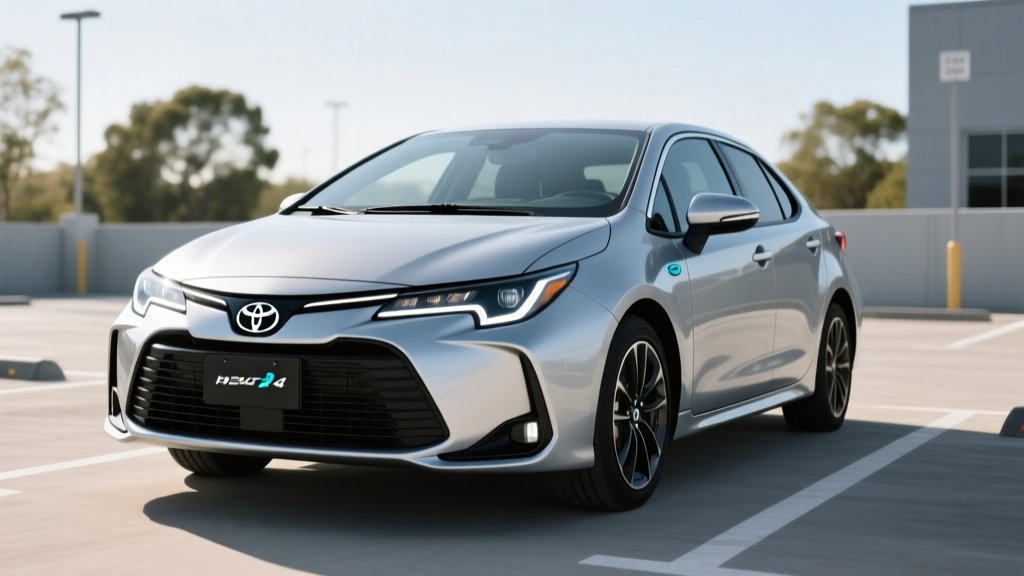
If your priority is squeezing maximum miles out of every gallon without plugging in, the 2024 Toyota Corolla Hybrid LE is one of the most efficient new cars you can buy. With an EPA-estimated 50 MPG combined and standard electronic all-wheel drive, it undercuts most competitors on price while delivering fuel economy that rivals dedicated hybrids costing thousands more. But how does it stack up in the real world, and is a conventional hybrid still the right choice as plug-in options proliferate?
We've analyzed EPA data, owner reports, and Toyota's powertrain specifications to give you a precise, numbers-driven look at what the Corolla Hybrid LE actually offers — and where it falls short.
Quick Verdict: Who the Corolla Hybrid LE Is For
The 2024 Corolla Hybrid LE targets buyers who want EV-like efficiency without range anxiety, charging infrastructure dependence, or a plug-in hybrid's premium price. Starting around $23,500 MSRP (before destination), it's roughly $3,000–$5,000 less than comparable PHEVs and delivers 50 MPG without ever needing a charger.
Choose the Corolla Hybrid LE if: You drive 200+ miles weekly, lack reliable home charging access, want the lowest upfront cost, and prioritize proven reliability over electric-only driving.
Look at a PHEV (like the Prius Prime) or full BEV if: You have home Level 2 charging, your daily commute is under 40 miles round-trip, and you want to eliminate most gasoline use.
EPA Fuel Economy and Real-World MPG
The 2024 Corolla Hybrid LE carries an EPA rating of 53 city / 46 highway / 50 combined MPG with standard electronic AWD. That combined figure ties it with the Hyundai Elantra Hybrid Blue and trails only the Toyota Prius (up to 57 MPG combined) in the compact hybrid segment.
| Driving Cycle | EPA Estimate | Real-World Expectation |
|---|---|---|
| City | 53 MPG | 50–58 MPG (regenerative braking favors stop-and-go) |
| Highway | 46 MPG | 42–48 MPG (aero drag reduces hybrid advantage at 70+ mph) |
| Combined | 50 MPG | 47–53 MPG depending on driving mix |
Real-world note: Toyota's hybrid system excels in city driving, where the electric motor handles low-speed propulsion and regenerative braking recaptures energy. Owners consistently report exceeding the EPA city estimate in stop-and-go traffic. Highway efficiency drops somewhat — at sustained 75–80 mph speeds, the gasoline engine carries most of the load, and the aerodynamic penalty of the Corolla's sedan profile becomes more apparent. In cold weather (below 32°F), expect a 5–10% MPG reduction as the engine runs more frequently to maintain cabin heat and battery temperature.
According to fueleconomy.gov, the Corolla Hybrid LE's 50 MPG combined saves an estimated $3,750 in fuel costs over 5 years compared to the average new vehicle, assuming 15,000 miles/year and $3.50/gallon regular unleaded.
Hybrid vs. Plug-In Hybrid vs. Full EV: Which Fits You?
Before committing to the Corolla Hybrid LE, it's worth understanding where it sits in the electrification spectrum. The Corolla Hybrid is a conventional hybrid (HEV) — it cannot be plugged in and has no electric-only driving range beyond very low-speed maneuvering.
| Feature | HEV (Corolla Hybrid) | PHEV (e.g., Prius Prime) | BEV (e.g., Tesla Model 3) |
|---|---|---|---|
| Plug-in Charging | No — never plugs in | Yes — Level 1/2 AC | Yes — Level 1/2/DC fast |
| Electric-Only Range | ~0.5 mi at low speed | 39–44 mi (EPA) | 250–350+ mi (EPA) |
| Battery Size | ~1.0 kWh (NiMH) | 13.6 kWh (Li-ion) | 50–82 kWh (Li-ion) |
| Combined MPG/MPGe | 50 MPG | 52 MPG + 127 MPGe | 130+ MPGe |
| Starting MSRP | ~$23,500 | ~$33,445 | ~$38,990+ |
| Federal Tax Credit (§30D) | Not eligible | Up to $7,500* | Up to $7,500* |
* §30D credit eligibility depends on MSRP caps, buyer income limits, battery critical-mineral sourcing, and point-of-sale transfer rules. Always verify current-year requirements at irs.gov.
The Corolla Hybrid LE makes sense if you lack home charging, drive long distances regularly, or simply want the lowest total cost of ownership with zero lifestyle changes. A PHEV like the Prius Prime is ideal if you can charge at home and want to complete most daily driving on electricity while retaining a gas engine for road trips. A full BEV eliminates gasoline entirely but demands charging access and a higher upfront investment.
Powertrain Specs: Engine, Motor, and Performance
Under the hood, the 2024 Corolla Hybrid LE pairs Toyota's fifth-generation hybrid system with a 1.8-liter Atkinson-cycle four-cylinder engine. The setup is shared with the Prius, though tuned slightly differently for the Corolla's sedan platform.
| Engine | 1.8L 4-cyl Atkinson cycle |
| Engine Output | 97 hp / 105 lb-ft torque |
| Electric Motor (front) | 70 kW (94 hp) / 135 lb-ft |
| Rear Motor (AWD) | 30 kW (41 hp) — activates on demand |
| Combined System Output | 138 hp |
| Hybrid Battery | ~1.0 kWh, Nickel-Metal Hydride (NiMH) |
| Transmission | eCVT (planetary gearset, no fixed gears) |
| Drivetrain | Electronic AWD (standard) |
| 0–60 mph | ~9.0 seconds (est.) |
| Fuel Tank | 11.4 gallons |
| Total Driving Range | ~570 miles (EPA est.) |
The 138 combined horsepower puts the Corolla Hybrid LE behind the standard gas Corolla (169 hp) and well behind sportier hybrids like the Prius (194 hp). Acceleration is adequate for merging and passing but not quick — the 0–60 time hovers around 9 seconds. The electronic AWD system engages the rear motor only when traction is needed, minimizing efficiency penalties.
The eCVT is not a traditional belt-driven CVT; it uses a planetary gearset that blends engine and motor power seamlessly. There are no simulated "gears" or rubber-band sensations common in older CVTs. The trade-off is a drone under hard acceleration as the engine holds at peak RPM, but this is typical of all Toyota hybrids.
Pricing, Trims, and Tax Credit Eligibility
The 2024 Corolla Hybrid is offered in a single LE trim, which simplifies the buying decision. Pricing breaks down as follows:
| Trim | MSRP (before destination) | With Destination (~$1,095) |
|---|---|---|
| LE (AWD standard) | $23,500 | ~$24,595 |
Standard equipment on the LE includes an 8-inch touchscreen with wireless Apple CarPlay and Android Auto, Toyota Safety Sense 3.0 (adaptive cruise control, lane-keeping assist, automatic emergency braking, road sign assist), LED headlights, automatic climate control, and a 7-inch digital driver display.
Federal tax credit: The Corolla Hybrid LE is a conventional HEV and does not qualify for the federal §30D Clean Vehicle Credit, which applies only to plug-in hybrids (PHEVs) and battery electric vehicles (BEVs). However, some states and local utilities offer rebates for high-efficiency vehicles — check your state energy office or utility provider for current programs.
Reliability, Battery Warranty, and Long-Term Costs
Toyota's hybrid powertrain is among the most proven in the industry, with over 25 years of continuous refinement since the original Prius. The Corolla Hybrid's NiMH battery pack is smaller and less stressed than those in larger hybrids, contributing to longevity.
Hybrid Battery Warranty: Toyota covers the hybrid battery and hybrid system components for 10 years or 150,000 miles (whichever comes first) from the date of first use. This applies nationwide and is transferable to subsequent owners.
Powertrain Warranty: The gasoline engine and eCVT are covered for 5 years / 60,000 miles.
Battery Replacement Cost (out of warranty): A replacement NiMH hybrid battery for the Corolla Hybrid typically runs $2,000–$3,500 including labor at a Toyota dealer. Independent hybrid specialists often offer refurbished units for $1,200–$2,000.
In practice, Toyota hybrid batteries routinely exceed 150,000 miles without significant degradation. The NiMH chemistry is less energy-dense than lithium-ion but is extremely tolerant of the shallow charge-discharge cycles typical of hybrid operation (the battery rarely drops below 40% or above 80% state of charge). Failures before 100,000 miles are rare.
According to NHTSA, the 2024 Corolla Hybrid carries a 5-Star Overall Safety Rating, and the IIHS has historically rated the Corolla sedan as a Top Safety Pick when equipped with the standard TSS suite.
Pros and Cons at a Glance
Pros
- 50 MPG combined — among the highest of any AWD vehicle sold in the US
- Low starting MSRP (~$24,595 with destination) — cheapest AWD hybrid available
- Standard Toyota Safety Sense 3.0 with full ADAS suite
- 10-year / 150,000-mile hybrid battery warranty
- No charging infrastructure needed — fill up at any gas station
- Proven, reliable Toyota hybrid powertrain with deep service network
- Standard electronic AWD — rare at this price point
Cons
- Only one trim (LE) — no premium options like leather, sunroof, or premium audio
- 138 hp feels sluggish for highway passing and merging
- No federal tax credit eligibility (HEV, not PHEV)
- Rear-seat legroom is tight (35.0 inches) compared to some competitors
- Small 11.4-gallon fuel tank means more frequent fill-ups despite high MPG
- Cabin noise under hard acceleration (eCVT drone)
- No DC fast charging or plug-in capability by design
Corolla Hybrid LE vs. the Competition
The compact hybrid sedan segment has several strong contenders. Here's how the Corolla Hybrid LE stacks up on key metrics:
| Model | EPA Combined MPG | HP | AWD Available | Starting MSRP |
|---|---|---|---|---|
| Toyota Corolla Hybrid LE | 50 | 138 | Standard | $23,500 |
| Hyundai Elantra Hybrid Blue | 54 | 139 | No | $26,250 |
| Toyota Prius LE (AWD) | 54 | 196 | Available | $28,345 |
| Honda Civic Hybrid (FWD) | 49 | 200 | No | $28,950 |
The Elantra Hybrid Blue edges out the Corolla on pure MPG but lacks AWD and costs nearly $3,000 more. The Prius offers significantly more power and slightly better efficiency but at a $5,000+ premium. The Corolla Hybrid LE's value proposition is clear: it's the most affordable AWD hybrid on the market with top-tier efficiency.
Ownership Costs Over 5 Years
To understand the Corolla Hybrid LE's total cost of ownership, we modeled 5 years / 75,000 miles of driving at $3.50/gallon regular and national-average insurance rates:
| Cost Category | Corolla Hybrid LE | Corolla LE (gas, FWD) |
|---|---|---|
| MSRP (with destination) | $24,595 | $23,095 |
| Fuel (75,000 mi) | $5,250 | $7,875 |
| Insurance (est. avg) | $7,500 | $7,200 |
| Maintenance (est.) | $2,200 | $2,500 |
| 5-Year Depreciation (est.) | $10,500 | $10,000 |
| Total 5-Year Cost | $50,045 | $50,670 |
The hybrid's fuel savings of roughly $2,625 over 5 years nearly offsets its higher purchase price, and lower maintenance costs (regenerative braking extends pad life, no traditional transmission fluid changes) help close the gap further. For high-mileage drivers (20,000+ miles/year), the hybrid becomes the clear financial winner.
Frequently Asked Questions
How many MPG does the 2024 Toyota Corolla Hybrid LE get?
The EPA rates the Corolla Hybrid LE at 53 city / 46 highway / 50 combined MPG. In real-world city driving, many owners report 52–58 MPG thanks to regenerative braking. Highway driving at 75+ mph typically yields 42–48 MPG.
Does the Corolla Hybrid need to be plugged in?
No. The Corolla Hybrid is a conventional hybrid (HEV). Its small NiMH battery recharges through regenerative braking and the gasoline engine. You never plug it in — just fill up at any gas station as normal.
Is the Corolla Hybrid eligible for a federal tax credit?
No. The federal §30D Clean Vehicle Credit applies only to plug-in hybrids (PHEVs) and battery electric vehicles (BEVs). The Corolla Hybrid, as a conventional HEV, does not qualify. Some state or utility rebates may apply — check local programs.
How long will the hybrid battery last and what does replacement cost?
Toyota covers the hybrid battery for 10 years or 150,000 miles. In practice, Toyota hybrid NiMH batteries commonly last 150,000–200,000+ miles. Out-of-warranty replacement runs approximately $2,000–$3,500 at a dealer, or $1,200–$2,000 through an independent hybrid specialist using refurbished cells.
Should I buy the Corolla Hybrid LE or a plug-in hybrid like the Prius Prime?
If you have reliable home charging and a commute under 40 miles round-trip, the Prius Prime (39–44 miles electric-only range) lets you drive mostly on electricity and may qualify for up to $7,500 in federal tax credits. If you lack charging access, drive long distances, or want the lowest upfront cost, the Corolla Hybrid LE is the more practical choice.
Does the Corolla Hybrid have AWD?
Yes. Electronic AWD is standard on every 2024 Corolla Hybrid LE. A small rear electric motor engages automatically when the system detects front-wheel slip, providing traction in rain, snow, and loose surfaces without a significant fuel economy penalty.
How does the Corolla Hybrid compare to the standard gas Corolla?
The gas Corolla LE (2.0L, 169 hp) gets an EPA 35 MPG combined — 15 MPG less than the hybrid. The hybrid costs roughly $1,500 more upfront but saves approximately $2,600+ in fuel over 5 years at 15,000 miles/year. The gas model is quicker (0–60 in ~7.5 seconds) but significantly less efficient.