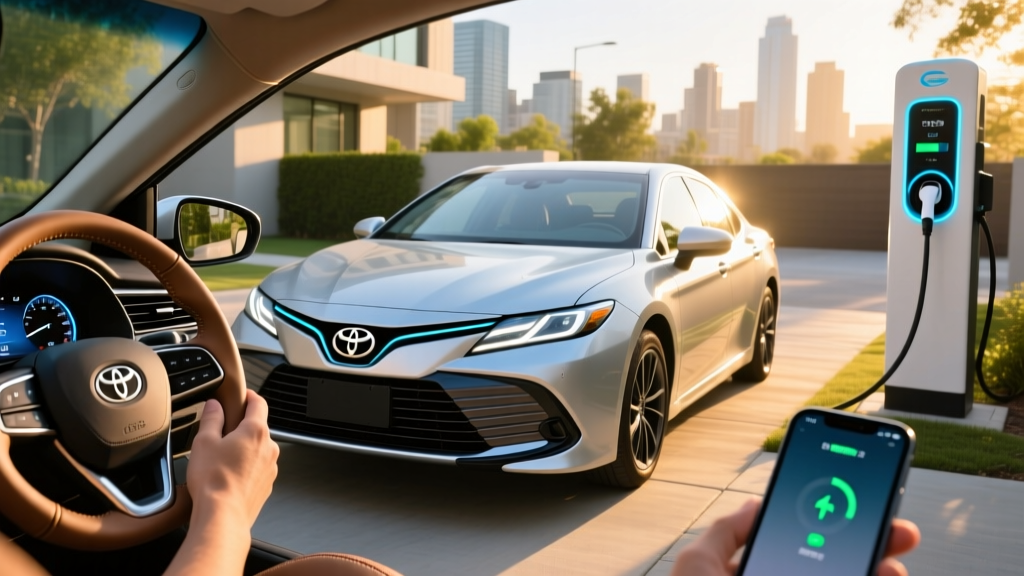
The 2024 Toyota Camry SE Hybrid occupies a narrow but valuable lane: a sport-tuned midsize sedan that returns mid-40s MPG without requiring a plug, a charger, or any change to your daily routine. With 208 combined horsepower, a 0-60 mph time around 7.5 seconds, and a starting MSRP near $30,000, it competes against both conventional gas sedans and the growing crop of plug-in hybrids and full EVs. This review breaks down exactly what the SE Hybrid trim delivers — EPA numbers, real-world fuel economy, battery longevity, and whether it qualifies for any federal tax incentives — so you can decide if it's the right electrified choice for your driveway.
2024 Toyota Camry SE Hybrid: Quick Verdict
The Camry SE Hybrid is a conventional hybrid electric vehicle (HEV), not a plug-in. It generates all its electricity from its gasoline engine and regenerative braking — there is no charging port, no electric-only driving mode, and no plug to deal with. What you get instead is seamless fuel-economy improvement over the gas-only Camry, with Toyota's proven hybrid reliability and a sport-tuned suspension on the SE trim that adds genuine handling engagement.
| Specification | Value |
|---|---|
| Powertrain | 2.5L 4-cyl + electric motor (HEV) |
| Combined Horsepower | 208 hp |
| 0-60 mph | ~7.5 seconds |
| EPA MPG (City / Hwy / Combined) | 46 / 46 / 46 (FWD) |
| Drivetrain | FWD (AWD-e available on other trims) |
| Hybrid Battery | ~1.6 kWh (NiMH), self-charging |
| Fuel Tank | 13.2 gallons |
| Total Range | ~607 miles |
| Base MSRP (SE Hybrid) | $29,995 |
| Federal Tax Credit (§30D) | Not eligible |
| Hybrid Battery Warranty | 10 years / 150,000 miles |
HEV vs. PHEV: Where the Camry SE Hybrid Fits
Before evaluating fuel economy, it's essential to understand what kind of hybrid you're buying — because the distinction determines everything from daily driving experience to tax-credit eligibility.
| Feature | HEV (Camry SE Hybrid) | PHEV (e.g., RAV4 Prime) | BEV (e.g., Tesla Model 3) |
|---|---|---|---|
| Plug-in Charging | No | Yes | Yes |
| Electric-Only Range | None (~1 mi at low speed) | 25-42 mi typical | 250-350+ mi |
| Gas Engine | Yes (primary) | Yes (backup) | No |
| Battery Size | ~1.6 kWh | 13-18 kWh | 50-100 kWh |
| Federal Tax Credit (§30D) | Not eligible | Up to $7,500* | Up to $7,500* |
| Home Charger Needed | No | Recommended (Level 2) | Essential (Level 2) |
The 2024 Camry lineup does not include a plug-in hybrid variant. Toyota reserves PHEV technology for models like the RAV4 Prime and Prius Prime. If you want electric-only commuting from a Toyota sedan, the Prius Prime is the closest option, offering up to 44 miles of EV range. The Camry SE Hybrid is strictly a self-charging HEV — and that's by design, targeting buyers who want maximum MPG without infrastructure changes.
Fuel Economy: EPA Ratings and Real-World MPG
The 2024 Camry SE Hybrid with front-wheel drive carries an EPA rating of 46 mpg city / 46 mpg highway / 46 mpg combined, per fueleconomy.gov. The AWD-e variant (available on LE and XLE Hybrid trims, not the SE) drops slightly to 44/43/44 mpg.
| Driving Condition | EPA MPG | Real-World Expectation |
|---|---|---|
| City | 46 mpg | 47-52 mpg (hybrids excel in stop-and-go) |
| Highway (70 mph) | 46 mpg | 42-45 mpg (less regen benefit at speed) |
| Combined | 46 mpg | 44-48 mpg (varies by driving mix) |
| Cold Weather (below 32°F) | — | 38-42 mpg (engine runs more for cabin heat) |
Real-world note: Toyota's hybrid system recovers energy during braking and deceleration, which means city and suburban driving often yields MPG above the EPA sticker. Owners on Fuelly and Edmunds forums routinely report 48-52 mpg in mixed suburban commuting. Highway-only road trips at 75+ mph, however, will drop into the low 40s because the electric motor provides less assist at sustained high speeds and aerodynamic drag dominates.
With a 13.2-gallon fuel tank, total range sits at approximately 607 miles at the combined EPA figure — enough for most drivers to visit a gas station once every two weeks or less.
Powertrain and Performance: 208 HP, Sport-Tuned Chassis
The SE Hybrid pairs Toyota's 2.5-liter Dynamic Force four-cylinder engine (176 hp, 163 lb-ft) with a permanent-magnet electric motor integrated into the eCVT transaxle. Combined system output is 208 horsepower. Unlike turbocharged gas sedans, the electric motor delivers instant torque from a stop, giving the Camry SE Hybrid responsive off-the-line acceleration that belies its efficiency focus.
The SE trim specifically adds:
- Sport-tuned suspension with stiffer damping than LE/XLE trims
- 18-inch black alloy wheels with all-season tires
- Paddle shifters for simulated gear steps in the eCVT
- Drive Mode Select (Eco, Normal, Sport)
The 0-60 mph time of approximately 7.5 seconds places the Camry SE Hybrid ahead of the non-hybrid 4-cylinder Camry (~8.1 seconds) and competitive with turbocharged midsize rivals. Sport mode sharpens throttle response and steering weight, though the eCVT still drones under hard acceleration — a characteristic of all power-split hybrid transmissions.
Hybrid Battery Longevity, Warranty, and Replacement Cost
Hybrid battery lifespan remains the single most common concern among first-time hybrid buyers. The 2024 Camry SE Hybrid uses a nickel-metal hydride (NiMH) battery pack rated at approximately 1.6 kWh — far smaller than an EV battery, and far less stressed.
Toyota Hybrid Battery Warranty
Coverage: 10 years or 150,000 miles (whichever comes first), transferable to subsequent owners.
What's covered: Defects in materials/workmanship, and capacity loss below a defined threshold that impairs hybrid system function.
Source: Toyota Warranty Guide
In practice, Toyota's hybrid batteries have demonstrated exceptional longevity. The Prius, which uses similar NiMH chemistry, routinely reaches 200,000+ miles on its original battery pack. Failures before 150,000 miles are uncommon, and the 10-year/150,000-mile warranty provides substantial protection.
Replacement cost if out of warranty: A new OEM hybrid battery for the Camry Hybrid runs approximately $2,500-$4,000 including labor at a Toyota dealer. Independent hybrid specialists often offer refurbished packs for $1,500-$2,500. Given the battery's small size and modest stress levels compared to an EV pack, this is a worst-case scenario most owners will never face.
Pricing, Trims, and Tax Credit Eligibility
The 2024 Toyota Camry SE Hybrid starts at an MSRP of $29,995 (including destination charge). Key trims and pricing:
| Trim | MSRP | Key Additions over SE |
|---|---|---|
| LE Hybrid (FWD) | $28,855 | Base hybrid, 17" wheels, softer suspension |
| SE Hybrid (FWD) | $29,995 | Sport suspension, 18" black wheels, paddle shifters |
| SE Hybrid Nightshade | $31,295 | Blacked-out exterior accents, bronze wheels |
| XLE Hybrid (FWD) | $33,145 | Leather, premium audio, softer ride |
Federal Tax Credit: Does the Camry SE Hybrid Qualify?
No. The Camry SE Hybrid does not qualify for the IRS §30D Clean Vehicle Credit. Under current IRS rules, the §30D credit applies only to plug-in electric vehicles (PHEVs and BEVs) with a battery capacity of at least 7 kWh and external charging capability. The Camry's 1.6 kWh self-charging NiMH pack does not meet this threshold.
Conventional hybrids like the Camry SE Hybrid are also ineligible for most state EV rebate programs, which similarly require plug-in capability. However, some states and local utilities offer modest incentives (typically $250-$500) for any vehicle achieving 40+ MPG combined — check your state energy office for current programs.
Camry SE Hybrid vs. PHEV vs. Full EV: Which Should You Choose?
The right electrified vehicle depends on your driving patterns, charging access, and budget. Here's a practical decision framework:
Choose the Camry SE Hybrid (HEV) If:
- You cannot install a home charger (apartment, street parking, no garage)
- You want zero behavior change — just drive and fill up with gas
- Your annual mileage is moderate (10,000-15,000 miles) and fuel savings alone justify the hybrid premium
- You want proven Toyota reliability with a 10-year battery warranty
- Your budget is under $35,000
Choose a PHEV (e.g., Prius Prime) If:
- You have home Level 2 charging and a commute under 40 miles round-trip
- You want to drive mostly on electricity but need gas for longer road trips
- You qualify for the $7,500 federal tax credit (income and sourcing rules apply)
- You want to reduce gas consumption by 70-90% on daily drives
Choose a Full EV (e.g., Tesla Model 3, Hyundai Ioniq 6) If:
- You have reliable home charging and access to DC fast chargers for road trips
- You want zero tailpipe emissions and the lowest per-mile fuel cost
- You qualify for the $7,500 federal credit and your state offers additional EV rebates
- You're ready to plan charging stops on longer trips
Ownership Costs: Fuel Savings vs. Gas-Only Camry
At 46 MPG combined and a national average gas price of $3.40/gallon (early 2026), the Camry SE Hybrid costs approximately $0.074 per mile in fuel. The gas-only 4-cylinder Camry LE (28/39/32 mpg combined) costs about $0.106 per mile. That's a savings of roughly $320 per year for a driver covering 10,000 miles annually, or $1,600 over five years.
| Vehicle | MPG Combined | Annual Fuel Cost | 5-Year Fuel Cost |
|---|---|---|---|
| Camry SE Hybrid | 46 mpg | $739 | $3,696 |
| Camry SE (Gas 4-cyl) | 32 mpg | $1,063 | $5,313 |
| Annual Savings (Hybrid) | — | $324 | $1,617 |
The SE Hybrid's ~$1,140 premium over the gas SE trim pays for itself in fuel savings in roughly 3.5 years at current prices, and sooner if gas prices rise. Factor in the hybrid's stronger resale value (Toyota hybrids consistently command $1,500-$3,000 more at trade-in than their gas counterparts) and the total-cost-of-ownership case strengthens further.
Pros, Cons, and the Bottom Line
Pros
- 46 MPG combined — often exceeded in real-world city driving
- No plug, no charger, no behavior change required
- 208 hp with responsive electric-motor torque
- Sport-tuned suspension on SE adds genuine handling engagement
- 10-year/150,000-mile hybrid battery warranty
- Strong resale value and proven Toyota reliability
- 607-mile total range eliminates any range concern
Cons
- No federal or state EV tax credits
- eCVT drones under hard acceleration (common to all power-split hybrids)
- AWD-e not available on SE Hybrid trim
- No electric-only driving mode, even at low speeds
- Interior materials and infotainment trail Hyundai/Kia rivals
- Modest fuel-cost savings vs. PHEV or full EV for high-mileage drivers
Frequently Asked Questions
How many MPG does the 2024 Camry SE Hybrid get?
The EPA rates the FWD Camry SE Hybrid at 46 mpg city, 46 mpg highway, and 46 mpg combined. In real-world suburban driving, many owners report 48-52 mpg thanks to regenerative braking. Highway-only trips at 75+ mph typically yield 42-45 mpg. Cold weather (below freezing) can reduce efficiency to 38-42 mpg as the engine runs more frequently to heat the cabin.
Does the Camry SE Hybrid need to be plugged in?
No. The Camry SE Hybrid is a conventional hybrid (HEV) with no charging port. The 1.6 kWh battery recharges through the gasoline engine and regenerative braking during deceleration. You simply fill up with gas as you would any other car.
Is the Camry Hybrid reliable and what does battery replacement cost?
Toyota's hybrid system is among the most proven in the industry, with millions of Prius and Camry Hybrids on the road. The hybrid battery is covered by a 10-year/150,000-mile warranty. Out-of-warranty replacement costs approximately $2,500-$4,000 for a new OEM pack, but most owners will never need one — these batteries regularly exceed 200,000 miles.
Does the 2024 Camry SE Hybrid qualify for any tax credit?
No. Under IRS §30D rules, the federal Clean Vehicle Credit requires a plug-in vehicle with at least 7 kWh of battery capacity. The Camry SE Hybrid's 1.6 kWh self-charging system does not qualify. Some states offer small incentives for high-MPG vehicles, but these vary by jurisdiction — check your state energy office for details.
Camry Hybrid vs. Prius: which is more efficient?
The 2024 Prius (LE trim) achieves 57 mpg combined — 11 mpg more than the Camry SE Hybrid. However, the Prius is a compact liftback with less rear-seat room and a firmer ride. The Camry offers more interior space, a smoother highway ride, and a more traditional sedan profile. If maximum MPG is your top priority, the Prius wins. If you need midsize-sedan room and prefer the Camry's driving dynamics, the 46-mpg SE Hybrid is the better fit.
How does the Camry SE Hybrid compare to a PHEV or full EV?
A PHEV like the Prius Prime (44 miles EV range, 52 mpg combined after battery depletion) can eliminate most gasoline use on short commutes if you charge at home, and it qualifies for the $7,500 federal credit. A full EV like the Tesla Model 3 eliminates gas entirely but requires home charging and trip planning for road trips. The Camry SE Hybrid is the right choice if you cannot charge at home, want zero lifestyle adjustment, and prefer the simplicity of a gas station fill-up with dramatically improved efficiency.
Note: This review covers the 2024 model year Camry SE Hybrid. Toyota redesigned the Camry for 2025 with a hybrid-only lineup and updated styling. If you're shopping new in 2026, compare the current-generation Camry Hybrid SE against this outgoing model for updated pricing and features. All specifications sourced from fueleconomy.gov and Toyota Motor Corporation. Tax credit information reflects IRS §30D rules as of early 2026 — consult a tax professional for personal eligibility.