Quick Verdict: The Sportiest Hybrid Sedan That Just Works
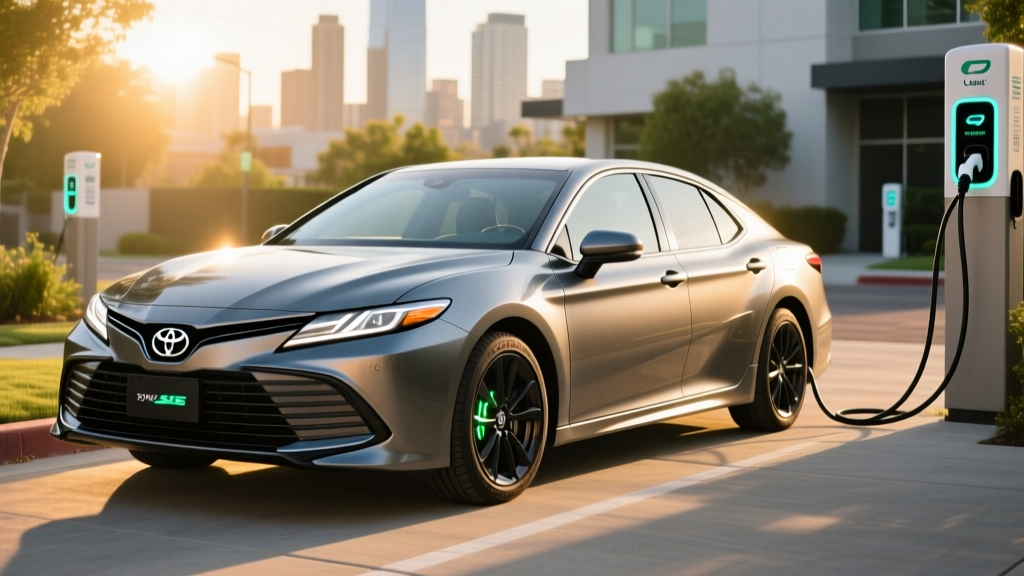
The 2024 Toyota Camry Hybrid XSE occupies a specific niche: buyers who want hybrid efficiency without plugging in, wrapped in Toyota's sportiest Camry styling. With an EPA-estimated 44 city / 47 highway / 44 combined MPG, a 208-horsepower hybrid powertrain, and a starting MSRP around $33,490, it undercuts most plug-in hybrids and EVs on upfront cost while delivering fuel economy that rivals them on a cost-per-mile basis.
But the XSE trim adds firmer suspension tuning, 19-inch alloy wheels, and a gloss-black sport grille — trade-offs that slightly reduce efficiency compared to the LE Hybrid's 51 MPG combined. This review breaks down exact numbers, real-world MPG observations, battery longevity data, and how the Camry Hybrid XSE stacks up against PHEV and full-electric alternatives for 2026 buyers.
EPA Fuel Economy vs. Real-World MPG
| Trim | City MPG | Highway MPG | Combined MPG | Drivetrain |
|---|---|---|---|---|
| LE Hybrid | 51 | 53 | 52 | FWD |
| SE / XLE Hybrid | 44 | 47 | 44 | FWD |
| XSE Hybrid | 44 | 47 | 44 | FWD |
| XSE Hybrid AWD | 44 | 43 | 43 | AWD |
Source: fueleconomy.gov
Hybrid vs. Plug-In Hybrid: What the Camry Actually Is
The 2024 Camry Hybrid is a conventional hybrid (HEV), not a plug-in hybrid (PHEV). This distinction matters for buyers cross-shopping electrified vehicles:
| Feature | HEV (Camry Hybrid) | PHEV (e.g., RAV4 Prime) | BEV (e.g., Tesla Model 3) |
|---|---|---|---|
| Plug-in charging required? | No — charges via regen & engine | Yes — Level 1 or Level 2 | Yes — Level 2 or DC fast |
| Electric-only range | ~1 mile at low speed | 25–42 miles typical | 250–350+ miles (full battery) |
| Battery size | ~1.0 kWh (NiMH) | 13–18 kWh (Li-ion) | 60–82 kWh (Li-ion) |
| Fuel / energy source | Gasoline only | Gasoline + electricity | Electricity only |
| Federal tax credit (§30D) | Not eligible | Up to $7,500 (if eligible) | Up to $7,500 (if eligible) |
| Typical starting MSRP | $28,000–$34,000 | $40,000–$48,000 | $38,000–$55,000 |
The Camry Hybrid's small ~1.0 kWh nickel-metal hydride (NiMH) battery pack assists the gasoline engine during acceleration and captures energy during braking. It cannot drive on electric power alone beyond brief low-speed creep. You never plug it in — you simply fill it with gasoline and drive.
Powertrain Specs: 208 HP from Toyota's Hybrid Synergy Drive
| Specification | Value |
|---|---|
| Engine | 2.5L 4-cylinder Atkinson-cycle |
| Engine output | 176 hp / 163 lb-ft torque |
| Electric motor output | 118 hp (front) / 40 hp (rear, AWD only) |
| Net combined horsepower | 208 hp (FWD & AWD) |
| Transmission | eCVT (planetary gearset, not belt-driven) |
| 0–60 mph | ~7.1 seconds (FWD) |
| Hybrid battery | ~1.0 kWh NiMH (245V) |
| Drivetrain | FWD standard; electronic AWD optional |
| Fuel tank capacity | 13.2 gallons |
| Total driving range | ~580 miles (at 44 MPG combined) |
The 208 net horsepower figure is not simply the engine and motor added together — Toyota's Hybrid Synergy Drive blends power sources through a planetary gearset eCVT. The result is seamless, linear acceleration with no shift shock. The XSE's sport-tuned suspension and paddle shifters (which simulate stepped gear ratios) add engagement without changing the underlying powertrain output.
The optional electronic AWD adds a separate 40 hp rear motor that engages only when front-wheel slip is detected. Unlike mechanical AWD systems, there is no driveshaft — the rear motor disconnects during steady cruising to avoid efficiency loss. The AWD XSE drops to 43 combined MPG, a minimal penalty.
Pricing, Trims, and Tax Credit Eligibility
The 2024 Camry Hybrid XSE started at an MSRP of approximately $33,490 (FWD) and $34,890 (AWD), including destination charges. Key XSE features include:
- 19-inch black alloy wheels
- Sport-tuned suspension
- Gloss-black front grille and rear spoiler
- SofTex-trimmed sport seats with heated front seats
- 9-inch touchscreen with wireless Apple CarPlay / Android Auto
- Toyota Safety Sense 2.5+ (adaptive cruise, lane-keeping, pre-collision)
- Wireless phone charger and dual USB-C ports
Battery Warranty, Lifespan, and Replacement Cost
Toyota's NiMH hybrid batteries have a strong longevity track record. Data from fleet operators and long-term owners shows Camry Hybrid batteries routinely lasting 150,000–200,000+ miles before capacity loss triggers a check-engine light. Unlike BEV batteries, the Camry's small NiMH pack operates in a narrow state-of-charge window (roughly 40–80%), which dramatically reduces degradation stress.
Replacement cost if out of warranty:
- New OEM Toyota battery pack: $2,500–$4,000 (parts + labor at dealership)
- Refurbished/reconditioned battery: $1,500–$2,500 (independent hybrid specialists)
- Individual module replacement (if only one cell fails): $500–$1,200
For context, BEV battery replacements run $8,000–$20,000. The Camry Hybrid's small battery is one of the cheapest electrified-vehicle batteries to replace, and the 10-year warranty means most original owners will never pay out of pocket.
Who Should Buy the Camry Hybrid XSE vs. a PHEV or EV?
Choose the Camry Hybrid XSE if:
- You lack home charging access (apartment, street parking)
- You want zero behavior change — just gas up and drive
- Your budget is under $35,000
- You drive 12,000–15,000 miles/year and want 580+ miles per tank
- You value Toyota's reliability and resale value track record
- You prefer a sport-tuned sedan over a crossover
Consider a PHEV or EV instead if:
- You have Level 2 home charging and a short commute (<35 miles)
- You want to drive mostly on electricity and qualify for the $7,500 tax credit
- You want one-pedal driving and instant EV torque
- Your state offers additional PHEV/EV rebates (e.g., California, Colorado)
- You drive in frequent stop-and-go traffic and want EV-mode silence
- Lowering your tailpipe emissions is a priority
The math is straightforward: the Camry Hybrid XSE at 44 MPG and ~$33,500 MSRP costs roughly $1,200/year in gasoline (at $3.50/gal, 15,000 miles). A comparable PHEV like the Toyota Prius Prime ($39,000+ MSRP) might cost $400–$800/year in energy but requires home charging infrastructure ($500–$2,000 install). A BEV like the Tesla Model 3 ($38,990 MSRP, potentially $31,490 after tax credit) costs $500–$700/year in electricity but demands charging planning for road trips. The Camry Hybrid wins on simplicity and upfront cost; PHEVs and EVs win on per-mile energy cost if you can charge at home.
Pros and Cons
✓ Pros
- 44 MPG combined — real-world often exceeds in city driving
- 580+ mile total range on a single tank
- No plug-in charging needed — zero infrastructure cost
- 10-year/150,000-mile hybrid battery warranty
- XSE sport styling and firmer suspension tuning
- Strong Toyota reliability and resale value
- Toyota Safety Sense 2.5+ standard
✗ Cons
- Not eligible for $7,500 federal tax credit
- XSE's 19-inch wheels reduce MPG vs. LE Hybrid (52 combined)
- Cannot drive on electric-only power beyond low-speed creep
- eCVT drone under hard acceleration (no true gear shifts)
- Rear seat space tighter than Honda Accord Hybrid
- No DC fast charging capability (not applicable to HEV)
Frequently Asked Questions
How many MPG does the 2024 Camry Hybrid XSE actually get?
The EPA rates the XSE Hybrid at 44 city / 47 highway / 44 combined MPG. Real-world testing shows most drivers achieve 42–48 MPG in mixed driving. City-heavy routes with frequent stops often push above 46 MPG thanks to regenerative braking, while sustained 80 mph highway cruising drops to 39–42 MPG.
Does the Camry Hybrid XSE need to be plugged in?
No. The Camry Hybrid is a conventional HEV. Its ~1.0 kWh battery charges entirely through regenerative braking and the gasoline engine. There is no plug, no charging port, and no electric-only driving range to manage.
How far can the Camry Hybrid drive on electric only?
Effectively zero meaningful miles. The hybrid system can propel the car on electric power alone for roughly 0.5–1 mile at speeds below 25 mph (e.g., creeping through a parking lot). This is not comparable to a PHEV's 25–42 mile electric range. The Camry Hybrid's electric motor primarily assists the gas engine rather than replacing it.
Is the hybrid battery reliable, and what does replacement cost?
Toyota's NiMH hybrid batteries are among the most proven in the industry, routinely lasting 150,000–200,000+ miles. The 10-year/150,000-mile warranty covers defects and premature capacity loss. Out-of-warranty replacement runs $2,500–$4,000 for a new OEM pack, or $1,500–$2,500 for a refurbished unit — far less than a BEV battery replacement.
Does the 2024 Camry Hybrid qualify for any tax credit?
Not at the federal level. The IRS §30D Clean Vehicle Credit requires a plug-in vehicle with at least 7 kWh of battery capacity. The Camry Hybrid's ~1.0 kWh NiMH pack does not qualify. Some state or utility programs may offer small efficiency rebates — check IRS.gov and your state energy office for current programs.
How does the XSE compare to the Camry Hybrid LE on fuel economy?
The LE Hybrid achieves 51 city / 53 highway / 52 combined MPG — an 8 MPG combined advantage over the XSE. The difference comes from the LE's smaller 17-inch wheels, lighter weight, and lower rolling-resistance tires. If maximum fuel savings is your priority, the LE is the efficiency king. The XSE trades ~8 MPG for sportier styling, larger wheels, and upgraded interior materials.
Camry Hybrid XSE vs. Honda Accord Hybrid Sport — which is better?
The Accord Hybrid Sport (46 combined MPG, 204 hp, ~$34,000 MSRP) offers slightly more rear-seat space and a more refined powertrain feel. The Camry Hybrid XSE counters with available AWD (Honda doesn't offer it on the Accord), a longer hybrid battery warranty track record, and marginally lower starting price. Both are strong choices — drive both and decide on feel.